Original research · LegiScan wave-1 tracker · As of September 18, 2026 · Distinct from sales-tax-on-services, tip-credit, and contract guides · Not legal advice
Which states let a food truck run on one health + fire certificate instead of re-inspecting city by city? Wave 1 finds three enacted approaches — Alabama (one health + one fire recognition starting 2027-01-01), Oklahoma (state license recognition live since 2025-11-01), and Texas (statewide mobile-vendor license standing up 2026-07-01) — plus an Arizona veto and several pending bills. Passed is not the same as “program live,” and local business licenses can still stack.
Key findings
- Alabama is the cleanest “one health + one fire” design — but it is not live yet. SB197 (Act 2026-398) was enacted 2026-04-09. The act took effect 2026-07-01; the statewide certificate recognition for routine local re-inspections starts 2027-01-01 (enrolled text + State Fire Marshal advisory).
- Oklahoma already runs a recognition model. The Food Truck Freedom Act (HB1076) took effect 2025-11-01: locals generally must recognize a valid state (or Tulsa/Oklahoma County licensing-authority) food establishment license within five business days.
- Texas is building a statewide occupational license, not a county-certificate passport. HB2844 (signed 2025-06-20) creates Chapter 437B. General effective date 2026-07-01; vendors are not required to hold the new license before that date. Locals may not prohibit a compliant licensed vendor or impose conflicting rules.
- Arizona’s city-permit preemption bill was vetoed. HB2118 was vetoed 2026-06-19 — vetoed ≠ law.
- Pending does not equal protection. Michigan, Missouri, South Carolina, Minnesota, and New Jersey appear in the watch set; New Jersey’s bill points toward more frequent inspections.
- How to start a food truck — permit/startup hub by state (practical guide, not bill tracker).
- Food truck industry statistics — CBP/BFS market footprint (not legislation).
- Sales tax on services bills and WC threshold bills — different LegiScan magnets.
- Tip-credit by state — wage rules for tipped crews, not inspection reciprocity.
Status map (wave 1)
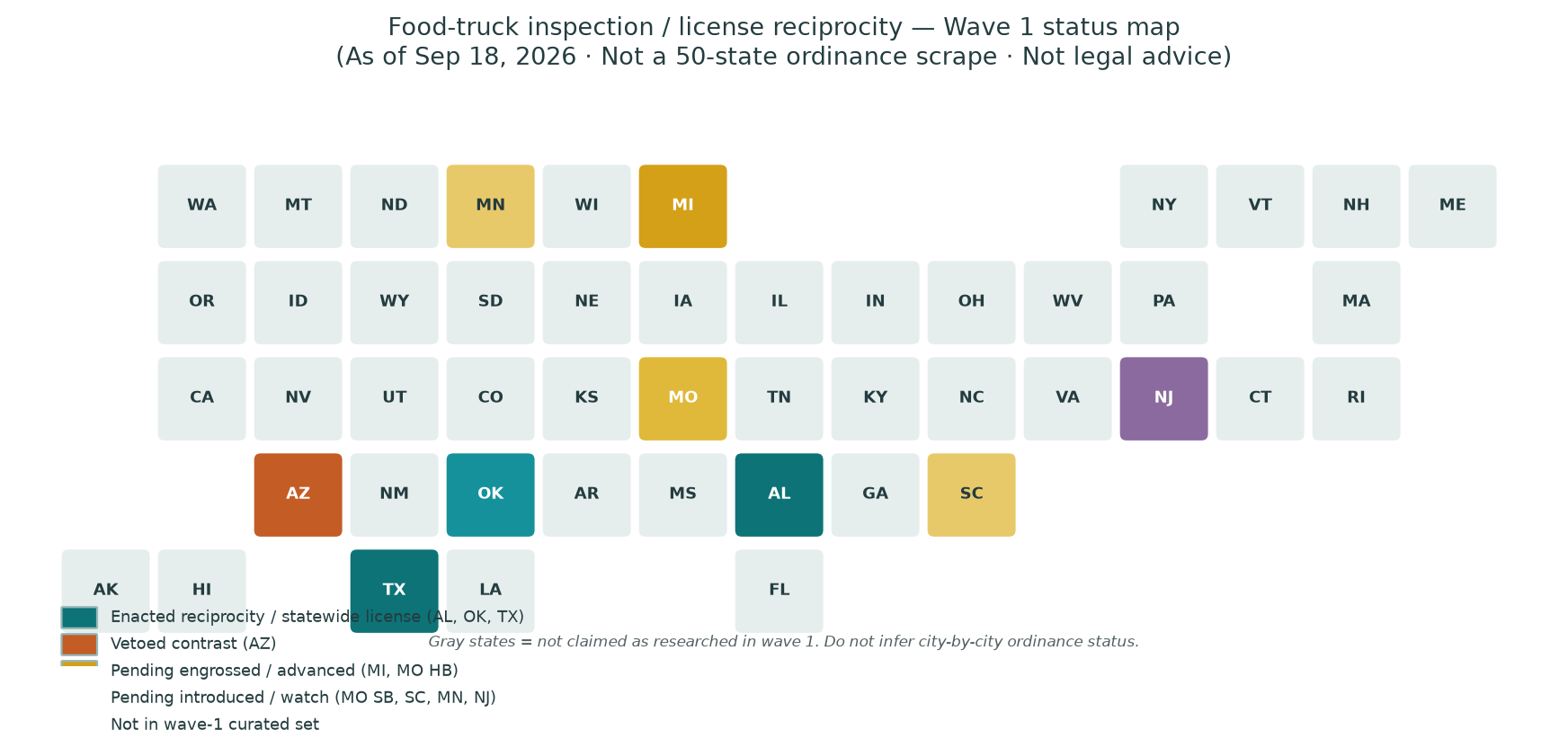
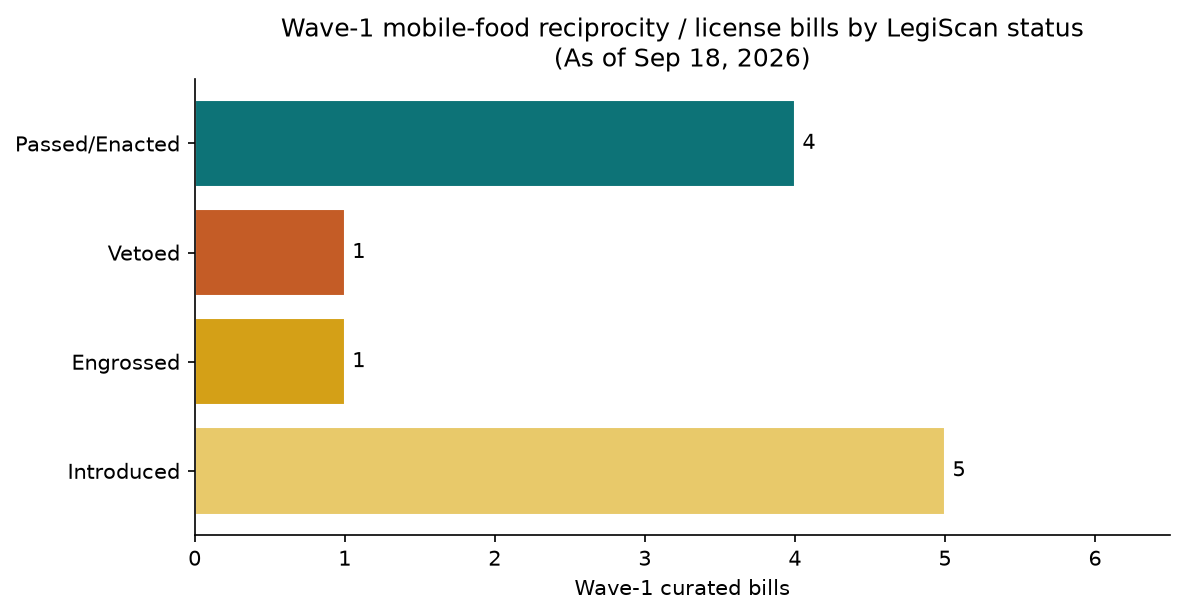
Wave-1 bill table
Read status carefully: Proposed ≠ law. Passed ≠ program live. Vetoed ≠ law. Effective dates and agency stand-up matter as much as the roll-call. This is not a 50-state local-ordinance scrape.
| State | Bill | LegiScan status | Status date | Editorial bucket | Law / program dates | Reciprocity / recognition posture | Business-license stacking? |
|---|---|---|---|---|---|---|---|
| Alabama | AL SB197 bill_id 2089352 |
Passed | 2026-04-09 | Enacted — program standing up | 2026-07-01 Program/live: 2027-01-01 |
On/after 2027-01-01: one valid commissary-county health certificate + one authorized fire certificate (6-month) exempts routine local health/fire re-inspections statewide. Spot/emergency inspections still allowed. | Yes — localities may still require business licenses and other non-health/fire ordinances (enrolled §1(d)). |
| Oklahoma | OK HB1076 bill_id 2049132 |
Passed | 2025-05-05 | Enacted — recognition live | 2025-11-01 Program/live: 2025-11-01 |
Valid OSDH (or Tulsa/Oklahoma County licensing-authority) food establishment license must be recognized by other local authorities within 5 business days; locals may issue non-conflicting recognition permits. | Locals may still apply reasonable non-conflicting health/safety/zoning/noise/park/event rules; conflicting extra permits barred. |
| Oklahoma | OK HB3369 bill_id 2078443 |
Passed | 2026-05-12 | Enacted — companion fire rule | See enrolled effective-date clause Program/live: n/a (fire-equipment rules) |
Modifies automatic fire-extinguishing-system mandate for food trucks / mobile food establishments; removes an expiration date. Companion safety rule — not a standalone reciprocity statute. | n/a — equipment/standard change |
| Texas | TX HB2844 bill_id 1970845 |
Passed | 2025-06-20 | Enacted — license regime standing up | 2026-07-01 (general); §437B.004 rules authority 2025-09-01; HHSC rules due by 2026-05-01 Program/live: License required starting 2026-07-01 |
State DSHS mobile food vendor license required; locals may not prohibit a compliant licensed vendor or impose conflicting regs. Health inspections via DSHS or collaborative local agreements. Rules may not require an additional fire inspection if the vehicle passed a state/local fire inspection within the prior 12 months. | Vendors still must comply with non-conflicting local fire codes, location/zoning, and other local laws (enrolled §437B.101). |
| Arizona | AZ HB2118 bill_id 2064912 |
Vetoed | 2026-06-19 | Vetoed — contrast | n/a — not law Program/live: n/a |
Would have prohibited cities/towns from requiring local regulatory permits/licenses for mobile food vendors while preserving certain county licensing/enforcement authority. Governor vetoed — not law. | n/a — bill did not become law |
| Michigan | MI HB5451 bill_id 2082136 |
Engrossed | 2026-03-03 | Pending — engrossed | n/a until enacted Program/live: n/a |
Would provide for annual fire inspections for food trucks (amends Food Law). House engrossed/passed; referred to Senate Regulatory Affairs. Not enacted. | Unknown until final text / enactment |
| Minnesota | MN HF4268 bill_id 2133072 |
Introduced | 2026-03-12 | Pending — introduced | n/a until enacted Program/live: n/a |
Would modify mobile food unit licensure requirements. Introduced; referred to Health Finance and Policy. Not enacted. | Unknown |
| Missouri | MO HB3157 bill_id 2101655 |
Introduced | 2026-01-29 | Pending — house committee advanced | n/a until enacted Program/live: n/a |
Creates provisions relating to licensing of mobile food vendors. HCS reported do pass; later reported do pass from Rules. Not enacted as of LegiScan pull. | Unknown until final text |
| Missouri | MO SB1631 bill_id 2108555 |
Introduced | 2026-02-05 | Pending — introduced | n/a until enacted Program/live: n/a |
Title: establishes a statewide mobile food vendor license. Introduced; referred to Emerging Issues and Professional Registration. Not enacted. | Unknown until final text |
| New Jersey | NJ A2924 bill_id 2096139 |
Introduced | 2026-01-13 | Pending — opposite direction | n/a until enacted Program/live: n/a |
Would require monthly health and fire safety inspections for mobile retail food establishments — more frequent inspections, not reciprocity. Included as contrast watch. | Unknown |
| South Carolina | SC H5523 bill_id 2142884 |
Introduced | 2026-04-14 | Pending — introduced | n/a until enacted Program/live: n/a |
Title: Mobile food vendors. Introduced and referred to Labor, Commerce and Industry. Follow-on watch item — verify text before treating as reciprocity. | Unknown |
Alabama deep dive (Act 2026-398)
Enrolled SB197 is the clearest national cite for “one health + one fire certificate travels.” On and after January 1, 2027, a mobile food unit with a valid health inspection certificate (from the county where its commissary is located) and a valid fire inspection certificate (from a fire department authorized by the State Fire Marshal) is exempt from further routine local health or fire safety inspections as a condition of operating elsewhere in Alabama. County health and certifying fire officials may still inspect while the unit is operating and may shut it down for significant health or life-safety violations.
- Fire inspection certificates are valid for six months; hood suppression and cleaning tags, LP-gas, and electrical checks are spelled out against IFC / NFPA standards.
- The State Fire Marshal must keep a list of authorized local fire departments and a uniform inspection process.
- Section 1(d) preserves local power to require a business license and other ordinances that are not routine health/fire re-inspections.
- Section 2: the act becomes effective July 1, 2026 — which starts agency/local adaptation — while the operator-facing recognition clock is January 1, 2027.
The Alabama State Fire Marshal advisory bulletin confirms Act# 2026-398 and states the statewide inspection program will be fully implemented and operational by January 1, 2027. Until then, operators should continue following current local permitting and inspection rules.
What operators should do with this
- Name your jurisdictions. List every city/county you actually serve — reciprocity only helps where a statute (and effective date) covers you.
- Separate health, fire, and business license. Even in Alabama’s design, business licenses can still stack. Zoning, parks, and special-event rules are separate fights.
- Calendar the live dates. OK recognition: already past (2025-11-01). TX state license: 2026-07-01. AL dual-certificate recognition: 2027-01-01.
- Keep proof on the truck. License, latest health certificate, fire tag/service records — and know which agency issued each.
- Treat pending bills as watch items. MI / MO / SC / MN / NJ rows are not operating authority.
- Insurance still matters. Reciprocity does not replace coverage — see food truck insurance by state.
Downloads
- Wave-1 CSV — bill IDs, status dates, effective/program dates, reciprocity notes.
- Status map (PNG)
- Status bars (PNG)
Methods, inclusion rules, and limitations
We screened LegiScan searches for mobile-food vendor license, food-truck inspection, and reciprocity language (current and recent sessions), then getBill-verified each curated ID and cross-checked enacted rows against chaptered/enrolled text and agency notices. Inclusion is editorial: high-signal statewide recognition, license, or local-preemption bills — not every bill that mentions “food truck.”
- Wave 1 only. We did not scrape every municipal mobile-food ordinance. Gray map states are simply outside this curated set.
- Status codes are leads. LegiScan progress is not a substitute for enrolled text, chapter numbers, or agency implementation bulletins.
- No “best state” ranking. This page answers a recognition question, not where to incorporate.
- Not legal advice. Confirm with the issuing health department, fire authority, and city business-license office before you roll.
Bill data courtesy of LegiScan (CC BY 4.0). Screening notes, effective-date verification, and operator framing are ours.
Related guides
- How to start a food truck — permits & licenses by state
- Food truck industry statistics (2026)
- Food truck insurance requirements by state
- Best states to start a food truck
- Tip-credit by state — payroll rules where mobile-food crews are tipped