Original data analysis · Published October 16, 2026
Quote the same $2,500 drywall-and-trim repair in California and North Carolina and you hit very different state licensing rules. California’s contractor threshold is $1,000. North Carolina’s general contractor threshold is $40,000.
Across the ten states checked here, the same small repair business needs a contractor or home-improvement license in six, a contractor or home-improvement registration in two, and falls below the cited state project thresholds in two. The trade, annual sales and location can matter as much as the price on one estimate.
The job stays the same in every state
This is a paid repair for a homeowner: patch damaged drywall and replace interior trim in an existing owner-occupied home built in 1990. The entire project costs $2,500, including labor and materials. The established solo business advertises its services, has no employees and performs about $30,000 in home-improvement work annually.
There is no electrical, plumbing, HVAC, structural, lead or asbestos work. We assume the locality confirms that this particular job needs no permit. The business is not the homeowner doing DIY work, a public utility or another exempt operator. Those details prevent a generic “handyman under $X” claim from hiding the exceptions.
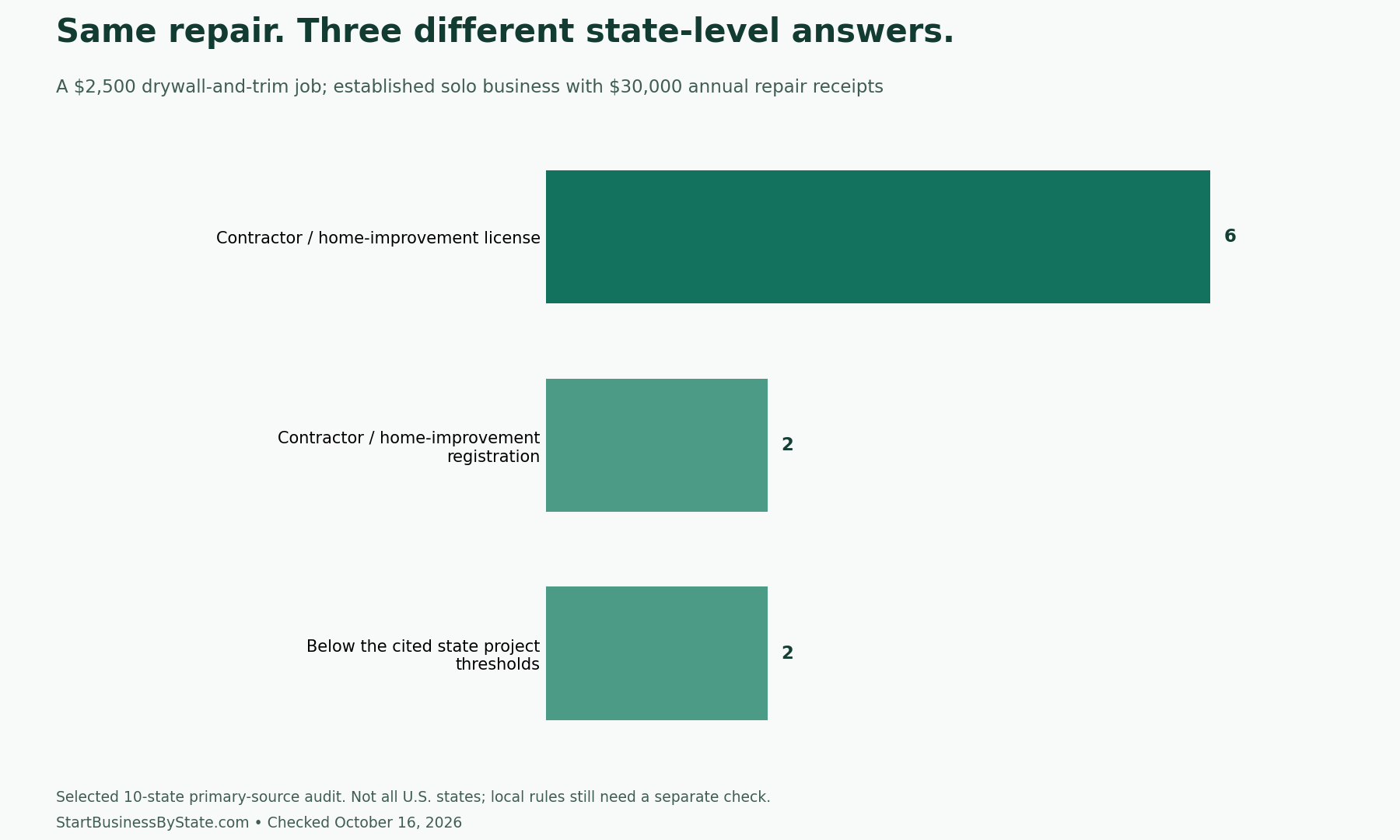
What happens to the same quote in ten states?
| State | Result for this scenario | Rule that drives it | Why |
|---|---|---|---|
| California | License required | $1,000 project threshold; permits or employee labor can trigger licensing below it. Official source | The $2,500 total exceeds the minor-work exemption. |
| Arizona | License required | Minor-work exemption is below $1,000, subject to additional conditions. Official source | The $2,500 job is above the exemption; a permit is another trigger. |
| Nevada | License required | Limited repair/maintenance exemption below $1,000, with exclusions. Official source | The $2,500 repair does not fit the small-job exemption. |
| Oregon | License required | Paid improvements to real property generally require a CCB license. Official source | Drywall and trim repair are construction work; the narrow minor-work exception does not cover this price. |
| Washington | Contractor registration required | Construction contractors must register with L&I. Official source | Repairing a building falls within the registration requirement; registration includes bonding and insurance. |
| Tennessee | Below these state project thresholds | Home improvement: $3,000 to under $25,000 in adopting counties; contractor license: $25,000+. Official source | At $2,500, neither cited state project threshold is reached. Check local business requirements. |
| Virginia | License required | Class C covers this project size, with a suitable work classification. Official source | The $2,500 job and assumed $30,000 annual volume fit Class C limits. |
| North Carolina | Below this state project threshold | General contractor license at $40,000 or more per project. Official source | This $2,500 non-specialty repair is below the general contractor threshold. Check local requirements. |
| Pennsylvania | Home-improvement registration required | $5,000 or more in annual home-improvement work. Official source | The assumed $30,000 annual business volume triggers registration, even though this job is only $2,500. |
| Maryland | License required | MHIC licensing applies to soliciting or performing covered home improvements. Official source | The state explicitly includes drywall work in its home-improvement scope. |
Three details that change the answer
Pennsylvania looks at the business’s annual work
The $2,500 job is not the only number that matters. At the assumed $30,000 annual home-improvement volume, the business exceeds Pennsylvania’s $5,000 annual registration threshold. Looking only at the invoice would miss that requirement.
California counts the whole project
Labor and materials belong in the same total. The current state guidance also identifies permits and employee labor as licensing triggers. Calling the job a repair, or breaking one project into smaller contracts, does not make the $2,500 scenario fit its minor-work exemption.
Tennessee’s intermediate rule has a county boundary
The state’s home-improvement program applies in nine adopting counties: Bradley, Davidson, Hamilton, Haywood, Knox, Marion, Robertson, Rutherford and Shelby. The $2,500 example sits below its cited project range. A larger job can cross that range before it reaches the statewide $25,000 contractor threshold.
Follow the requirement that matches the work
Confirm the work category with the licensing agency, then confirm permits and local business registrations with the city or county. Washington calls its contractor credential a registration; that still carries bonding and insurance requirements. A general business license and permission to perform a regulated trade answer different questions.
Use our state business-license guide for the general registration layer. When forming an LLC, keep the business name consistent across the formation filing, license application, contracts and coverage documents.
How we checked the comparison
We applied one stated repair scenario to ten selected state-agency sources on October 16, 2026. These are our classifications of those rules, not individual agency determinations about a submitted project. Each row links to the primary source; no school, contractor marketplace or license blog supplies a threshold.
Additional scope checks: Oregon contractor statutes, Maryland’s definition and examples of home improvements, and Arizona’s statute and rule book. Virginia’s cited licensing sheet is revised September 1, 2025. California’s current $1,000 guidance supersedes older $500 explanations.
“Below the cited state project thresholds” means only that those particular contractor/home-improvement thresholds are not reached. It does not mean a business can skip local registrations, permits or specialty-trade rules. The comparison excludes fees, tests and application timelines and is not a complete 50-state survey. Recheck the linked agency before bidding work with different facts.
Cite this study
StartBusinessByState.com. “Same $2,500 Repair. Different Licensing Rules.” Published October 16, 2026. https://startbusinessbystate.com/small-repair-contractor-license-thresholds/.
Our original analysis and graphic are available under CC BY 4.0. Credit this study and link to this page when reusing them. Underlying source materials retain their own terms and remain available from the original agencies. This permission applies to our original analysis and graphic, not to the source publications.
Embed the chart with a credit link
<figure><a href="https://startbusinessbystate.com/small-repair-contractor-license-thresholds/"><img src="https://startbusinessbystate.com/wp-content/uploads/2026/10/small-repair-contractor-license-thresholds.png" alt="Same $2,500 Repair. Different Licensing Rules." style="max-width:100%;height:auto"></a><figcaption>Source: <a href="https://startbusinessbystate.com/small-repair-contractor-license-thresholds/">StartBusinessByState.com</a></figcaption></figure>