Day care prices rose 3.1% over the past year, a little less than overall inflation, while many providers face rising costs.
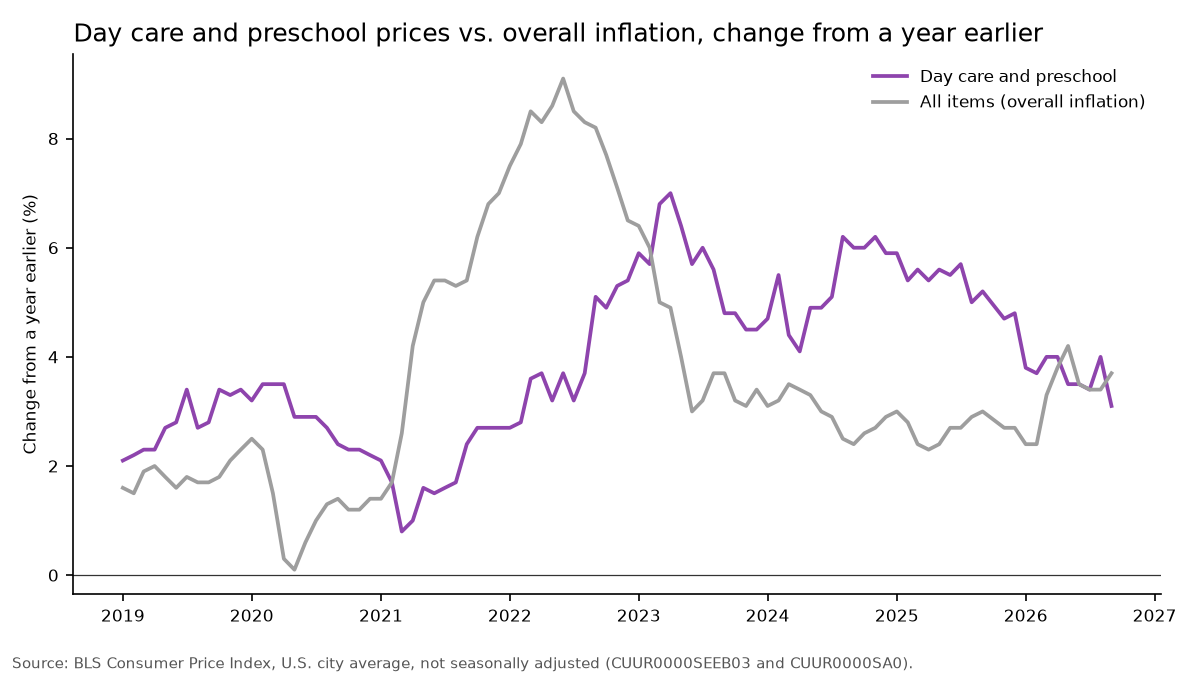
Prices families pay for day care and preschool rose 3.1% from September 2025 to September 2026, according to the Bureau of Labor Statistics’ Consumer Price Index. That’s a bit below overall inflation of 3.7%. Day care prices also rose more slowly than overall prices in May and September 2026.
A year earlier, day care prices were up 5.2%, faster than inflation. Over 10 years, day care prices rose 42.5%, slightly more than the 39.6% rise in prices overall.
Why it matters for providers
Day care is still expensive for many families, but slower price growth can squeeze providers. Staff pay, insurance, food and rent are most of a center’s costs, and those keep rising. When a center can’t raise tuition as fast as its costs, margins shrink.
In Hamilton County, Tennessee, 18 child care centers have closed this year while 19 opened, and the county has more than 3,400 empty seats, the Chattanooga Times Free Press reported. Local experts there pointed to a pause in state tuition assistance certificates after federal funding changes, along with affordability and staffing. Causes differ from place to place, and a national price index can’t show what’s happening in any one town.
What this means if you run or plan to open a daycare
Price your tuition from your actual costs, not just what nearby centers charge, and review it every year. Keep a cushion for enrollment dips, since empty seats cost almost as much as full ones. Insurance is one of the costs that can change at renewal; see our guides to daycare insurance in Wisconsin, Washington and Mississippi.
How we got these numbers
We used the Consumer Price Index for day care and preschool (series CUUR0000SEEB03) and for all items (CUUR0000SA0), U.S. city average, not seasonally adjusted. The index tracks changes in what families pay out of pocket for the same kind of care over time; it isn’t the average price of care. Data pulled October 18, 2026.