By StartBusinessByStatePublisher: Robert SmithResearch process
California landscaping insurance needs to match your work, from lawn maintenance to landscape installation. Compare liability, employee-injury, equipment and vehicle coverage; check C-27 license and client requirements separately.
Get my landscaping insurance quote
Quotes through Thimble, an online business insurance agency. Review your price and coverage before buying.
We may earn a commission if you buy through our links, at no additional cost to you.
California insurance requirements for landscapers
Use your licensing rules and written customer requirements to set the coverage you need. Give the agency those documents so it can check the quote against them.
California Division of Workers’ Compensation guidance and Labor Code §3700 require employers with one or more employees to secure workers’ compensation. Part-time and family labor can count. A sole owner with no employees is a different question from a crew of helpers.
For CSLB licensees, a C-27 Landscaping contractor may currently file a no-employee exemption with the Board (C-27 is not among the classifications barred from exemptions such as C-8, C-20, C-22, C-39 and D-49). SB 1455 delayed the all-licensee workers’ compensation mandate to January 1, 2028. Until then, exemption eligibility still ends the day you hire employees — Labor Code coverage and CSLB filings are not the same paperwork.
C-27 bond is not general liability
Active C-27 licenses require a $25,000 contractor license bond under Business and Professions Code §7071.6. That surety protects consumers and unpaid wages in the statutory scheme — it is not a general-liability policy and does not replace liability coverage. Licensed LLCs must carry at least $1 million in liability coverage for five or fewer personnel of record, with $100,000 more per additional person up to $5 million, plus a separate $100,000 employee/worker bond. These are separate from the $25,000 contractor bond. See CSLB’s LLC requirements. Cities, HOAs and general contractors routinely demand GL limits and additional-insured endorsements by contract.
Jobs at or above the contractor license threshold still need the correct CSLB classification. Commercial pesticide application is a separate California Department of Pesticide Regulation (DPR) credential — confirm any DPR financial-responsibility rules with DPR when you apply chemicals for hire.
Keep an accident from putting your whole route at risk
Which landscaping coverages should you compare?
| What you need to protect | What to compare |
|---|---|
| Customer injury, damaged plants, irrigation and hardscape claims | General liability, including products and completed operations for finished landscape work. |
| Herbicide drift, fertilizer burn and chemical application claims | Ask whether pesticide/herbicide applicator wording is included, excluded or available by endorsement — not automatic on every GL form. |
| Crew injuries on the job | Workers’ compensation once your state’s employee trigger is met (or if you elect coverage sooner). |
| Trucks, trailers and travel between jobs | Commercial auto (and hired/non-owned auto when helpers drive personal vehicles). GL does not replace auto. |
| Mowers, blowers, trailers and tools away from the shop | Tools and equipment / inland marine at storage, in transit and on jobs — not the truck’s auto policy. |
| License, permit or pesticide financial-responsibility floors | Surety bond or filed liability certificate when a board or statute requires it — separate from a client COI. |
Commercial auto, trailers and tools
Tell the auto insurer about travel between customers, trailers and who drives. Personal auto policies typically exclude business use of a work truck. Ask about hired/non-owned auto when crew members drive personal vehicles. Schedule mowers, blowers and specialty tools on inland marine / tools coverage for storage, transit and jobsites.
Match each risk to the right policy
The $25,000 CSLB bond does not pay third-party injury claims the way GL does. GL does not replace workers’ compensation or commercial auto. A COI does not amend the policy. Pesticide claims may be excluded without applicator wording. An exemption on file with CSLB is not a substitute for covering employees once you hire them.
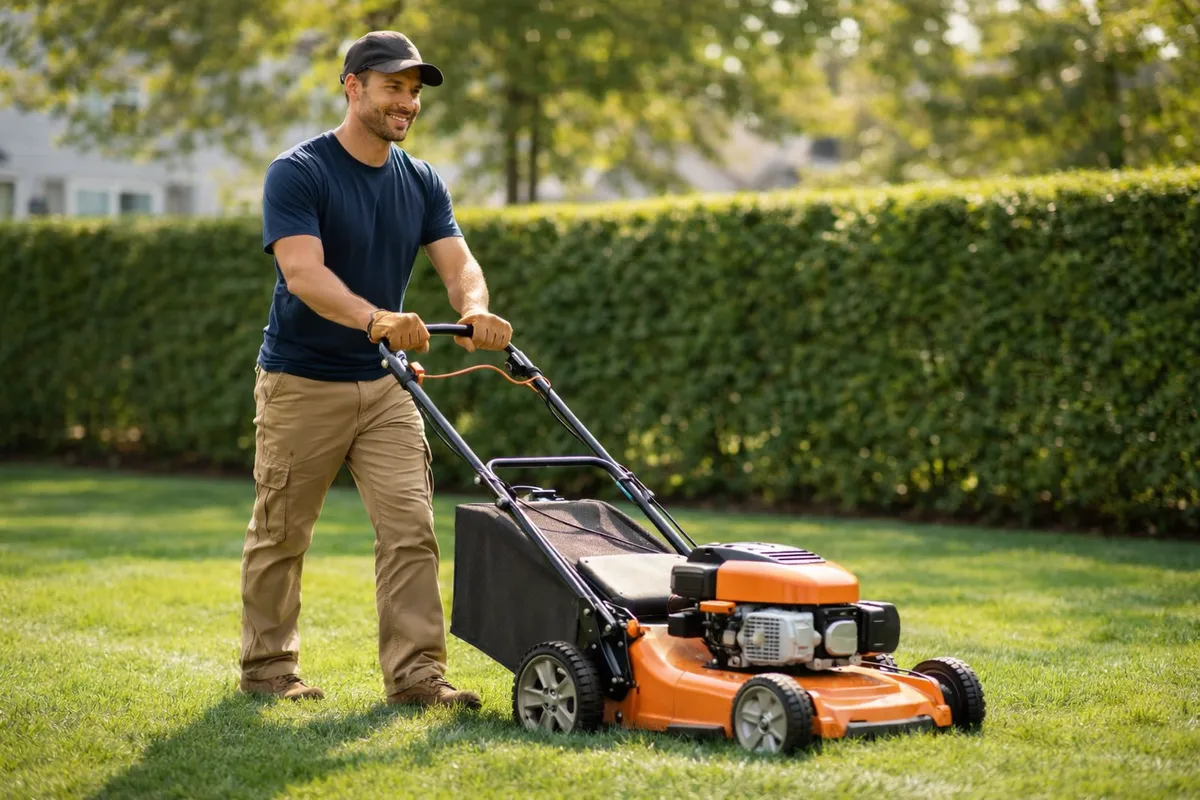
A mower can throw debris toward a window, or a customer can trip over equipment left near a path. General liability helps with covered injury and property damage claims and their defense costs. Start with the lawn and landscape services you actually sell.
Protect customers and their property
Discuss liability for mowing, planting, maintenance and finished landscape work. Explain irrigation or hardscape installations so the agency can review those activities too.
Protect your landscaping crew
Workers’ compensation addresses employee injuries. Share payroll, job duties and seasonal staffing, and use the state requirements above when planning coverage.
Protect mowers, blowers and tools
Tools and equipment coverage can address covered losses away from your shop. Include replacement values, equipment storage, trailers and any rented machinery.
Cover the trip between properties
Commercial auto addresses business vehicle risks. Include the trucks, trailers, drivers and towing arrangements you use on your route.
Tell the agency about chemical application, tree work, excavation and other specialties. Ask which activities and endorsements your quote includes before accepting those jobs.
These are separate coverage needs. Available products and terms depend on your work, location and insurer; a liability quote does not automatically include every policy above.
How much does landscaping insurance cost in California?
Your price depends on your services, location, staffing, claims history and the coverage you select. A quote gives you a price for your own business. Use the figures below to plan your budget.
| Coverage | Monthly median | Annual median |
|---|---|---|
| General liability | $63 | $761 |
| Workers’ compensation | $150 | $1,802 |
| Commercial auto | $299 | $3,590 |
| Business owner’s policy | $92 | $1,101 |
| Tools and equipment | $53 | $637 |
| License/permit bond | $9 | $112 |
| Commercial umbrella | $92 | $1,101 |
How much does California landscaping insurance cost?
Insureon’s national landscaping customer medians (source checked November 3, 2026) provide a starting reference: general liability $63/month ($761/year), workers’ compensation $150/month ($1,802/year), tools and equipment $53/month ($637/year), commercial auto $299/month ($3,590/year), license/permit bonds $9/month ($112/year), commercial umbrella $92/month ($1,101/year), and a business owner’s policy $92/month ($1,101/year). These are national Insureon landscaping-customer medians — not state-specific quotes and not personalized insurer prices.
Do not add every row together. A business owner’s policy can bundle general liability with property, so those lines may overlap. Workers’ compensation, commercial auto, pesticide endorsements and surety bonds remain separate questions. Your provider needs services, revenue, payroll, vehicles, claims, limits and equipment values to quote the actual crew.
Request an annual total for the same service mix and coverage dates. Ask whether payment plans, certificates, additional-insured endorsements or midyear changes add charges.
Review the annual total, deductible and limits together. Include any required endorsements so the quote prices the protection your work calls for. A business owner’s policy can combine liability and property coverage; those costs can overlap.
Get your landscaping insurance quote
Thimble arranges business insurance with insurers. Its landscaping insurance route lets you price available liability coverage online.
- Describe your business. Enter your location, crew and landscaping services. Include mowing, planting, maintenance and any specialty operations.
- Review the available coverage and price. Match the limits, covered activities and dates to your requirements. You choose whether to purchase.
- Put your policy and proof of insurance in place. After purchasing a policy, access your certificate online and check the coverage start date before the job.
A certificate of insurance shows your existing coverage. It does not add coverage or make a customer an additional insured; that may require a policy endorsement.
Prepare your California landscaping insurance quote
- Business entity, operating address, start date and years in business.
- Services: mowing, planting, hardscape, irrigation, tree work, snow (if any) and pesticide/fertilizer applications.
- Revenue, payroll, worker roles, owner participation and any 1099 help.
- Truck and trailer details, drivers, and where equipment is stored overnight.
- Tool and equipment values, plus any pesticide products and application methods.
- Claim history, current policies, license or pesticide filings, and each client’s written insurance requirements.
Have providers quote the same activities, limits, deductibles and effective date. Ask for the annual total, payment charges and costs for required endorsements. Get written confirmation of unresolved exclusions before relying on the policy for a new California job.
Get protection for the next stop on your route
Get my landscaping insurance quote
Continue to Thimble’s landscaping insurance page to start your quote.
We may earn a commission if you buy through our links, at no additional cost to you.
California landscaping insurance questions
When does a California landscaper need workers’ compensation?
Employers with one or more employees must secure WC under Labor Code §3700. A C-27 licensee with no employees may currently file a CSLB exemption; that changes for all licensees on January 1, 2028 under the SB 1455 delay of SB 216.
Does CSLB require general liability for a C-27 license?
Most non-LLC C-27 licensees have no CSLB general-liability minimum. Licensed LLCs must carry at least $1 million in liability coverage for five or fewer personnel of record, with $100,000 more per additional person up to $5 million, plus a separate $100,000 employee/worker bond. These are separate from the $25,000 contractor bond. Clients and general contractors may require higher limits by contract.
Is the contractor bond the same as liability insurance?
No. The bond is a surety filing for licensing and consumer/wage protection under the Contractors State License Law. General liability is a separate insurance product.
Does a certificate make a GC an additional insured?
No. Confirm additional-insured endorsements, limits and dates in the policy before you rely on the COI.
Sources and further coverage guidance
Related guides
California landscaping · Landscaping business insurance
Sources
- DIR DWC — Employer information — WC required with 1+ employees
- Labor Code §3700 — Employer duty to secure compensation
- CSLB — Bond requirements — $25,000 contractor bond (B&P §7071.6)
- CSLB — SB 1455 changes — All-licensee WC delayed to Jan 1, 2028
- Insureon — landscaping insurance cost — National customer medians, updated October 12, 2026
Coverage and contract help
- Insurance requirements for contracts: what limits, certificates and endorsements commercial and public buyers ask for.
Original source review: September 14, 2026
Requirements and source benchmarks checked September 14, 2026. Policy terms and availability depend on the insurer and your business.
Page presentation updated November 2, 2026. State requirements and cost benchmarks retain their separately stated source-review dates. Coverage is subject to eligibility, policy terms and state availability.
Cost benchmarks rechecked November 2, 2026 against Insureon’s current landscaping-customer figures. These remain national medians, not state-specific prices or a Thimble quote. Separately dated regulatory corrections do not imply that every local requirement has been verified.