By StartBusinessByStatePublisher: Robert SmithResearch process
Original research · U.S. Bureau of Economic Analysis state personal income and employment (table SAINC4, revised September 30, 2026) and BLS consumer prices · By StartBusinessByState · Published November 18, 2026
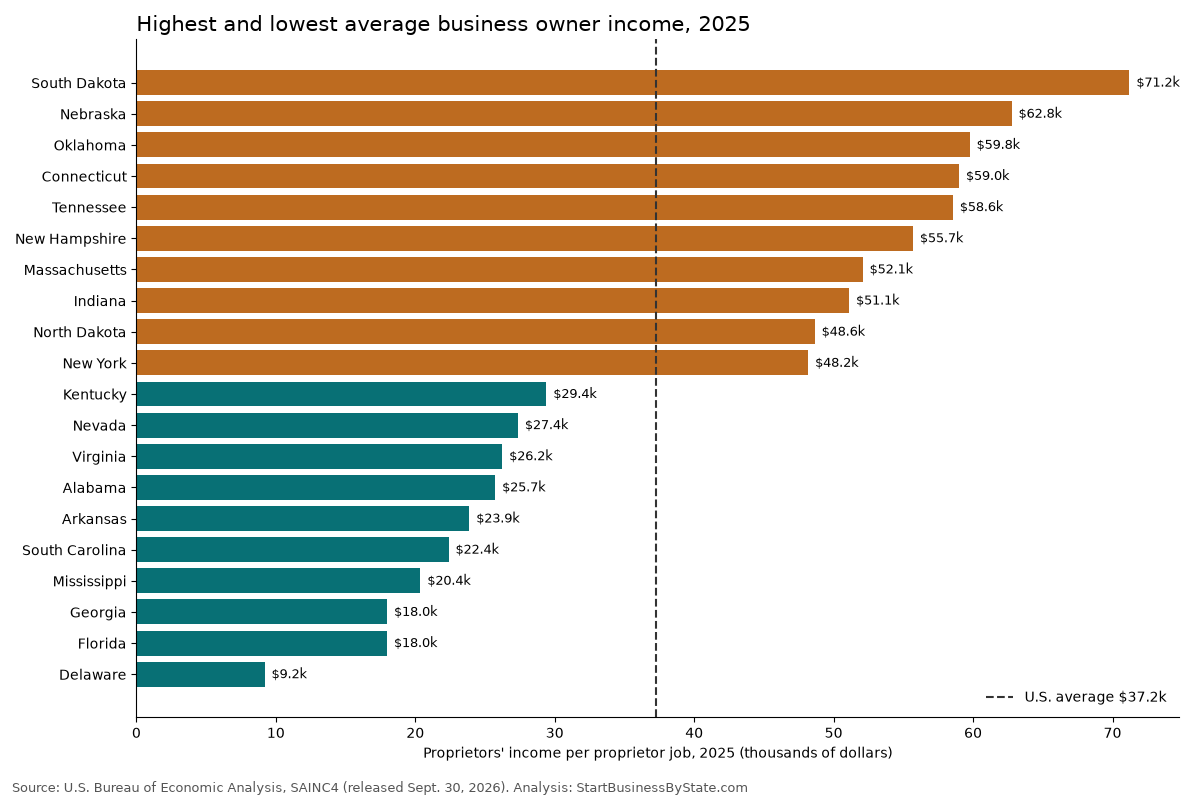
Short answer: in 2025, the average proprietor job in the U.S. brought in $37,237 of proprietors’ income. Among the states, that ranged from $9,189 in Delaware to $71,212 in South Dakota. Since 2019, average owner income rose 7.8%, far behind prices (25.9%) and behind average wages (33.1%). The number of proprietor jobs grew 20.7% over the same years, so more owners are splitting the pie.
What “business owner income” means here
The U.S. Bureau of Economic Analysis (BEA) tracks two numbers for every state. One is proprietors’ income: the profit earned by sole proprietors and partnerships after business expenses, with adjustments for inventory and for the wear and tear on equipment and buildings. The other is proprietor jobs: the number of sole proprietors and partners. We divide the first by the second to get average income per owner job.
Two things to keep in mind. First, a person with a full-time job and a weekend side business counts as a proprietor, so the average includes a lot of small side income. Second, owners of corporations who pay themselves a salary are counted with employees, not here. So this is a picture of sole proprietors and partners, which is how most small businesses start.
Business owner income by state, 2025
Click a column heading to sort. “Owner vs. worker” shows owner income as a share of average pay per wage and salary job in the same state.
| State | Income per owner job, 2025 | Pay per wage job, 2025 | Owner vs. worker | Owner income change, 2019 to 2025 | Proprietor jobs, 2025 | Share of all jobs |
|---|---|---|---|---|---|---|
| United States | $37,237 | $79,216 | 47% | +7.8% | 54,600,700 | 25.0% |
| Alabama | $25,727 | $63,893 | 40% | +9.0% | 717,110 | 24.2% |
| Alaska | $41,532 | $79,518 | 52% | +32.2% | 106,497 | 22.6% |
| Arizona | $30,471 | $74,214 | 41% | +13.4% | 1,072,986 | 24.1% |
| Arkansas | $23,871 | $62,537 | 38% | +22.6% | 428,031 | 23.6% |
| California | $41,661 | $97,593 | 43% | -0.7% | 6,288,000 | 24.7% |
| Colorado | $42,806 | $84,983 | 50% | +24.4% | 1,148,847 | 27.1% |
| Connecticut | $58,989 | $89,808 | 66% | +22.0% | 650,494 | 26.8% |
| Delaware | $9,189 | $74,841 | 12% | -70.1% | 169,828 | 25.0% |
| District of Columbia | $86,721 | $128,000 | 68% | +69.8% | 121,400 | 13.5% |
| Florida | $17,970 | $74,767 | 24% | -5.1% | 4,824,732 | 31.8% |
| Georgia | $17,974 | $74,658 | 24% | -36.7% | 2,005,027 | 27.9% |
| Hawaii | $36,482 | $72,248 | 50% | +5.1% | 213,971 | 23.1% |
| Idaho | $34,298 | $63,519 | 54% | -9.9% | 324,475 | 26.2% |
| Illinois | $34,135 | $81,719 | 42% | -3.4% | 1,866,242 | 22.8% |
| Indiana | $51,107 | $66,130 | 77% | +17.7% | 854,192 | 20.3% |
| Iowa | $42,045 | $62,482 | 67% | +49.4% | 481,335 | 22.7% |
| Kansas | $36,102 | $64,580 | 56% | -12.3% | 463,888 | 23.1% |
| Kentucky | $29,398 | $62,504 | 47% | +18.9% | 599,755 | 22.1% |
| Louisiana | $30,918 | $64,774 | 48% | +6.0% | 771,611 | 27.2% |
| Maine | $32,732 | $67,359 | 49% | +26.4% | 222,901 | 24.8% |
| Maryland | $29,962 | $83,185 | 36% | -3.0% | 1,074,604 | 26.8% |
| Massachusetts | $52,079 | $98,028 | 53% | +20.4% | 1,207,246 | 24.0% |
| Michigan | $31,990 | $70,622 | 45% | +22.1% | 1,392,422 | 23.4% |
| Minnesota | $41,240 | $76,085 | 54% | +36.6% | 837,502 | 21.4% |
| Mississippi | $20,364 | $54,766 | 37% | +0.2% | 458,937 | 26.8% |
| Missouri | $40,417 | $67,950 | 59% | +63.4% | 923,497 | 23.1% |
| Montana | $34,351 | $63,052 | 54% | +28.2% | 219,454 | 28.8% |
| Nebraska | $62,761 | $64,782 | 97% | +67.6% | 319,576 | 22.7% |
| Nevada | $27,361 | $70,940 | 39% | -1.4% | 539,565 | 24.9% |
| New Hampshire | $55,686 | $80,088 | 70% | +19.9% | 225,635 | 23.9% |
| New Jersey | $38,879 | $85,895 | 45% | -13.0% | 1,639,817 | 26.9% |
| New Mexico | $32,895 | $64,433 | 51% | +34.1% | 257,190 | 21.7% |
| New York | $48,172 | $99,540 | 48% | +7.6% | 3,334,204 | 24.7% |
| North Carolina | $29,706 | $73,261 | 41% | +5.8% | 1,612,011 | 23.5% |
| North Dakota | $48,641 | $66,650 | 73% | +41.8% | 140,829 | 23.3% |
| Ohio | $31,390 | $69,621 | 45% | +7.7% | 1,623,218 | 22.0% |
| Oklahoma | $59,753 | $62,512 | 96% | +42.8% | 653,200 | 26.5% |
| Oregon | $36,156 | $75,170 | 48% | +10.1% | 627,960 | 23.5% |
| Pennsylvania | $39,942 | $73,187 | 55% | -7.7% | 1,772,111 | 21.7% |
| Rhode Island | $36,178 | $71,967 | 50% | +18.1% | 160,574 | 23.3% |
| South Carolina | $22,384 | $65,062 | 34% | -11.6% | 781,263 | 24.1% |
| South Dakota | $71,212 | $59,914 | 119% | +53.2% | 172,067 | 25.9% |
| Tennessee | $58,550 | $70,022 | 84% | +23.2% | 1,225,365 | 26.4% |
| Texas | $48,083 | $77,640 | 62% | +23.7% | 5,866,139 | 28.4% |
| Utah | $33,867 | $70,341 | 48% | +22.6% | 609,338 | 24.8% |
| Vermont | $37,149 | $66,558 | 56% | +35.3% | 116,918 | 26.6% |
| Virginia | $26,233 | $81,751 | 32% | +1.3% | 1,344,838 | 23.2% |
| Washington | $37,046 | $98,401 | 38% | -6.3% | 1,038,137 | 21.3% |
| West Virginia | $31,425 | $59,608 | 53% | +10.4% | 178,793 | 19.6% |
| Wisconsin | $33,944 | $67,274 | 50% | +16.8% | 765,292 | 19.9% |
| Wyoming | $29,893 | $64,833 | 46% | -4.2% | 151,676 | 33.6% |
Dollar figures are not adjusted for inflation. 2025 figures are BEA’s first estimates and may be revised.
The top states were South Dakota ($71,212), Nebraska ($62,761), Oklahoma ($59,753), Connecticut ($58,989), Tennessee ($58,550). The bottom states were Delaware ($9,189), Florida ($17,970), Georgia ($17,974), Mississippi ($20,364), South Carolina ($22,384). In 25 states, the average owner job earned less than half of what the average wage job paid.
Farm income matters in some states. In South Dakota (37%), Iowa (32%), North Dakota (32%), Nebraska (27%), farm proprietors earned a large share of all proprietors’ income in 2025, so a good or bad crop year moves the state average. In 41 states, more than 90% came from non-farm businesses. Delaware’s low figure reflects very low non-farm proprietors’ income in BEA’s 2024 and 2025 estimates; its average was $30,695 in 2019.
Owner income since 2019: behind prices and wages
From 2019 to 2025, average income per owner job rose 7.8% in the U.S. Consumer prices rose 25.9% over the same years, based on the BLS consumer price index, so the typical owner job lost buying power. Average pay per wage and salary job rose 33.1%.
Owner income grew faster than prices in 12 states, led by Nebraska (+68%), Missouri (+63%), South Dakota (+53%), Iowa (+49%). It fell in 14 states, including Delaware (-70%), Georgia (-37%), New Jersey (-13%), Kansas (-12%), South Carolina (-12%).
One reason: total proprietors’ income rose 30% nationally, but it was spread across 20.7% more proprietor jobs, from 45.2 million in 2019 to 54.6 million in 2025. In Florida, proprietor jobs rose 42% while average income per owner job fell 5%. Georgia had a similar pattern: proprietor jobs up 27%, average income down 37%.
Why the average owner earns less than the average worker
- Side businesses pull the average down. Part-time consultants, weekend sellers and others with small side businesses count as proprietors.
- Losses count. Proprietors’ income is net of losses, so owners who lost money lower the average.
- Owners pay their own costs. Profit is what’s left after business expenses, but owners still pay the full 15.3% self-employment tax and usually buy their own health coverage.
- Some owners become corporations. Owners who switch to an S corporation and pay themselves a wage move that pay out of this measure.
Example: if you leave a job paying the U.S. average of $79,216 to run a full-time business, a typical first goal is to match that pay after expenses, plus about 7.65% more to cover the employer half of Social Security and Medicare tax that your old employer used to pay.
What to do with these numbers
- Set a pay target. Use the wage column for your state as the bar to beat. If your business can’t get there in a few years, decide whether it stays a side business.
- Price for profit, not just sales. Owner income is profit. Track your profit each month, not just revenue.
- Set aside tax money. Put part of every payment you receive aside for income tax and self-employment tax, and pay quarterly estimated taxes to the IRS.
- Look at an S corporation when profit grows. Once profit is steady, ask a tax professional whether paying yourself a salary through an S corporation saves you tax.
- Protect the income you have. An LLC can keep business debts separate from your personal assets, and liability insurance covers claims.
Related: income needed to buy a home by state, sole proprietor profit by state and industry (IRS data), self-employment statistics, how to pay yourself from an LLC and self-employment tax for 2027.
Making your business official?
Form your LLC with LegalNature. Compare small business insurance quotes from Simply Business.
We may earn a commission if you use these links. It doesn’t change what you pay, and it doesn’t affect the information on this page.
How we did this
All income and job counts come from the BEA’s state table SAINC4, last revised September 30, 2026, which covers 2009 to 2025. Income per owner job is proprietors’ income (line 70, farm and nonfarm, with inventory valuation and capital consumption adjustments) divided by proprietors employment (line 7040). Pay per wage job is wages and salaries (line 50) divided by wage and salary employment (line 7020). Share of all jobs is proprietors employment divided by total employment (line 7010). Inflation is the change in the annual average consumer price index for all urban consumers (CPI-U), 255.657 in 2019 and 321.943 in 2025. The BEA counts jobs, not people, and does not publish a median, so these are averages. Sources: BEA Regional Data, SAINC4; BEA definition of proprietors' income; BLS Consumer Price Index.
Common questions
How much does the average business owner make?
In 2025, the average U.S. proprietors’ income per proprietor job was $37,237, according to BEA data. That is about 47% of the $79,216 average pay per wage and salary job. Many proprietor jobs are side businesses, so the average is pulled down by people who earn only a little from self-employment.
Which state has the highest business owner income?
Among the 50 states, South Dakota had the highest average at $71,212 per proprietor job in 2025, followed by Nebraska ($62,761) and Oklahoma ($59,753). Washington, D.C., was higher still at $86,721.
Which state has the lowest business owner income?
Delaware had the lowest average at $9,189 per proprietor job in 2025, followed by Florida ($17,970) and Georgia ($17,974).
Has business owner income kept up with inflation?
No, on average. From 2019 to 2025, proprietors’ income per proprietor job rose 7.8% nationally, while consumer prices rose 25.9%. Average pay per wage and salary job rose 33.1%. Only 12 states saw owner income grow faster than prices.
What counts as a proprietor?
The BEA counts sole proprietors and partners in partnerships, including people with a side business. Each business a person owns counts as a job, so one person can count more than once. Owners of corporations, including S corporations, are counted as employees if they pay themselves wages, not as proprietors.
Published November 18, 2026.