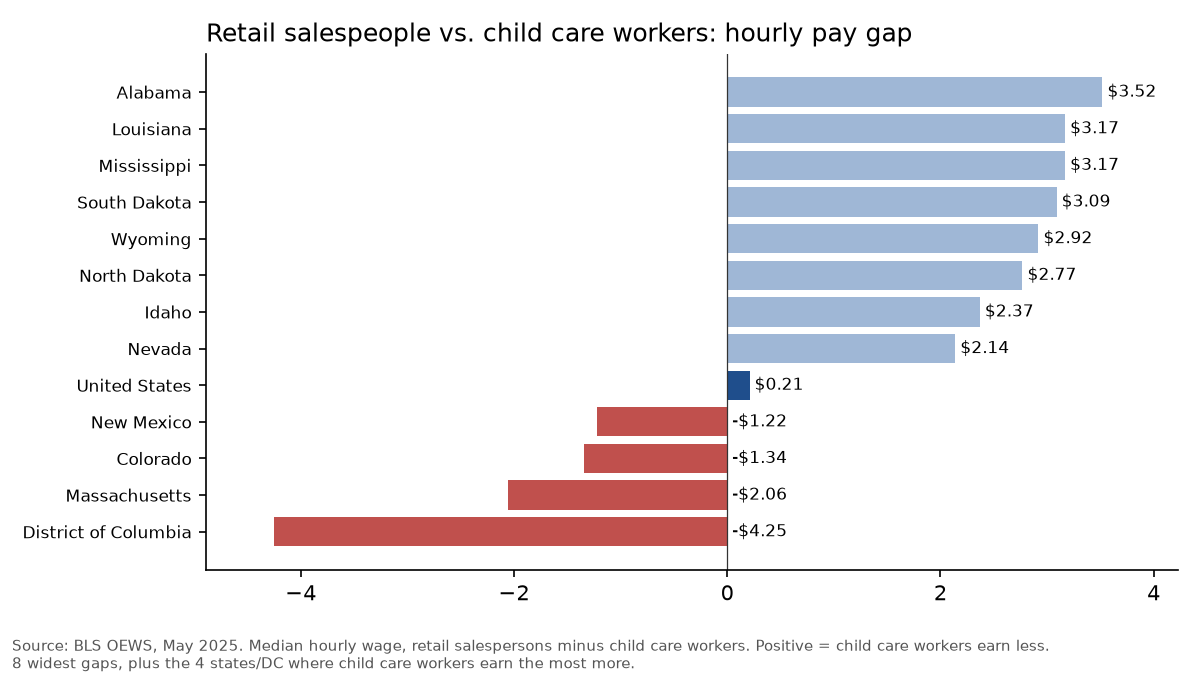
Child care workers and retail salespeople earn similar pay nationally, but child care workers come out behind in 36 states.
Child care workers in the U.S. earned a median of $16.82 an hour in May 2025, compared with $17.03 for retail salespeople, according to the Bureau of Labor Statistics. Nationally, that’s a difference of $0.21 an hour.
State by state, child care workers earned less than retail salespeople in 36 states. The gaps were largest in Alabama ($10.92 vs. $14.44), Louisiana ($11.01 vs. $14.18) and Mississippi ($10.60 vs. $13.77). In 18 of those 36 states, the difference was less than $1 an hour.
In the other 14 states and the District of Columbia, child care workers earned the same or more. The biggest differences in that direction were in D.C. ($4.25 more an hour), Massachusetts ($2.06 more) and Colorado ($1.34 more).
Compared with fast-food jobs
Child care workers earned more than fast-food and counter workers in most places. The exceptions were five states: California, Nevada, South Dakota, Alabama and Mississippi, where fast-food and counter workers had the higher median.
Why it’s in the news
States are trying different ways to keep child care staff. In October, Pennsylvania announced a total of $30 million for child care recruitment and retention bonuses of at least $540 per eligible worker. In Pennsylvania, child care workers’ median was $14.49 an hour, compared with $15.00 for retail salespeople.
These figures are medians for employees. They don’t include owners of home-based programs who work for themselves, and they don’t account for benefits, hours or the training each job requires.
What this means if you run or plan to open a daycare
Staff pay is usually the largest cost in a child care budget, so local wages for retail and other entry-level jobs are worth checking when you set tuition and plan hiring. You’ll also need coverage for the program itself; see our guides to daycare insurance in Wisconsin and daycare insurance in Mississippi.
How we got these numbers
All wages are median hourly wages from the Bureau of Labor Statistics’ Occupational Employment and Wage Statistics (OEWS) survey for May 2025, the newest release, pulled through the BLS public data API. The median is the midpoint: half of workers in the job earn more and half earn less. OEWS covers employees on payrolls; it does not include self-employed business owners. Occupation codes: 39-9011 (childcare workers), 41-2031 (retail salespersons) and 35-3023 (fast food and counter workers). Childcare workers does not include preschool teachers or child care center directors. Figures cover all 50 states and the District of Columbia. Data pulled October 18, 2026.