Census survey data show about 24% of child care workers relied on Medicaid or a similar public health plan in 2024, and 15% lived in households that got SNAP.
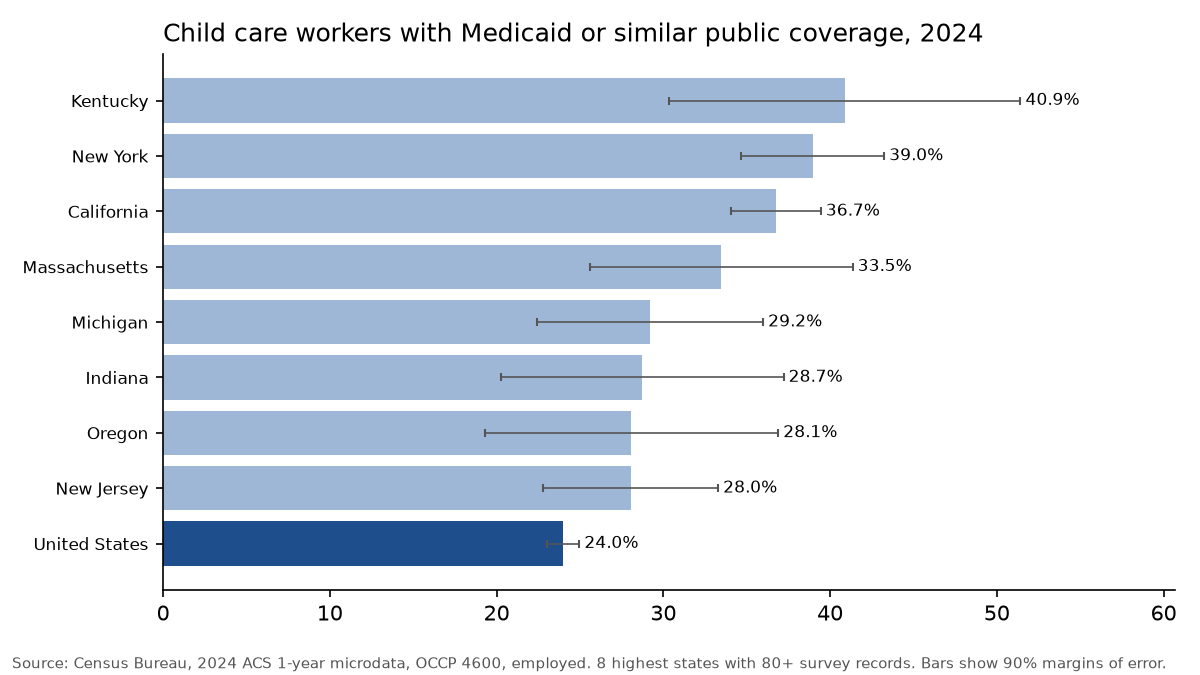
About 24% of employed child care workers in the U.S., roughly 1 in 4, had Medicaid or another means-tested public health plan in 2024, according to Census Bureau survey data (margin of error ±1.0 points). That works out to about 227,000 of the 947,000 people working in the job.
Other findings from the same survey:
- 14.8% (±0.8) lived in a household that received SNAP (food stamps) in the past year.
- 11.4% (±0.8) had no health insurance at all.
- The rest had job-based, privately bought, Medicare or other coverage.
How states compare
Among the 31 states with enough survey responses, the highest Medicaid shares were in Kentucky (41%, ±11), New York (39%, ±4) and California (37%, ±3). Kentucky’s sample is small, so its rank isn’t certain. The lowest were Texas (10%), Georgia (8%) and Utah (6%). In Texas and Georgia, low Medicaid shares came with high uninsured rates: in Texas, 28% (±4) of child care workers had no coverage. Utah had both a low Medicaid share and a low uninsured rate. State rules on who qualifies for Medicaid differ, which affects these numbers.
How it compares with other service jobs
Child care workers’ Medicaid share is similar to that of maids and housekeepers (26%) and higher than janitors (18%), landscapers (17%) and electricians (7%). The survey doesn’t record why someone has a given type of coverage.
What this means if you run or plan to open a daycare
Staff pay and benefits are a big part of any child care budget. Whatever you decide on benefits, you’ll also need business coverage for the program itself; see our guides to daycare insurance in Wisconsin and daycare insurance in Washington.
How we got these numbers
We counted employed civilians in occupation code 4600 (child care workers) in the Census Bureau’s 2024 American Community Survey public use microdata (PUMS), using person weights and 80 replicate weights for 90% margins of error. “Medicaid” means the survey’s HINS4 item: Medicaid, Medical Assistance, or any government-assistance plan for people with low incomes or a disability. People can have more than one type of coverage. SNAP is measured for the whole household, not the worker alone. The group includes center staff, home-based providers and nannies, both employees and self-employed; it doesn’t include preschool teachers or program directors. State results are shown only where at least 80 workers were surveyed. The 2025 survey comes out October 29, 2026. Data pulled October 17, 2026.