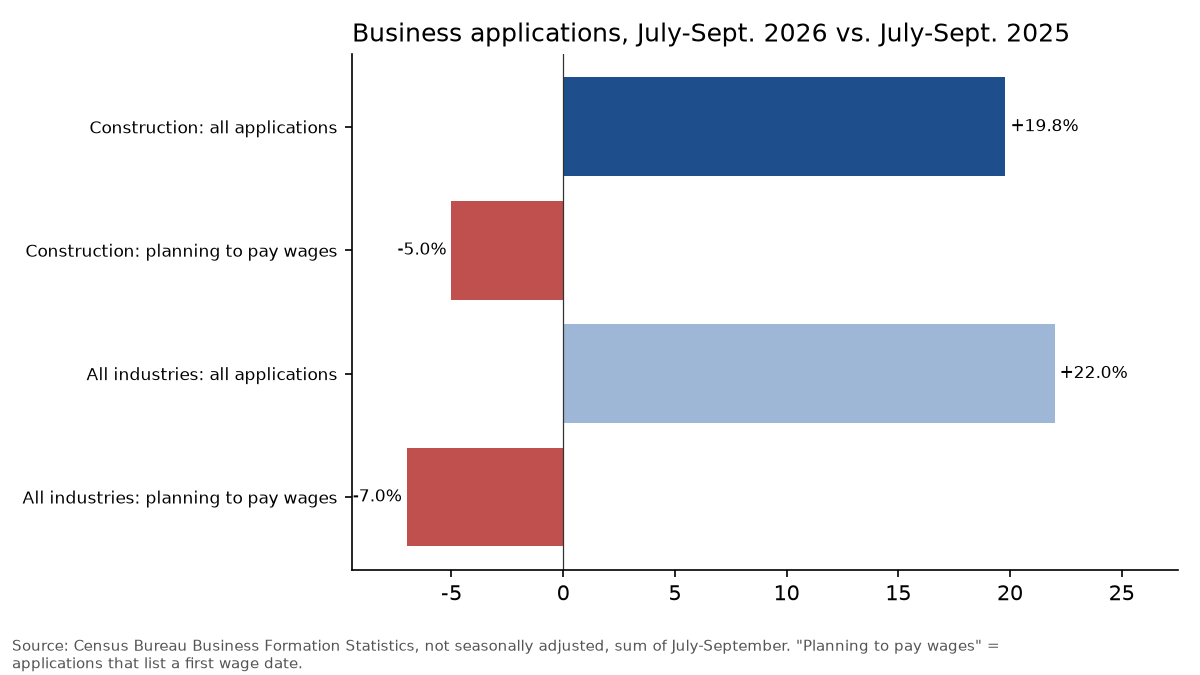
More people are filing to start construction businesses, up 19.8% this summer, but fewer of them plan to hire employees.
People filed 146,995 applications to start construction businesses from July through September 2026, up 19.8% from 122,720 in the same months of 2025, according to Census Bureau data released in its September business formation report. Construction includes electricians, plumbers, HVAC contractors, roofers, remodelers and other trades.
But fewer of those new filers expect to hire. Applications that list a planned date to start paying wages fell 5.0% in construction, from 11,499 to 10,925. So far this year (January through September), construction applications are up 12.1% while those planning to pay wages are down 15.7%.
The same split shows up across the whole economy: total applications rose 22.0% this summer, while applications planning to pay wages fell 7.0%. Construction filings are rising about as fast as filings overall, not faster.
An application isn’t a running business
These numbers count applications for an Employer Identification Number (EIN), the tax ID the IRS issues. Many applicants never open, some apply for a side job or a holding company, and some form an LLC for a business that already exists. The Census Bureau’s definitions explain how it estimates which applications are likely to become businesses with payrolls. Think of the numbers as a sign of interest in starting a business, not a count of new contractors.
What may be behind the trend
The drop in applications planning to pay wages suggests more new filers expect to work alone or with a partner, at least at first. Steady repair and upgrade work, high pay for skilled trades and the cost of hiring help in a tight labor market can all push new contractors toward a one-person start. The data can’t say which reason matters most.
What this means if you’re starting a trade business
If you’re going solo, setting up an LLC can keep your business finances separate from your personal ones. Rules and fees vary by state. See how to set up an LLC in Pennsylvania, Kansas or Oklahoma.
How we got these numbers
We used the Census Bureau’s Business Formation Statistics through its public data API: total business applications (BA) and applications with planned wages (WBA) for construction (NAICS 23) and all industries, not seasonally adjusted, summed for July-September and January-September. We don’t use the “high-propensity” series for construction because the Census Bureau counts every application in specialty trades (NAICS 238) and heavy construction (237) as high-propensity. Data pulled October 18, 2026.