Updated October 12, 2026. Data: Federal Reserve Bank of New York Consumer Credit Panel/Equifax, state figures for the fourth quarter of each year through 2025 (published February 2026). The next state update is expected in early 2027.
At the end of 2025, 12.4% of U.S. credit card balances were 90 or more days late, up from 11.2% a year earlier and 8.1% in 2019. Nevada had the highest rate (16.3%), followed by Florida (14.9%) and Louisiana (14.2%). Wisconsin had the lowest (8.0%). The rate rose in 51 states over the year. When customers pay late, a line of credit can bridge the gap; compare types of business loans before you need one.
Seriously late card balances by state
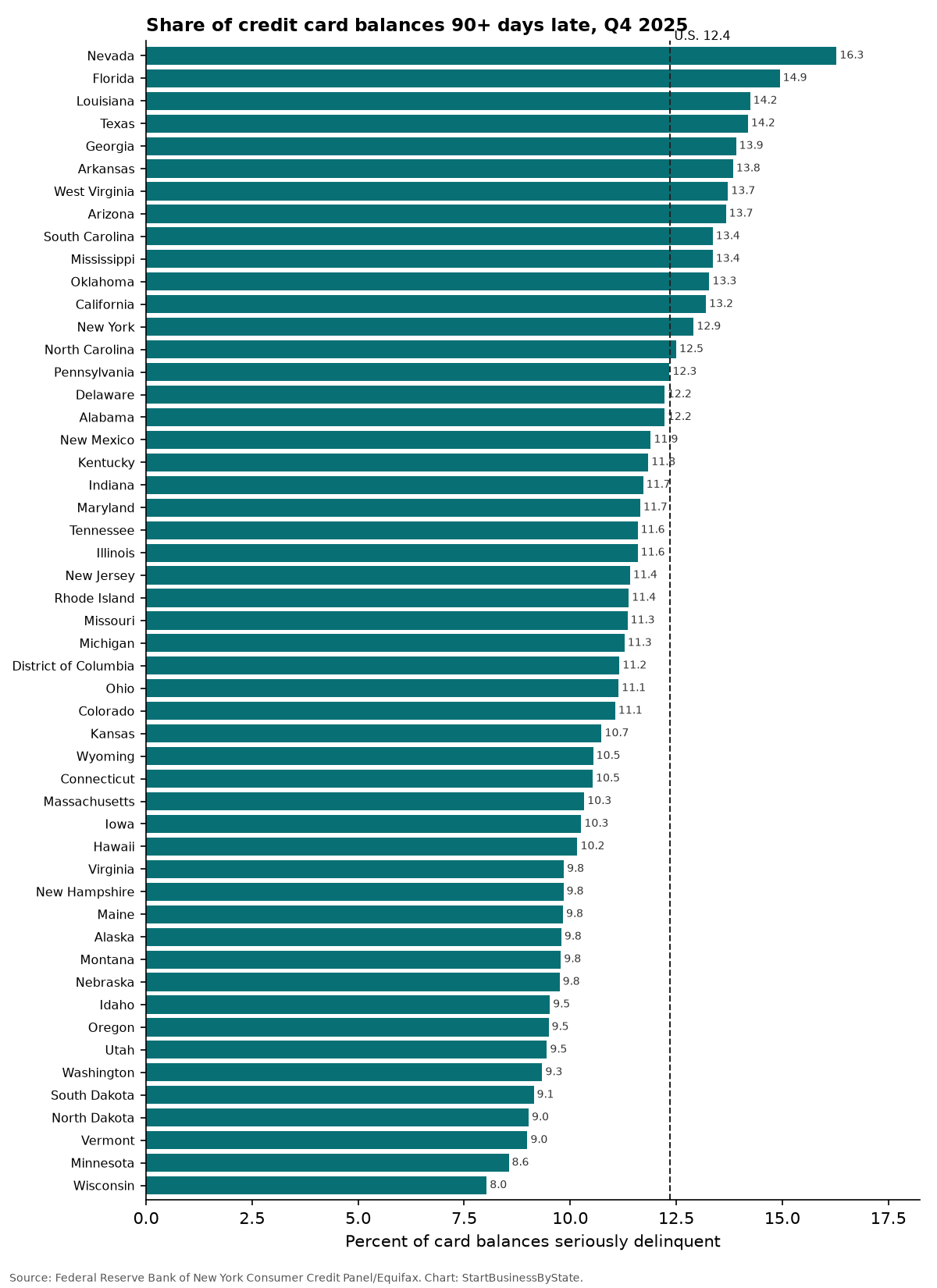
“Seriously delinquent” here means the payment is at least 90 days past due. The rate is a share of balances (dollars owed), not a share of people. Southern and Sun Belt states tend to have the highest rates, and the Upper Midwest the lowest.
State-by-state table
Click a column to sort. Balance per person is the average credit card balance across all adults with a credit report in the state.
| State | 90+ days late, 2025 | 90+ days late, 2024 | Change (points) | 90+ days late, 2019 | Card balance per person, 2025 |
|---|---|---|---|---|---|
| U.S. | 12.4% | 11.2% | +1.1 | 8.1% | $4,350 |
| Alabama | 12.2% | 11.2% | +1.0 | 8.4% | $3,400 |
| Alaska | 9.8% | 9.2% | +0.6 | 6.6% | $5,250 |
| Arizona | 13.7% | 12.1% | +1.6 | 10.4% | $4,530 |
| Arkansas | 13.8% | 12.5% | +1.3 | 9.7% | $3,310 |
| California | 13.2% | 12.0% | +1.2 | 8.7% | $5,000 |
| Colorado | 11.1% | 9.8% | +1.3 | 6.5% | $4,910 |
| Connecticut | 10.5% | 9.9% | +0.6 | 7.1% | $4,960 |
| Delaware | 12.2% | 11.3% | +0.9 | 8.6% | $4,520 |
| District of Columbia | 11.2% | 10.8% | +0.4 | 6.5% | $5,500 |
| Florida | 14.9% | 13.5% | +1.4 | 10.5% | $5,050 |
| Georgia | 13.9% | 12.5% | +1.4 | 8.3% | $4,610 |
| Hawaii | 10.2% | 9.4% | +0.8 | 7.2% | $5,220 |
| Idaho | 9.5% | 8.8% | +0.7 | 6.8% | $3,870 |
| Illinois | 11.6% | 10.4% | +1.2 | 6.6% | $4,260 |
| Indiana | 11.7% | 10.7% | +1.0 | 7.0% | $3,410 |
| Iowa | 10.3% | 9.6% | +0.7 | 7.0% | $3,250 |
| Kansas | 10.7% | 9.9% | +0.9 | 6.4% | $3,670 |
| Kentucky | 11.8% | 10.9% | +0.9 | 7.8% | $3,140 |
| Louisiana | 14.2% | 12.9% | +1.3 | 8.6% | $3,610 |
| Maine | 9.8% | 8.8% | +1.0 | 6.2% | $3,760 |
| Maryland | 11.7% | 10.4% | +1.2 | 7.4% | $5,090 |
| Massachusetts | 10.3% | 9.6% | +0.7 | 7.2% | $4,650 |
| Michigan | 11.3% | 10.5% | +0.8 | 6.9% | $3,670 |
| Minnesota | 8.6% | 7.9% | +0.7 | 6.1% | $3,990 |
| Mississippi | 13.4% | 12.5% | +0.8 | 9.5% | $3,030 |
| Missouri | 11.3% | 10.7% | +0.7 | 7.7% | $3,550 |
| Montana | 9.8% | 8.7% | +1.1 | 7.0% | $3,850 |
| Nebraska | 9.8% | 9.2% | +0.6 | 6.7% | $3,650 |
| Nevada | 16.3% | 14.5% | +1.8 | 11.5% | $5,060 |
| New Hampshire | 9.8% | 8.9% | +1.0 | 6.6% | $4,500 |
| New Jersey | 11.4% | 10.4% | +1.1 | 7.5% | $5,160 |
| New Mexico | 11.9% | 10.6% | +1.3 | 9.0% | $3,520 |
| New York | 12.9% | 12.0% | +0.9 | 9.0% | $4,820 |
| North Carolina | 12.5% | 11.3% | +1.2 | 8.2% | $4,160 |
| North Dakota | 9.0% | 8.1% | +0.9 | 5.6% | $3,970 |
| Ohio | 11.1% | 10.4% | +0.8 | 7.4% | $3,560 |
| Oklahoma | 13.3% | 12.2% | +1.1 | 8.9% | $3,460 |
| Oregon | 9.5% | 8.5% | +1.0 | 6.3% | $4,030 |
| Pennsylvania | 12.3% | 11.4% | +0.9 | 8.0% | $3,950 |
| Rhode Island | 11.4% | 10.4% | +1.0 | 8.1% | $4,490 |
| South Carolina | 13.4% | 12.1% | +1.3 | 8.2% | $4,090 |
| South Dakota | 9.1% | 8.8% | +0.3 | 6.3% | $3,530 |
| Tennessee | 11.6% | 10.5% | +1.1 | 7.8% | $3,710 |
| Texas | 14.2% | 13.0% | +1.2 | 9.2% | $4,620 |
| Utah | 9.5% | 7.9% | +1.6 | 5.8% | $4,260 |
| Vermont | 9.0% | 8.1% | +0.9 | 5.8% | $3,790 |
| Virginia | 9.8% | 8.9% | +0.9 | 6.6% | $4,770 |
| Washington | 9.3% | 8.3% | +1.0 | 5.8% | $4,640 |
| West Virginia | 13.7% | 12.4% | +1.3 | 8.1% | $3,180 |
| Wisconsin | 8.0% | 7.6% | +0.4 | 5.5% | $3,400 |
| Wyoming | 10.5% | 9.1% | +1.5 | 7.5% | $3,990 |
Why this matters if you own a small business
- Customers may be stretched. When more card balances go unpaid, households often cut back on optional spending first, like dining out, home projects and personal services.
- Owners use personal cards too. Many new owners float early expenses on personal credit cards. Late payments hurt your personal credit score, which lenders check when you apply for a business loan.
- Separate business and personal money. A business bank account and, when you qualify, business credit in the company’s own name make it easier to track costs and build a business credit history.
- For the mortgage side of the picture, see mortgage delinquency by state. For what card payments cost merchants, see credit card swipe fees by state.
Established business that needs working capital?
If your business has been running at least 6 months with steady sales, a business funding product may cost less than carrying balances on personal cards. See business funding options from Cardiff. Fora Financial generally looks for 6+ months in business and about $240,000+ in yearly revenue: check Fora Financial working capital.
We may earn a commission if you use this link. It doesn’t change what you pay, and it doesn’t affect the data on this page.
About the data
- Source: Federal Reserve Bank of New York, State Level Household Debt Statistics 2003–2025 (February 2026), based on the New York Fed Consumer Credit Panel, a 5% random sample of anonymized Equifax credit reports.
- What the rate means: the percent of credit card balances that were 90 or more days delinquent in the fourth quarter of each year.
- Figures are shown as published, rounded to one decimal. We don’t offer a download for this page because the underlying data belongs to the New York Fed. Get the full file from the link below.
Sources
Cite this data
Reporters and bloggers may use these numbers and charts. Please credit StartBusinessByState and link to this page.
Source: StartBusinessByState, “Credit Card Delinquency by State: Where Late Payments Are Highest,” https://startbusinessbystate.com/credit-card-delinquency-by-state/ (updated October 12, 2026).
FAQ
Which state has the highest credit card delinquency?
Nevada: 16.3% of card balances were 90+ days late at the end of 2025. Florida (14.9%) and Louisiana (14.2%) were next.
Which state has the lowest?
Wisconsin (8.0%), followed by Minnesota (8.6%).
Is credit card delinquency rising?
Yes. Nationally, the share of balances 90+ days late rose from 11.2% at the end of 2024 to 12.4% at the end of 2025, and it rose in 51 states.
What does 90+ days delinquent mean?
The payment is at least three months overdue. At that point the account is usually reported as seriously late and may be sent to collections or charged off.
Where is this data from?
The Federal Reserve Bank of New York, using its Consumer Credit Panel of anonymized Equifax credit reports.
Last updated October 12, 2026 by StartBusinessByState.