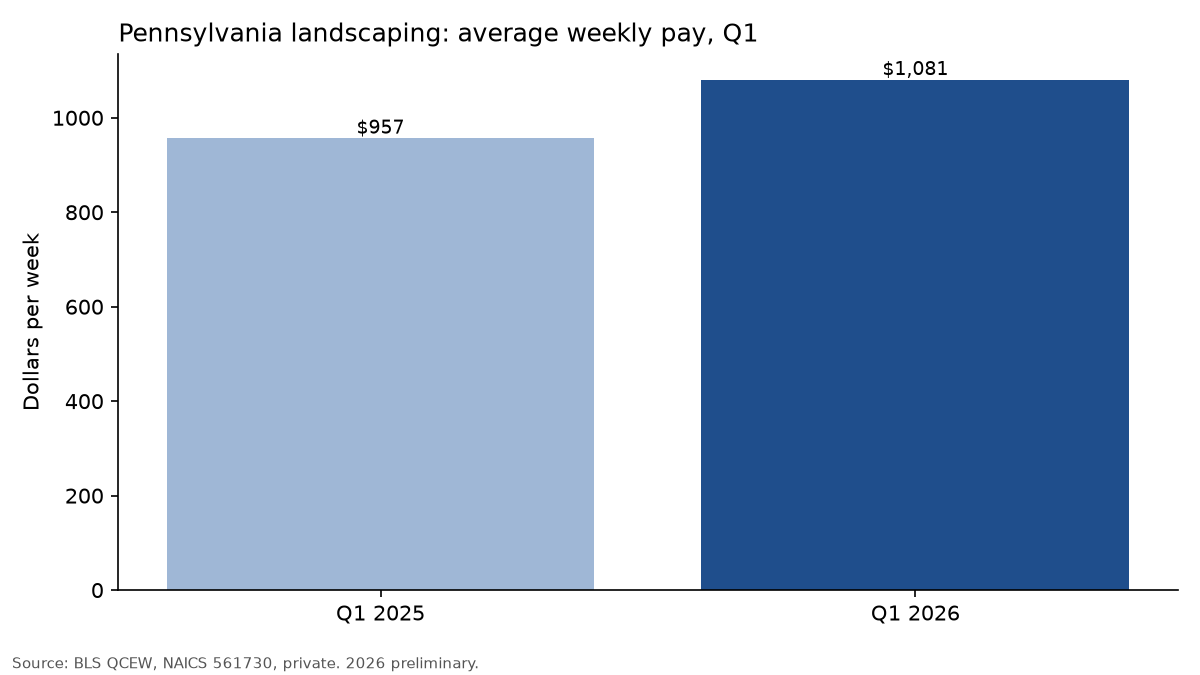
Average pay at Pennsylvania landscaping companies rose 13.0% in a year, federal data show, even as the number of jobs held about steady.
Average pay at Pennsylvania landscaping companies rose from $957 to $1,081 a week between early 2025 and early 2026, a 13.0% jump. Over the same months the number of landscaping locations grew 3.3% to 5,273, while jobs averaged about 25,831, nearly flat (-0.6%). Counting March alone, jobs fell 2.6% to 28,942.
A word of caution: January through March is the off-season, when many crews are laid off and mostly year-round and higher-paid staff remain. A bigger share of those workers, or snow-removal bonuses, can push the winter average up. Pay later in the year is usually lower. For how jobs shift through the seasons nationally, see our look at landscaping jobs.
SBA lending picked up too
Lenders approved 72 SBA 7(a) loans worth $17.2 million to Pennsylvania landscaping businesses in fiscal 2025, up from 66 loans worth $9.3 million in fiscal 2024.
What this means if you’re starting a landscaping business
Expect to pay more to keep good crew leaders, and price your jobs with that in mind. Workers’ comp and liability costs rise with payroll, so get quotes early; our guide to landscaping insurance in Pennsylvania explains what’s typically required. If you haven’t formed your company yet, see how much it costs to start an LLC in Pennsylvania.
How we got these numbers
Jobs, business locations and pay come from the federal Quarterly Census of Employment and Wages (QCEW) run by the Bureau of Labor Statistics. It counts workers covered by unemployment insurance, so it misses most self-employed owners. We compare January–March 2026 with January–March 2025 for private employers in industry code 561730 (landscaping services). “Jobs” is the average of the three months; the March-only number is in the CSV. “Business locations” counts each worksite, so a company with three sites counts three times. Average weekly pay mixes full-time and part-time workers, so it isn’t an hourly rate. The 2026 figures are preliminary and BLS may revise them. SBA loan counts come from the SBA 7(a) loan data file (data through June 30, 2026), matched on the borrower’s state and industry code. They show approvals, not money actually paid out, and leave out other SBA programs and regular bank loans. SBA fiscal years run October to September, so fiscal 2026 has only nine months so far. Data pulled October 16, 2026.