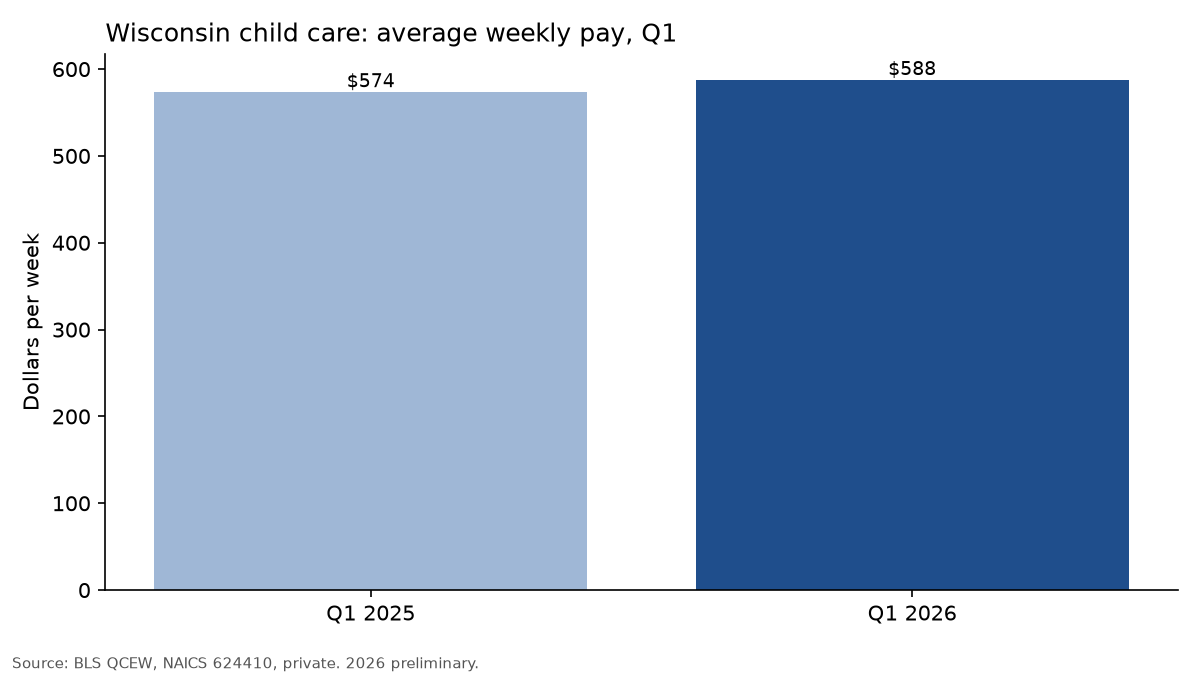
Wisconsin keeps adding child care centers, but the workforce isn’t growing. Average pay rose to $588 a week in early 2026, federal data show.
Wisconsin had 1,531 child care locations in early 2026, 17 more than a year earlier (+1.1%). The number of people working in them barely moved: about 18,949 jobs, compared with 18,972 a year before (-0.1%).
Average pay rose 2.4%, from $574 to $588 a week. That average includes part-time staff, so many full-time workers earn more, and some earn less.
What this means if you’re opening a daycare
More centers chasing about the same number of workers usually means hiring is competitive. Payroll is typically a daycare’s largest cost, so budget for wages near or above the state average to fill shifts. Before you open, compare quotes for liability, property and workers’ comp coverage; our guide to daycare insurance in Wisconsin explains what’s usually required.
SBA loans to Wisconsin child care businesses
Lenders approved 23 SBA 7(a) loans worth $9.3 million to Wisconsin child care businesses in fiscal 2025, compared with 29 loans worth $13.2 million in fiscal 2024. In the first nine months of fiscal 2026, lenders approved 13 loans worth $8.8 million. See how these loans work and what else is available in our guide to daycare business loans. If you haven’t set up your business yet, here’s how to form an LLC in Wisconsin.
How we got these numbers
Jobs, business locations and pay come from the federal Quarterly Census of Employment and Wages (QCEW) run by the Bureau of Labor Statistics. It counts workers covered by unemployment insurance, so it misses most self-employed owners. We compare January–March 2026 with January–March 2025 for private employers in industry code 624410 (child day care services). “Jobs” is the average of the three months; the March-only number is in the CSV. “Business locations” counts each worksite, so a company with three sites counts three times. Average weekly pay mixes full-time and part-time workers, so it isn’t an hourly rate. The 2026 figures are preliminary and BLS may revise them. SBA loan counts come from the SBA 7(a) loan data file (data through June 30, 2026), matched on the borrower’s state and industry code. They show approvals, not money actually paid out, and leave out other SBA programs and regular bank loans. SBA fiscal years run October to September, so fiscal 2026 has only nine months so far. Data pulled October 16, 2026.