Original research · State legislatures + U.S. Treasury + BLS QCEW · Last updated October 6, 2026
Laws checked: every law on this page was confirmed on the official state legislature or state agency website on October 6, 2026. Business counts: BLS QCEW, 2026 Q1.
The federal government has stopped making new pennies, and states are writing rounding rules one by one. As of October 6, 2026, 19 states have passed a law that lets or tells businesses round cash totals to the nearest nickel. Card and other electronic payments still go to the exact cent everywhere. The other 30 jurisdictions (counting DC) have no rounding law of any kind yet, and Congress has passed a federal bill, the Common Cents Act (H.R. 10167), that is waiting on the President.
Key findings
- 19 states have a merchant rounding law. 15 allow rounding and 4 require it for at least some sellers. Counting New Mexico and Oklahoma, which round only government payments, 21 states have acted.
- Required in 4 states, on different clocks. Georgia since July 1, 2026. Indiana for cash sales after December 31, 2026. California from July 1, 2027. Arizona requires it of any seller that no longer has or uses pennies, and makes them post a notice.
- The common rule is symmetrical rounding. Arizona, Nebraska and Oklahoma, for example, round totals ending in 1, 2, 6 or 7 cents down and 3, 4, 8 or 9 up. The U.S. Treasury’s penny FAQ (December 23, 2025) points to the same method. Hawaii and Nebraska round a total of 1 or 2 cents up to 5 cents. Indiana lets a business round down, up, or to the nearest nickel.
- Sales tax is figured before rounding. Arizona and Indiana spell this out, and Virginia ordered its Department of Taxation to report on sales tax effects by November 1, 2026.
- 175,463 cash-heavy small businesses sit in states with a merchant rule. That is 46% of the 381,566 beauty salons, barber shops, laundromats, food trucks and limited-service restaurants counted by BLS in 2026 Q1.
- 5 more states have live bills. New York (A09274, passed one chamber), New Jersey (A5233, passed one chamber), Pennsylvania (HB2388, passed one chamber), Michigan (SB1014, introduced), Ohio (HB737, introduced).
Taking cash and card payments in a salon?
Build one checkout routine for appointments, receipts and customer payments. Use the salon guide to compare the tools for that workflow.
Which states have penny rounding laws?
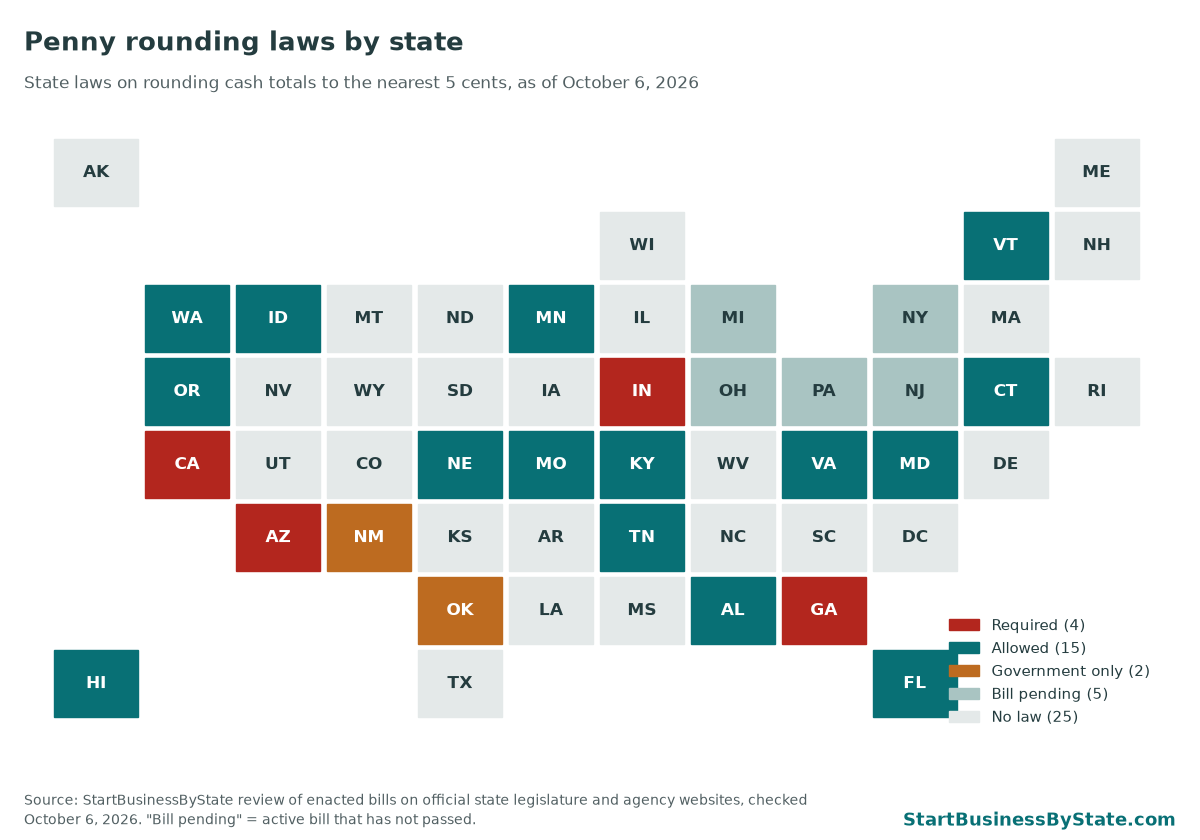
The South and West moved first. In the Northeast, only Connecticut and Vermont have passed rounding laws so far, though bills are moving in New York, New Jersey and Pennsylvania.
Penny rounding laws in every state
Click a column header to sort. “Official text” links go to the state legislature or agency page we checked. A blank effective date means the law takes effect on the state’s standard date or we could not confirm a specific one.
| State | Status | Law | Effective | What it does | Source | Cash-heavy small businesses |
|---|---|---|---|---|---|---|
| Arizona | Required | HB 2938, Laws 2026, Ch. 5 (A.R.S. 44-7952) | Arizona general effective date | A seller that doesn't have or use pennies must round cash totals to the nearest 5 cents (1-2 and 6-7 cents down, 3-4 and 8-9 up), post a notice at the register, and figure sales tax on the unrounded price. Enforced by weights and measures. | official text | 6,714 |
| California | Required | AB 1793, Ch. 896, Stats. 2026 (California Common Cents Act, Civil Code 1789.60-1789.67) | July 1, 2027 | Requires merchants to round cash totals to the nearest 5 cents. A separate law, SB 1005 (Ch. 321, Stats. 2026), lets local agencies round cash payments. | official text | 47,042 |
| Georgia | Required | HB 1112, Act 445 | July 1, 2026 | Merchants must round cash purchases to the nearest 5 cents, but must still accept exact payment in pennies while pennies remain legal tender. | official text | 13,665 |
| Indiana | Required | SB 243, P.L. 128-2026 (IC 23-15-13; IC 5-36.5) | Cash transactions after Dec. 31, 2026 | Business entities must round cash totals, either down, up, or to the nearest 5 cents. State and local tax payments in cash are also rounded under a separate penny phaseout chapter. | official text | 7,393 |
| Alabama | Allowed | HB 545, Act 2026-548 | April 17, 2026 | Businesses may round cash totals to the nearest 5 cents. Does not apply to payments to state or local government. | official text | 6,264 |
| Connecticut | Allowed | HB 5349, Public Act 26-128 | Cash totals may be rounded to the nearest 5 cents. | official text | 4,454 | |
| Florida | Allowed | SB 1074, Ch. 2026-68, Laws of Florida | May 11, 2026 | Businesses may round cash totals to the nearest 5 cents. | official text | 27,484 |
| Hawaii | Allowed | SB 3255, Act 159 | July 1, 2026 | Authorizes rounding cash totals to the nearest 5 cents. Totals of 1 or 2 cents round up to 5 cents. | official text | 2,483 |
| Idaho | Allowed | S 1350, Session Laws Ch. 241 (Idaho Code 63-3643) | July 1, 2026 | Businesses may round cash totals to the nearest 5 cents. | official text | 2,347 |
| Kentucky | Allowed | HB 757, 2026 Acts Ch. 161 | Rounding may be used when buying or selling goods or services. Cash payments of debts owed to the state, cities, counties and school districts are rounded. | official text | 4,887 | |
| Maryland | Allowed | SB 893, Ch. 516 / HB 1026, Ch. 515 | May 12, 2026 | Businesses may round cash totals to the nearest 5 cents. | official text | 7,040 |
| Minnesota | Allowed | HF 4591, Laws 2026, Ch. 119, Sec. 7 | Authorizes rounding of cash transactions to the nearest 5 cents. | official text | 5,694 | |
| Missouri | Allowed | HB 2819 (RSMo 144.285) | August 28, 2026 | A vendor may round cash totals to the nearest 5 cents. | official text | 6,564 |
| Nebraska | Allowed | LB 838, Sec. 39 | Sellers, and employers paying cash wages, may round cash amounts to the nearest 5 cents. Totals of 1 or 2 cents round up to 5 cents. | official text | 2,308 | |
| Oregon | Allowed | HB 4178, Oregon Laws 2026, Ch. 126 | April 7, 2026 | Businesses may round cash totals to the nearest 5 cents. | official text | 4,858 |
| Tennessee | Allowed | HB 1744 / SB 1810, Public Chapter 602 | March 18, 2026 | Rounding cash totals to the nearest 5 cents is not a deceptive trade practice once the penny is no longer produced. | official text | 7,745 |
| Vermont | Allowed | S.327, Act 128, Sec. 13b | Authorizes nickel rounding of cash transactions. | official text | 629 | |
| Virginia | Allowed | HB 954, 2026 Acts Ch. 713 (Code 6.2-200.1, 6.2-200.2) | July 1, 2026 | Businesses may round cash totals, and cash wages, to the nearest 5 cents. The Department of Taxation reports on sales tax effects by Nov. 1, 2026. | official text | 10,699 |
| Washington | Allowed | SHB 2334, Ch. 138, Laws of 2026 | June 11, 2026 | Businesses may round cash totals to the nearest 5 cents. | official text | 7,193 |
| New Mexico | Government only | HB 291, Laws 2026, Ch. 31 | Lets the tax secretary permit or require rounding of tax payments to 5 cents. Does not cover private sales. | official text | 1,949 | |
| Oklahoma | Government only | HB 3075, Oklahoma Common Cents Act | November 1, 2026 | State agencies must round cash payments to 5 cents (tax levies excluded). Cities, counties and other political subdivisions may round until July 1, 2027, then must. Does not cover private sales. | official text | 3,821 |
| Michigan | Bill pending | SB1014 (Introduced) | Requires rounding down of certain cash transactions | official text | 9,512 | |
| New Jersey | Bill pending | A5233 (Passed one chamber) | Allows rounding for cash transactions | official text | 12,287 | |
| New York | Bill pending | A09274 (Passed one chamber) | Requires merchants to round cash purchases to the nearest 5 cents | official text | 26,013 | |
| Ohio | Bill pending | HB737 (Introduced) | Cash payments to government rounded to a nickel | official text | 13,958 | |
| Pennsylvania | Bill pending | HB2388 (Passed one chamber) | Rounding of payments made in physical legal tender | official text | 15,677 | |
| Alaska | No law | 670 | ||||
| Arkansas | No law | 3,216 | ||||
| Colorado | No law | 7,363 | ||||
| Delaware | No law | 1,275 | ||||
| District of Columbia | No law | 1,049 | ||||
| Illinois | No law | 13,559 | ||||
| Iowa | No law | 3,035 | ||||
| Kansas | No law | 2,822 | ||||
| Louisiana | No law | 5,516 | ||||
| Maine | No law | 1,509 | ||||
| Massachusetts | No law | 8,389 | ||||
| Mississippi | No law | 3,252 | ||||
| Montana | No law | 1,125 | ||||
| Nevada | No law | 3,915 | ||||
| New Hampshire | No law | 1,608 | ||||
| North Carolina | No law | 12,220 | ||||
| North Dakota | No law | 817 | ||||
| Rhode Island | No law | 1,492 | ||||
| South Carolina | No law | 5,701 | ||||
| South Dakota | No law | 840 | ||||
| Texas | No law | 30,928 | ||||
| Utah | No law | 4,481 | ||||
| West Virginia | No law | 1,787 | ||||
| Wisconsin | No law | 5,689 | ||||
| Wyoming | No law | 539 |
“Cash-heavy small businesses” = private establishments in beauty salons (NAICS 812112), barber shops (812111), coin-operated laundries and drycleaners (812310), mobile food services (722330) and limited-service restaurants (722513), BLS QCEW 2026 Q1. A dash or zero can mean BLS suppressed a small count.
Download the data (CSV)Which businesses feel penny rounding most?
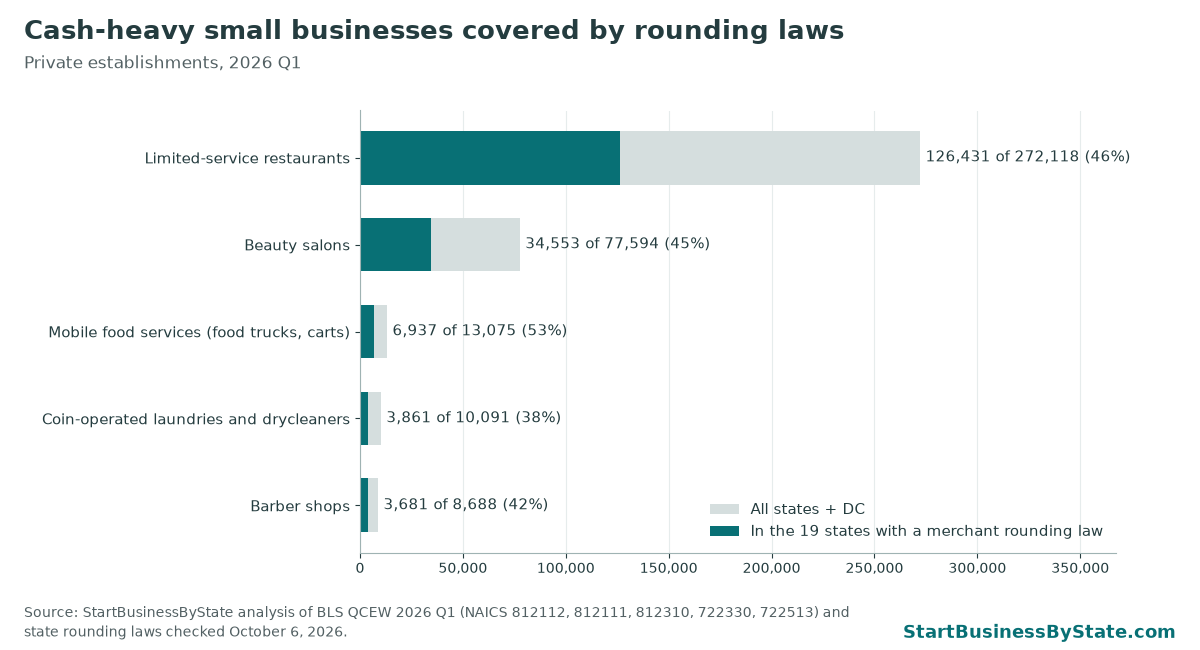
Rounding matters most where customers still pay with bills and coins and tickets are small. A $6.48 coffee rounds to $6.50 under the common rule. That 2 cents doesn’t matter once. Over thousands of cash sales a year, it shows up in your drawer count, and you need a rule your customers trust.
What penny rounding means for your business
Check the cash and card workflows together when choosing a payment system. Our salon booking and payments guide and plumbing invoices and payments guide explain setup for two service-business models that collect directly from customers.
- Find your state’s rule first. Use the table above. If your state requires rounding, you have to do it. If it allows rounding, you can choose. If there’s no law, round down (in the customer’s favor) or keep giving exact change.
- Round only cash, and only the final total. Ring up items and tax to the cent, then round the total if the customer pays cash. Card payments stay exact.
- Post a sign. Arizona requires one. Everywhere else, it heads off arguments at the register: “Cash totals are rounded to the nearest 5 cents.”
- Update your register or POS. Most point-of-sale systems have a cash rounding setting. Turn it on and test a few totals before your first shift.
- Salons, barbers and food trucks. Cash and tips go together in these businesses. Price services in round amounts (say $35, not $34.99) and the issue mostly disappears. See our hair salon and food truck startup guides, and the salon break-even calculator.
- Thinking of a cash surcharge or card fee instead? Card surcharges have their own rules. See credit card swipe fees by state and junk fee laws by state.
How we did this
- Finding bills. We searched LegiScan’s national bill database for 2025-2026 bills on cash rounding, pennies, one-cent coins and nickel rounding, then filtered to bills marked enacted.
- Verifying laws. For each enacted bill, we opened the chaptered or enrolled text, or the bill status page, on the official state legislature website (and the state revenue department notice where one exists) and read the rounding section. We count a state only if that official text confirms it. We left out resolutions and studies (for example, a Louisiana study resolution).
- Categories. “Required” means the law says a business “shall” or “must” round at least some cash sales. “Allowed” means “may,” “authorized,” or a safe harbor from deceptive-practice claims (Tennessee). “Government only” covers laws that round only payments to state or local government.
- Federal status. Congress.gov actions for H.R. 10167. Treasury guidance: “Penny Production Cessation FAQs,” U.S. Department of the Treasury.
- Businesses. BLS Quarterly Census of Employment and Wages, 2026 Q1, private establishments by state for NAICS 812112, 812111, 812310, 722330 and 722513.
Caveats
- This page is not legal advice. Some laws have exceptions (for example, Alabama’s excludes payments to government) and details on signs, tax and records. Read your state’s text.
- Bills are moving fast. We recheck LegiScan weekly and confirm any change on the official site before updating this page.
- Some effective dates follow a state’s standard rule for new laws. Where the official text did not state a date, we left it blank.
Laws are public records; BLS data is public domain. This page has no ads or affiliate links. Cite as: StartBusinessByState, “Penny Rounding Laws by State,” updated October 6, 2026, https://startbusinessbystate.com/cash-rounding-laws-by-state/
Related research
- Credit card swipe fees by state.
- Junk fee laws by state.
- Sales tax on services by state.
- Salon industry statistics and food truck industry statistics.
Your next step: set up salon booking and payments
FAQ
Which states allow rounding to the nearest nickel?
As of October 6, 2026: Arizona, California, Georgia, Indiana, Alabama, Connecticut, Florida, Hawaii, Idaho, Kentucky, Maryland, Minnesota, Missouri, Nebraska, Oregon, Tennessee, Vermont, Virginia and Washington. In Arizona, California, Georgia and Indiana, rounding is required for at least some sellers. New Mexico and Oklahoma round only certain payments to the government.
Is it legal to round cash prices in my state if there is no law?
The penny is still legal tender, and many states have consumer protection or pricing laws that were written before the penny stopped. Without a state law, rounding up can carry legal risk. Rounding down in the customer’s favor is the safer choice until your state acts. Ask your state attorney general’s consumer office or a lawyer if you are unsure.
Do I have to round card payments?
No. Every state law we reviewed applies only to cash. Card, check and electronic payments are charged to the exact cent. The U.S. Treasury also recommends that non-cash payments stay exact.
Do I charge sales tax on the rounded amount?
Generally no. Arizona and Indiana require tax to be figured on the price before rounding, and most other laws round the final total after tax. Check with your state revenue department, because tax rules vary.
Is there a federal penny rounding law?
Not yet. The Common Cents Act (H.R. 10167) passed the House on September 14, 2026 and the Senate on September 28, 2026, according to Congress.gov. It had not been signed when we checked on October 6, 2026.
Are pennies still legal tender?
Yes. The Treasury says pennies keep their legal tender status and face value, and the Federal Reserve will keep recirculating the roughly 114 billion pennies already out there. Businesses can still deposit pennies at their banks.
Last updated October 6, 2026. Laws checked October 6, 2026. Pending bills rechecked weekly.