October 2026 edition · 8 cities checked against official city or state pages · Updated by StartBusinessByState
Short answer: Most big cities make food trucks work from a licensed commissary, and many limit how close a truck can park to a restaurant. Fees and buffer distances vary a lot from city to city. Texas is the big change for 2026: since July 1, one state license covers mobile vendors statewide, though cities still control where trucks can park.
Key facts
- Chicago: $1,000 license to cook on the truck ($700 if it only serves prepackaged food), plus fire fees; trucks must stay 200 ft from a restaurant’s street-level entrance and can stay at one spot for no more than 4 hours.
- Las Vegas: 150 ft from an open restaurant’s main entrance, 1,000 ft from schools, and must move every 30 minutes on public streets.
- Pittsburgh (2026 rules): 150 ft from a business selling the same or similar main product unless it agrees.
- Texas: state mobile vendor license since July 1, 2026, at $309 to $876 plus inspection fees for higher-risk units.
- Denver no longer requires a 200-ft buffer from restaurants; trucks keep 10 ft from other trucks and structures.
Distance-from-restaurant rules
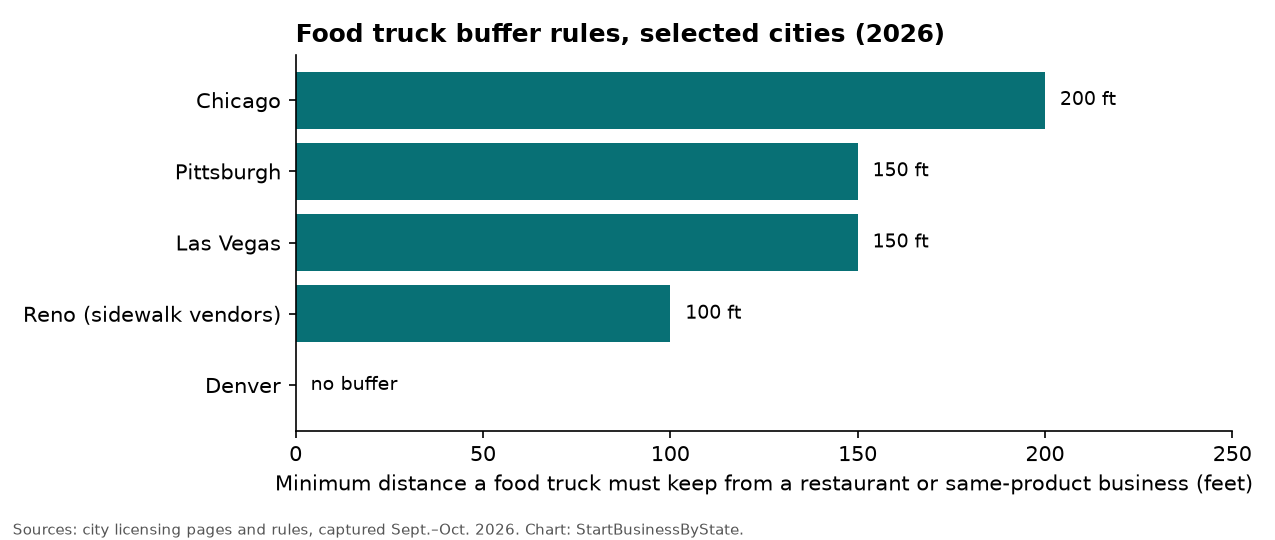
Buffer rules are meant to protect sit-down restaurants and keep sidewalks clear. Truck owners say the rules shrink the places they can legally sell. Cities have moved in both directions. Denver dropped its restaurant buffer. Pittsburgh’s 2026 rules kept a 150-ft competition buffer but exempt private property and hours when the nearby business is closed.
Food truck rules by city
| City | Permit and license fees | Commissary | Restaurant-distance rule | Other location rules | Source | State guide |
|---|---|---|---|---|---|---|
| Chicago | $700 (mobile food dispenser) or $1,000 (mobile food preparer) city license, plus $100 fire permit and $150 fire-suppression plan review | Yes: commissary letter required | 200 ft from the street-level entrance of a restaurant (rule doesn’t apply midnight–2 a.m.) | 4-hour limit per spot; no sales 2–5 a.m.; liability insurance of at least $350,000 | City of Chicago BACP, Food Trucks | IL food truck guide |
| Las Vegas | $50 initial processing fee per business license application (and per added vehicle) | Yes: commissary required | 150 ft from the primary entrance of an open restaurant | 1,000 ft from schools; must move every 30 minutes on public right-of-way; auto insurance 100/300/25 | City of Las Vegas, Mobile Food Vendor instruction sheet | NV food truck guide |
| Reno (sidewalk vendors) | City sidewalk vendor license (fee not listed on program page) | Health permit through Northern Nevada Public Health | 100 ft from a business selling the same product | 1,500 ft from resort hotels; $1 million general liability insurance | City of Reno, Sidewalk Vendors | NV food truck guide |
| Pittsburgh | City vending license (see 2026 rules) | Not stated on program page | 150 ft from a brick-and-mortar business or permitted vendor selling the same or similar main product, unless that business agrees; doesn’t apply outside its hours or on private property | 2026 rules updated in March 2026 | City of Pittsburgh PLI, Vending Rules and Regulations 2026 | PA food truck guide |
| Washington, D.C. | $99 vending business license (2 years); $300 mobile vending site permit; $55 employee badge | Not stated on DLCP vending page (DC Health sets food rules) | Not a restaurant-distance rule; vending is limited to designated zones and sites | Site permits are tied to specific vending locations | DC DLCP, Vending | DC food truck guide |
| New York City | Two-year permit $200 (food processing) or $75 (non-processing), plus a separate supervisory license per vendor | Yes: unit must be stored and serviced at a DOHMH-approved commissary | No citywide restaurant-distance rule in the Health Code program page; street rules restrict where trucks may park | Citywide cap on permits | NYC Health, Mobile Food Vendors | NY food truck guide |
| Austin (and all of Texas) | Since July 1, 2026, the state licenses mobile vendors: $309 (Type I), $618 plus $400 inspection (Type II), $876 plus $500 inspection (Type III) | Generally yes: central preparation facility | Not set by the state license | HB 2844 made one state permit valid statewide; cities still control zoning and parking | Texas DSHS, Mobile Food Vendors | TX food truck guide |
| Denver | City mobile retail food establishment license (fee schedule on city site) | Yes: commissary for county health license | None: the zoning code no longer has a 200-ft restaurant buffer (amended Feb. 2025) | 10 ft from other trucks and structures; 50 ft from residential districts | Denver mobile retail food truck, trailer and cart guide | CO food truck guide |
Fees are city or state program fees as posted. They don’t include business registration, sales tax permits, vehicle registration or insurance.
State rules and costs
Health permits are usually issued by a county or state health department, and the rules for working across county lines differ by state. Our food truck inspection reciprocity by state table covers that. For startup budgets, see food truck costs in 2026 and food truck insurance. For a market view, see food truck industry statistics and the best states to start a food truck. Every state has a guide under food truck licenses by state.
Methods and limits
- We took each rule from the city’s or state’s own licensing page, rules PDF or code, linked in the table. Chicago, Las Vegas, Reno and DC pages were captured in September 2026; the others were checked in October 2026.
- We only list a city when we could confirm its rules from an official source. Several large cities (including Los Angeles, Houston, Phoenix and Atlanta) aren’t listed because their official pages couldn’t be read reliably for this edition.
- Rules change often and often have exceptions (events, private property, late-night hours). Confirm with the city before you book a spot.
Cite this data
Reporters and bloggers may use these numbers and charts. Please credit StartBusinessByState and link to this page.
Source: StartBusinessByState, “Food Truck Rules by City (2026): Permits, Commissary and Distance-From-Restaurant Limits,” https://startbusinessbystate.com/food-truck-rules-by-city/ (updated October 7, 2026).
FAQ
How far does a food truck have to be from a restaurant?
It depends on the city. Chicago requires 200 feet from a restaurant’s street-level entrance, and Las Vegas 150 feet from an open restaurant’s main entrance. Pittsburgh requires 150 feet from a business selling a similar product unless it agrees. Denver has no restaurant buffer.
Do food trucks need a commissary?
In most large cities, yes. Chicago, Las Vegas and New York City require trucks to work from an approved commissary, and Texas generally requires a central preparation facility.
How much is a food truck permit?
In our sample, program fees run from a $50 processing fee in Las Vegas to $1,000 for a Chicago mobile food preparer license. A Texas state license costs $309 to $876 plus inspection fees.
Did Texas change food truck permits in 2026?
Yes. Since July 1, 2026, the Texas Department of State Health Services issues mobile food vendor licenses that are valid statewide. Cities still regulate zoning and parking.
Last updated October 7, 2026 by StartBusinessByState.