USPTO Open Data Portal · Office actions mailed 2008–September 2026 · Last updated October 14, 2026
Most rejections of AI patent applications now say the claims cover something that can’t be patented. In 2025, 67% of rejections from the patent office’s AI examining units cited Section 101, the rule on what can be patented at all. Across all patent examining units it was 15%. That doesn’t mean AI can’t be patented: in our sample, 68% of AI applications that got a Section 101 rejection in 2018–2019 later became patents.
Key findings
- 67% of AI rejections cited Section 101 in 2025, up from 25% in 2020. For all patents it was 15%. In January–September 2026 it was 61% for AI and 14% overall.
- It has swung before. The AI share hit 71% in 2018, then fell to 24% in 2019, the year the patent office issued new eligibility guidance.
- The July 2024 AI guidance was followed by a higher share, not a lower one: 62% in the year before it and 69% in the year after. The monthly peak was 73% in July 2025.
- Since December 2025 the share has been 61%, after an August 2025 memo to examiners and a December 2025 notice on machine-learning claims.
- Rejection isn’t the end. Of 859 sampled AI applications with a Section 101 rejection in 2018–2019, 68% are now patents and 32% were abandoned. Without a Section 101 rejection, 74% became patents.
How often AI rejections cite Section 101, 2008–2026
When an examiner turns down some or all of an application’s claims, they mail a written “office action” that gives the reasons. This chart shows the share of first and final rejections that give Section 101 as one reason. The teal line is the patent office’s AI examining units. The orange line is every examining unit.
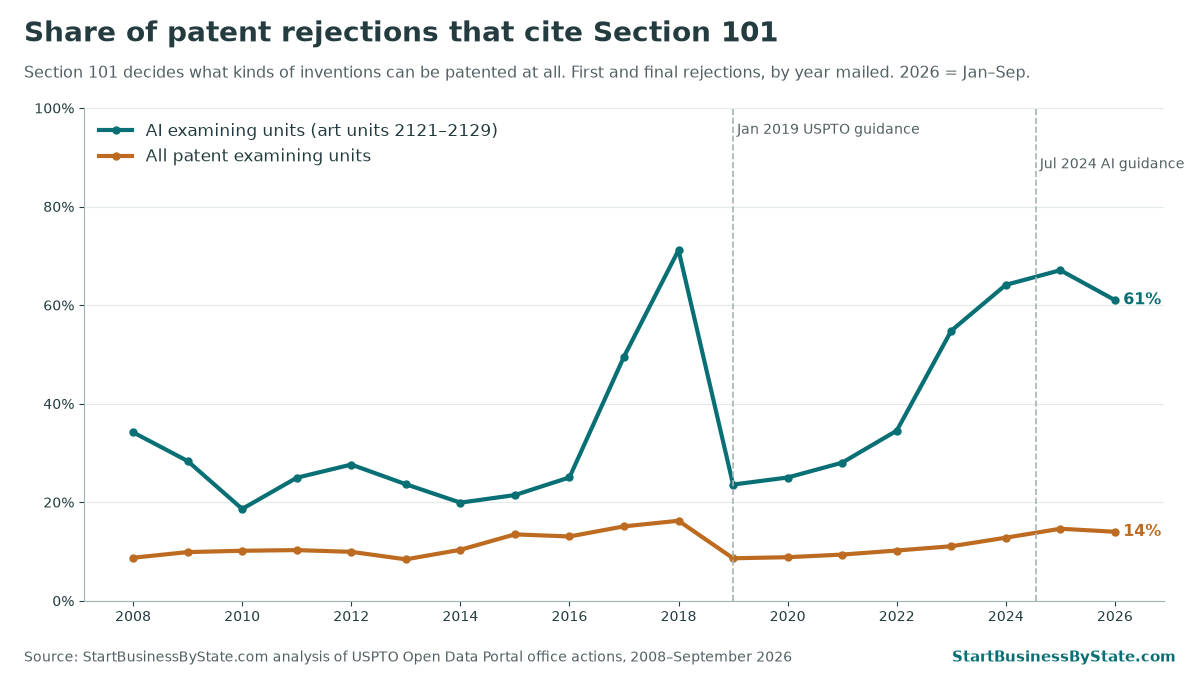
Section 101 rejections in AI rose after 2016 and peaked in 2018. In January 2019 the patent office issued revised guidance on what can be patented, and the AI share fell to 24% that year. It stayed between 24% and 28% through 2021, then climbed again from 2022.
What happened after the 2024 AI guidance
On July 17, 2024, the patent office published a guidance update on patent eligibility, including on AI. It added three AI examples for examiners and said it didn’t change existing practice. In August 2025 it sent examiners in software and AI a memo with reminders on Section 101. In December 2025 it issued a notice on the Ex parte Desjardins decision, about machine-learning claims that improve how the model itself works.
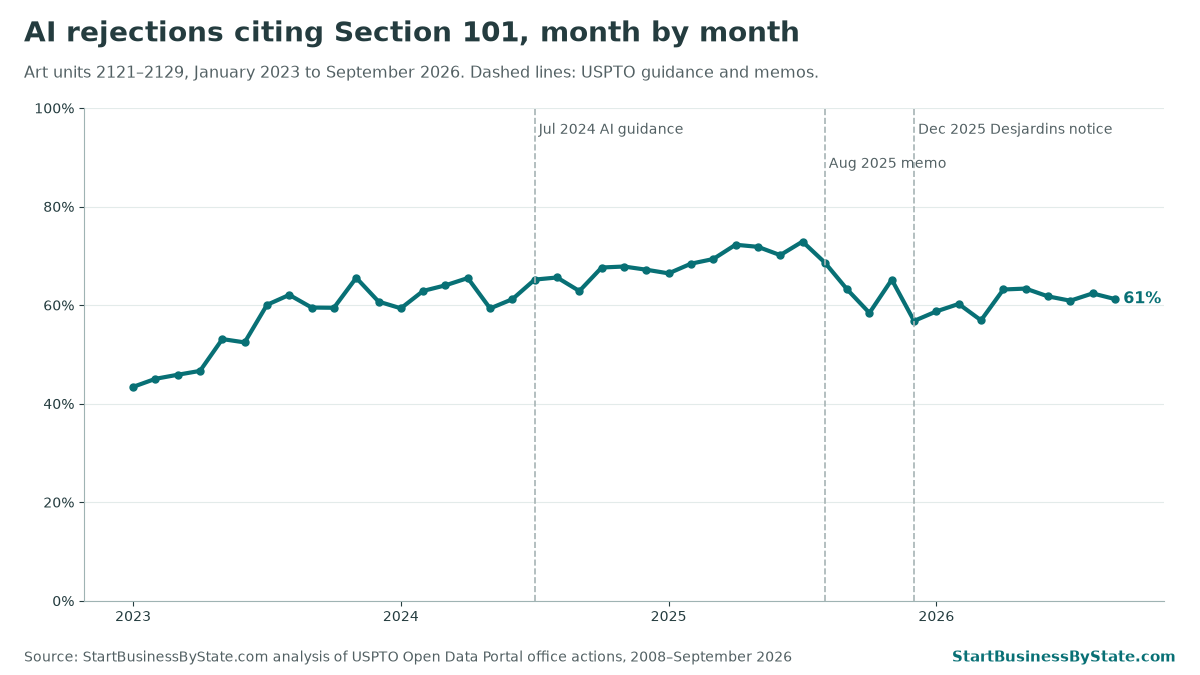
The share did not fall after the 2024 update. It averaged 62% in the 12 months before and 69% in the 12 months after. It has been lower since late 2025, at 61%. These are timing patterns. The data can’t show whether the guidance caused them, and the mix of applications examiners see also changes over time.
What gets through
A rejection is a step in the process, not a final no. To see how things end, we took a random sample of 1,500 of the 8,855 applications that got a rejection from the AI units in 2018–2019 and looked up each one’s status today. That’s long enough ago for most to be settled.

- 68% of AI applications that got a Section 101 rejection later became patents, compared with 74% of those that didn’t.
- 32% were abandoned. Most abandoned applications in the data are listed as “failure to respond,” meaning the applicant stopped answering the patent office.
- Applications usually get through by changing the claims so they describe a specific technical improvement, not just the idea of using AI. The patent office’s own examiner manual on eligibility explains the test.
Where the inventors are
The patent office data on rejections doesn’t include where inventors live, so we looked it up for a random sample of 2,500 of the 7,360 applications that got a rejection from the AI units in 2024–2025. We used the home state of the first inventor named. 53% of the sample had a first inventor outside the U.S., most often in Japan, China, South Korea, India, Germany.
Across the U.S. inventors in the sample, 70% of applications got at least one Section 101 rejection in 2024–2025. The table lists states with at least 20 sampled applications. Smaller states had too few to report.
| State (first inventor) | AI applications in sample | Share with a Section 101 rejection |
|---|---|---|
| California | 478 | 67% |
| New York | 122 | 75% |
| Washington | 82 | 72% |
| Texas | 77 | 68% |
| Massachusetts | 70 | 79% |
| New Jersey | 42 | 71% |
| Illinois | 37 | 78% |
| Virginia | 30 | 73% |
| Pennsylvania | 30 | 83% |
| North Carolina | 27 | 78% |
| Florida | 25 | 60% |
| Maryland | 20 | 75% |
Sample of 2,500 applications (1,183 with a U.S. first inventor). With 20 to 50 applications, a state’s share can be off by 10 points or more just by chance, so small gaps between states don’t mean much.
Small companies were rejected under Section 101 at a similar rate to large ones:
| Applicant size (fee status) | Applications in sample | Share with a Section 101 rejection |
|---|---|---|
| Large (regular fee) | 2,011 | 73% |
| Small or micro | 489 | 69% |
What this means for a small business
- If your product uses AI, expect the patent office to ask whether your claims are just an abstract idea. Budget for at least one round of answering a rejection.
- Patent attorneys and agents handle these responses. Most of the sampled AI applications that were abandoned were dropped because no one replied.
- For the bigger picture, see the generative AI patent tracker, where AI patents are invented, and why AI patent grants have slowed.
Download the data
Download the monthly numbers (CSV)
One row per month, January 2008 to September 2026: rejections and Section 101 rejections in the AI units and in all units.
Cite or share this data
Source: StartBusinessByState.com analysis of USPTO Open Data Portal office action data. https://startbusinessbystate.com/ai-patent-rejections/
Methods and caveats
- Source. USPTO Open Data Portal: Office Action Text Retrieval and Office Action Search, plus patent file data for each sampled application. Pulled October 14, 2026. Office actions cover applications filed in 2001 or later. The data starts in 2008.
- Rejections. Non-final (CTNF) and final (CTFR) rejections, by the date they were mailed. One application can have several.
- Section 101. A rejection counts if its text says claims are “rejected under 35 U.S.C. 101” (including “35 USC” and “§” forms). A hand check of 20 random 2025 AI matches found 20 real Section 101 rejections; 17 of the 20 said the claims were directed to an abstract idea or mental process. We didn’t use the portal’s own rejection-type tags, because our checks found they often flag a section that is only quoted, not used.
- AI units. Art units 2121–2129. 95% of the 2024–2025 sample carry CPC code G06N (AI and machine learning). AI inventions examined elsewhere aren’t counted, and art unit numbering can change over time.
- Samples. Random samples (fixed seed) of 2,500 applications with a 2024–2025 AI-unit rejection and 1,500 with a 2018–2019 one. For each, we checked every rejection mailed in that window for Section 101 and read its current status, first inventor’s residence and entity size from the patent office’s file data. Entity size is the current status on file.
- Timing isn’t cause. The guidance dates on the charts are for reference. Changes in the share can also reflect which applications reached examiners.
FAQ
What is a Section 101 rejection?
Section 101 of the patent law lists what can be patented: processes, machines, manufactured items and compositions of matter. Courts have said abstract ideas, laws of nature and natural phenomena can't be patented on their own. A Section 101 rejection means the examiner thinks the claims fall into one of those exceptions, most often an abstract idea such as math or a mental process.
Is a rejection the end of the road?
No. Most patent applications get at least one rejection. The applicant can answer by arguing, changing the claims or both. In our sample of AI applications that got a Section 101 rejection in 2018–2019, 68% have since become patents.
What counts as an AI application here?
We use the patent office's AI examining units: art units 2121 to 2129. In our sample, 95% of the applications they examined carry the patent code for AI and machine learning (CPC G06N). Some AI inventions are examined in other units, so this is not every AI application.
How do you know a rejection cites Section 101?
We count a first or final rejection when its full text says claims are "rejected under 35 U.S.C. 101." We hand-checked a random sample of 20 from 2025 and all 20 were real Section 101 rejections.
Did the 2024 AI guidance change the numbers?
The patent office's July 2024 guidance did not lower the share right away. In the 12 months after it (August 2024–July 2025), 69% of AI-unit rejections cited Section 101, compared with 62% in the 12 months before. Since December 2025, after an August 2025 memo and a December 2025 notice, it has been 61%. These numbers show timing only; they don't prove what caused the changes.
How often is this updated?
We plan to refresh it every few months from the patent office's data. Each edition shows the date it was pulled.