Original research · USPTO PatentsView (granted patents through 2025; file released April 10, 2026) · USPTO Open Data Portal (published applications through September 2026) · Last updated September 30, 2026
AI patent grants peaked in 2023 and have fallen since, even as the AI boom took off. The USPTO granted 29,163 AI patents in 2023 and 27,847 in 2025. Machine-learning patents fell further, from 16,764 to 13,786 (-18%). The whole drop came from U.S. inventors. Meanwhile, generative AI filings nearly tripled. Our data shows the drop, but not the reason.
Key findings
- AI patent grants peaked in 2023. 29,163 in 2023, 28,541 in 2024 and 27,847 in 2025, a drop of 4.5%.
- Machine-learning patents fell more: 16,764 to 13,786, down 18%.
- Total patent grants went up. All U.S. utility grants rose from 312,067 to 325,041. So AI’s share of grants slipped from 9.3% to 8.6%.
- The drop came from U.S. inventors. AI patents with a U.S. first inventor fell from 16,186 to 13,762 (-15%). Those with a first inventor elsewhere rose from 12,977 to 14,085 (+9%). The U.S. share fell from 58.1% in 2019 to 49.6% in 2025.
- Applications fell too, then turned up. Published AI applications fell from 36,342 in 2022 to 32,656 in 2025. January to September 2026 is up 10% on the same months of 2025.
- Generative AI is the exception. Published generative AI applications went from 939 in 2023 to 2,754 in 2025, and 3,452 in just the first nine months of 2026.
AI patent grants by year
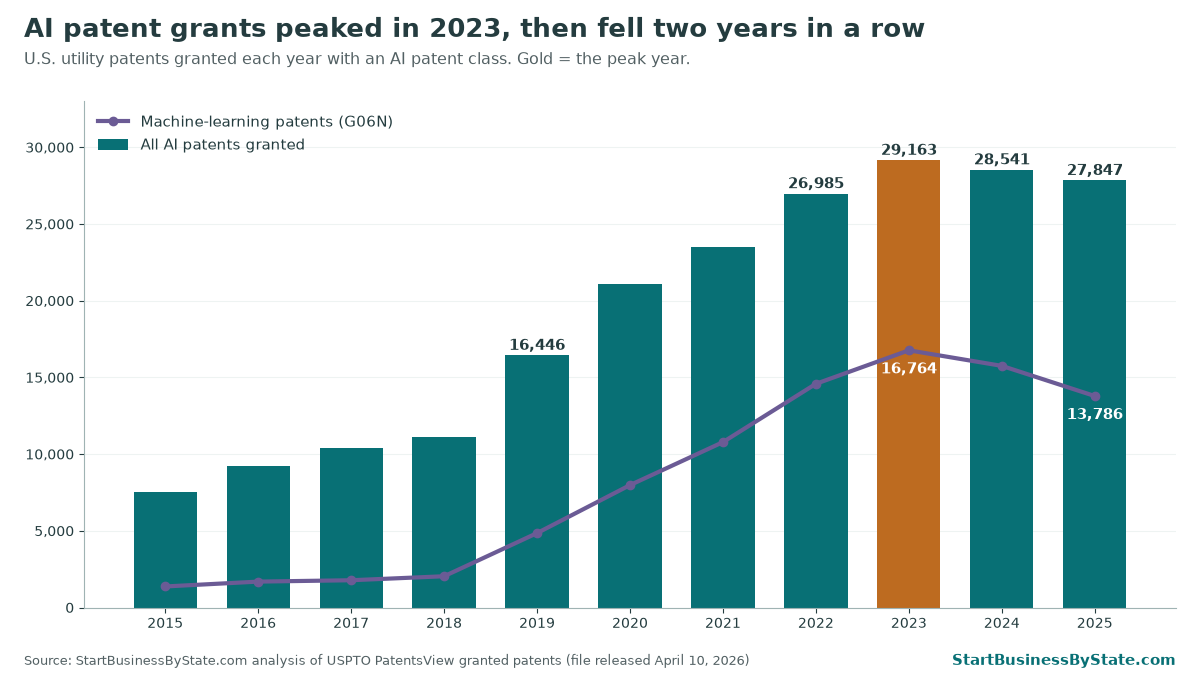
AI patents grew fast for years. Grants more than tripled from 2015 to 2022. Then they peaked in 2023 and slipped two years in a row. The drop is modest for all AI patents (4.5%) but bigger for the core machine-learning group (18%).
This happened while total patent grants were rising, so it isn’t just the patent office granting fewer patents overall.
Who got fewer AI patents?
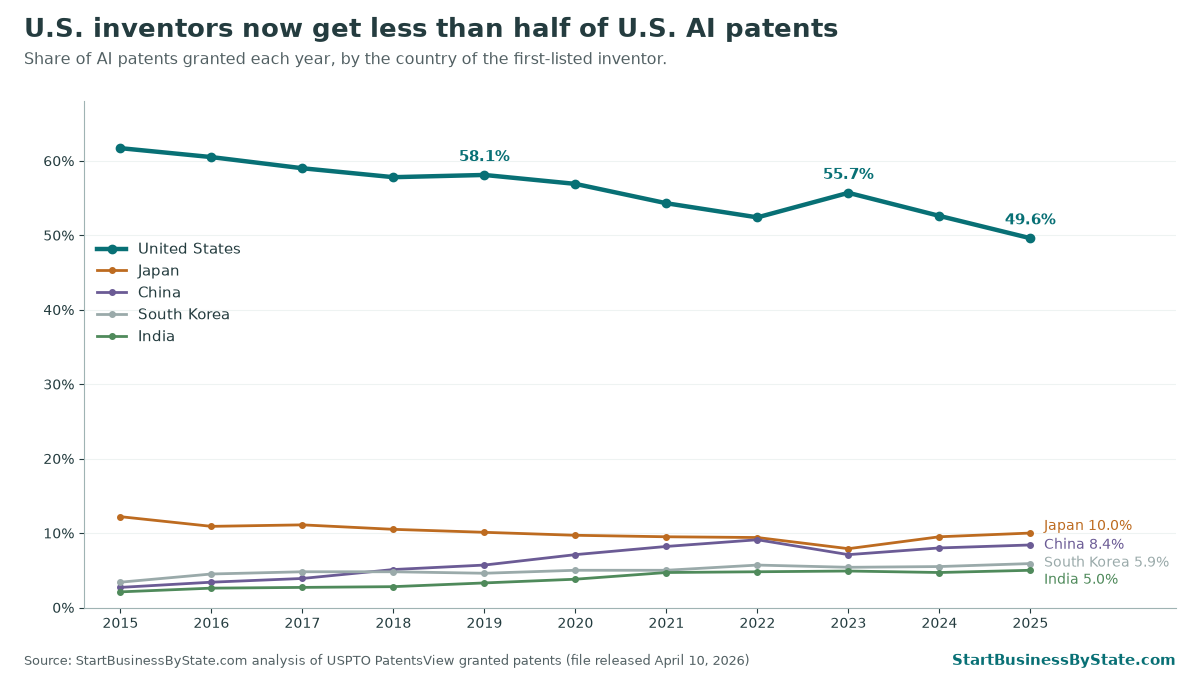
From 2023 to 2025, AI patents with a U.S. first inventor fell by 2,424. Patents for first inventors in other countries rose by 1,108. Japan went from 2,285 to 2,775, South Korea from 1,556 to 1,644 and Germany from 697 to 873.
So the U.S. share dropped to 49.6%, below half for the first time since at least 2015. U.S. inventors still get far more AI patents than any other country. For where in the U.S. they live, see AI patents by state.
The paradox: fewer grants, more generative AI filings
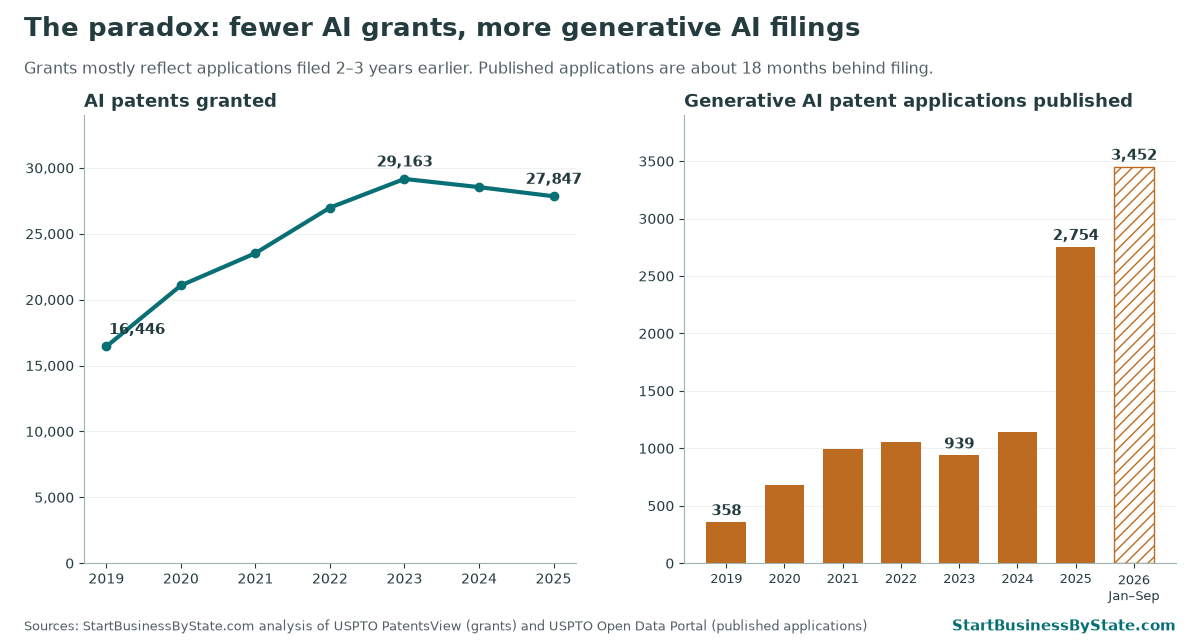
ChatGPT came out in late 2022. Since then, generative AI patent filings have shot up. Published generative AI applications nearly tripled from 2023 to 2025, and 2026 is already past 2025. Our generative AI patent tracker follows them month by month.
Part of the gap is timing. A patent application is usually published about 18 months after it’s filed. A grant usually comes later still: the typical AI patent granted in 2025 was filed about 2.8 years earlier. So most of the post-ChatGPT filings haven’t had time to become patents.
Why did AI grants fall? What we know and what we don’t
Our data shows the drop. It doesn’t show the reason. Below are possible explanations from public sources. Each is attributed to its source. None of them is proven to be the cause, and more than one could be at work.
1. A record backlog at the patent office
The USPTO’s FY 2025 Agency Financial Report says its inventory of unexamined patent applications grew from 576,103 in 2020 to a record 837,928 in January 2025. It also says the average wait for a first decision rose 39%, from 14.8 months at the end of 2020 to 20.5 months by January 2025. In an April 10, 2026 press release, the USPTO said the backlog had fallen to 776,995.
Our data fits a slower process: the typical AI patent granted in 2025 took 2.75 years from filing, up from 2.29 years for 2021 grants. But a slower office doesn’t fully explain the AI drop, because total grants rose over the same years.
2. More “patent eligibility” rejections for AI
U.S. law doesn’t allow patents on abstract ideas, and examiners sometimes reject AI and software claims on those grounds (under Section 101 of the patent law). Two analyses found these rejections rising for AI:
- Patent attorney Eli Mazour’s newsletter Voice of IP reported in June 2024, using USPTO data, that 77% of office actions from the USPTO work group that examines AI and simulation modeling included a Section 101 rejection. It said that was more than double the 2022 rate.
- Law professor Dennis Crouch, writing on Patently-O in August 2026, found that 42% of AI applications with a first office action in 2025 drew a Section 101 rejection, against 6.9% of other applications. He wrote that he couldn’t tell how much of the change came from what applicants are filing versus changes at the USPTO.
The USPTO has issued several eligibility documents for AI since then. They include the 2024 Guidance Update on Patent Subject Matter Eligibility, Including on Artificial Intelligence (July 17, 2024), an August 4, 2025 memo reminding examiners in software and AI areas how to apply the rules, and the precedential Ex parte Desjardins decision (decided September 26, 2025), which found a machine-learning claim eligible. Grants through 2025 are too early to show whether these changed anything.
3. Fewer AI applications a few years earlier
Our own data shows that published AI applications fell after 2022 (36,342 in 2022 to 32,656 in 2025). Fewer applications in the pipeline would mean fewer grants later. This tells us what happened, not why fewer were filed.
4. How patents are classified
We use each patent’s current classification codes. Codes are sometimes updated after the fact, so a patent can move into or out of the AI groups. This can shift year-to-year counts a little in future data.
Year by year
| Year | AI patents granted | Machine-learning (G06N) granted | AI share of all grants | U.S. first-inventor share | Typical years from filing to grant | AI applications published | Generative AI applications published |
|---|---|---|---|---|---|---|---|
| 2015 | 7,528 | 1,371 | 2.5% | 61.7% | 2.74 | — | — |
| 2016 | 9,216 | 1,688 | 3.0% | 60.5% | 2.56 | — | — |
| 2017 | 10,426 | 1,777 | 3.3% | 59.0% | 2.36 | — | — |
| 2018 | 11,123 | 2,037 | 3.6% | 57.8% | 2.32 | 18,764 | — |
| 2019 | 16,446 | 4,850 | 4.6% | 58.1% | 2.37 | 24,991 | 358 |
| 2020 | 21,079 | 7,978 | 6.0% | 56.9% | 2.26 | 31,255 | 685 |
| 2021 | 23,528 | 10,780 | 7.2% | 54.3% | 2.29 | 35,712 | 992 |
| 2022 | 26,985 | 14,581 | 8.4% | 52.4% | 2.50 | 36,342 | 1,054 |
| 2023 | 29,163 | 16,764 | 9.3% | 55.7% | 2.53 | 35,783 | 939 |
| 2024 | 28,541 | 15,751 | 8.8% | 52.6% | 2.66 | 33,857 | 1,141 |
| 2025 | 27,847 | 13,786 | 8.6% | 49.6% | 2.75 | 32,656 | 2,754 |
| 2026 (Jan–Sep) | — | — | — | — | — | 27,221 | 3,452 |
Grants: USPTO PatentsView, all first-inventor countries, grants through December 31, 2025. “Typical years” is the median time from filing to grant. Applications: USPTO Open Data Portal, by year first published; 2026 covers January to September. The U.S. first-inventor count for 2025 (13,762) includes 8 patents from Puerto Rico, so it is slightly higher than the 13,754 on our state page. Download the full table (CSV)
What this means for a small business
- Getting an AI patent can take a long time. The typical AI patent granted in 2025 was filed about 2.8 years earlier. Plan for that wait before counting on a patent to protect your product. Some filers move much faster: see how one small-entity filer built a big AI patent portfolio.
- Expect questions about whether your idea can be patented at all. AI and software claims draw more eligibility rejections than other fields, according to the analyses above. A registered patent attorney or agent can help you describe the technical improvement, which is what the USPTO’s recent guidance focuses on.
- Small businesses pay less. Small entities get about 60% off most USPTO fees, and micro entities about 80%. See small businesses’ share of AI patents for how often small filers patent AI.
- Using AI doesn’t require a patent. Most businesses will simply buy AI tools. See small-business AI use by state and check AI laws by state before using AI with customers or job applicants.
Methods and caveats
- Grants. USPTO PatentsView granted-patent tables (grants through December 31, 2025; file released April 10, 2026). Utility patents only, counted by grant year. Country is the first-listed inventor’s country.
- Applications. USPTO Open Data Portal patent application search, pulled September 30, 2026, counted by year first published. Unpublished applications aren’t included. Applications and grants come from different data sets, so don’t add them together.
- AI definition. At least one current patent class in G06N (machine learning), G06F40 (language processing), G06V (image and video recognition) or G10L15 (speech recognition). Generative AI uses the generative-network class G06N3/0475 or a title that mentions “large language model,” “LLM” or “generative” (the same definition as our tracker).
- Timing. Grants mostly reflect applications filed two to three years earlier. Published applications reflect filings about 18 months earlier.
- Causes. We don’t claim a cause. The possible explanations above come from the public sources listed below.
Sources for possible explanations
- U.S. Patent and Trademark Office, FY 2025 Agency Financial Report (backlog and first-action wait times).
- U.S. Patent and Trademark Office, “USPTO turns the corner on unexamined patent application backlog reduction”, April 10, 2026. See also the USPTO Patents Dashboard.
- U.S. Patent and Trademark Office, 2024 Guidance Update on Patent Subject Matter Eligibility, Including on Artificial Intelligence, Federal Register, July 17, 2024.
- U.S. Patent and Trademark Office, “Reminders on evaluating subject matter eligibility of claims under 35 U.S.C. 101”, August 4, 2025.
- U.S. Patent and Trademark Office, Ex parte Desjardins designated precedential, 2025.
- Eli Mazour, Voice of IP, “Section 101 Rejections Soar at USPTO”, June 18, 2024.
- Dennis Crouch, Patently-O, “Rise of AI Patents and their Corresponding Eligibility Rejections”, August 8, 2026.
Cite or share this data
Free to use with credit: “Source: StartBusinessByState.com analysis of USPTO patent data.” Please link to this page. Download the table (CSV)
More AI patent data: AI patents by state, the generative AI patent tracker, small businesses’ share of AI patents, AI patents in Main Street industries and AI inventors vs. AI users by state.
FAQ
Are AI patents really going down?
AI patent grants are. They fell from 29,163 in 2023 to 27,847 in 2025, while total U.S. patent grants rose. Published AI applications also fell from 2022 to 2025, but the first nine months of 2026 are running ahead of the same months in 2025 (27,221 vs 24,838).
Why did AI patent grants fall?
Our data shows the drop, but it can’t show the reason. Public sources point to a few possibilities: a record USPTO backlog, more patent-eligibility rejections for AI applications in 2024 and 2025, and fewer AI applications filed a few years earlier. Each is described, with links, on this page. None of them is proven to be the cause.
Doesn't the generative AI boom mean more AI patents?
For filings, yes. Published generative AI applications went from 939 in 2023 to 2,754 in 2025 and 3,452 in just January to September 2026. But a patent is usually granted two to three years after filing, so most of those haven’t reached the grant stage yet.
Did foreign inventors overtake U.S. inventors?
Not any single country. U.S. inventors still get far more AI patents than anyone else (13,762 in 2025). But their count fell 15% from 2023, while patents for first inventors outside the U.S. rose 9%. That pushed the U.S. share below half, the lowest since at least 2015.
What counts as an AI patent?
A U.S. utility patent with at least one current patent class in G06N (machine learning and neural networks), G06F40 (language processing), G06V (image and video recognition) or G10L15 (speech recognition). Machine-learning patents are the G06N group alone.
Can I use these numbers and charts?
Yes. Please credit StartBusinessByState.com and link to this page. The full yearly table is free to download as a CSV.