USPTO Open Data Portal · Rejections mailed January 2021–September 2026 · Last updated October 14, 2026
Generative AI is now a regular topic in patent rejections. From January to September 2026, 7,649 first or final rejections mentioned “large language model,” “generative AI,” “ChatGPT” or “OpenAI,” up from 3,005 in the same months of 2025. Before 2023 there were almost none. In the last three months it was 1.5% of all rejections. When examiners mention ChatGPT, it’s usually because earlier work already did something similar: 12 of 25 we checked by hand cited it as prior art.
Month by month
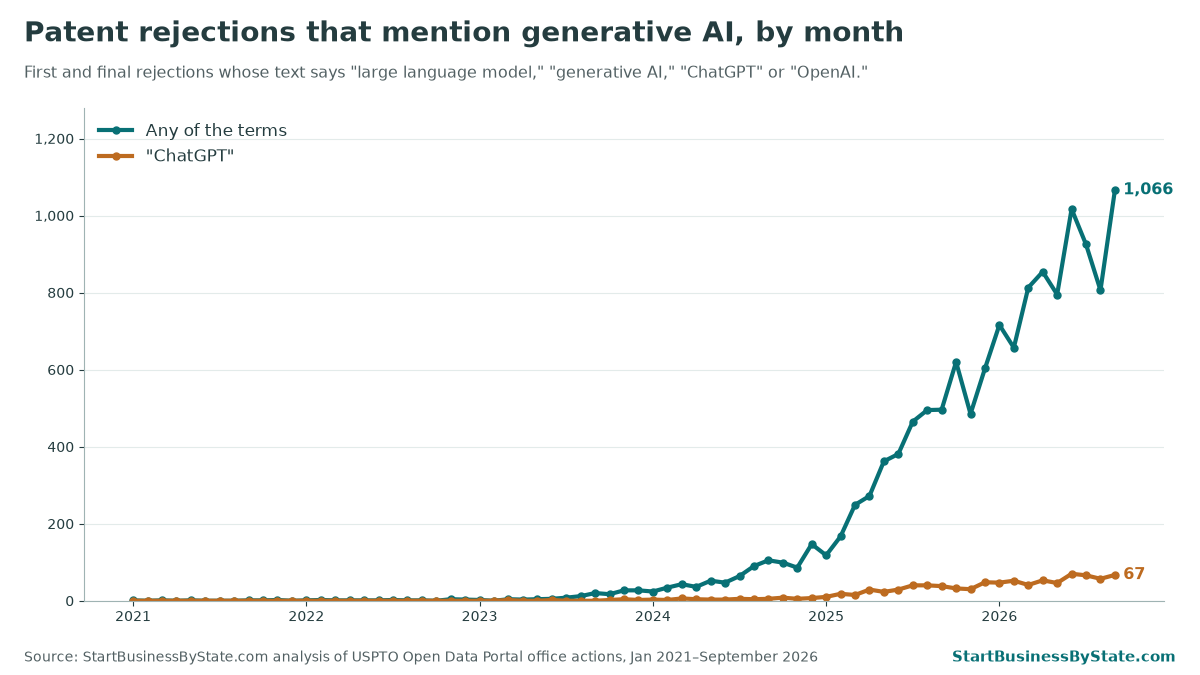
| Year | Any term | Large language model | Generative AI | ChatGPT | OpenAI |
|---|---|---|---|---|---|
| 2022 | 18 | 0 | 2 | 0 | 16 |
| 2023 | 129 | 71 | 45 | 12 | 31 |
| 2024 | 827 | 594 | 305 | 55 | 46 |
| 2025 | 4,713 | 3,502 | 1,823 | 352 | 170 |
| 2026 (Jan–Sep) | 7,649 | 5,553 | 3,313 | 499 | 258 |
One rejection can mention several terms, so the columns add up to more than “any term.”
Why examiners bring up ChatGPT
We read 25 random rejections from January 2025 to September 2026 that mention ChatGPT and sorted each by why it came up.
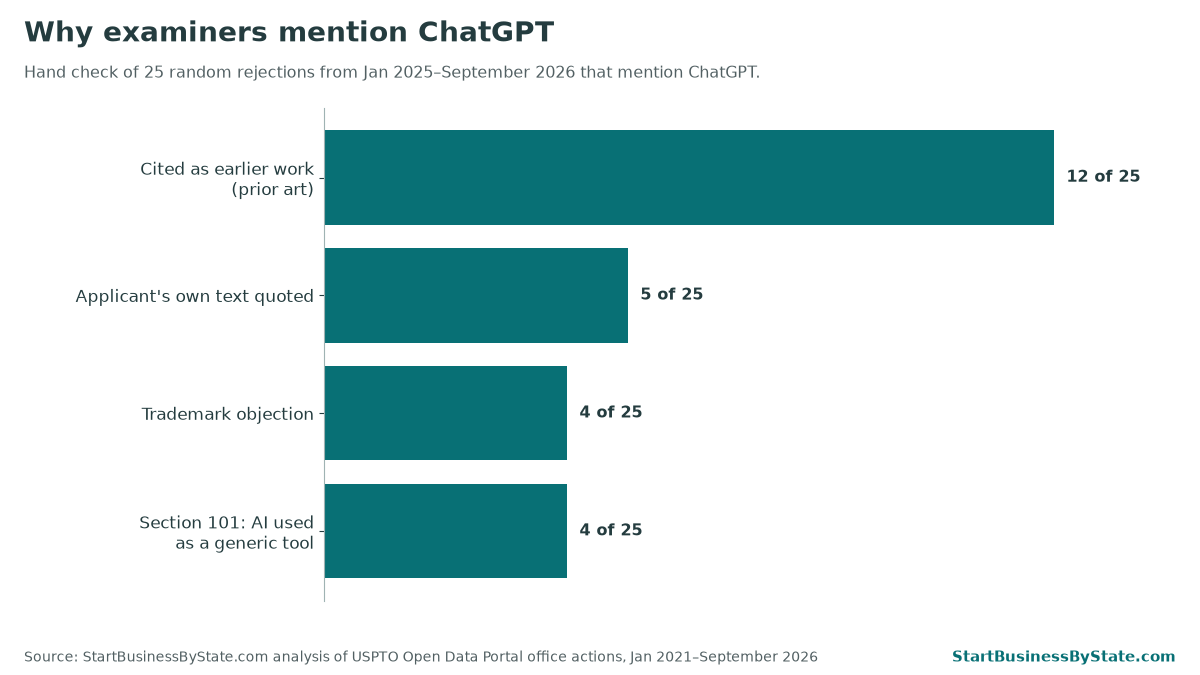
- Prior art (12 of 25). The examiner cited an article or patent that discusses ChatGPT to argue the claimed idea already existed or was obvious. Several were research papers and how-to articles from 2023 with ChatGPT in the title. See the examiner manual on obviousness.
- The applicant’s own words (5 of 25). The examiner quoted the application, which named ChatGPT as an example model.
- Trademark (4 of 25). The examiner objected to the brand name in the description or claims. The patent rules on trademarks ask for a generic description alongside it.
- Section 101 (4 of 25). The examiner said using a public chatbot like ChatGPT is just using a computer as a tool, so the claim is still an abstract idea. The patent office’s 2024 AI guidance covers how examiners judge these claims.
What this means for a small business
- If your invention uses an off-the-shelf chatbot, expect the examiner to ask what’s new beyond using it. Describe the technical change your product makes.
- Search 2023–2025 articles and papers, not just patents. A lot of the prior art against AI applications isn’t patents.
- Use generic terms such as “large language model” in your claims, with brand names only as examples.
- Related: why the patent office rejects so many AI inventions and the generative AI patent tracker.
Download the data
Download the monthly counts (CSV)
Cite or share this data
Source: StartBusinessByState.com analysis of USPTO Open Data Portal office action data. https://startbusinessbystate.com/chatgpt-patent-rejections/
Methods and caveats
- Source. USPTO Open Data Portal, Office Action Search, full-text phrase search. First (CTNF) and final (CTFR) rejections by mail date. Pulled October 14, 2026.
- Terms. “large language model,” “generative AI,” “generative artificial intelligence,” “ChatGPT,” “OpenAI.” Matching ignores capitalization.
- Hand check. 25 random ChatGPT matches (fixed seed), each read and labeled once. A sample of 25 gives a rough split, not exact shares.
- Mentions aren’t rejections for AI. A rejection can mention ChatGPT for any reason, and the mention may not be what the claims were rejected for.
FAQ
Does a mention mean the examiner used ChatGPT?
No. Almost all mentions are about the application or earlier work. Examiners cite articles and patents that discuss ChatGPT, quote the applicant's own description, or object to the brand name. This page doesn't measure whether examiners use AI tools.
Why would an examiner object to the word ChatGPT?
Patent rules say trademarks in an application should be capitalized and paired with a generic description, because a brand can change what it refers to. In a claim, a trademark can make the claim unclear.
Can ChatGPT conversations or articles count as prior art?
Yes. Prior art is anything public before your filing date, including articles, blog posts and research papers. Many rejections in our sample cited papers with ChatGPT in the title.
Which terms did you count, and which did you drop?
We count "large language model," "generative AI," "generative artificial intelligence," "ChatGPT" and "OpenAI." We left out model names such as GPT-4, Gemini and Claude. In a hand check, "Gemini" and "Claude" often matched other things, such as a plant virus family and an examiner's first name.
How often is this updated?
Monthly.