USPTO Open Data Portal · Petition decisions 2012–2025 · Last updated October 14, 2026
Small inventors are the main users of the patent office’s paid fast lane. In 2025, small and micro entities accounted for 9,383 of the 14,305 Track One decisions (66%). In 2015 it was 46%. Track One lets an applicant pay extra for a final decision in about a year instead of the usual wait. 94% of small and micro requests were granted.
Track One: the paid fast lane
The patent office’s Track One program aims to reach a final decision within about 12 months of granting the request. It has a yearly cap, raised from 15,000 to 20,000 in July 2025.
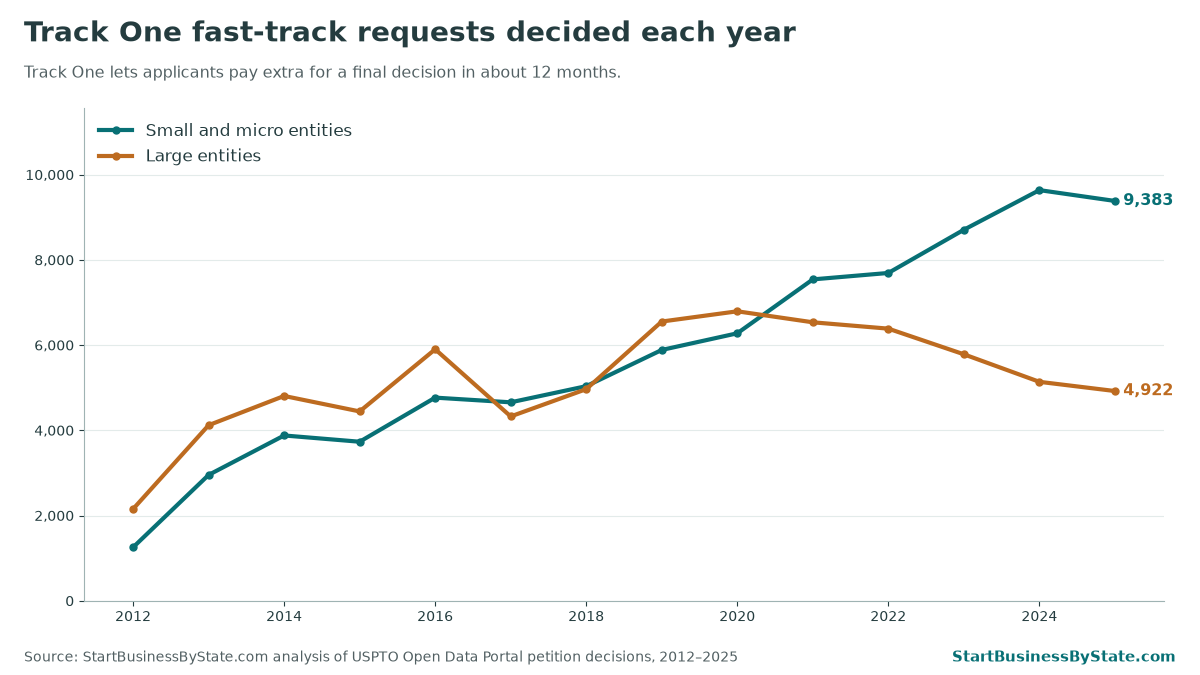
Large-company Track One decisions peaked at 6,793 in 2020 and were 4,922 in 2025. Small and micro decisions kept growing, to 9,383.
Every way to speed up a patent
| Route | Decisions, 2025 | Small and micro share | Granted (small and micro) | Granted (large) |
|---|---|---|---|---|
| Track One (pay for priority) | 14,305 | 66% | 94% | 96% |
| Patent Prosecution Highway | 10,231 | 50% | 84% | 80% |
| Applicant age 65 or older | 4,212 | 80% | 95% | 97% |
| Accelerated Examination (ended 2025) | 56 | 93% | 33% | 25% |

- The Patent Prosecution Highway is split about evenly: 50% of 2025 decisions were for small or micro entities. It needs a matching application in another country that already has allowable claims.
- Age 65 or older requests are almost always granted: 95% for small and micro entities in 2025. See the patent office’s rules on making an application special.
- Accelerated Examination closed to new utility petitions on July 10, 2025. The patent office ended the program because few people used it and Track One was available.
What this means for a small business
- If you need a patent fast, for investors or a product launch, Track One is the main paid option. Small entities pay a reduced fee. See the fee schedule.
- Faster isn’t always better. Track One ends if you ask for a deadline extension, and you’ll still get rejections to answer.
- Related: the 4 reasons patents get rejected and how small inventors get lost patents back.
Download the data
Cite or share this data
Source: StartBusinessByState.com analysis of USPTO Open Data Portal petition decision data. https://startbusinessbystate.com/patent-fast-track/
Methods and caveats
- Source. USPTO Open Data Portal, Petition Decision Search, by decision date. Pulled October 14, 2026.
- Routes. Petition type codes: Track One 643; Patent Prosecution Highway 652; age 601; Accelerated Examination 604 and 646.
- Counts are decisions. Track One requests filed with a request for continued examination may be recorded differently, so totals here won’t match the patent office’s own Track One counts.
- 2026 is left out of the charts. Track One decisions recorded in this dataset dropped sharply in mid-2026. We can’t tell from the data why.
- Entity size is the status on the decision record. Granted includes “granted in part.”
FAQ
What is Track One?
Track One, also called prioritized examination, lets an applicant pay an extra fee so the patent office aims to reach a final decision within about 12 months. There's a yearly cap on how many requests it grants, raised to 20,000 in July 2025.
Do small companies pay less for Track One?
Yes. Small and micro entities pay reduced patent office fees, including for Track One. Check the current fee schedule for amounts.
What is the Patent Prosecution Highway?
If a patent office in another country has already found some claims allowable, the applicant can ask the U.S. office to examine the matching U.S. claims faster. It's used by applicants who file in more than one country.
Can I speed up my application because of my age?
Yes. An inventor who is 65 or older can ask to have the application made special. There's no fee for it.
Why are the latest months lower?
Our 2026 counts are partial, and Track One decisions recorded in this dataset fell sharply in mid-2026. We don't know if that's a change in how decisions are recorded or in use of the program, so we use full years through 2025.