USPTO Open Data Portal · Office actions mailed 2018–September 2026 · Last updated October 14, 2026
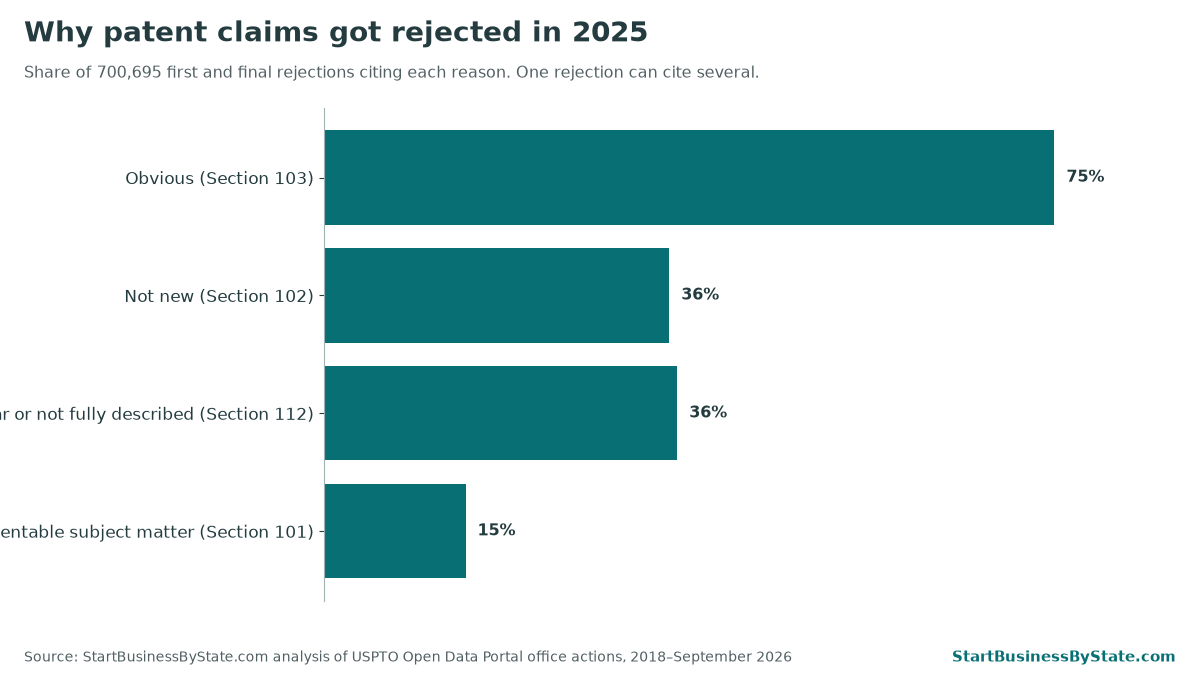
Most patent rejections say the invention is obvious. In 2025, 75% of the 700,695 rejections U.S. patent examiners sent cited Section 103, which covers inventions that would have been obvious. Next came “not new” (Section 102) and “unclear or not fully described” (Section 112), at 36% and 36%. Only 15% said the invention isn’t the kind of thing that can be patented (Section 101), but that share was 39% in computers and software.
The 4 reasons, in plain English
- Obvious (Section 103). The examiner says someone skilled in the field could have combined things that already existed to get your invention. See the examiner manual on obviousness.
- Not new (Section 102). One earlier patent, article or product already shows the same thing. See the manual on novelty.
- Unclear or not fully described (Section 112). The claims are vague, or the application doesn’t explain enough to show you had the invention or how to make it. See the manual on description.
- Not patentable subject matter (Section 101). The claims cover an abstract idea, a law of nature or a natural product. See the manual on eligibility.
Which fields hear which reason
The patent office sorts examiners into technology centers by field. The reasons differ a lot from one center to the next.
| Field (technology center) | Rejections, 2025 | Section 101 | Section 102 | Section 103 | Section 112 |
|---|---|---|---|---|---|
| Biotech and organic chemistry | 68,295 | 12% | 29% | 67% | 60% |
| Chemicals and materials | 96,991 | 2% | 32% | 85% | 42% |
| Computers and software | 57,549 | 39% | 24% | 77% | 27% |
| Networks and security | 69,820 | 8% | 33% | 81% | 20% |
| Communications | 64,892 | 13% | 36% | 80% | 19% |
| Semiconductors and electrical | 102,398 | 5% | 47% | 76% | 30% |
| Transportation, construction and e-commerce | 113,543 | 35% | 35% | 72% | 34% |
| Mechanical, manufacturing and products | 110,167 | 9% | 43% | 79% | 45% |
| All fields | 700,695 | 15% | 36% | 75% | 36% |
- Section 101 is mostly a software and business-method issue: 39% in computers and software and 35% in the center that handles e-commerce, compared with 2% in chemicals and materials.
- Section 112 is highest in biotech and chemistry, at 60%. Claims about living things and molecules have to be described in great detail.
- Obviousness leads everywhere: from 67% to 85% of rejections in every field.

Section 101 is rising in software

In computers and software, the Section 101 share went from 12% in 2020 to 39% in 2025, close to its 2018 level of 40%. Across all fields it was 16% in 2018, 9% in 2020 and 15% in 2025. For a closer look at AI, see why the patent office rejects so many AI inventions.
What this means for a small business
- Plan for at least one rejection. It’s normal, and replying is part of the cost of a patent.
- Search earlier patents before you file. Obviousness and “not new” rejections both come from what already exists.
- Write the application in detail. Vague claims and thin descriptions draw Section 112 rejections.
- Related: small businesses’ share of AI patents and AI patents by industry.
Download the data
Cite or share this data
Source: StartBusinessByState.com analysis of USPTO Open Data Portal office action data. https://startbusinessbystate.com/patent-rejection-reasons/
Methods and caveats
- Source. USPTO Open Data Portal, Office Action Text Retrieval. Non-final and final rejections (CTNF, CTFR) by mail date, 2018 to September 2026. Pulled October 14, 2026.
- How a reason counts. The rejection’s text says claims are “rejected under 35 U.S.C.” 101, 102, 103 or 112 (including “35 USC,” “§” and “pre-AIA” forms). We didn’t use the portal’s own rejection-type tags: in a hand check, the Section 102 tag was right for only 6 of 16 rejections, because it also fires when the law is just quoted.
- Fields. By the art unit that sent the rejection (for example 2100–2199). Design patents are left out. The “All fields” row includes every art unit.
- Counts are rejections, not applications. One application can get several.
FAQ
Does a rejection mean I won't get a patent?
No. Most applications get at least one rejection. The applicant can reply with arguments, change the claims, or both, and many applications are allowed after that back-and-forth.
What is an office action?
It's the letter a patent examiner sends with a decision on your application. A rejection lists which claims were rejected and under which section of the patent law.
Why do the shares add up to more than 100%?
One rejection letter often cites several reasons. For example, some claims can be rejected as obvious while others are rejected as unclear.
Where do the industry groups come from?
The patent office splits examiners into technology centers by field. We grouped each rejection by the art unit that sent it. Design patents (Technology Center 2900) are left out.
How often is this updated?
Once a year, after the patent office's data covers the full year, with a check partway through the year.