Original research · USPTO Open Data Portal (published patent applications, 2019 to September 2026; data pulled September 30, 2026) · Last updated September 30, 2026
About 1 in 4 patent applications in Main Street industries now involve AI, and small businesses file a big share of them. In 2025, 27.6% of restaurant and hotel patent applications involved AI, along with 26.7% in farming, 25.0% in construction and 24.1% in healthcare. Small and micro entities filed 54% of the AI applications in real estate and 50% in construction. The counts are small, so we show them next to every percentage.
Key findings
- About 1 in 4 Main Street patent applications involve AI. In 2025: restaurants and hotels 27.6% (56 of 203), hiring, scheduling and logistics 26.9% (2,119), farming 26.7% (127), retail 25.9% (1,627), construction 25.0% (50), healthcare 24.1% (1,934) and real estate 22.4% (68). Across all U.S. patent applications, the figure is 8.3%.
- Construction doubled. AI applications for construction went from 25 in 2019 to 50 in 2025. It is the only Main Street industry that is also up since 2022 (+25%). There were 44 more in just January to September 2026.
- Small filers are behind about half of the AI applications in several Main Street industries: real estate 54% (37 of 68), construction 50% (25 of 50), restaurants and hotels 48% (27 of 56) and healthcare 48% (928 of 1,934). Across all AI applications, it’s 24%. For vehicle driver-assist, it’s 14%.
- Healthcare has the most. 1,934 AI applications in 2025, up 42% since 2019. Farming is up 74% (73 to 127).
- HVAC is the exception. Only 4.5% of HVAC control applications involved AI (37 of 828).
- Business-method patents fell after 2022, but that doesn’t mean less AI. Retail applications fell 26% overall, and AI’s share of them stayed near a quarter. In 2026 so far, the AI share is up again in every Main Street industry except HVAC.
How much of each industry’s patenting is AI?
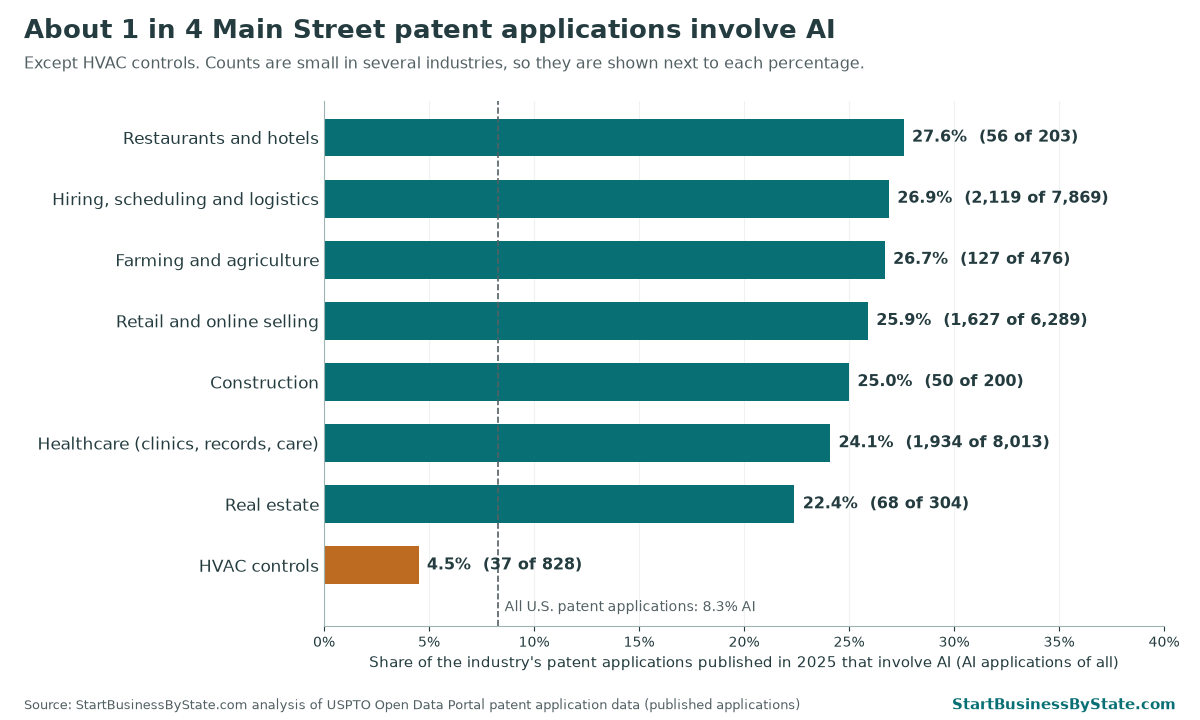
Every patent gets one or more classification codes. Some codes describe what the invention is used for, like running a restaurant (G06Q 50/12) or managing a construction project (G06Q 50/08). We counted the applications with each industry’s codes, then checked how many also had an AI code.
This tells you what the invention is for, not who filed it. A restaurant AI patent might come from a point-of-sale software company, a delivery app or a restaurant chain. The data can’t tell them apart.
Seven of the eight Main Street industries land between 22% and 28%. That’s about three times the share for all patent applications (8.3%). One likely reason: most of these codes cover computer-run ways of doing business, which is where AI tends to show up.
The trend since 2019
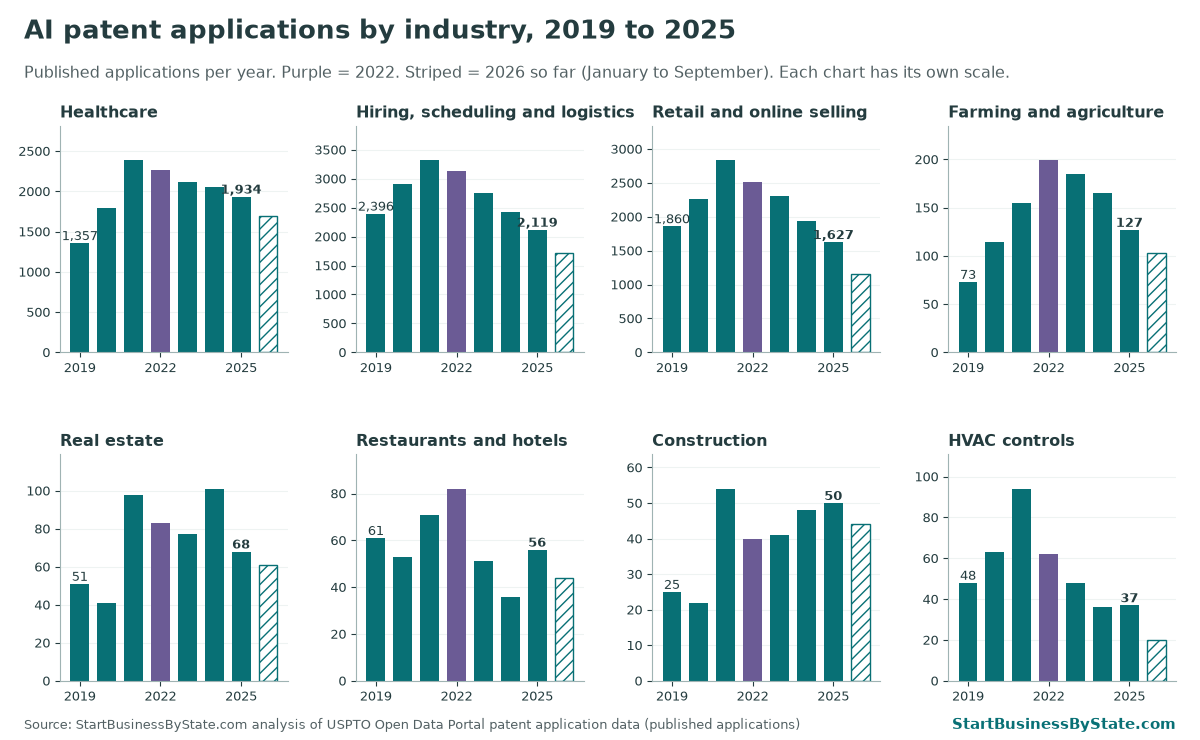
- Up since 2019: construction +100% (25 to 50), farming +74% (73 to 127), healthcare +42% (1,357 to 1,934) and real estate +33% (51 to 68).
- Down since 2019: HVAC −23% (48 to 37), retail −12%, hiring, scheduling and logistics −12% and restaurants and hotels −8% (61 to 56).
- Small numbers jump around. Restaurants and hotels went from 82 in 2022 to 36 in 2024 and back to 56 in 2025. Real estate went from 101 to 68. Swings like that are normal when the counts are this small, so don’t read much into a single year.
Small businesses file a big share
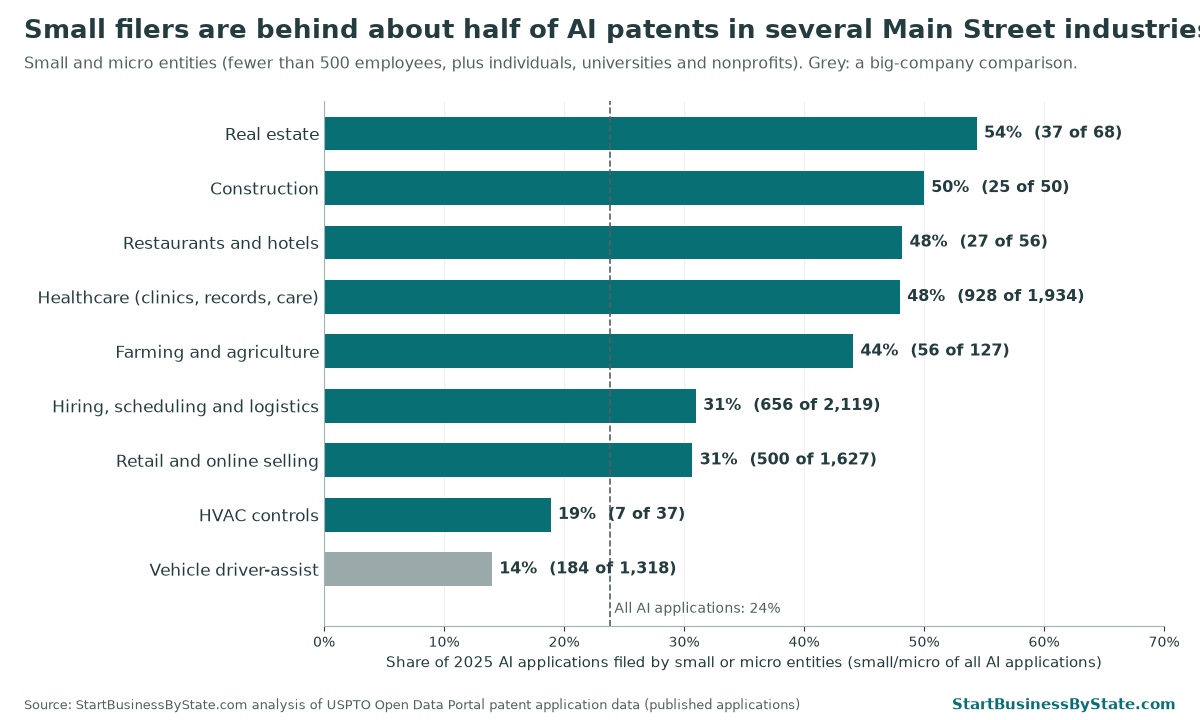
Across all AI patent applications, small and micro entities filed 24% in 2025. In Main Street industries, the share is often double that: 54% (37 of 68) in real estate, 50% (25 of 50) in construction and 48% (27 of 56) in restaurants and hotels. Big companies dominate the technical kinds of AI, like vehicle driver-assist, where small filers have just 14%.
“Small entity” includes businesses with fewer than 500 employees, but also universities, nonprofits and independent inventors. So not every small filer is a Main Street business. For more on who files, see small businesses’ share of AI patents.
Why the drop after 2022 doesn’t mean less AI
Many of these industries use “business method” patent classes (the G06Q codes). Those classes shrank after 2022, whether or not AI was involved:
- Retail applications fell 26% overall from 2022 to 2025. Hiring, scheduling and logistics fell 23%, and restaurants and hotels fell 30%.
- All U.S. patent applications fell only 6% over the same years.
- AI’s share within those classes stayed around a quarter, and in 2026 so far it’s higher than in 2025: retail 27.1%, hiring and logistics 30.2%, restaurants and hotels 28.2%. AI’s share of all U.S. patent applications is also up, from 8.3% in 2025 to 9.3% in 2026 so far.
So the fewer AI applications mostly track fewer business-method applications overall. This data can’t show why those fell. Business-method inventions face strict rules on what can be patented at all, and some companies may be keeping ideas as trade secrets instead. Meanwhile, business use of AI keeps growing: see small-business AI use by industry.
All industries
| Industry (patent classes) | AI applications, 2019 | 2022 | 2025 | 2026 (Jan–Sep) | AI share of all applications, 2025 | Change since 2019 | Change since 2022 | Small/micro share of AI applications, 2025 |
|---|---|---|---|---|---|---|---|---|
| All U.S. patent applications | 24,991 | 36,342 | 32,656 | 27,221 | 8.3% of 393,045 | +31% | −10% | 24% 7,787 of 32,656 |
| Main Street industries | ||||||||
| Restaurants and hotels * G06Q 50/12 |
61 | 82 | 56 | 44 | 27.6% of 203 | −8% | −32% | 48% 27 of 56 |
| Farming and agriculture G06Q 50/02, A01B 79 |
73 | 199 | 127 | 103 | 26.7% of 476 | +74% | −36% | 44% 56 of 127 |
| Construction * G06Q 50/08, G06Q 50/165 |
25 | 40 | 50 | 44 | 25.0% of 200 | +100% | +25% | 50% 25 of 50 |
| Healthcare (clinics, records, care) G16H |
1,357 | 2,263 | 1,934 | 1,689 | 24.1% of 8,013 | +42% | −14% | 48% 928 of 1,934 |
| Retail and online selling G06Q 30 |
1,860 | 2,513 | 1,627 | 1,159 | 25.9% of 6,289 | −12% | −35% | 31% 500 of 1,627 |
| Hiring, scheduling and logistics G06Q 10 |
2,396 | 3,137 | 2,119 | 1,720 | 26.9% of 7,869 | −12% | −32% | 31% 656 of 2,119 |
| Real estate * G06Q 50/16 |
51 | 83 | 68 | 61 | 22.4% of 304 | +33% | −18% | 54% 37 of 68 |
| HVAC controls * F24F 11 |
48 | 62 | 37 | 20 | 4.5% of 828 | −23% | −40% | 19% 7 of 37 |
| For comparison | ||||||||
| Vehicle driver-assist B60W |
1,180 | 1,686 | 1,318 | 971 | 27.0% of 4,888 | +12% | −22% | 14% 184 of 1,318 |
| Finance and insurance G06Q 40 |
404 | 714 | 526 | 383 | 22.5% of 2,339 | +30% | −26% | 28% 147 of 526 |
| Education * G06Q 50/20 |
68 | 99 | 71 | 96 | 37.0% of 192 | +4% | −28% | 69% 49 of 71 |
| Energy and utilities G06Q 50/06 |
84 | 109 | 132 | 98 | 18.1% of 730 | +57% | +21% | 37% 49 of 132 |
| Transportation services G06Q 50/40, 50/47 |
167 | 247 | 143 | 104 | 18.5% of 772 | −14% | −42% | 24% 35 of 143 |
* Fewer than 100 AI applications in 2025. Treat year-to-year changes with care. Counts are published U.S. utility patent applications by year of first publication. An application can fall into more than one industry (for example, land development is in both construction and real estate). Source: USPTO Open Data Portal, pulled September 30, 2026. Download the full table (CSV)
What this means for your business
- AI tools for your industry are being built right now. About a quarter of new patent applications aimed at restaurants, farms, builders, clinics and stores involve AI. Expect more scheduling, pricing, ordering and estimating tools pitched to you.
- A lot of that invention comes from small companies. In real estate and construction, about half of AI applications come from small or micro entities. If you have a genuinely new idea for how your trade works, you wouldn’t be alone in filing.
- Patenting a business method is hard. Business-method patents face strict rules, which is one reason these classes shrank. Talk to a registered patent attorney or agent before you spend money. Small entities pay about 60% less in USPTO fees, and the USPTO’s Patent Pro Bono Program offers free help to those who qualify.
- Using AI doesn’t require a patent. Most businesses will simply buy AI tools. See how many businesses in your field already do in small-business AI use by industry, and check AI laws by state before you use AI for hiring or customer chat.
- In HVAC, AI is still rare in patents. Only about 1 in 22 HVAC control applications involves AI. For the bigger picture on the trade, see HVAC industry statistics.
Methods and caveats
- Source. USPTO Open Data Portal patent application search, pulled September 30, 2026. U.S. utility patent applications, counted by the year they were first published. 2026 covers January 1 to September 30. Applications usually publish about 18 months after filing, and unpublished applications aren’t included.
- Industries. Each industry is a set of patent classification (CPC) codes that describe what the invention is used for: restaurants and hotels G06Q 50/12; farming G06Q 50/02 or A01B 79; construction G06Q 50/08 or G06Q 50/165; healthcare G16H; retail G06Q 30; hiring, scheduling and logistics G06Q 10; real estate G06Q 50/16; HVAC controls F24F 11. The codes describe the invention’s use, not the filer’s industry. An application can be in more than one industry.
- AI. An application counts as AI if it also has a current code in G06N (machine learning), G06F40 (language processing), G06V (image and video recognition) or G10L15 (speech recognition). The AI share is AI applications divided by all applications in that industry’s codes.
- Small and micro entities. The fee status currently on file with the USPTO. It includes businesses with fewer than 500 employees, universities, nonprofits and independent inventors.
- Small numbers. Restaurants and hotels, construction, real estate and HVAC each had fewer than 100 AI applications in 2025. Their percentages can move a lot from year to year.
- Codes change. Patent codes are sometimes updated after the fact, so past years can shift slightly in future pulls.
Cite or share this data
Free to use with credit: “Source: StartBusinessByState.com analysis of USPTO patent application data.” Please link to this page. Download the table (CSV)
More AI data: AI patents by state, small businesses’ share of AI patents, the generative AI patent tracker, AI inventors vs. AI users by state and small-business AI use by industry.
FAQ
Does this show which restaurants or builders are filing AI patents?
No. Patent classes describe what an invention is for, not who filed it. A restaurant AI patent could come from a software company, a payment company or a restaurant chain. What this data shows is how much AI invention is aimed at each kind of business.
Why do some industries have such small numbers?
Few patent applications are aimed at these industries at all. Construction had 200 applications published in 2025, and 50 of them involved AI. With numbers this small, a change of 10 or 20 applications can swing the percentage a lot. We mark industries with fewer than 100 AI applications with an asterisk.
Why did AI patent applications fall in retail and hiring after 2022?
Most business-method patent classes shrank after 2022, not just the AI ones. Retail applications fell 26% overall from 2022 to 2025, while all U.S. applications fell 6%. AI’s share of retail applications stayed at about a quarter and rose again in 2026 so far (27.1%). So the drop doesn’t mean businesses are doing less with AI. This data can’t tell us the exact reason.
What is a small or micro entity?
A small entity is generally a business with fewer than 500 employees, a university, a nonprofit or an independent inventor. A micro entity is a smaller group that also meets income and filing limits. Both pay lower USPTO fees. The status we use is the one on file today.
Why is HVAC so low?
The HVAC class (F24F 11) covers control systems for heating, cooling and ventilation. Most of those inventions are about sensors, valves and control logic, not AI. Only 4.5% (37 of 828) involved AI in 2025.
What counts as an AI patent application?
A published U.S. utility patent application with at least one patent class for machine learning (G06N), language processing (G06F40), image and video recognition (G06V) or speech recognition (G10L15).
How is this different from your AI use by industry page?
This page is about inventing: patent applications for AI aimed at each industry. Small-business AI use by industry is about using AI: the share of businesses in each industry that use AI tools, from the Census Bureau.
Can I use these numbers and charts?
Yes. Please credit StartBusinessByState.com and link to this page. The full table is free to download as a CSV.