Original research · USPTO PatentsView (granted patents through 2025; file released April 10, 2026) · USPTO Open Data Portal · company and public records checked September 30, 2026 · Last updated September 30, 2026
Digital Global Systems, a spectrum-technology company based in Tysons, Virginia, received 162 AI patents in 2025 with a U.S. first inventor. That’s more than Snap (148) and just behind Nvidia (163). It paid the USPTO’s small-entity fee rates, which cut most fees by 60%. Most of these patents are continuations: new patents built on earlier applications in the same family, mostly covering spectrum management.
Key facts
Every fact below comes from a public record or the company’s own website. Here’s where each one comes from.
| Fact | What we found | Source |
|---|---|---|
| Headquarters | 7950 Jones Branch Dr, Tysons, VA 22102. Founded in 2013, “headquartered in northern Virginia.” | Company website |
| What it does | AI-powered RF and spectrum-awareness products (CLEARSITE, CLEARSKY) for defense, public safety, telecom, airports, seaports and smart cities. | Company website |
| Size | The company’s homepage lists 48 employees. | Company website |
| Legal form | Delaware corporation. It has filed only Form D notices of private stock sales (2013 to 2018) with the SEC. It doesn’t file annual reports. | SEC EDGAR, CIK 1581455 |
| Patent owner location | Virginia (assignee address on its patents). | USPTO PatentsView |
| Inventor location | 149 of its 162 AI patents from 2025 list a first inventor in Winter Garden, Florida. The rest list Lee’s Summit, Missouri (7) and Baltimore, Maryland (6). | USPTO PatentsView |
| Fee status | Small entity on all 683 of its applications in the USPTO’s records. | USPTO Open Data Portal |
| AI patents granted in 2025 | 162 with a U.S. first inventor (PatentsView); 177 by first-listed applicant (Open Data Portal). | USPTO PatentsView; USPTO Open Data Portal |
| Total portfolio | The company says it holds “more than 700 issued and pending patents.” | Company website |
How it ranks against big tech
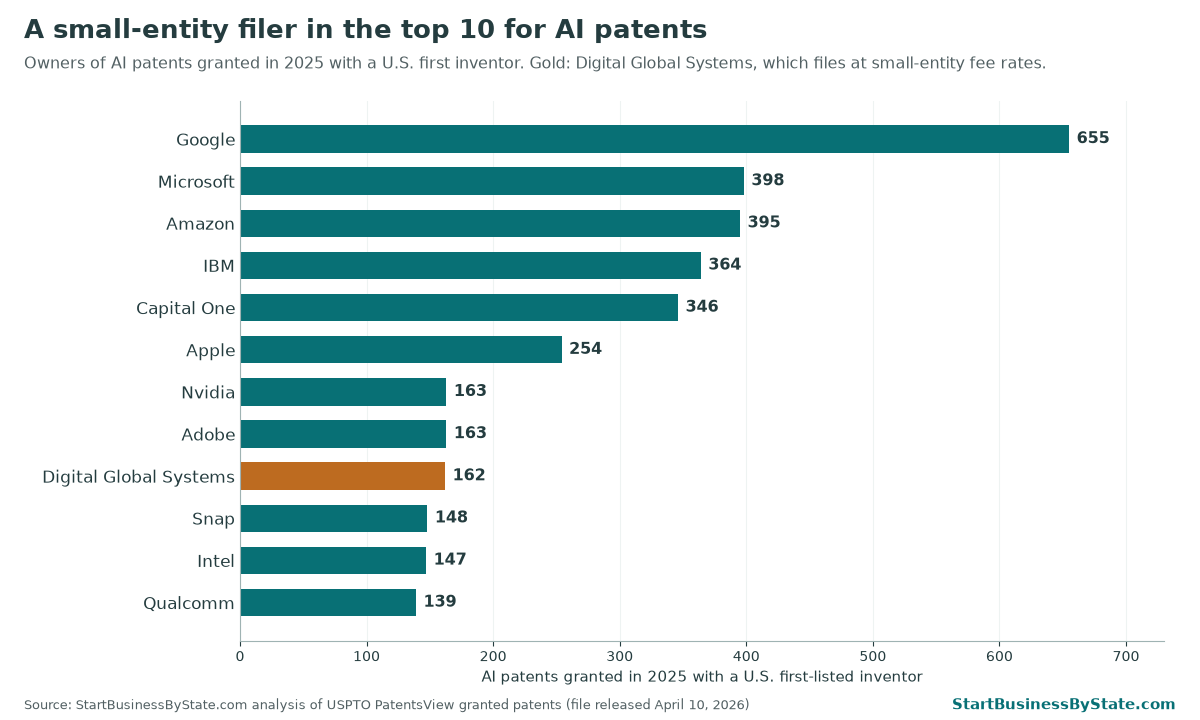
Among owners of AI patents with a U.S. first inventor, Digital Global Systems ranked #9 in 2025. It finished one patent behind Nvidia and Adobe and ahead of Snap, Intel and Qualcomm. Counting AI patents from every country, it ranked #22.
Among small-entity filers, it was far ahead of everyone else. The next-largest small-entity AI patent recipients in 2025 were the Korean research institute ETRI (95, under two spellings of its name) and AtomBeam Technologies (61). For the full small-business picture, see small businesses’ share of AI patents.
| Rank | Patent owner | 2025 AI patents (U.S. first inventor) |
|---|---|---|
| 1 | 655 | |
| 2 | Microsoft | 398 |
| 3 | Amazon | 395 |
| 4 | IBM | 364 |
| 5 | Capital One | 346 |
| 6 | Apple | 254 |
| 7 | Nvidia | 163 |
| 8 | Adobe | 163 |
| 9 | Digital Global Systems | 162 |
| 10 | Snap | 148 |
| 11 | Intel | 147 |
| 12 | Qualcomm | 139 |
How the portfolio was built
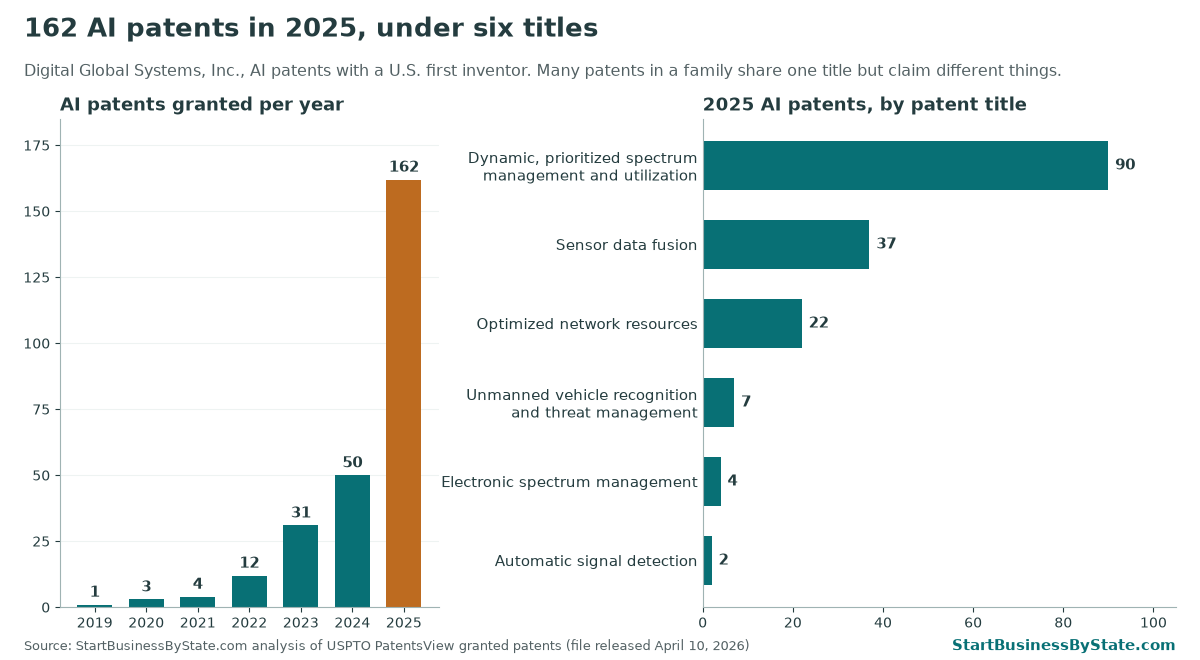
It grew fast. Its AI patent count went from 1 in 2019, 3 in 2020, 4 in 2021, 12 in 2022, 31 in 2023, 50 in 2024, 162 in 2025.
A few families, many patents. The 162 AI patents from 2025 use just 6 titles. 90 share one title: “System, method, and apparatus for providing dynamic, prioritized spectrum management and utilization.” Each patent claims something different, but they share the same description.
Mostly continuations. We read the “related applications” section of a random sample of 15 of its 2025 AI patents. All 15 were continuations (13) or continuations-in-part (2) of earlier applications. Nine of them trace back to the same provisional application, filed May 1, 2020. For example, U.S. Patent 12,457,501 was filed in January 2025 and granted in October 2025. Its family chain runs back through more than a dozen earlier applications to one filed on October 30, 2020.
Filed recently, granted quickly. 160 of the 162 were filed in 2024 or 2025. The median one took 222 days from filing to grant. That compares with about 2.8 years for all AI patents granted in 2025 (see the AI patent slowdown). The patents don’t say why they moved faster, and we haven’t drawn a conclusion.
A big effect on Florida. Because most of the inventors are listed in Winter Garden, these patents count toward Florida in inventor-based state rankings. Florida’s AI patent grants rose from 319 in 2022 to 521 in 2025. Without Digital Global Systems, the rise would be about 20%, not 63%. See AI patents by state.
What we checked, and what we couldn’t
- Company website: confirmed the Tysons headquarters, founding year, products, 48-employee figure and the “more than 700” patent claim.
- USPTO records: confirmed patent counts, titles, inventor cities, owner state, small-entity status and continuation history.
- SEC EDGAR: confirmed it’s a Delaware corporation that has filed Form D notices. It doesn’t file annual reports, so there is no public revenue figure.
- Florida Division of Corporations (Sunbiz): no entity named “Digital Global Systems” is registered. The Winter Garden link comes from inventor addresses on the patents, not from a Florida office.
- Virginia State Corporation Commission business search: we couldn’t check this one. The search requires a human verification step. So we rely on the company website and patent records for its Virginia location.
Lessons for small businesses
You don’t need a portfolio this size, and most small businesses won’t need one. But the tools Digital Global Systems used are open to any small business.
- Claim the fee discount if you qualify. A business with no more than 500 employees (counting affiliates) can usually claim small-entity status and get 60% off most USPTO fees. Micro entities get 80% off. You lose the discount if you’ve licensed or assigned the invention to a larger company. (USPTO: save on fees)
- Use continuations to protect versions of one idea. While an application is still pending, you can file a continuation that claims a different version of the same invention and keeps the original filing date. (USPTO MPEP 211) That’s how one invention can turn into many patents. Each continuation costs a new set of fees, though, and fees go up for continuations filed more than six years after the first application.
- Plan for the cost. At small-entity rates, the basic USPTO fees for one patent (filing, search, exam and issue) total about $1,250, before extra-claim fees. Then you pay maintenance fees to keep the patent alive. Attorney fees usually cost far more than the USPTO fees.
- If speed matters, there’s a paid fast track. The USPTO’s Track One program aims to reach a final decision in about 12 months, for an extra fee. (USPTO Track One) We don’t know whether Digital Global Systems used it.
- Know where you stand before you file. Your patent attorney or agent can tell you whether your idea is likely to qualify. And check AI laws by state before you put AI in front of customers.
| USPTO fee (utility patent) | Standard | Small entity | Micro entity |
|---|---|---|---|
| Basic filing (electronic) | $350 | $70 | $70 |
| Search | $770 | $308 | $154 |
| Examination | $880 | $352 | $176 |
| Issue | $1,290 | $516 | $258 |
| Basic total per patent | $3,290 | $1,246 | $658 |
| Track One fast track (extra) | $4,515 | $1,806 | $903 |
| Maintenance at 3.5 / 7.5 / 11.5 years | $2,150 / $4,040 / $8,280 | $860 / $1,616 / $3,312 | $430 / $808 / $1,656 |
Source: USPTO fee schedule (fees in effect since January 19, 2025). Doesn’t include extra-claim fees, continuation surcharges or attorney fees. We didn’t estimate what Digital Global Systems paid, because fees changed in 2025 and claim counts vary.
Methods and caveats
- Main count. USPTO PatentsView granted utility patents (through December 31, 2025; file released April 10, 2026), counted by grant year and first-listed owner. “U.S. first inventor” means the first-listed inventor has a U.S. address.
- Second count. The USPTO Open Data Portal counts by first-listed applicant and shows each application’s fee status. It gives 177 AI grants for 2025, not 162. The two data sets assign owners in slightly different ways.
- AI definition. At least one current patent class in G06N (machine learning), G06F40 (language processing), G06V (image and video recognition) or G10L15 (speech recognition), the same as our other AI patent pages.
- Continuation sample. 15 randomly chosen 2025 AI patents, read from the published patent text.
- Not covered. We didn’t look at licensing, revenue or the company’s finances. This page describes the patent record only.
Cite or share this data
Free to use with credit: “Source: StartBusinessByState.com analysis of USPTO patent data.” Please link to this page. Download the patent list (CSV)
More AI patent data: AI patents by state, small businesses’ share of AI patents, the AI patent slowdown, the generative AI patent tracker and AI patents in Main Street industries.
FAQ
What is Digital Global Systems?
Digital Global Systems, Inc. (DGS) is a company that makes AI-powered radio-frequency (RF) and spectrum-awareness products, such as CLEARSITE and CLEARSKY. Its website says it was founded in 2013 and is headquartered at 7950 Jones Branch Drive in Tysons, Virginia. It is a Delaware corporation in SEC records.
How many AI patents did Digital Global Systems get in 2025?
162 by our main count: AI patents granted in 2025 with a U.S. first-listed inventor, from USPTO PatentsView. A broader count in the USPTO Open Data Portal, which counts by first-listed applicant, shows 177. That’s the most of any small-entity filer.
What is small-entity status?
It’s a USPTO fee status. A small business with no more than 500 employees (including affiliates), an individual inventor or a nonprofit can qualify, as long as it hasn’t licensed or assigned the invention to a larger company. Small entities get 60% off most patent fees. Micro entities get 80% off.
What is a continuation patent?
A new application that builds on an earlier, still-pending application in the same family. It uses the same description but asks for different claims, and it keeps the earlier filing date for what they share. Filing several continuations lets a company protect different versions of one invention.
Why did these patents come through so fast?
We don’t know. The median DGS AI patent granted in 2025 took 222 days from filing to grant, compared with about 2.8 years for all AI patents granted that year. The USPTO offers paid fast-track programs, but the patents themselves don’t say how they were examined, so we haven’t drawn a conclusion.
Can a small business do the same thing?
The same tools are open to any small business: small-entity fee discounts, continuations and fast-track exams. But each patent still costs money in USPTO fees and usually far more in attorney fees, and a big portfolio is a long-term cost. Talk to a registered patent attorney or agent before you start.