A childcare subsidy waitlist can block new funded enrollment while payments for existing children continue. This tracker separates those situations across Alabama, Arizona, Indiana, Maryland, DC and one Colorado county example. It also shows Indiana’s recent voucher trend and models what payment delays or unapproved new enrollments could mean for a provider.
Coverage: five selected states plus DC, not a 50-state census or a ranking of funding cuts. Colorado coverage is local. Counts have different dates and are not added into a national total.
Three findings worth separating
- Indiana’s CCDF waitlist declined 25.5% from April to July 2026: 39,352 to 29,328. Active CCDF vouchers increased from 39,173 to 45,454, or 16.0%, over those same observations. These are recorded changes, not proof of why families left the list. FSSA, August 5 review, page 47.
- Arizona reported 14,719 children in 8,881 families waiting on September 11, 2026. That is a later observation than Indiana’s; it is not a same-date state comparison. Arizona DES.
- DC distinguishes families from providers: some priority groups can enroll, but new providers joining the subsidy program remain on hold in the reviewed notice. Existing participating providers can add facilities. DC OSSE.
Childcare subsidy restrictions: selected-state tracker
Checked September 18, 2026. A missing count means we did not verify a comparable count in the reviewed source, not that nobody is waiting. State names lead to the relevant business guide; policy links lead to the administering agency. Scroll the table horizontally on a phone.
| Jurisdiction / scope | New enrollment restriction / date | Existing families or providers | Verified waitlist count / source |
|---|---|---|---|
| AlabamaStatewide notice | New applicants waitlisted, with listed priority exceptions.New applications from May 8, 2026; notice published May 15 | Continued assistance depends on eligibility and program participation. | Not verified in this review Official policy |
| ArizonaStatewide program | Most new applicants waitlisted; Cash Assistance and Department of Child Safety referral exceptions described by DES.Count: September 11, 2026 | The reviewed notice addresses new applicants; it does not document a blanket stop to existing payments. | 14,719 children (2026-09-11); 8,881 families Official policy |
| ColoradoElbert County example only; not a statewide status | Elbert accepts and processes applications; eligible families wait for funding. Other counties can differ.Elbert County waitlist effective April 1, 2026 | Elbert says current benefits are unchanged, subject to timely redetermination and requested information. | Not verified in this review Official policy |
| District of ColumbiaDistrictwide program | Priority groups 1–3 may enroll; groups 4–6 wait. New providers joining the subsidy program are on hold.Waitlist/provider hold May 12; priority update July 8, 2026 | Eligible current families can continue after redetermination and may add siblings. Participating providers may add facilities. | Not verified in this review Official policy |
| IndianaStatewide CCDF; OMWPK separately reported | New voucher applicants and children added to existing vouchers enter the waitlist; priority categories apply.Policy checked September 18; count: July 2026 | Existing benefits can continue with eligibility, reauthorization and available funding. | 29,328 children (2026-07) Official policy · Count source |
| MarylandStatewide CCS program | Partial new-enrollment freeze; TANF/TCA, SSI and homelessness exceptions for qualifying families.Partial freeze May 1, 2025; homelessness exception July 1, 2026 | MSDE says enrolled-child payments continue; adding children to existing cases is outside the partial freeze. | Not verified in this review Official policy |
Colorado’s department separately announced county fiscal-control and waitlist-process rules effective August 14, 2026. That announcement does not establish a single statewide enrollment status. CDEC July bulletin.
These records concern financial assistance. They do not count empty classrooms, all eligible children, or families on a private daycare’s waiting list. For a different measure, see our childcare business-count comparison; it also is not a count of licensed vacancies.
Indiana: the waitlist improved, but has not disappeared
The agency’s July observation lists 29,328 children on the CCDF waitlist and 45,454 active CCDF vouchers. The broader voucher-program total also includes On My Way Pre-K; this chart keeps that separate. The full download preserves both programs and their published totals.
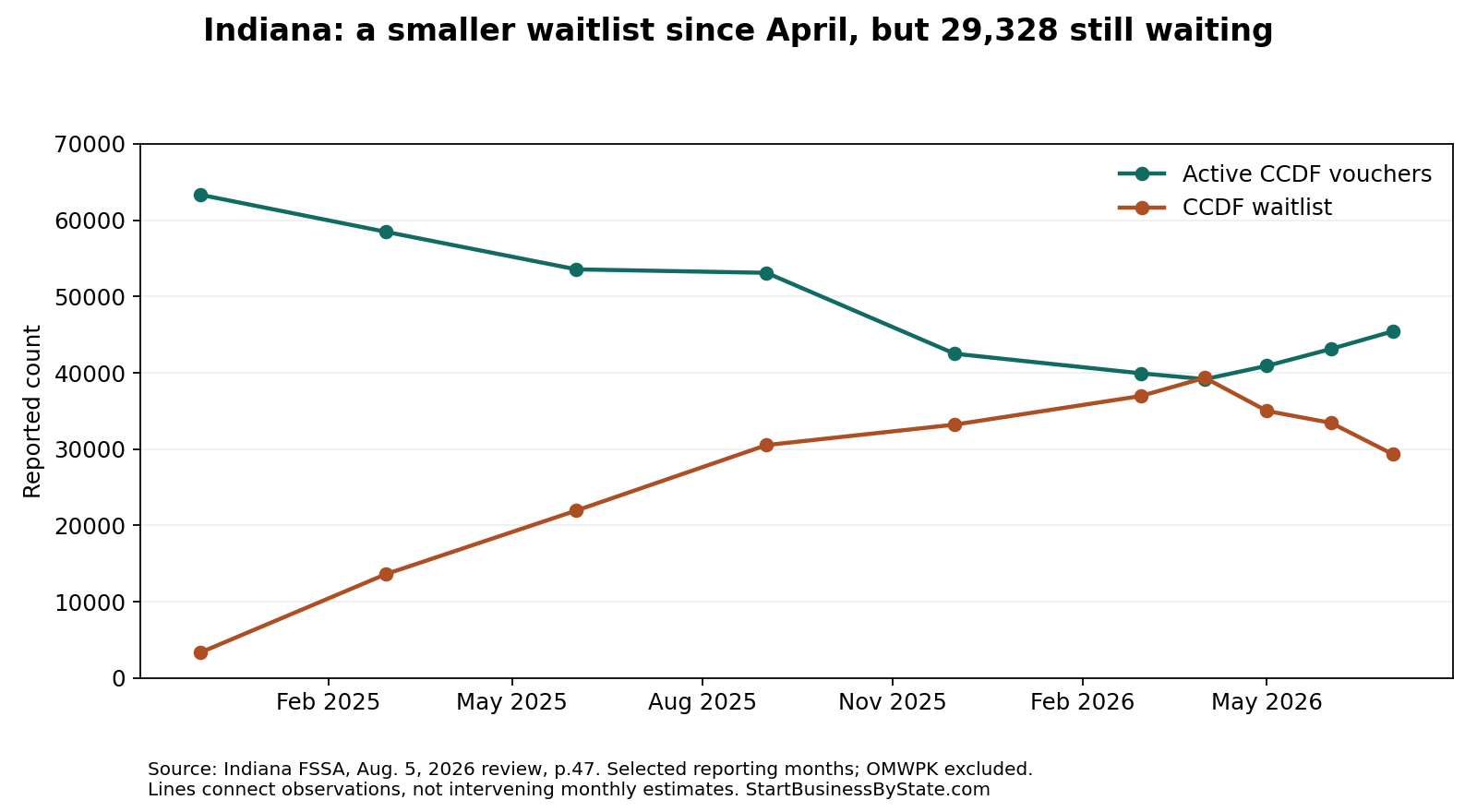
| Observation month | Active vouchers | Waitlist |
|---|---|---|
| 2024-12 | 63,351 | 3,328 |
| 2025-03 | 58,476 | 13,629 |
| 2025-06 | 53,565 | 21,955 |
| 2025-09 | 53,109 | 30,533 |
| 2025-12 | 42,509 | 33,215 |
| 2026-03 | 39,940 | 36,961 |
| 2026-04 | 39,173 | 39,352 |
| 2026-05 | 40,917 | 35,007 |
| 2026-06 | 43,130 | 33,447 |
| 2026-07 | 45,454 | 29,328 |
The source does not identify each exit from the waitlist. Enrollment, eligibility changes, reconfirmation and other administrative changes cannot be disentangled from these counts alone. We therefore do not call the decline “children newly served,” add enrollment to the waitlist as a unique-child denominator, or attribute it to a single policy.
What changed in federal payment rules in 2026?
A final CCDF rule published May 12 took effect July 13, 2026. It removed federal requirements concerning a 7% family co-payment ceiling, some direct-service grants/contracts, prospective provider payments and enrollment-based payments. Removing those mandates does not mean every state changed its practices or that authorized payments were canceled. Providers must check their own state or county terms. Official final rule, pages 25796–25808.
Estimate your provider’s subsidy exposure
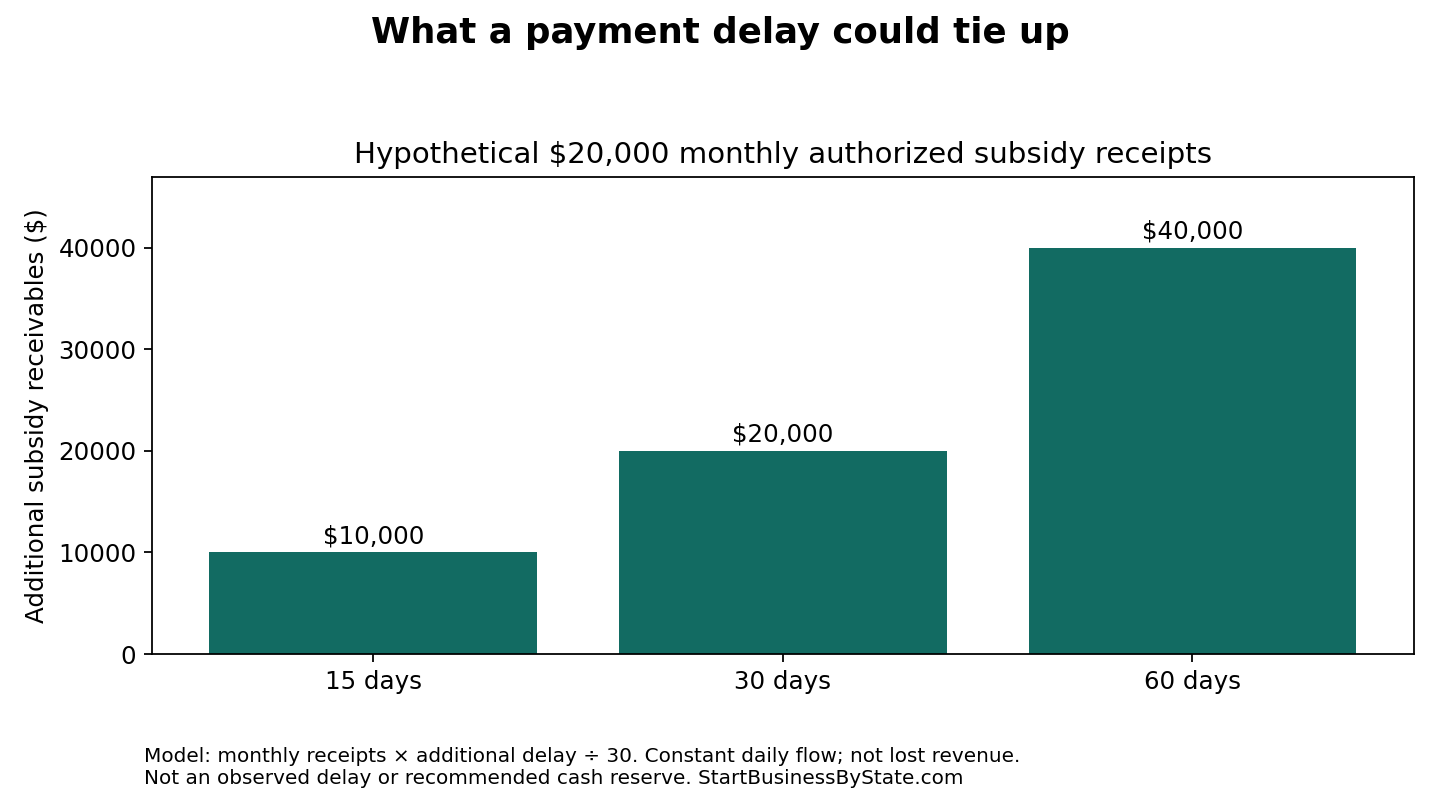
Keep payment timing separate from unapproved growth. Use the government-paid portion, excluding parent co-payments. These are hypothetical planning calculations, not observed state losses or forecasts. They do not determine eligibility or reimbursement rates.
Enter all five values within the displayed limits. Days, enrollments and months must be whole numbers; dollar inputs allow cents.
Additional subsidy receivables: $20,000.00
Planned subsidy receipts not yet authorized over the selected period: $12,000.00
Do not add these outputs: they describe different groups and different time horizons. Delayed receivables are not automatically lost revenue. Unapproved planned receipts are not money already owed to the provider.
How to use the numbers
The delay calculation assumes steady daily receipts and a 30-day month. It estimates an extra receivables balance after a payment lag develops, not a recommended reserve or a prediction of actual invoices. Real payment batches, expenses and other cash receipts can produce different cash needs.
The new-enrollment calculation assumes the planned children would otherwise receive the entered amount throughout the period. It excludes replacements, private-pay receipts, partial approvals and any later retroactive payment. It is not profit: staffing and other costs are not deducted. Neither scenario is multiplied by statewide waitlist counts.
Before committing to another classroom, verify each child’s authorization dates, renewal deadlines, approved rate and provider participation status. Compare your own contracts with historical parent childcare prices, but do not substitute parent prices for subsidy reimbursement. Our daycare startup guides cover operating requirements; daycare insurance guidance addresses separate liability and coverage decisions, not protection against a subsidy waitlist.
Sources, methods and downloadable data
Permission to open a location and approval to receive subsidy payments are separate decisions. Compare recent daycare zoning changes before committing to a property; subsidy enrollment still needs its own check.
- Selected-state policy tracker CSV — scope, exceptions, dates, verified counts, source URLs and review date. Blank numeric fields are unverified, not zero.
- Indiana voucher and waitlist series CSV — ten observations with CCDF, OMWPK and total columns, transcribed from the agency’s August 5, 2026 presentation, page 47.
- Payment-delay scenarios CSV — 12 hypothetical combinations with their assumptions. These are modeled values.
Selection: a targeted review of documented subsidy restrictions, not a representative sample. Alabama, Arizona, Indiana, Maryland and DC have program-level notices; the Colorado row covers Elbert County only. Jurisdictions omitted from the table were not classified. This page is manually reviewed, not a real-time feed. Arizona’s source says its count updates weekly; the count captured here is explicitly dated September 11.
Quality checks: Indiana’s program components reconcile to published totals at all ten observations. Percentage changes use April 2026 as the denominator and are rounded to one decimal. We reviewed the source PDF table visually and checked extracted values separately. Counts remain as published; administrative revisions, program definitions and observation dates limit comparisons.
Limits: agency notices and the official FSSA and Federal Register records support this review. We do not estimate a national total, a provider’s share of revenue from subsidies, or losses from the policy notices. A waitlist alone does not establish a funding cut, a closure, or a shortage of physical childcare places.
Reuse: writers may reuse our original charts and calculated scenarios with attribution to StartBusinessByState.com and a link to this page. Cite the underlying agency for official figures, keep dates and scope attached, and label modeled scenarios as hypothetical. Suggested citation: “StartBusinessByState.com, Childcare Subsidy Waitlists & Provider Funding, checked September 18, 2026.”
Common questions
Does a subsidy freeze stop all provider payments?
No blanket conclusion follows from the word “freeze.” Maryland’s notice explicitly preserves payments for enrolled children, while restricting most new enrollment. Read the program’s exceptions and current authorizations.
Can a subsidy waitlist tell me where to open a daycare?
It identifies families waiting for assistance under that program’s rules. It does not establish that they can pay privately, that no childcare space exists, or that your business can enroll as a subsidy provider.
Is this a list of every state with a waitlist?
No. It is a dated, selected-jurisdiction review with one county example. Use the linked agencies to confirm changes before making operating decisions.