New Mexico, New Hampshire, Rhode Island and Washington have enacted changes that reduce selected zoning barriers for childcare businesses. The rules affect different kinds of providers: a family home, a larger home program and a commercial center do not receive the same treatment. Washington also gives cities time to implement its change into 2027.
Reviewed September 18, 2026 · Four selected state reforms · Official legislation and agency sources · Downloadable comparison below
This guide answers a property question: does the local zoning process still stand between you and opening? Start with the comparison, then use our state daycare startup guides for the broader opening process. This is a selected reform tracker, not a complete inventory of all 50 states or a ranking of the easiest places to operate.
Which states changed childcare zoning rules?
Three of these reforms took effect in 2026. Washington’s law took effect in 2025, with local implementation tied to 2027 deadlines. The table distinguishes an effective state law from the date a city must update its rules.
Showing 4 states.
| State / startup guide | Program covered | Effective date / implementation | Barrier addressed | Important limit and source |
|---|---|---|---|---|
| New Mexico | Homes and centers | 2026-07-01 | Homes treated as residential use; centers permitted by right in commercial, mixed-use and multifamily residential zones. | Licensing remains. Center pickup/stacking rules can remain; uniformly applied reasonable HOA requirements can remain. SB 96 (2026), Chapter 62 |
| New Hampshire | Homes and centers | 2026-07-01 | Qualifying family/group homes by right on residential lots; centers by right on commercial land. | Center site-plan review may remain above 30 licensed children; industrial/manufacturing exception and safety requirements remain. Private covenants are not overridden. HB 1195 (2026), Chapter 217 |
| Rhode Island | Homes | 2026-06-19 | Municipalities cannot impose a family-childcare-home capacity ceiling below 12 through local ordinance or regulation. | State licensing requirements still determine the capacity authorized for a particular home; this is not an automatic 12-child license. S 2273 / H 7371 (2026) |
| Washington | Centers | 2027 implementation | Cities and towns must permit centers and building conversions outright in most zones. | Industrial, light-industrial and open-space zones excepted. 2027 comprehensive-plan-update cities implement with that update; other cities by July 27, 2027. ESSB 5509 (2025), Chapter 276 |
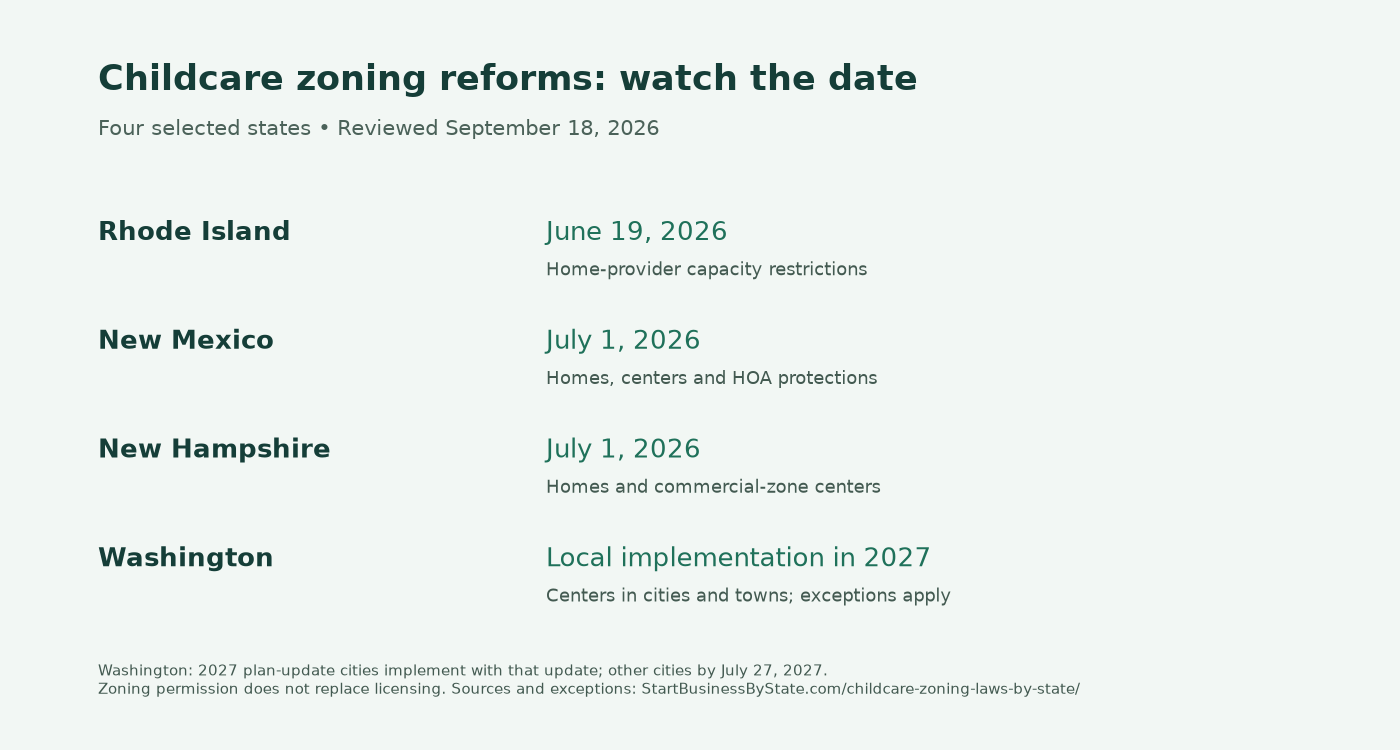
Four differences that matter before you choose a property
New Mexico: homes, centers and private restrictions
SB 96 treats qualifying childcare homes as residential use and opens commercial, mixed-use and multifamily residential zones to centers by right. It also limits special parking demands: centers cannot be required to supply off-street parking, though designated pickup stacking can be required, capped at one space per 10 children of proposed licensed capacity. Reasonable uniformly applied HOA requirements can remain, but associations cannot effectively prohibit or unreasonably restrict covered childcare homes. Licensing remains with ECECD. Read the signed law.
For a prospective operator, the useful question is which requirement a local official is applying: a prohibited childcare-specific zoning condition, or a building or licensing condition that still applies. ECECD confirms the July 1, 2026 start date in its 2026 legislative summary.
New Hampshire: the 30-child threshold is about site-plan review
HB 1195 allows qualifying home programs by right on residential lots, including a primary or existing accessory structure, without local site-plan review. Centers receive by-right treatment on commercial land, subject to the law’s industrial/manufacturing exception. A municipality may retain site-plan review when a center’s licensed capacity exceeds 30 children. That is not a statewide enrollment cap. Fire, building, water and sewage requirements remain. The home-program provision expressly leaves private covenants intact. Read the enrolled law, effective July 1, 2026.
For example, a proposed 36-child center should not budget on the assumption that by-right zoning removes site-plan review. A smaller center still needs its separate licensing and safety approvals.
Rhode Island: a zoning ceiling is not your licensed capacity
The S 2273/H 7371 reform prevents municipalities from using local rules to cap a licensed family childcare home below 12 children. It preserves state licensing rules. A home approved for fewer children therefore needs the appropriate licensing approval before expanding; the zoning change alone does not turn it into a 12-child program. This is a home-provider reform, not a blanket rule for commercial centers. The legislature’s signed-law announcement explains the distinction between state capacity rules and municipal limits.
Washington: check the city’s implementation calendar
ESSB 5509 requires cities and towns to allow childcare centers and building conversions outright in most zones, excluding industrial, light-industrial and open-space zones. Reasonable restrictions, including pickup and drop-off rules, can remain. Cities scheduled for a comprehensive-plan update in 2027 implement the change with that update; other cities have until July 27, 2027, two years after the law’s effective date. The city requirement should not be treated as a blanket rule for unincorporated county land. Read the signed session law.
Someone leasing a building in late 2026 should ask whether the city has already implemented the law. The state enactment date alone does not answer that question.
Before signing a daycare lease: five checks
- Identify the exact parcel and provider category. Ask the licensing agency whether your proposal is a family home, group home or center. Confirm the zoning district and jurisdiction.
- Get the applicable local process in writing. Ask whether the state reform has been implemented and which permits, reviews or inspections remain.
- Check the property separately from the zoning label. Review occupancy, exits, water, sewage, outdoor space, drop-off arrangements and required alterations with the responsible agencies.
- Read the lease and private covenants. New Mexico’s home-provider protection and New Hampshire’s express preservation of private covenants illustrate why one state’s answer cannot be copied into another.
- Price the remaining opening costs. Obtain contractor and staffing estimates, confirm capacity, and review daycare insurance coverage for the program and premises before committing to an opening budget.
Sources, methodology and free downloads
We compared four selected enacted reforms using official legislative text and government guidance, with LegiScan bill histories used to cross-check enactment status. Fields are program type, timing, zoning barrier addressed and conditions that remain. The comparison is an editorial synthesis, not a statistical sample. It does not measure new childcare places, approval time saved, lower tuition or business profitability.
For Rhode Island, S 2273 passed without a substitute listed in the bill history and was signed June 19, 2026; the legislature subsequently confirmed enactment. The linked bill takes effect on passage. The general online code pages reviewed had not incorporated that new provision, so the tracker relies on the bill text and signed-law announcement rather than presenting an older code page as updated law.
We excluded Virginia HB 258 from the reform count because its childcare terminology changes do not establish a comparable new zoning opening. Introduced proposals, including North Carolina S 1051, are not counted as enacted reforms. Omission of a state does not mean it lacks childcare zoning protections. Review date: September 18, 2026; this page is a dated snapshot, not an automatic legislative alert.
Writers may use the original comparison and graphic with attribution to StartBusinessByState.com and a link to this page. Keep the review date and scope limitations with the data; consult the linked primary laws before describing a specific location as eligible.
Common questions
Does “by right” mean I can open immediately?
No. It addresses permission for the land use. Licensing, property safety, staffing and any remaining approvals must still be satisfied.
Can every Rhode Island home now take 12 children?
No. The reform limits municipal capacity restrictions. The number a particular provider may serve still depends on state licensing requirements and that home’s approval.
Does Washington’s law already apply the same way in every city?
The law is enacted, but local implementation has a timetable extending into 2027. Confirm the city’s current ordinance and comprehensive-plan schedule before relying on it for a property.
Do these reforms prove childcare shortages will shrink?
No. Reducing a zoning barrier is one step. This review does not measure whether new providers open, how many licensed places they create or whether families can afford them.