Original research · Law tracker · Last updated Sept 29, 2026
Laws checked through Sept 29, 2026. Scam figures are for calendar year 2025.
The short answer: 31 states now have laws on AI deepfakes in elections, up from 5 before 2024. 5 of them passed their first one this year, just ahead of the Nov 3 midterms. At least 16 states passed laws on sexual deepfakes from 2023 to 2026. Meanwhile, the FBI logged $893 million in losses to AI-related scams in 2025.
This page is general information, not legal advice. Laws change and details matter, so check with a lawyer in your state before you make big decisions.
Key findings
- 31 states regulate election deepfakes. Most require a label on AI-made or AI-altered political ads close to an election.
- Courts have pushed back. A federal judge struck down two of California’s 2024 election deepfake laws in August 2025. Hawaii’s 2024 law was blocked in January 2026.
- 5 states joined this year: Vermont, Maine, Tennessee, Maryland and Louisiana.
- At least 16 states passed sexual deepfake laws from 2023 to 2026. Many states had older laws too. A federal law, the TAKE IT DOWN Act, passed in 2025.
- AI scams cost $893 million in 2025. That’s from 22,364 complaints to the FBI. People 60 and older reported $352.5 million of it.
Deepfake laws by state
Click a column to sort. Type a state to filter. Each law links to its official bill record.
| State | Election deepfake law? | Election laws | Sexual deepfake laws, 2023-26 | Fraud, likeness and other deepfake laws |
|---|---|---|---|---|
| Alabama | Yes, since 2024 | HB 172 (2024) | – | – |
| Alaska | No | – | – | – |
| Arizona | Yes, since 2024 | SB 1359 (2024) HB 2394 (2024) |
– | – |
| Arkansas | No | – | HB 1529 (2025) HB 1877 (2025) |
HB 1071 (2025) AI copies of a person's likeness in commercial use |
| California | Yes, since 2019 | AB 730 (2019) AB 972 (2022) AB 2355 (2024) AI disclosure on political ads AB 2839 (2024) struck down in court, Aug 2025 AB 2655 (2024) struck down in court, Aug 2025 AB 502 (2026) |
AB 621 (2025) | AB 1836 and AB 2602 (2024) Contracts and consent for digital replicas of performers AB 723 (2025) Real estate ads must disclose digitally altered photos SB 1050 (2026) False advertising rules for synthetic performers AB 2025 (2026) Rental listing photos |
| Colorado | Yes, since 2024 | HB24-1147 (2024) | – | – |
| Connecticut | No | – | – | – |
| Delaware | Yes, since 2024 | HB 316 (2024) | HB 353 (2024) | – |
| District of Columbia | No | – | – | – |
| Florida | Yes, since 2024 | HB 919 (2024) | – | – |
| Georgia | No | – | – | – |
| Hawaii | Yes, since 2024 | SB 2687 (Act 191) (2024) blocked by a federal court, Jan 2026 | – | – |
| Idaho | Yes, since 2024 | H 664 (2024) | H 575 (2024) H 727 (2026) |
– |
| Illinois | No | – | HB 2123 (2023) SB 382 (2023) |
HB 4875 (2024) Right-of-publicity law updated for AI copies of recording artists |
| Indiana | Yes, since 2024 | HB 1133 (2024) | HB 1047 (2024) | – |
| Iowa | No | – | – | – |
| Kansas | No | – | – | – |
| Kentucky | Yes, since 2025 | SB 4 (2025) | – | – |
| Louisiana | Yes, since 2026 | HB 459 (2026) HB 639 (2026) AI robocalls |
SB 175 (2023) HB 119 (2026) SB 42 (2026) SB 110 (2026) |
SB 346 / SB 347 (2026) Deepfakes used against K-12 students; campus safety rules |
| Maine | Yes, since 2026 | LD 517 (2026) | – | – |
| Maryland | Yes, since 2026 | SB 141 (2026) | – | SB 8 (2026) Identity fraud using AI or deepfakes; up to 5 years and $10,000 |
| Massachusetts | No | – | – | – |
| Michigan | Yes, since 2023 | HB 5141 (2023) HB 5144 (2023) |
HB 4047 / HB 4048 (2025) | – |
| Minnesota | Yes, since 2023 | HF 1370 (2023) HF 4772 (2024) |
HF 1370 (2023) | – |
| Mississippi | Yes, since 2024 | SB 2577 (2024) | – | – |
| Missouri | No | – | – | – |
| Montana | Yes, since 2025 | SB 25 (2025) | SB 413 (2025) | – |
| Nebraska | No | – | LB 383 (2025) | – |
| Nevada | Yes, since 2025 | AB 73 (2025) | – | – |
| New Hampshire | Yes, since 2024 | HB 1596 (2024) | – | HB 1432 (2024) Bans certain harmful uses of deepfakes and lets victims sue |
| New Jersey | No | – | – | A 3540 (2025) Criminal penalties for making or sharing deceptive deepfakes |
| New Mexico | Yes, since 2024 | HB 182 (2024) | – | – |
| New York | Yes, since 2024 | S 9678 (2024) 2024-25 budget, Part MM (2024) |
S 1042 (2023) | S 8420 (2025) Ads must disclose synthetic performers S 8391 (2025) Post-death rights to a performer's digital replica |
| North Carolina | No | – | – | – |
| North Dakota | Yes, since 2025 | HB 1167 (2025) | – | – |
| Ohio | No | – | – | – |
| Oklahoma | No | – | – | – |
| Oregon | Yes, since 2024 | SB 1571 (2024) | – | – |
| Pennsylvania | No | – | – | SB 649 (Act 35) (2025) New crime of "digital forgery" |
| Rhode Island | Yes, since 2025 | H 5872 / S 816 (2025) | – | – |
| South Carolina | No | – | – | – |
| South Dakota | Yes, since 2025 | SB 164 (2025) | – | – |
| Tennessee | Yes, since 2026 | HB 1513 / SB 1624 (2026) | HB 2163 / SB 2668 (2024) SB 1346 / HB 1299 (2025) |
HB 2091, ELVIS Act (2024) Protects a person's voice and likeness from AI copies |
| Texas | Yes, since 2019 | SB 751 (2019) | SB 1361 (2023) HB 3133 (2025) SB 1621 (2025) |
– |
| Utah | Yes, since 2024 | SB 131 (2024) | – | SB 271 (2025) Unauthorized AI copies of a person's likeness or voice |
| Vermont | Yes, since 2026 | S 23 (2026) | – | – |
| Virginia | No | – | – | – |
| Washington | Yes, since 2023 | SB 5152 (2023) | – | – |
| West Virginia | No | – | SB 198 (2025) | – |
| Wisconsin | Yes, since 2024 | AB 664 (2024) | – | – |
| Wyoming | No | – | HB 102 (2026) | – |
Download the list: deepfake-laws-by-state-2026.csv. A “No” or “-” means we did not find a law in our search. Older sexual-image laws from before 2023 are not listed.
Deepfakes and the 2026 midterms
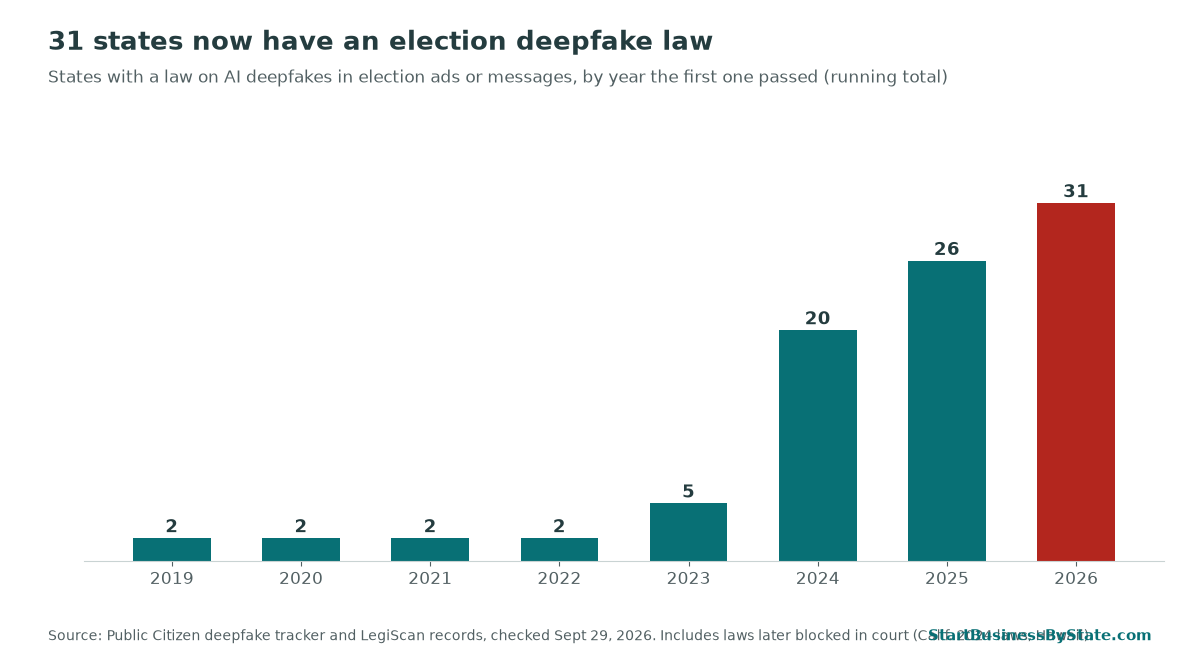
The midterm elections are Nov 3, 2026. It is the first midterm since cheap AI tools made fake audio and video easy to make. According to Public Citizen’s tracker, 31 states now have a law on the books. Most of them work the same way:
- They cover fake or AI-altered images, audio or video of a candidate.
- Many apply only in a set window before an election, such as the last 90 days.
- A clear label like “This ad was made with AI” usually satisfies the law.
- Candidates can often go to court to stop the ad, and some states add fines or criminal charges.
These laws have run into free-speech challenges. In August 2025 a federal judge struck down California’s AB 2839 and AB 2655. Hawaii’s law was permanently blocked in January 2026. Pluribus News reported in July that the midterms are putting the rest of these laws to the test.
AI scam losses: what the FBI reported
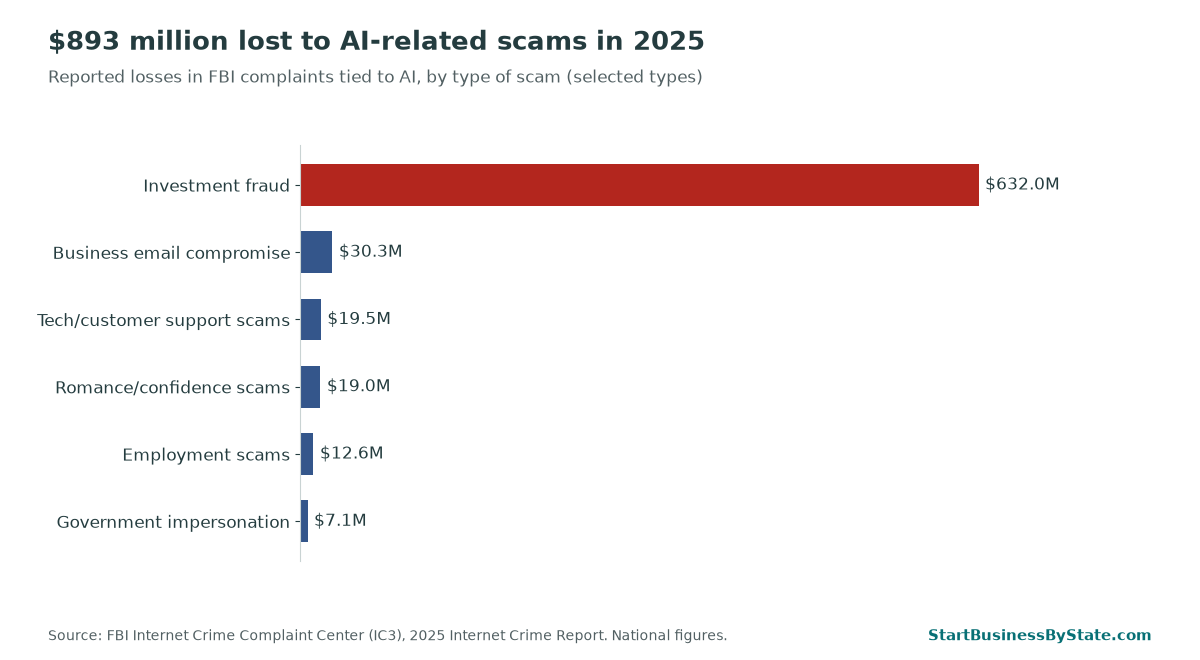
The FBI’s 2025 Internet Crime Report has a section on complaints that involved AI. These are national numbers. The report’s state tables don’t separate out AI.
- 22,364 complaints tied to AI, with $893,346,472 in reported losses.
- That’s a small slice of all complaints: 1,008,597 complaints and $20.9 billion in total losses.
- Businesses lost more than $30 million to email scams involving AI. The FBI says crooks use AI to write emails that sound like the boss, and cloned voices to ask for wire transfers.
- “Distress” scams using a cloned voice of a family member cost victims more than $5 million.
- Scammers used fake voices or video in online job interviews. The FBI says the goal usually seems to be getting into a company’s computer network.
- People 60 and older filed 3,143 AI-related complaints with $352,496,231 in losses.
What this means for your business
- Set a call-back rule for money requests. If “the owner” or a vendor asks by email, text or voice to wire money or change bank details, call them back at a number you already have. A cloned voice can sound real.
- Watch for fake applicants. On video interviews, look for lips that don’t match the words. Don’t give network access to a new remote hire until you’ve checked their ID.
- Label AI in your own ads. If you use AI images of people, or AI-altered photos of a home or rental, several states now require a label. California requires it for real estate and rental listing photos. New York requires it for ads with “synthetic performers.”
- Don’t use someone’s face or voice without written permission. That includes a celebrity sound-alike. Tennessee, Arkansas, Utah, Illinois, New York and California have added AI rules to likeness laws.
- Political ads have extra rules. If you make ads or social posts for a campaign this fall, check the state’s label rule and deadline window.
More on AI rules for small businesses: AI chatbot laws by state and AI in hiring laws by state. See how many owners in your state use AI at all on small-business AI use by state.
For every kind of state AI law in one place, see our companion page, AI laws by state.
Cite or share this data
You’re welcome to use the table and charts. Please credit and link to this page.
Source: StartBusinessByState.com review of state deepfake laws and FBI IC3 data, Sept 29, 2026. https://startbusinessbystate.com/deepfake-laws-by-state/
Methods and sources
- Election laws. We started with Public Citizen’s deepfake election tracker (updated Sept 29, 2026) and checked each state’s bill against its official LegiScan record. The year shown is the year the state’s first election deepfake law passed.
- Sexual deepfake and other laws. We tagged 2025 and 2026 state AI bills in LegiScan by keyword, then read the record and summary of each enacted one. We added laws from 2023 and 2024 that we found along the way. This list is not complete for years before 2023, and many states had older image-abuse laws that may already cover deepfakes.
- What we dropped. Illinois SB 3020 was tagged as a deepfake law but has no AI or deepfake provisions. New York budget bills and bills that only mention deepfakes in passing were left out. Pennsylvania’s 2025 digital forgery law is listed under fraud, not elections.
- Scam numbers. From the FBI IC3 2025 Internet Crime Report. “AI-related” means the complaint included AI-related information. Losses are what victims reported, and many scams are never reported.
- Sources. LegiScan; Public Citizen; FBI IC3; Georgetown Free Speech Project; Pluribus News; TAKE IT DOWN Act (S 146). Accessed Sept 29, 2026.
FAQ
How many states have election deepfake laws?
31 states as of Sept 29, 2026, based on Public Citizen’s tracker and our check of each bill record. That count includes California’s 2024 laws and Hawaii’s law, which courts have struck down or blocked.
Are deepfake political ads illegal?
Not everywhere, and usually not outright. Most state laws require a clear label saying the ad was made or changed with AI, often only in the weeks or months before an election. Some let candidates sue to stop the ad. Congress has not passed a law on deepfake political ads.
How much money do people lose to AI scams?
The FBI’s Internet Crime Complaint Center got 22,364 complaints tied to AI in 2025, with $893.3 million in reported losses. Most of that, $632 million, was investment fraud. Businesses reported more than $30 million in losses to email scams involving AI.
Can someone use my face or voice in an ad without asking?
Many states already protect your name and likeness in ads. Some have added AI rules on top. Tennessee’s ELVIS Act protects voices. Arkansas and Utah cover AI copies of a person’s likeness or voice. New York now requires ads to disclose “synthetic performers.”
Is there a federal deepfake law?
Yes, for one kind. The TAKE IT DOWN Act, passed in 2025, makes it a federal crime to publish sexual deepfakes of real people without consent and requires websites to take them down. There is no federal law on election deepfakes.
Does this page show AI scam numbers by state?
No. The FBI report has state tables, but they are not broken out for AI. We only use the national AI figures.