Workplace heat-protection rules depend on the state, the job and how heat is measured. California and Washington use outdoor air-temperature triggers; Oregon and Maryland use heat index. Nevada requires a job-hazard assessment for covered employers. Colorado and Virginia’s new 2026 laws set agency tasks or rulemaking deadlines, which should not be mistaken for a new break schedule already in force.
Reviewed September 18, 2026 · Seven selected states · Five current standards or assessment rules, plus two new legislative developments
Use this guide before planning landscaping crews, rooftop HVAC work or other hot-weather service jobs. It compares selected rules relevant to service businesses, not every state or every occupation. State names in the table lead to our landscaping startup guides; use the landscaping business hub or HVAC business hub for the broader launch process.
State heat-protection rules: current requirements versus future deadlines
The thresholds below are entry points for checking the official rule, not a complete compliance plan. All temperatures are Fahrenheit. Indoor work, agriculture, emergencies and short incidental exposures can receive different treatment.
Showing 7 states.
| State / landscaping startup guide | Status | Measure and starting point | Additional requirement or milestone | Important qualification and source |
|---|---|---|---|---|
| California | Current outdoor standard | Air temperature Shade must be present above 80 F; timely shade on request at or below 80 F. | 95 F or above: high-heat procedures for listed industries, including construction and landscaping. | Basic outdoor protections apply below the shade trigger. The 10-minute/every-2-hour high-heat schedule in section 3395(e)(6) is agriculture-specific. Indoor work has a separate standard. Official source |
| Washington | Current outdoor standard | Air temperature / clothing 80 F for ordinary clothing; 52 F for nonbreathable clothing. | At least 10 minutes every 2 hours at 90 F or above; at least 15 minutes every hour at 100 F or above, subject to rule conditions. | Controls that reduce exposure below 90 F and specified emergency operations affect high-heat duties. Incidental outdoor exposure has a defined exemption; agricultural rules are separate. Official source |
| Oregon | Current indoor/outdoor standard | Heat index 80 F or above for covered work. | 90 F or above: additional protections and a written rest schedule using one of three permitted options. | Employer-designed option begins with10 minutes every 2 hours at 90 F and15 minutes every hour at 100 F, adjusted for risk factors. Incidental exposure, process-generated heat and other exclusions require checking. Official source |
| Maryland | Current indoor/outdoor standard | Heat index 80 F or above for covered work. | 90 F or above: written high-heat procedures, monitoring and protective work/rest arrangements. | COMAR permits specified rest schedules, current NIOSH recommendations or demonstrated effective alternative controls. Scope exemptions apply; one fixed break schedule is not universal. Official source |
| Nevada | Current hazard-assessment rule | Job hazard assessment Generally employers with more than 10 employees must assess job heat hazards; no single statewide numeric trigger in this comparison. | If hazardous conditions are identified, address controls, monitoring, responsibility and training through the written safety program. | Smaller employers still have duties concerning recognized hazards; special explosives-manufacturing rules and climate-controlled-work exceptions apply. Review May 21, 2026 guidance. Official source |
| Colorado | 2026 law: agency tasks | Not a new numeric service-employer trigger HB26-1272: agency data work due by January 15, 2027; model prevention plan due by July 1, 2028. | This enacted law does not itself supply a new universal service-business break timetable. | The row addresses this new law only; it is not a finding that Colorado has no existing protections or agriculture-specific rules. Official source |
| Virginia | 2026 law: standard development | Thresholds to be set by the Board Adopt heat-illness prevention regulations by May 1, 2028. | Statute directs future water, cooling access, rest, acclimatization, training and emergency provisions. | Agency adoption deadline is not a verified employer compliance start date. Numeric heat/high-heat thresholds are not supplied by this statute. Official source |
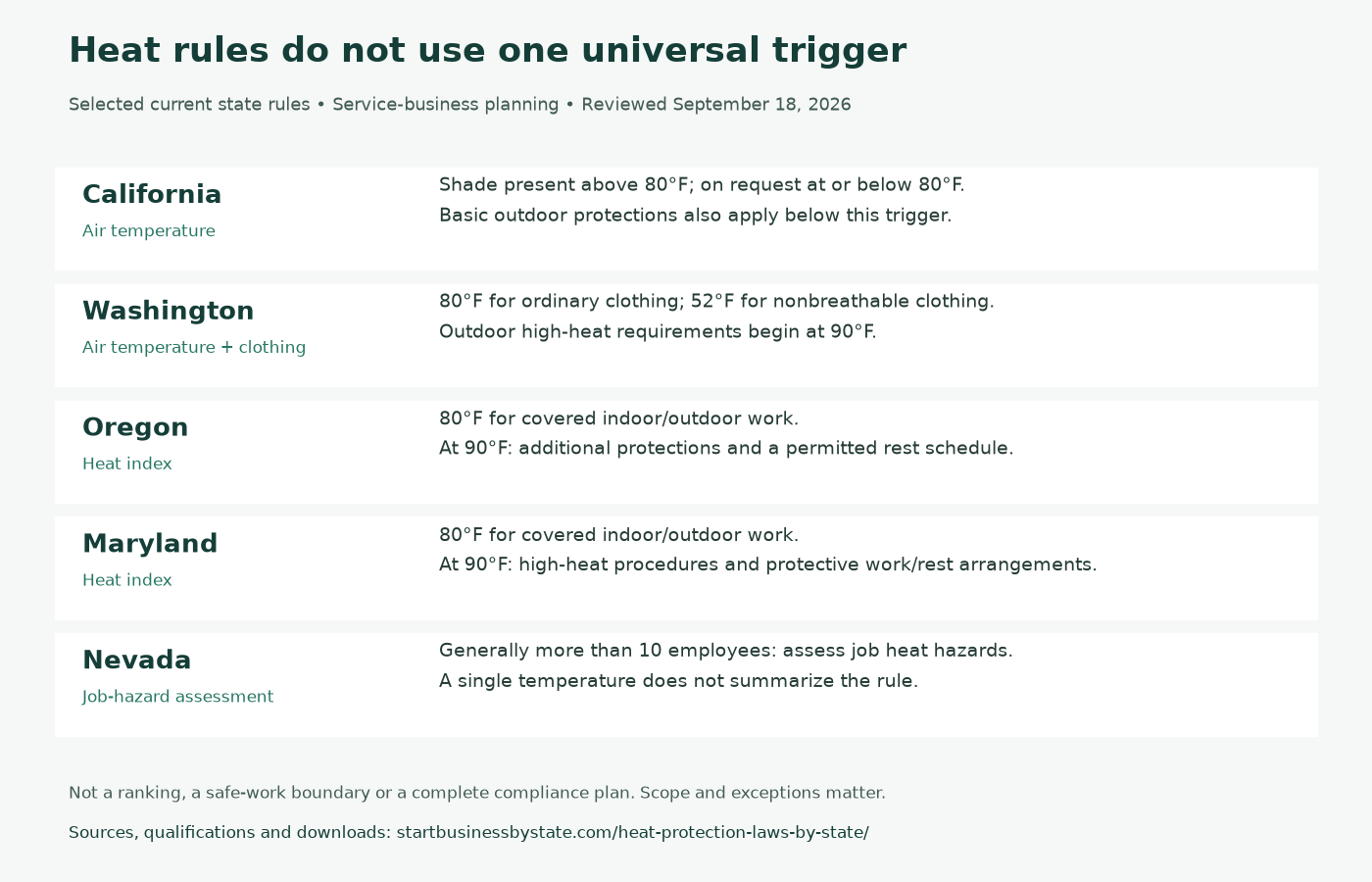
Four assumptions that can produce the wrong work plan
1. A weather app’s temperature is not always the rule’s measurement
Oregon and Maryland use heat index, which accounts for humidity as well as temperature. California’s outdoor shade trigger and Washington’s outdoor action levels use air temperature. Washington also lowers its action level to 52°F for nonbreathable clothing. A crew wearing protective clothing cannot simply borrow the ordinary-clothing threshold. Washington’s Be Heat Smart guidance explains its action levels; Oregon’s heat-stress resources cover its heat-index approach.
For example, a landscaping contractor comparing Oregon with Washington should not label both jobs “below the limit” from one air-temperature reading. First identify the applicable measure, clothing and work conditions. The absence of a particular numeric trigger does not establish that the work is safe.
2. A break schedule from another industry may not apply to yours
California’s outdoor standard requires high-heat procedures at 95°F or above for listed industries, including landscaping and construction. But the specific 10-minute cooldown every two hours in section 3395(e)(6) is an agriculture-specific provision. It should not be copied into a landscaping guide as that industry’s statutory high-heat schedule. Other outdoor protections still apply, including access to recovery periods. California also has a separate indoor heat standard.
Oregon offers three ways to establish its required high-heat rest schedule. Its employer-designed option starts with minimum intervals and requires adjustments for risk factors; a NIOSH-based option and a separate simplified schedule are also available. Maryland permits specified schedules, current NIOSH recommendations or demonstrated effective alternative controls under its high-heat provisions. That flexibility is conditional, not permission to omit protections or documentation.
3. Nevada’s small-employer distinction is not a universal exemption from heat safety
Nevada’s assessment rule generally covers employers with more than 10 employees, rather than “10 or more.” The state’s May 21, 2026 guidance explains the assessment, written-program requirements when hazards are identified, exceptions and smaller employers’ continuing duties concerning recognized hazards. It is misleading to reduce this approach to a single 90°F trigger or tell every business with ten employees that heat hazards need no attention. Use the current guidance linked in the table rather than an older summary.
4. An enacted law can set an agency deadline rather than an immediate employer requirement
Colorado HB 26-1272 requires agency data work by January 15, 2027 and a model temperature-related injury and illness prevention plan by July 1, 2028. Those are different milestones. This law does not itself provide a new universal break timetable for landscaping or HVAC businesses. The row concerns this law; it does not erase existing protections or Colorado’s separate agricultural rules. See the official bill record and signed text in the table.
Virginia directs development of heat-illness prevention regulations covering matters such as water, cooling access, rest and training. Its agency says the Board must adopt the standard by May 1, 2028. The Board will establish heat and high-heat thresholds. That agency deadline is not a verified employer compliance start date. Virginia DOLI describes the standard under development.
Federal status is a separate check. OSHA’s national heat-rule page describes a proposed rule. Do not present its proposed thresholds as a final nationwide standard. Existing obligations concerning recognized serious heat hazards can still apply; consult OSHA’s heat standards and General Duty Clause guidance.
What should a service business check before quoting hot-weather work?
- Identify the actual worksite and task. A roof, shaded yard, mechanical room and climate-controlled office can call for different assessments. Confirm which occupational-safety authority and rule apply.
- Choose the required measurement and account for the job. Record the relevant temperature or heat index and consider clothing, exertion, sun and other site conditions. Do not substitute a statewide daily high for an assessment required at the work area.
- Put the operating arrangements in the quote and work plan. Allow for water access, shade or cooling, staffing, required rest, acclimatization, training and monitoring. A customer’s preferred completion time does not waive employer duties.
- Assign responsibility before dispatch. Make the plan usable by the crew: who monitors conditions, who can change the work schedule and how emergency response is organized. Follow the applicable rule’s documentation and training requirements.
- Review coverage separately. Safety compliance and insurance answer different questions. Use our landscaping insurance guide or HVAC insurance guide to review workers’ compensation and other business coverage needs. A general liability policy should not be assumed to replace employee injury coverage or a prevention plan.
Sources, methodology and downloadable files
We reviewed official state regulations, agency guidance and enacted legislation as of September 18, 2026. LegiScan bill histories provided an additional enactment check for Colorado HB 26-1272 and Virginia HB 1092; operative conclusions come from government text and guidance. The original comparison records state, rule status, measure, starting point, high-heat requirement or future milestone, and qualifications. Each record includes a primary-source URL and review date.
This is a selected-state reference, not an exhaustive inventory of states, local ordinances, occupational exceptions or every required plan element. The five current-rule rows were selected for useful contrasts in service-business planning. Colorado and Virginia were selected for their new 2026 legislative developments. Their 2028 milestones fall outside the next twelve months; Colorado’s January 2027 milestone does not. Omission does not mean a state lacks protection. We have not ranked states by worker safety, enforcement intensity or business cost.
The graphic and downloadable comparison summarize the reviewed sources; the checklist is an editorial planning aid, not a state-approved safety plan. No injury reduction, new employer cost, affected-worker count or future inspection probability is estimated. This is a dated review, not an automatic legal-change monitoring service. Recheck official sources before relying on a threshold or deadline.
Writers may reuse our original comparison and graphic with attribution to StartBusinessByState.com and a link to this page. Keep the review date, selected-state scope and qualifications with the material; link to the operative government source for a specific legal requirement.
Common questions
Does federal OSHA already have a final nationwide heat rule?
The OSHA rulemaking page reviewed for this guide describes a proposal. That does not remove existing obligations concerning recognized serious heat hazards, and applicable state requirements must be checked separately.
Are temperature and heat index interchangeable?
No. Heat index incorporates humidity. Use the measure specified by the applicable rule and account for clothing and other conditions the rule requires.
Does a landscaping crew in California automatically get the agricultural break schedule?
No. The outdoor rule’s specific two-hour agricultural cooldown provision should not be described as a universal landscaping schedule. Landscaping employers still need to follow applicable basic and high-heat protections.
Do Colorado and Virginia’s new laws mean new breaks are required immediately?
These laws assign agency work or development of standards. The listed future deadlines are not a substitute for checking current requirements, and they should not be presented as verified employer compliance start dates.