By StartBusinessByStatePublisher: Robert SmithResearch process
Original research · BLS Consumer Price Index, Producer Price Index and Current Employment Statistics · By StartBusinessByState · Published November 17, 2026
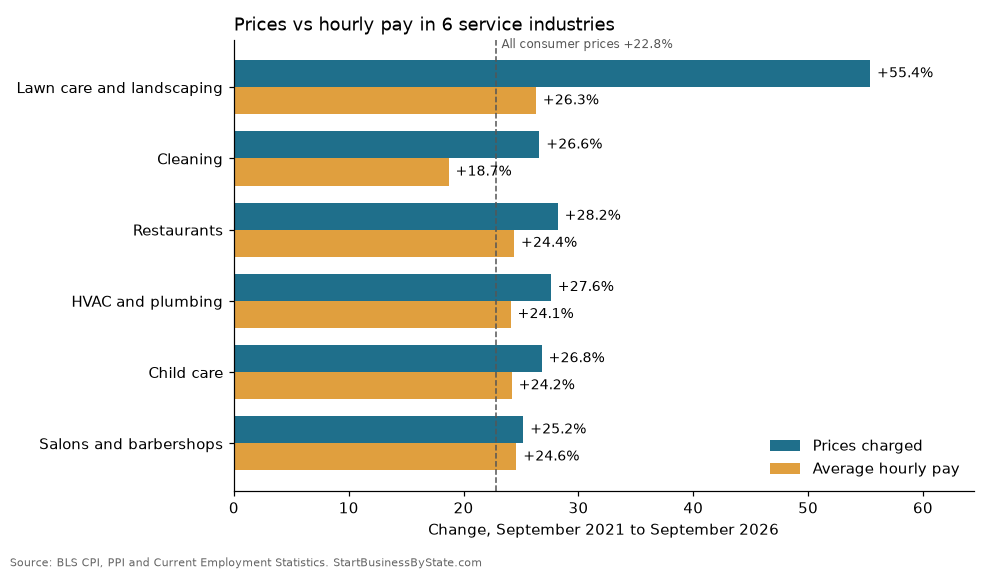
Short answer: on labor, most small service businesses have kept up. Prices for lawn care rose 55.4% in five years while landscaping workers’ hourly pay rose 26.3%. Restaurant prices rose 28.2% vs 24.4% for pay. The closest race was salons and barbershops: 25.2% vs 24.6%. All consumer prices rose 22.8% over the same time.
Prices vs hourly pay, by industry
We compared what each industry charges customers with what it pays workers per hour, using the same five-year window: September 2021 to September 2026. “Gap” is price growth minus pay growth. A positive gap means prices rose faster than pay.
| Industry | Price change | Hourly pay change | Gap | Average hourly pay, Sept. 2021 to Sept. 2026 | Price measure |
|---|---|---|---|---|---|
| Lawn care and landscaping | +55.4% | +26.3% | +29.1 pts | $22.80 to $28.79 | CPI: gardening and lawn care services |
| Cleaning | +26.6% | +18.7% | +7.9 pts | $18.52 to $21.99 | PPI: janitorial services |
| Restaurants | +28.2% | +24.4% | +3.8 pts | $17.31 to $21.53 | CPI: food away from home |
| HVAC and plumbing | +27.6% | +24.1% | +3.5 pts | $34.14 to $42.38 | PPI: plumbing, heating and AC contractors (nonresidential work) |
| Child care | +26.8% | +24.2% | +2.6 pts | $18.15 to $22.54 | CPI: day care and preschool |
| Salons and barbershops | +25.2% | +24.6% | +0.6 pts | $21.52 to $26.82 | CPI: haircuts and other personal care services |
Price measures are the Consumer Price Index (what households pay) or, for HVAC, plumbing and cleaning, the Producer Price Index (what businesses receive). The HVAC and plumbing index covers nonresidential building work only. Hourly pay is average hourly earnings of all employees from the BLS Current Employment Statistics survey, not seasonally adjusted. September 2026 producer price and pay figures are preliminary.
Other costs: food and equipment
Pay is the biggest cost for most service businesses, but not the only one. Two inputs show how other costs moved:
- Restaurants: producer prices for processed foods and feeds rose 15.8% from September 2021 to September 2026, much less than restaurant menu prices (28.2%).
- HVAC and plumbing: producer prices for AC, refrigeration and heating equipment rose 41.7%, more than the 27.6% rise in what contractors charged for nonresidential work. That gap can squeeze contractors who buy equipment and charge for installed work.
Rent, insurance, fuel and credit card fees are not in this comparison. Check your own books for those.
What it means for a small business
If your prices rose less than these industry figures, your margin may have shrunk even if sales are up. For example, a landscaping company that charged $50 for a weekly mow in September 2021 would be charging about $78 today if it matched the lawn care price index. A crew member paid $20 an hour then would earn about $25.26 if pay matched the industry average.
Many owners are still raising prices. In NFIB’s October 2026 survey, a seasonally adjusted net 33% of small business owners said they had raised average selling prices in the past three months, and a net 37% planned to raise them in the next three months, the highest since July 2022 (NFIB Small Business Economic Trends, October 2026).
For more context, see which states' small businesses are raising prices and the restaurant industry by state.
Steps to check your own prices
- Find your cost per job or per hour in 2021 or your first year, and today. Include wages, payroll taxes, materials and overhead.
- Compare it with your prices for the same years. If costs rose faster, your margin has shrunk.
- Look at your industry’s price change in the table. It shows what customers are paying other businesses.
- Raise prices in steps and tell customers ahead of time. Explain what changed, such as wages or supplies.
- Review every year, and build planned increases into contracts and service agreements.
Protect your margins
Insurance is one cost worth shopping. Compare small business insurance quotes from Simply Business. Starting a business? Form your LLC with LegalNature.
We may earn a commission if you use these links. It doesn’t change what you pay, and it doesn’t affect the information on this page.
How we did this
We pulled data from the Bureau of Labor Statistics on November 17, 2026: the Consumer Price Index (U.S. city average, not seasonally adjusted), the Producer Price Index and average hourly earnings of all employees from the Current Employment Statistics survey. We compared September 2021 with September 2026, the latest month available for all series. The gardening and lawn care price index has no data for 2022 and some other months, so we used only months with data. BLS series IDs are in the CSV. These are national figures and do not show any one business’s costs.
Common questions
Are small business prices keeping up with costs?
For labor costs, yes, in the six service industries we checked. From September 2021 to September 2026, prices rose faster than average hourly pay in all six. The gap was largest for lawn care and smallest for salons and barbershops. Wages are only one cost, though. Rent, insurance, supplies and equipment also matter.
How much have restaurant prices gone up since 2021?
Prices for food away from home rose 28.2% from September 2021 to September 2026, based on the Consumer Price Index. Restaurant workers’ average hourly pay rose 24.4%, and producer prices for processed foods rose 15.8%.
Why did lawn care prices rise so much?
The Consumer Price Index for gardening and lawn care services rose 55.4% from September 2021 to September 2026. BLS does not say why. This index is based on a small sample and is missing some months, so it moves more than most.
Are small businesses still raising prices?
Yes. In NFIB’s October 2026 survey, a seasonally adjusted net 33% of small business owners said they had raised average selling prices, and a net 37% planned to raise prices in the next three months, the highest reading since July 2022.
How should I decide whether to raise my prices?
Start with your own numbers: what you pay per labor hour, your materials and your overhead. Compare them with what you charged a year ago. If your costs rose faster than your prices, your margin has shrunk. Price changes in your industry, like the ones on this page, show what customers are already seeing elsewhere.
Published November 17, 2026. We will update these figures as BLS releases new data.