Landscaping business research · Checked September 18, 2026
Gas leaf-blower rules depend on the job address, equipment and work date. In this selected comparison, Alexandria’s general use prohibition starts November 17, 2026, and San Mateo’s starts January 1, 2027. Portland and Ann Arbor currently have seasonal restrictions. Arlington’s newly adopted prohibition starts in 2029.
Use the sourced table below before buying equipment or quoting a route. California’s statewide new-engine standards are different from a local ban on using equipment you already own.
For licensing and startup requirements, choose your state in our landscaping business guide. This page focuses on leaf-blower restrictions and purchasing decisions.
Selected jurisdictions, not a national count. The two upcoming starts are Alexandria and San Mateo, measured from September 18, 2026. California’s statewide engine rule is a separate eighth comparison row.
Where are gas leaf blowers restricted?
These are adopted restrictions, not bills awaiting passage. “Current” describes legal timing; it does not measure enforcement. An unlisted city is not necessarily unrestricted.
| Jurisdiction / status | Rule and dates | Scope and important distinctions | Official source |
|---|---|---|---|
| Alexandria, VirginiaFuture local use ban | General prohibition on gas-powered leaf-blower use begins November 17, 2026. City operations transitioned July 1, 2026. | City limits; the earlier city-operations deadline is not the deadline for every private contractor. | Read source |
| San Mateo, CaliforniaFuture local use ban | Ordinance 2026-03 prohibits operating or authorizing a gas leaf blower within city limits from January 1, 2027. | City, not all of San Mateo County. Electric blowers remain subject to residential-area hours and holiday restrictions. | Read source |
| Portland, OregonSeasonal local use ban | Gas use prohibited January 1–September 30 in 2026 and 2027; October–December remains the seasonal window. Year-round prohibition starts January 1, 2028. | Handheld/backpack equipment as defined in city code; property-owner obligation. City-determined inclement-weather exception and possible electric-infrastructure extensions. | Read source |
| Ann Arbor, MichiganSeasonal local use ban | Gas use prohibited June 1–September 30 through 2027; year-round prohibition begins January 1, 2028. | City identifies emergency/restoration and paving-work exceptions, and an exception for turbine blowers. Review definitions before assuming equipment qualifies. | Read source |
| Montgomery County, MarylandCurrent local use ban | Use restriction began July 1, 2025, covering handheld, backpack and walk-behind gas leaf-removal equipment. Sales restriction began July 1, 2024. | Agricultural-producer exemption; county guidance excludes Montgomery County Public Schools and Montgomery Parks. Check municipal jurisdiction for each address. | Read source |
| Washington, DCCurrent local use ban | Gas-powered leaf-blower use prohibited since January 1, 2022, for residents and landscapers. | DLCP excludes federally owned property. Retailers have a notice-based sales exception; this is not a blanket prohibition on every sale. | Read source |
| Arlington County, VirginiaFuture local use ban | Adopted July 18, 2026; use prohibition for gas-powered leaf blowers and leaf vacuums begins January 1, 2029. | Handheld, backpack and walk-behind fuel-burning equipment. Enacted, but the gas-use prohibition is not yet effective. | Read source |
| California statewide SORE rulesNew-engine standard | CARB’s zero-emission requirements concern most new small off-road engines from model year 2024, not a statewide ban on using every existing gas blower. | Existing CARB-compliant equipment can continue under the state SORE rules; a local use prohibition can still apply. | Read source |
State links open our state landscaping guides; the “Read source” column goes to the governing authority. For Montgomery County’s agricultural exemption and earlier sales deadline, see the county’s enacted-law explanation. Municipal applicability can differ; confirm the authority responsible for the exact property.
Which deadlines should a landscaping business plan around?
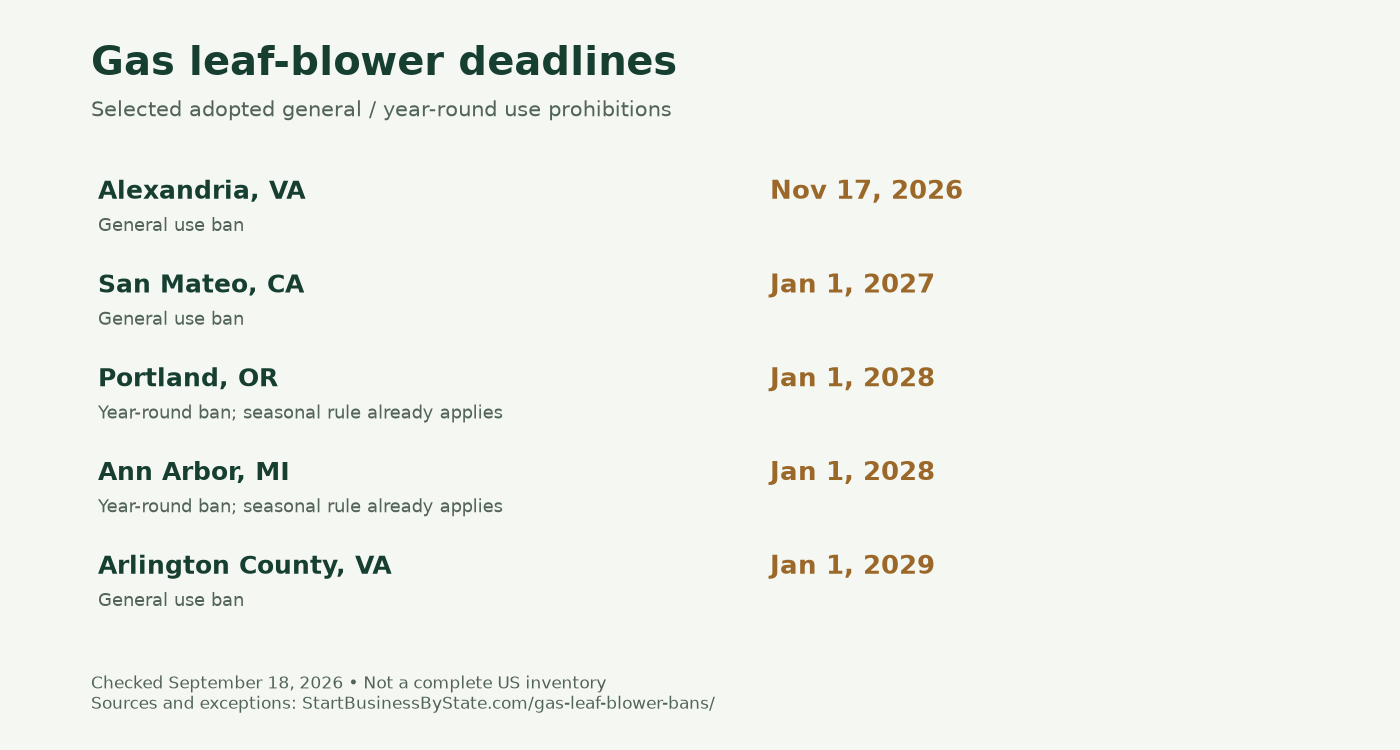
A company serving neighboring jurisdictions may need different equipment assignments on the same day. Keep a route sheet with the job address, property authority, date, allowed equipment and any documented exception. A mailing address alone may not establish city limits.
For seasonal cleanup, compare the legal work window with your staffing plan. Our landscaping employment seasonality study provides workforce context; its employment patterns do not determine local legal permission.
California: new engines versus existing equipment
The CARB SORE program concerns engine standards and certification. CARB explicitly states that it does not regulate the use of existing CARB-compliant SORE equipment. That does not override San Mateo’s local use prohibition or another city’s rules. Check both levels before deciding whether a machine can be purchased, sold or used.
Federal proposal to watch: S.J.Res. 205, introduced August 5, 2026, seeks congressional disapproval of EPA’s authorization decision for California’s SORE regulations. Our September 18 LegiScan bill-detail check shows it as introduced and referred to committee, not enacted. It does not establish that the California rule has been repealed, and it should not be treated as permission to ignore a separate local ordinance.
Electric leaf-blower rebates: check the current terms
A rebate announcement is not a funding reservation. Check the applicant rules, eligible models, approved dealers, purchase dates and whether approval must come before purchase. The program checks below are dated September 18, 2026.
Montgomery County: commercial applications listed as open
The county’s 2026 commercial rebate page lists $1,000 toward eligible blowers, batteries or chargers for landscapers, with a possible additional $250 for an eligible power distribution manager. Applicants need a Montgomery County address and must use listed dealers. Approved vouchers must be redeemed within 30 days; tax and special delivery fees remain the recipient’s responsibility. Funding can run out.
The detailed page says residential rebates are unavailable at this time, despite broader wording elsewhere on the county website. Use the detailed application requirements for purchasing decisions.
San Mateo: confirm the current purchase window first
The city advertises a commercial rebate of 75% of eligible cost, capped at $500. However, the application terms retrieved for this review show a purchase window ending June 30, 2026, while other indexed city material references an extension. We could not reconcile the dates. Treat current availability as unconfirmed; request current written terms from the city before budgeting a rebate for a new purchase.
Washington, DC: an old rebate link is not proof of a current blower offer
DLCP’s guidance refers readers to DCSEU for rebates, but the linked current program page is for residential electric lawn mowers. We have not verified a current commercial leaf-blower rebate there. Do not substitute a mower incentive for a blower incentive.
Budget with confirmed assistance only. No rebate entry means “not verified in this review,” not “no assistance exists.” Local utilities, air districts or manufacturers may offer separate programs with their own terms.
How to budget the switch without guessing at a price increase
- Inventory the route. Identify the first deadline that affects an actual customer, rather than replacing the whole fleet solely because a nearby city changed its rules.
- Test a representative job. Record crew time, batteries consumed and charging downtime for dry leaves, wet leaves and the distances your crews actually cover. A manufacturer’s maximum runtime is not a guaranteed full-day result.
- Get complete quotes. Include blowers, compatible batteries, chargers, any electrical work, tax, training and backup capacity. Confirm whether batteries and chargers are included in a kit.
- Separate cash timing from eventual cost. A later reimbursement does not pay the invoice today. Our commercial-contract cash guide explains how to plan around the lowest cash balance.
- Price the actual service. Add measured labor and equipment costs to the contract model. A universal percentage surcharge would conceal differences in route size, battery requirements and labor productivity.
Illustrative cash example: a $3,200 equipment-and-charging quote needs $3,200 upfront if no point-of-sale discount is confirmed. If a separately approved $500 reimbursement arrives later, the eventual net cost would be $2,700; the initial cash need remains $3,200. These are assumed amounts, not equipment prices or promised rebate eligibility.
Public buyers may specify equipment beyond the local minimum. Review our municipal landscaping bid guide before quoting. If you add equipment or battery storage, use the landscaping business insurance guide to prepare questions about equipment limits, theft, transport and exclusions; a policy should not be assumed to cover regulatory fines.
Common questions about leaf-blower bans
Is there one nationwide gas leaf-blower ban?
This comparison does not establish a nationwide prohibition. It documents selected local use restrictions and distinguishes California’s statewide engine standards. The applicable rule depends on the worksite.
Can I use a gas blower because I bought it before the ban?
Do not assume an older machine is exempt from a local use ban. A restriction on operating equipment can apply regardless of purchase date. Check the actual ordinance and any listed exception.
Does buying an electric blower remove every restriction?
No. Operating hours, noise rules, debris disposal and customer specifications can still apply. San Mateo’s adopted ordinance, for example, retains residential-area time limits for electric equipment.
Does a proposed state bill change today’s rules?
A proposal is not an enacted restriction. Our September 18 LegiScan check lists New Jersey S623 as introduced, not enacted. It is excluded from the adopted-rules table. Recheck current bill status before using any proposed deadline.
Sources, scope and downloadable data
We reviewed official municipal codes, agency explanations and program pages on September 18, 2026. The table includes seven local jurisdictions plus one statewide comparison, selected to show approaching deadlines, seasonal restrictions and different legal scopes. It is not an exhaustive US inventory, a count of affected businesses or a ranking of enforcement severity.
Dates are adoption or implementation dates as identified in the cited sources; the review date is separate. Rebates were checked against program-specific information where available, with unresolved availability explicitly labeled. The San Mateo ordinance itself confirms its January 2027 deadline even though rebate dates require clarification. LegiScan supports the separate proposal check; it is not a comprehensive source for city ordinances. This is a manually reviewed snapshot, not an automated alert service.
For citation: StartBusinessByState.com, “Gas Leaf-Blower Bans: Deadlines, Exceptions and Rebates,” checked September 18, 2026. The CSV includes the source and review date for every row. Please retain those dates when reusing the comparison and link to this page so readers can inspect its scope.