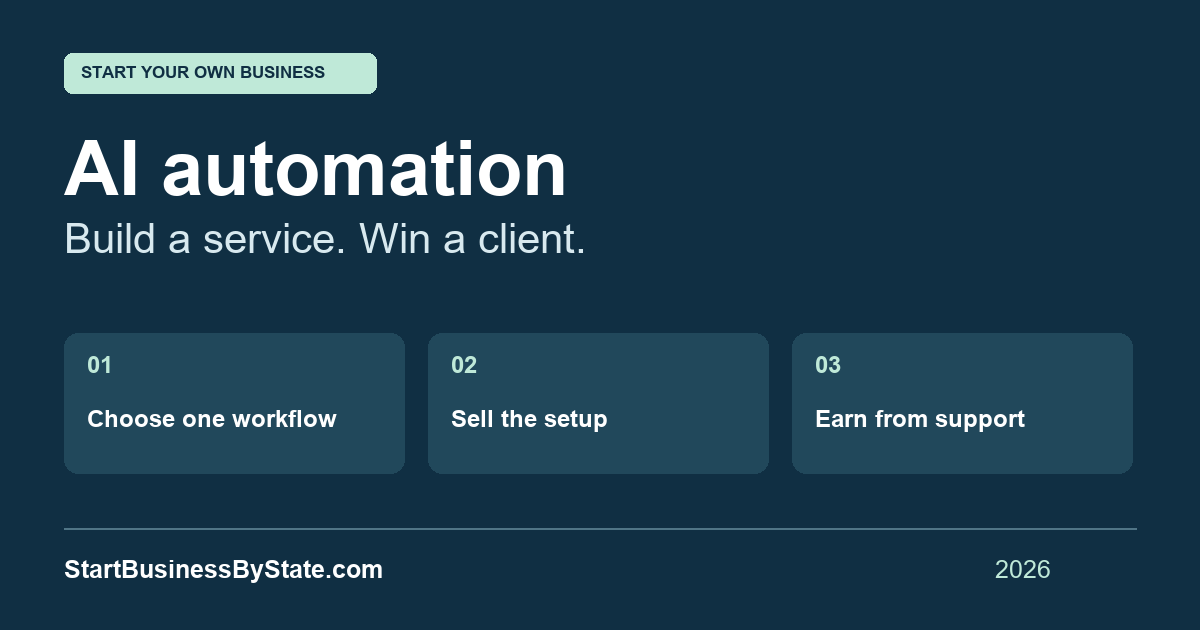
START A BUSINESS SELLING AI SERVICES
Turn the repetitive work inside a small business into a service you can sell. Build systems that organize new inquiries, prepare documents and keep customer follow-ups moving, then earn ongoing revenue by maintaining them.
To start an AI automation business, choose a customer group, build one useful workflow and package its setup and support. You can begin as a solo operator using existing software, then add clients and people as your delivery process improves.
By StartBusinessByState · Checked October 15, 2026. Some provider links are affiliate links. We may earn a commission if you use them, at no additional cost to you.
How an AI automation business makes money
Your customer pays you to make a task work reliably across the tools they already use. For example, a contractor receives a website inquiry, AI extracts the job details, and the system creates a customer record for the office to review. You build the connection, test it and keep it running.
Setup projects
Charge to map the process, connect the software, configure the AI step, test real examples and teach the customer how to use it. Define the deliverables and payment milestones before work begins.
Monthly support
Charge for monitoring, fixing failures, reviewing usage and making an agreed amount of improvements. A useful monthly service earns its renewal by keeping the system dependable.
What the revenue could look like
Two $2,500 setup projects plus ten clients paying $300 a month for support would produce $8,000 in monthly revenue. With $1,200 of contractor costs, $300 of software and $200 of insurance and administration, $6,300 would remain before paying for your own work and taxes.
Illustrative business model, not surveyed prices or a first-month forecast. With the same expenses and no new setup projects, the $3,000 support revenue would leave $1,300. Quote each project around its workload, and price support around the time it will take.
There is a market for implementation work. Upwork’s 2026 skills report recorded 178% growth in AI integration demand on its marketplace. That supports researching this service; it does not tell you how much a particular customer will spend. Source details.
1. Choose one customer and one service to sell
Use evidence to narrow the service: what businesses actually use AI for compares writing, document handling, information search and other tasks in the Census 2026 supplement.
Start with a business process you understand. An owner should be able to recognize the problem in your first sentence. “I organize your new job inquiries so your office can respond faster” gives a contractor something specific to consider.
| Customer | Service you build | What stays with a person |
|---|---|---|
| Home-service contractor | Read incoming job requests, extract location and job type, and prepare a customer record. | The office confirms urgency, service area and scheduling. |
| Small professional-services firm | Turn intake documents into a structured summary and a list of missing information. | A staff member checks the summary before advising the client. |
| Online store | Prepare answers using the store’s approved shipping, returns and product information. | Staff handle exceptions, refunds and uncertain answers. |
| Agency or consultant | Turn meeting notes into draft tasks and follow-up messages. | The account owner approves commitments and sends the message. |
Our AI adoption research by industry can help you explore customer groups. Follow it with conversations: ask owners which task repeats, how they handle it now and what goes wrong. Low AI adoption alone does not establish a willing buyer.
For the first package, choose one input, one useful output and a clear approval step. An AI receptionist, a support chatbot and a document-processing service each require different testing. Pick one to become good at first.
2. Build a working example before selling the setup
You can learn visual automation with tools such as Make or Zapier. More customized projects may involve n8n, programming and direct software connections. Start with the tool that connects the customer’s existing systems and that you can troubleshoot yourself.
Make Academy’s free courses provide a starting point. Practice connecting a form to a spreadsheet, then add an AI step that extracts or summarizes information. Use made-up customer details in your demonstration.
Before charging for delivery, be able to explain what happens when a field is missing, the AI is uncertain, a request arrives twice or a connected app stops responding. Build a visible failure alert and a way for staff to finish the task manually.
Record a short demonstration that shows an incoming request, the result and the review step. Use it in sales conversations. Build each customer’s production system in accounts they control where practical, with your access separately granted.
3. Set up the company that will sign your client contracts
An LLC gives your AI services business a separate legal identity for contracts, banking and ownership. It can help separate business liabilities from personal assets, subject to how you operate it and the circumstances of a claim. A solo operator can own an LLC; you do not need employees.
Choose your business name, appoint a registered agent and file your formation documents with the state. If you want help with that paperwork, ZenBusiness prepares and submits the LLC filing. Its Starter service is $0 plus your state’s filing fee.
Filing service provided by ZenBusiness. Optional services and trial renewals cost extra. State approval and processing times vary.
After formation, get an EIN if needed and open a separate business bank account. You can apply for an EIN free through the IRS. Put the company’s name on your agreement and invoices, and record expenses from the start.
Check your city or county’s business-license and home-office requirements. Your service and customers also determine which privacy and AI rules apply; use our state AI law tracker to identify issues to review before deployment.
4. Get insurance for the technology work you deliver
A client may claim that an automation error lost orders, damaged data or interrupted their business. Technology errors and omissions insurance addresses claims arising from your professional work, subject to the policy. Cyber coverage addresses a different set of data-security costs and liabilities.
Simply Business is an insurance agency that offers quotes for IT consultants. Describe your AI integration work, the systems you access and the customer data you handle so the agency can check available coverage for your services.
Get my technology business insurance quote
Quotes through Simply Business. Availability and coverage depend on your work, state and insurer. Ask specifically about AI-related services and exclusions, technology E&O and cyber coverage.
If you visit customer premises, ask about general liability too. Match the policy limits and any certificate of insurance to your client contract before the project starts.
5. Package a project the customer can understand
For evidence on how implementation work is sourced, see AI vendors versus AI-trained hires. The Census comparison separates outside consulting, staff training and new hires by business size.
Sell a defined result with a defined boundary. “Website inquiry intake setup” is easier to scope than “automate your business with AI.” Write down the apps involved, the data you will use, the result the customer will receive and how they will accept the work.
A first-project package
Connect one inquiry form to one customer database. Extract the job type and location, prepare a record for staff review and flag incomplete requests. Include a set of agreed test examples, a handover session and a defined period for correcting defects.
Quote extra forms, new software connections and added workflows separately. Offer ongoing monitoring after the customer accepts the setup.
Estimate your discovery, build, testing, training and support hours before naming a price. For example, 25 hours at an internal planning rate of $60 is $1,500 of labor. Add direct costs and a margin for the business. Those figures are assumptions for the calculation, not a published market rate.
Then compare the proposal with the customer’s problem. If the process takes five hours a week at a $30 hourly labor cost, the current labor value is about $650 a month: 5 × $30 × 52 ÷ 12. Some work will still need review. Use a measured improvement from the pilot when discussing savings.
For monthly support, specify the monitoring frequency, included changes, response hours and usage limits. Have the customer pay software vendors directly where practical, or show usage charges separately so growing volume does not silently consume your margin.
What does it cost to start an AI automation business?
With a computer and internet connection already available, your first spending decisions are software, business setup and protection. Free learning and demonstration tools let you validate a service before committing to a large software stack.
| Item | What to budget |
|---|---|
| Training and demo workflow | Make Academy is free. Make lists a free tier with 1,000 credits a month; a multi-step workflow can use several credits per run. |
| AI usage and production software | Use a capped testing budget, then price the customer’s expected volume. Model usage, automation subscriptions and customer-management tools may be separate charges. |
| LLC and local registration | Your state filing fee, any local license fees and the services you choose. Include recurring state charges in the ongoing budget. |
| Insurance and contract review | Obtain quotes for the work you will perform. Include contract review before taking on sensitive data or substantial service obligations. |
| Website, email and bookkeeping | A clear service page, professional email and a way to invoice and keep records. Start with the functions you will use. |
Example cash plan: allow $150 for three months of demonstration software and AI usage, $180 for a year of domain, basic website and email costs, and $200 contingency. That is $530, plus actual registration fees, insurance and contract costs. These are planning allowances to replace with your quotes; they exclude a computer and your living expenses.
Keep production software for paying customers separate from this testing budget. Where the agreement allows, take a project deposit and use payment milestones so you are not funding the entire build before the customer pays.
6. Put the scope, data access and handover in writing
A clear service agreement makes the project easier to deliver and bill. Include the exact workflow, payment schedule, acceptance tests, included revisions and what counts as additional work.
- Record who owns the accounts, workflow and finished materials, and how access transfers when the engagement ends.
- Agree which customer information may enter each tool, who can access it and when it will be deleted.
- Name the person who approves customer-facing messages, financial changes and other consequential actions.
- Define support hours, incident reporting, cancellation and the boundary between defect fixes and new features.
Use individual access permissions instead of shared passwords. Keep test information separate from live customer records. Have the customer approve the workflow before switching it on for real inquiries.
7. Get your first AI automation client
Start with businesses you can understand and reach: a former employer, an owner you know, or companies in a trade you have worked with. Ask to see how one recurring task gets done. A specific problem and a working demonstration make a stronger conversation than a list of AI tools.
- Talk to ten owners in one customer group. Ask about one process: where requests arrive, who handles them and which part takes the most effort. Ten is a manageable research target, not a conversion forecast.
- Adapt your demonstration to a recurring problem. Show sample inputs and outputs. Explain the approval step and what staff do when something fails.
- Offer a small paid pilot. Agree on a limited scope, a price and an acceptance test. Work in a test environment until the customer approves production access.
- Review the result together. Measure processing time, missed requests, corrections and ongoing workload. Ask permission before publishing the results or using the customer’s name.
A useful opening might be: “I build inquiry-intake systems for home-service businesses. Could you show me how a new website request gets into your schedule? I can show you a short example using sample job details.”
Web designers, bookkeepers and IT providers may also know businesses struggling with manual work. Explain exactly which process you handle so they can recognize a good referral. Keep the first customer close enough that you can learn from the handover.
8. Turn a finished project into a repeatable service
Before handover, run the agreed examples and failure cases with the customer. Give them a short operating guide, the account-access list, usage limits and a clear way to report a problem.
For a support client, review failed runs, usage and changes in the customer’s software. Show what you checked and fixed. Once the same setup works for several customers, document the reusable parts and price the exceptions separately. That is how you add capacity without rebuilding every engagement from scratch.
Questions before starting an AI automation agency
Do I need to know how to code?
You can build some form, document and customer-management workflows with visual tools. You still need to understand the process, test the result and diagnose failures. Bring in an experienced developer for work beyond what you can reliably deliver.
Can I start this business on my own?
Yes. You can sell and deliver a narrowly scoped service as a solo operator. Set support hours you can meet, then add specialist help as your projects require it.
Do I have to form an LLC?
An LLC is a business-structure choice, not an AI qualification. It gives the business its own legal identity and can help separate business liabilities from personal assets. A sole proprietor may also operate, subject to applicable registration rules. Choose the structure before signing contracts in the business’s name.
How soon can I get a paying client?
That depends on your skills, relationships and the usefulness of your offer. If you already understand a customer’s process and can demonstrate a working solution, you can discuss a paid pilot. If you are learning the tools, first build and troubleshoot a complete example.
Is an AI consulting business the same thing?
Consulting focuses on deciding where and how a customer should use AI. An automation business also builds and maintains the resulting systems. You can sell an initial assessment, but make clear whether implementation and support are included.
Check the business requirements where you work
The service you sell can reach customers nationwide. Your home state’s formation fees, recurring filings and local business rules still belong in your launch plan. Use the state business requirements directory when you are ready to check those details.
Sources and how to read the examples
Checked October 15, 2026. Revenue and budget examples are our illustrative calculations, not measured agency earnings, quoted insurance premiums or promises of results.
- Upwork, In-Demand Skills 2026: marketplace demand for AI implementation skills.
- U.S. Small Business Administration, launch your business: structures, registration and licensing.
- Make pricing: free-tier allowance and usage billing.
- ZenBusiness LLC service and Simply Business IT consultant coverage information were checked on their official sites. Provider links above lead to the available formation or quote process; individual services and coverage must be selected there.