Original data analysis · Published October 16, 2026
Writing and editing dominates business use of generative AI: 85.4% of businesses whose employees use it report that task. Searching for information comes next at 49.9%, followed by interpreting, analyzing, translating or summarizing documents at 44.6%.
The Census Bureau’s 2026 AI supplement lets us move beyond “Does this business use AI?” and see the work behind that answer. Its results point toward everyday communications and document work, with a smaller share using generative AI for coding or customer support.
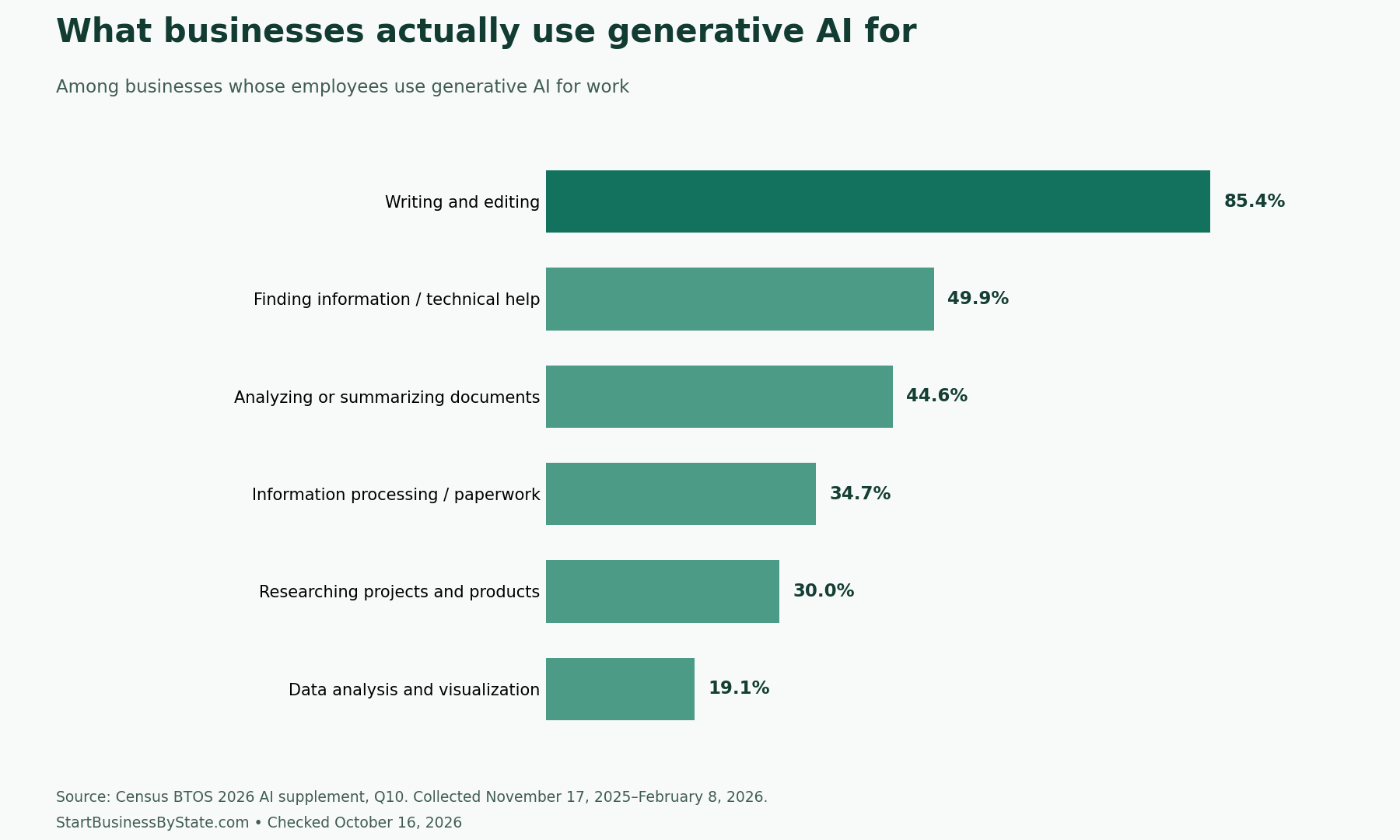
The ten tasks employees use generative AI for
Writing is much more common than coding in this survey. A service provider can start with a workflow the client already recognizes: drafting a response, extracting details from a document or finding information inside a knowledge base.
| Work task | Businesses reporting use | 90% margin, percentage points |
|---|---|---|
| Writing or editing documents, emails, or communications | 85.4% | ±0.41 |
| Searching for information or technical help | 49.9% | ±0.36 |
| Interpreting, analyzing, translating, or summarizing documents | 44.6% | ±0.46 |
| Information processing, paperwork, or filing | 34.7% | ±0.49 |
| Developing or researching new projects, processes, or products | 30.0% | ±0.36 |
| Data analysis or visualization | 19.1% | ±0.46 |
| Tutoring, training, or learning | 16.1% | ±0.43 |
| Customer support | 15.5% | ±0.36 |
| Software coding or debugging | 12.7% | ±0.38 |
| Other tasks | 6.1% | ±0.33 |
Which business functions use AI?
This is a different denominator: all businesses in the survey’s employer-business population. Sales and marketing leads at 14.3%, followed by strategy and business development at 12.4%. These figures cover AI generally, rather than generative AI alone.
| Business function | All businesses reporting AI use | 90% margin, percentage points |
|---|---|---|
| Sales and marketing | 14.3% | ±0.18 |
| Strategy and business development | 12.4% | ±0.18 |
| Information technology | 11.4% | ±0.15 |
| Research and development | 11.2% | ±0.16 |
| Public relations and communication | 9.3% | ±0.13 |
| Management and administration | 8.1% | ±0.15 |
| Customer service | 7.6% | ±0.15 |
| Legal and compliance | 7.1% | ±0.15 |
| Finance and accounting | 6.6% | ±0.13 |
| Provision of services, products, or merchandise (e.g., providing services, products, or merchandise to customers) | 6.4% | ±0.13 |
| Human resources | 4.2% | ±0.12 |
| Quality management and control | 2.8% | ±0.05 |
| Sourcing, supply chains, and purchasing | 2.6% | ±0.10 |
| Production of goods (e.g., making or assembling products, construction) | 1.7% | ±0.05 |
| Distribution | 0.9% | ±0.05 |
Small businesses are already using AI for marketing
Among businesses with one to four employees, 13.1% reported AI use in sales and marketing. The corresponding figures were 7.1% for customer service and 6.9% for management and administration. Those are separate functions, so a business can appear in more than one column.
| Employees | Sales and marketing | Customer service | Management and administration |
|---|---|---|---|
| 1–4 | 13.1% | 7.1% | 6.9% |
| 5–9 | 15.2% | 7.9% | 8.2% |
| 10–19 | 15.8% | 8.0% | 9.6% |
| 20–49 | 17.4% | 9.0% | 11.5% |
| 50–99 | 18.0% | 9.9% | 14.0% |
| 100–249 | 19.5% | 11.0% | 17.4% |
| 250+ | 19.0% | 14.2% | 16.3% |
What an automation provider can do with this
The task is only half the offer. Our study of outside AI vendors, hiring and staff training examines how AI users obtain implementation help and how that differs by company size.
The survey identifies tasks in use; it does not measure how many firms want to hire an outside consultant. Use it to choose a service to investigate with customers, then confirm the problem, budget and approval process with the business itself.
- Writing and document work: build a workflow that turns an approved source document into a draft email, report or summary, with a person checking the result.
- Finding information: organize a business’s approved instructions and documents so staff can retrieve a useful answer and its source.
- Customer follow-up: connect an inquiry to the right response, handoff and record. Test missed messages and incorrect answers before making it live.
These are service examples, not separate categories measured by Census. Choose one customer group and one measurable workflow before offering a broad “AI transformation” package.
Data, denominators and limitations
Source: Census Business Trends and Outlook Survey downloads, AI Supplement Table 2026. Collection ran November 17, 2025–February 8, 2026. Questions refer to the preceding six months; collection dates are not a single six-month business-activity window.
Q2 represents all companies in the target population (scope 1). Q10 represents businesses reporting employee generative-AI use in work tasks (scope 4). We do not divide Q2 by the two-week AI adoption percentage to estimate adopter-only shares: those questions have different reference periods. The survey covers employer businesses and excludes nonemployers; figures are business-weighted, not worker-weighted.
Margins shown are 1.645 times each published standard error, in percentage points. They describe sampling uncertainty, not all survey error. Small differences are not presented as statistically established rankings. Task answers can overlap. The employment-size table uses the corresponding published size rows; it is not a count of individual AI users.
Checked October 16, 2026. This supplement provides task detail; the separate AI adoption by industry study tracks the broader adoption question on its own schedule.
Cite this study
StartBusinessByState.com. “What Businesses Actually Use AI For: Writing, Documents and Office Work.” Published October 16, 2026. https://startbusinessbystate.com/what-businesses-use-ai-for/.
Our original analysis and graphic are available under CC BY 4.0. Credit this study and link to this page when reusing them. Underlying federal data remain available from the original agencies.
Embed the chart with a credit link
<figure><a href="https://startbusinessbystate.com/what-businesses-use-ai-for/"><img src="https://startbusinessbystate.com/wp-content/uploads/2026/10/what-businesses-use-ai-for.png" alt="What Businesses Actually Use AI For: Writing, Documents and Office Work" style="max-width:100%;height:auto"></a><figcaption>Source: <a href="https://startbusinessbystate.com/what-businesses-use-ai-for/">StartBusinessByState.com</a></figcaption></figure>