Original research · Official state program pages + Census + EIA + LegiScan · Last updated October 6, 2026
Data through: rebate status checked on each state’s official program page on October 6, 2026. Home heating fuel: Census ACS 2024 1-year. Prices: EIA 2025 annual averages. Rechecked monthly.
Federal heat pump rebates are open in 11 states and DC as of October 6, 2026, per official state program pages. Eight are fully open and four are open only for some homes or areas. California and Colorado ran out of single-family money. Since September 1, 2026, rebates no longer pay to swap a gas furnace for a heat pump.
Key findings
- Open in 11 states and the District of Columbia. Fully open: Georgia, Indiana, New Mexico, New York, North Carolina, Rhode Island, West Virginia and Wisconsin. Open with limits: Arizona, the District of Columbia, Maine and Michigan. Together they hold 32.0 million of the 132.7 million U.S. households (24.1%), per Census ACS 2024 table B25040.
- 31 states have not launched. Their official pages say the program is pending federal approval, being redesigned, on hold or “coming soon.” Missouri says rebates may not arrive until 2027 or as late as 2028. South Dakota never applied for its roughly $69 million.
- Two early states are out of single-family money. California’s single-family rebates have been fully reserved since February 24, 2026, with a waitlist. Colorado closed its single-family program in both regions (page updated August 2026).
- Gas-to-heat-pump swaps no longer qualify. DOE Program Notice 26-2 limits rebates to replacing electric equipment with more efficient electric equipment, plus new construction, for reservations made after August 31, 2026 (NASEO FAQ, August 2026). 46.6% of U.S. homes heat with utility gas.
- The federal tax credit is gone. The 25C credit, worth up to $2,000 a year for a heat pump, covered improvements made through December 31, 2025, according to the IRS. Rebates are now the main federal help left, and only where they are open.
- Running costs vary a lot by state. At 2025 average home prices, a heat pump in Florida needs a seasonal efficiency (COP) of just 1.73 to heat for less than a 95% gas furnace. In Alaska it needs 5.81. The U.S. average is 3.26. Modeled
Where you can apply for federal heat pump rebates
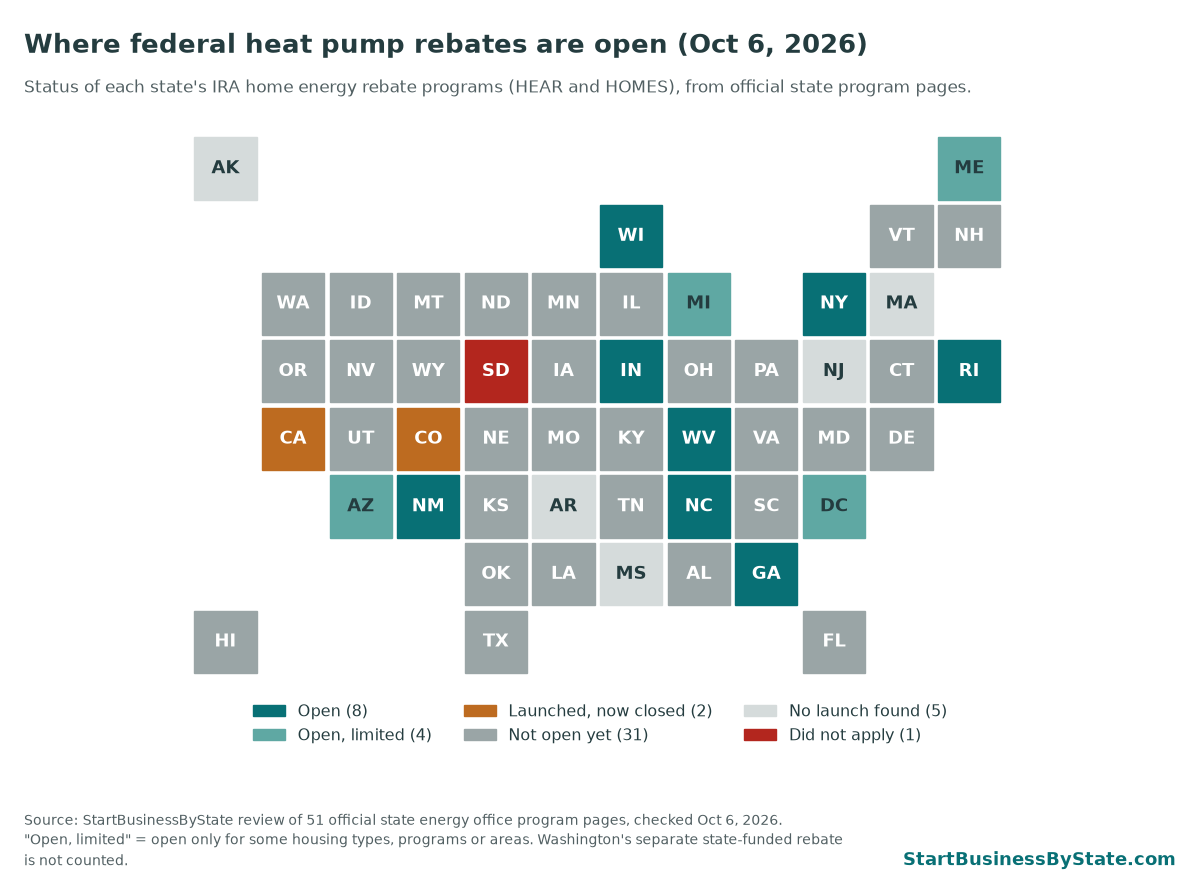
The Inflation Reduction Act gave every state money for two rebate programs. HEAR (Home Electrification and Appliance Rebates) pays toward heat pumps, heat pump water heaters, panels and wiring. HOMES pays for whole-home energy savings. States run the programs, so each one opens on its own schedule. More than four years after the law passed, most still have not opened.
The rules also changed this year. DOE’s Program Notice 26-2 ended rebates for fuel switching, meaning replacing a gas, propane or oil system with a heat pump. Reservations made after August 31, 2026 can cover only an electric-to-electric upgrade or new construction (NASEO FAQ on DOE program changes, August 2026). Several states that had not launched, including Maryland and Pennsylvania, now say they must redesign their programs first.
Heat pump rebate status and heating costs in every state
Click a column header to sort. The status column sorts from open to not available. Each state’s “Source” link goes to the official page we checked on October 6, 2026. State names link to our guide to starting an HVAC business there.
| State | Federal rebate status | What the state says | Homes heated with electricity | Homes heated with utility gas | Home electricity price (2025) | Home gas price, per Mcf (2025) | Break-even heat pump COP Modeled | Bills mentioning heat pumps |
|---|---|---|---|---|---|---|---|---|
| Georgia | Open | Georgia Home Energy Rebates portal is live with income-based rebates. Source | 57.6% | 37.4% | 14.73¢ | $20.42 | 2.08 | 3 |
| Indiana | Open | Indiana Energy Saver launched May 14, 2025 and is taking applications. Source | 32.1% | 58.6% | 16.23¢ | $11.49 | 4.08 | 0 |
| New Mexico | Open | Federal HEAR rebates available to income-eligible residents, rolled out in phases. Source | 22.5% | 63.2% | 15.08¢ | $9.83 | 4.43 | 3 |
| New York | Open | HEAR incentives are paid through NYSERDA's EmPower+ program for income-eligible households. Source | 16.5% | 59.8% | 26.39¢ | $17.58 | 4.33 | 24 |
| North Carolina | Open | Energy Saver North Carolina launched Jan 16, 2025 and is expanding county by county. Source | 66.0% | 25.0% | 14.02¢ | $16.42* | 2.47* | 0 |
| Rhode Island | Open | HEAR launched Sep 17, 2024; HOMES launched Sep 23, 2026. Source | 14.2% | 53.4% | 29.46¢ | $21.66* | 3.93* | 8 |
| West Virginia | Open | Statewide launch Sep 28, 2026, after a pilot. Source | 48.2% | 39.4% | 15.41¢ | $13.80 | 3.22 | 4 |
| Wisconsin | Open | Focus on Energy IRA HEAR is taking income-qualified applications. Source | 18.3% | 64.9% | 18.16¢ | $10.74 | 4.88 | 0 |
| Arizona | Open, limited | Efficiency Arizona restarted on a limited basis; reservations made on or after Sep 1, 2026 follow the new federal rules (no gas-to-electric). Source | 59.1% | 34.2% | 15.32¢ | $18.58 | 2.38 | 0 |
| District of Columbia | Open, limited | Federal rebates only through the DCSEU low-income AHRA and AHEP programs. Source | 49.9% | 45.0% | 21.94¢ | $16.68 | 3.80 | 0 |
| Maine | Open, limited | HEAR is live only for new affordable multifamily housing and manufactured (mobile) homes. Source | 13.5% | 8.3% | 27.78¢ | $18.95* | 4.23* | 6 |
| Michigan | Open, limited | MiHER is open, but new income-qualified applications are paused in five districts (Detroit, Warren, Grand Rapids, Lansing, Kalamazoo). Source | 12.5% | 74.8% | 20.01¢ | $10.92 | 5.29 | 6 |
| California | Launched, now closed | Launched in 2024; single-family rebates fully reserved since Feb 24, 2026, with a waitlist. Source | 30.1% | 60.6% | 32.54¢ | $22.01 | 4.27 | 16 |
| Colorado | Launched, now closed | Single-family HEAR closed in both regions (page updated August 2026). Source | 25.5% | 66.6% | 15.85¢ | $11.17 | 4.10 | 6 |
| Alabama | Not open yet | Program page says it is still being built. Source | 67.5% | 25.9% | 16.10¢ | $17.56 | 2.65 | 3 |
| Connecticut | Not open yet | Blueprints under DOE review; rebates not available until launch. Source | 20.2% | 36.2% | 29.38¢ | $16.83* | 5.04* | 0 |
| Delaware | Not open yet | Expected to launch once funding arrives; page is undated. Source | 39.1% | 41.3% | 17.13¢ | $15.97 | 3.10 | 0 |
| Florida | Not open yet | State portal says both programs are expected to launch in the future. Source | 89.7% | 5.9% | 15.24¢ | $25.48 | 1.73 | 1 |
| Hawaii | Not open yet | Completing pre-launch steps for final DOE approval. Source | 44.4% | 3.7% | 40.59¢ | $52.38 | 2.24 | 5 |
| Idaho | Not open yet | State page says rebates are not available. Source | 35.1% | 52.6% | 11.82¢ | $7.69 | 4.44 | 0 |
| Illinois | Not open yet | Launch pending DOE approval. Source | 18.9% | 75.5% | 17.69¢ | $11.25 | 4.54 | 24 |
| Iowa | Not open yet | State page says rebates are not yet available. Source | 25.3% | 59.7% | 13.72¢ | $10.61 | 3.73 | 0 |
| Kansas | Not open yet | Kansas Home Rebates is listed as coming soon. Source | 26.9% | 63.2% | 14.56¢ | $14.81 | 2.84 | 0 |
| Kentucky | Not open yet | Not yet accepting rebate applications. Source | 55.4% | 34.6% | 13.24¢ | $14.23 | 2.69 | 0 |
| Louisiana | Not open yet | State page says implementation is in progress; no application route. Source | 63.7% | 33.0% | 12.57¢ | $17.39 | 2.09 | 0 |
| Maryland | Not open yet | Must revise and resubmit its application under DOE's new rules (Sep 30, 2026 update). Source | 45.4% | 42.9% | 19.48¢ | $16.14* | 3.48* | 4 |
| Minnesota | Not open yet | Waiting for DOE approval; no estimated launch date. Source | 19.9% | 65.3% | 15.82¢ | $10.98 | 4.16 | 9 |
| Missouri | Not open yet | State says rebates may not arrive until 2027 or 2028. Source | 39.2% | 49.0% | 13.49¢ | $14.94 | 2.61 | 1 |
| Montana | Not open yet | State page says the program is not available. Source | 28.4% | 49.9% | 12.98¢ | $8.99 | 4.17 | 0 |
| Nebraska | Not open yet | Listed as preparing its application. Source | 31.8% | 58.7% | 12.34¢ | $11.40 | 3.13 | 0 |
| Nevada | Not open yet | Program page shows a timeline with no consumer launch. Source | 33.0% | 61.1% | 13.15¢ | $13.14 | 2.89 | 0 |
| New Hampshire | Not open yet | Under development; funding not yet available to consumers. Source | 11.9% | 22.2% | 24.56¢ | $18.61 | 3.81 | 0 |
| North Dakota | Not open yet | Neither program has launched; no estimated date. Source | 41.0% | 39.8% | 11.81¢ | $9.50 | 3.59 | 0 |
| Ohio | Not open yet | Awaiting DOE approval of the application submitted Nov 12, 2024. Source | 26.5% | 64.0% | 16.96¢ | $13.85 | 3.54 | 1 |
| Oklahoma | Not open yet | State describes the rebate programs as forthcoming. Source | 41.9% | 49.6% | 13.12¢ | $14.38 | 2.63 | 3 |
| Oregon | Not open yet | State page says no rebates are available. Source | 54.0% | 37.5% | 15.37¢ | $16.71 | 2.66 | 2 |
| Pennsylvania | Not open yet | Awaiting final DOE approval to launch (as of September 2026); redesigning for DOE's new rules. Source | 26.0% | 52.0% | 19.30¢ | $15.04 | 3.70 | 10 |
| South Carolina | Not open yet | Not available; state expects a 2026 launch. Source | 69.7% | 25.1% | 14.96¢ | $16.91* | 2.55* | 1 |
| Tennessee | Not open yet | Funding not yet available; needs full DOE approval and an executed agreement. Source | 64.6% | 30.2% | 13.18¢ | $11.84 | 3.21 | 0 |
| Texas | Not open yet | Not available (page updated Aug 21, 2026). Source | 60.5% | 35.4% | 15.47¢ | $19.42 | 2.30 | 3 |
| Utah | Not open yet | On hold until further notice. Source | 16.7% | 78.9% | 13.07¢ | $10.19 | 3.70 | 2 |
| Vermont | Not open yet | Not launched; rebates cannot be paid retroactively. Source | 11.8% | 19.8% | 22.92¢ | $18.00 | 3.68 | 1 |
| Virginia | Not open yet | Awaiting DOE review of updated application documents. Source | 57.7% | 32.6% | 15.28¢ | $16.79 | 2.63 | 23 |
| Washington | Not open yet | Federal program still at "program operation preparation" (Step 5). A separate state-funded rebate is not counted here. Source | 60.0% | 32.7% | 13.11¢ | $17.62 | 2.15 | 8 |
| Wyoming | Not open yet | Page still says the state "expects to launch HESP in 2025"; no launch found. Source | 24.2% | 59.1% | 13.38¢ | $11.74 | 3.29 | 0 |
| Alaska | No launch found | No consumer rebate program or launch date found on the Alaska Energy Authority site. Source | 15.3% | 48.3% | 26.09¢ | $12.96 | 5.81 | 0 |
| Arkansas | No launch found | No consumer rebate program or launch date found on Arkansas state energy pages. Source | 54.1% | 36.6% | 12.84¢ | $19.25 | 1.93 | 0 |
| Massachusetts | No launch found | State plans to deliver HEAR through Mass Save; no consumer launch announcement found. Source | 20.5% | 52.0% | 30.48¢ | $25.06 | 3.51 | 15 |
| Mississippi | No launch found | No consumer rebate program or launch date found on Mississippi state energy pages. Source | 57.8% | 30.5% | 14.03¢ | $16.65 | 2.43 | 0 |
| New Jersey | No launch found | Planned as add-ons to existing low-income programs (Comfort Partners); no consumer launch announcement found. Source | 16.7% | 74.0% | 22.63¢ | $14.21 | 4.60 | 7 |
| South Dakota | Did not apply | The state chose not to apply for its roughly $69 million allocation (August 2024). Source | 31.6% | 48.8% | 13.38¢ | $9.86 | 3.92 | 0 |
Status: official state program pages, checked October 6, 2026. Heating fuel: share of occupied housing units by main heating fuel, Census ACS 2024 1-year, table B25040. “Electricity” includes baseboard and other resistance heat as well as heat pumps. Prices: EIA average residential prices. *Gas price is from 2024 because EIA has not published a 2025 annual figure for that state. Bills: LegiScan search for “heat pump” in current sessions, October 6, 2026; a bill counts if the phrase appears anywhere in it.
Download the data (CSV)Is a heat pump cheaper to run than gas in your state?
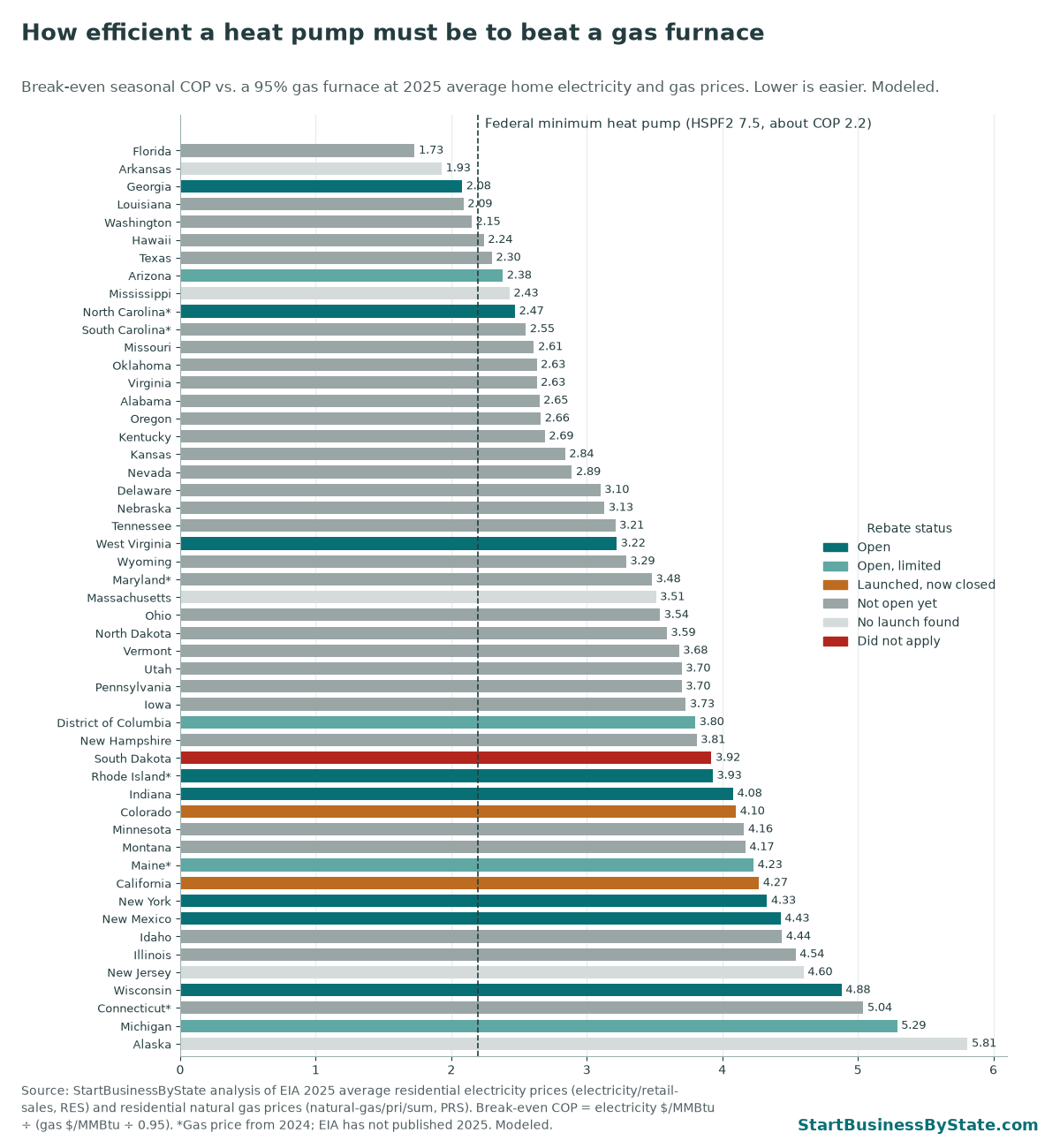
COP (coefficient of performance) is heat out divided by electricity in. A seasonal COP of 3 means the heat pump delivers three units of heat for each unit of electricity over the winter. The break-even COP is the point where a heat pump and a 95%-efficient gas furnace cost the same to run at your state’s average prices.
In 5 states, a heat pump at the federal minimum efficiency (about COP 2.2) already beats gas: Florida, Arkansas, Georgia, Louisiana and Washington. In those states, gas is expensive compared with electricity. In Alaska, Michigan and Connecticut, cheap gas and pricey electricity set a high bar, so savings depend on a high-efficiency unit. We compared heat pumps with gas only. EIA does not publish annual state propane and heating oil prices on the same basis, so those fuels are left out.
Homes that already heat with electricity are the market the rebates now serve. In Florida, 89.7% of homes heat with electricity, followed by South Carolina (69.7%), Alabama (67.5%) and North Carolina (66.0%). Nationally the figure is 41.8%.
What this means if you’re starting an HVAC business
Rebate work can fill a schedule, but only where a program is open and only for contractors the program has approved. Here is how to plan around it.
- Sign up early where programs are open. States pay rebates through registered contractors. Energy Saver North Carolina and Wisconsin’s Focus on Energy both have contractor sign-ups. West Virginia expects to need about 350 contractors for the statewide launch it announced on September 28, 2026. If you work in one of the open states, register before you market rebate jobs.
- Target homes that already heat with electricity. The new rules pay for electric-to-electric upgrades: old heat pumps, electric furnaces and baseboard heat. States with high electric heating shares have the most eligible homes. Gas-heated homes can still buy a heat pump, but the federal rebate won’t pay for the swap.
- Don’t promise money that isn’t there. The 25C tax credit ended with 2025, and most states have no open rebate. Quote the job at full price and show any rebate as a separate line that depends on program approval. Your state’s program page (linked in the table) is the source to share with customers.
- Sell running costs where the math works. In states with a low break-even COP, a heat pump can cut heating bills even without a rebate. In high break-even states, lead with comfort, cooling and replacing old electric heat. A maintenance agreement keeps those customers after the install.
- Watch equipment costs. Metal tariffs can push up what you pay for equipment and line sets. See our Section 232 tariff scenarios for HVAC.
New to the trade? Start with our guide to starting an HVAC business, then compare markets in the best states to start an HVAC business.
How we did this
- Rebate status. We read the official program page for each state’s energy office (or the agency that runs the program) on October 6, 2026 and sorted states by what the page says. “Open” means residents can apply now. “Open, limited” means open only for certain housing types, programs or areas: Arizona (limited restart under the new rules), Maine (new affordable multifamily and manufactured homes), Michigan (paused in five districts) and DC (only through two low-income programs). “No launch found” means we found no consumer program or launch announcement on official pages. Washington runs a separate state-funded rebate that we did not count, because this page tracks the federal programs.
- Program rules. NASEO, Home Energy Rebates FAQ, August 2026, summarizing DOE Program Notices 26-1 and 26-2. Federal HEAR caps as listed on Ohio’s program page. Tax credit: IRS, Energy Efficient Home Improvement Credit.
- Heating fuel. Census Bureau American Community Survey 2024 1-year estimates, table B25040 (house heating fuel): utility gas (B25040_002), bottled, tank or LP gas (003), electricity (004), fuel oil and kerosene (005), divided by occupied housing units (001). The 2025 1-year release was not yet available in the Census API.
- Energy prices. EIA Open Data API v2. Electricity: route electricity/retail-sales, residential sector (RES), annual average price, 2025. Natural gas: route natural-gas/pri/sum, price delivered to residential consumers (process PRS), annual, 2025, or 2024 where 2025 is withheld.
- Bills. LegiScan API getSearch for the phrase “heat pump” across all states in current sessions, run October 6, 2026. The count includes any bill that mentions heat pumps, from tax credits to homeowner association rules. California’s SB 222 on residential heat pump installations was chaptered on September 28, 2026 (LegiScan).
- a 95% AFUE gas furnace as the comparison
- statewide average residential prices (your utility’s rates may differ, and some utilities offer lower winter or heat pump rates)
- no difference in fixed monthly charges (a home that drops gas service entirely also saves its gas customer charge).
Caveats
- Program pages change often, and some are out of date. Wyoming’s page still says it “expects to launch HESP in 2025,” and Delaware’s undated page says it expects funding “later this year.” We report what each page says and flag stale ones in the table.
- New Mexico’s page still says HEAR equipment “must replace a non-electric model,” which predates the September 2026 rule change. Ask the program which rules apply before you quote.
- Census counts “electricity” as one heating fuel, so the electric share mixes heat pumps with baseboard and electric furnaces.
- Utility rebates and state-funded programs are separate from the federal programs and are not tracked here.
Census, EIA and federal program data are public domain. LegiScan data used under its API terms. This page has no ads or affiliate links. Cite as: StartBusinessByState, “Heat Pump Rebates by State,” updated October 6, 2026, https://startbusinessbystate.com/heat-pump-rebates-by-state/
Related research
- HVAC industry statistics: market size, jobs and wages.
- Where business electricity costs rose the most, by state.
- Electricity sources by state: how each state makes its power.
- Summer 2026 heat and HVAC employment.
- How to get commercial HVAC maintenance contracts.
FAQ
Which states have heat pump rebates open right now?
As of October 6, 2026: Georgia, Indiana, New Mexico, New York, North Carolina, Rhode Island, West Virginia and Wisconsin are open. Arizona, the District of Columbia, Maine and Michigan are open only for some homes, programs or areas. California and Colorado launched but ran out of single-family money. The other states have not opened, and South Dakota did not apply.
Can I get a federal rebate to replace a gas furnace with a heat pump?
Not for new reservations. Under DOE Program Notice 26-2, reservations made after August 31, 2026 can only cover replacing electric equipment with more efficient electric equipment, or equipment for new construction. Projects reserved by August 31 can still be finished and paid.
How much is the federal heat pump rebate?
Under the federal HEAR rules, up to $8,000 for a heat pump, up to $14,000 per household in total, for households earning under 150% of area median income. States set the exact amounts. Ohio’s program page lists the federal caps.
Is the 25C heat pump tax credit still available?
No. The IRS says the Energy Efficient Home Improvement Credit covered improvements made through December 31, 2025. It was worth up to $2,000 a year for a qualifying heat pump.
Is a heat pump cheaper to run than a gas furnace?
It depends on your state’s prices. Our break-even COP column shows how efficient a heat pump must be, on average over the season, to cost less than a 95% gas furnace at 2025 prices. The U.S. average is 3.26. A federal-minimum heat pump (HSPF2 7.5) works out to about COP 2.2.
Do HVAC contractors need to register to do rebate work?
Usually. Energy Saver North Carolina and Wisconsin’s Focus on Energy HEAR, for example, both run contractor registration for rebate jobs. Check your state’s program page in the table for its contractor sign-up.
How often is this page updated?
We recheck every state’s official program page each month and when a state announces a launch. Heating fuel data updates each fall with new Census figures, and prices update when EIA publishes a new year.
Last updated October 6, 2026. Rebate status checked on official state pages October 6, 2026. Next check: early November 2026.