Starting a cleaning, salon, daycare, landscaping, or HVAC shop? Your first state unemployment insurance (UI) bill is usually a published new-employer rate times the state’s taxable wage base — not a mystery invoice. This page ranks all 50 states and D.C. on that modeled year-1 cost for one employee who earns at least the wage base in tax year 2026.
Unemployment insurance tax changes for small employers by state.
Related payroll planning:
workers’ comp requirements and
paid sick leave employer-size thresholds.
Download CSV (51 jurisdictions)
What the ranking shows
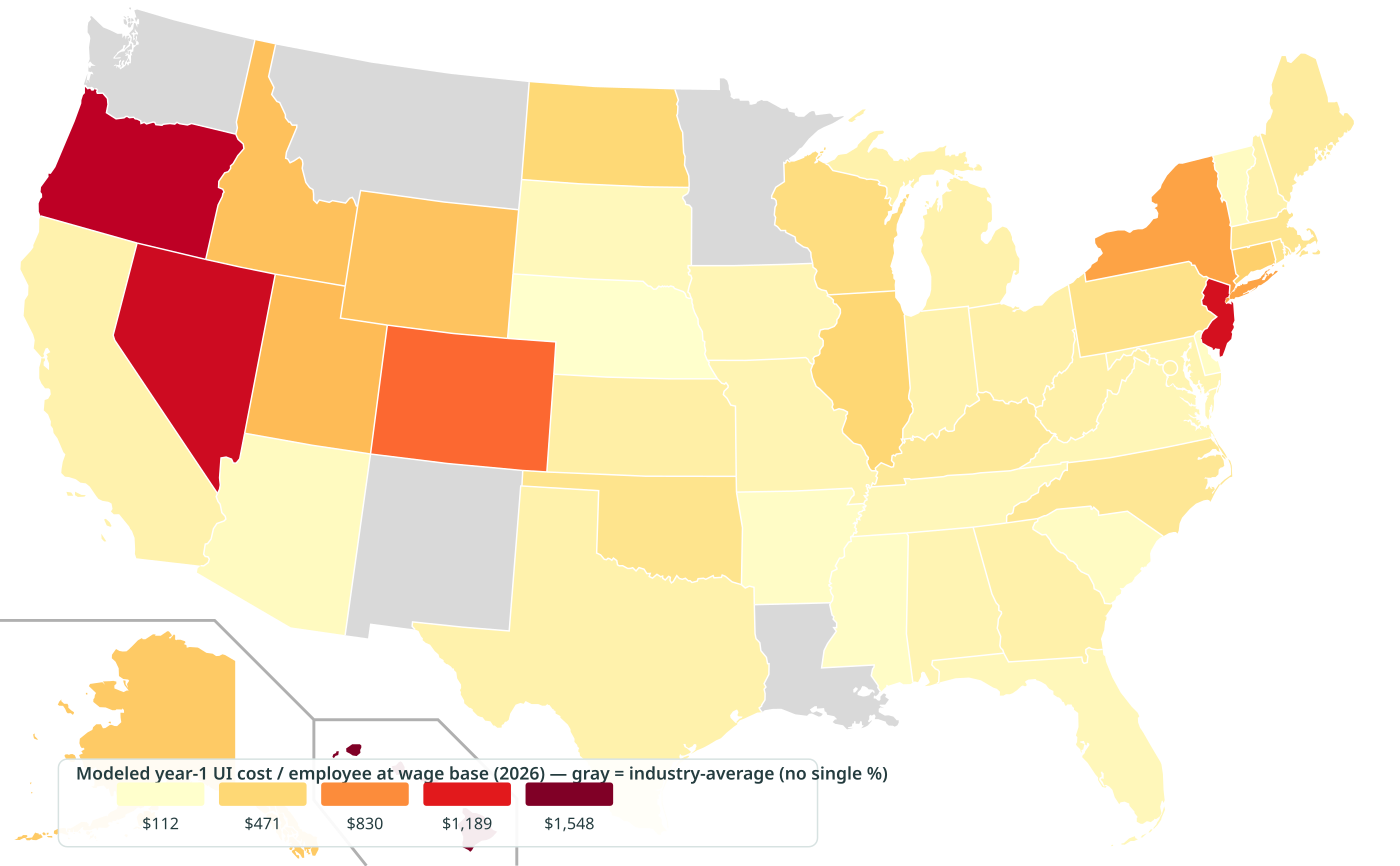
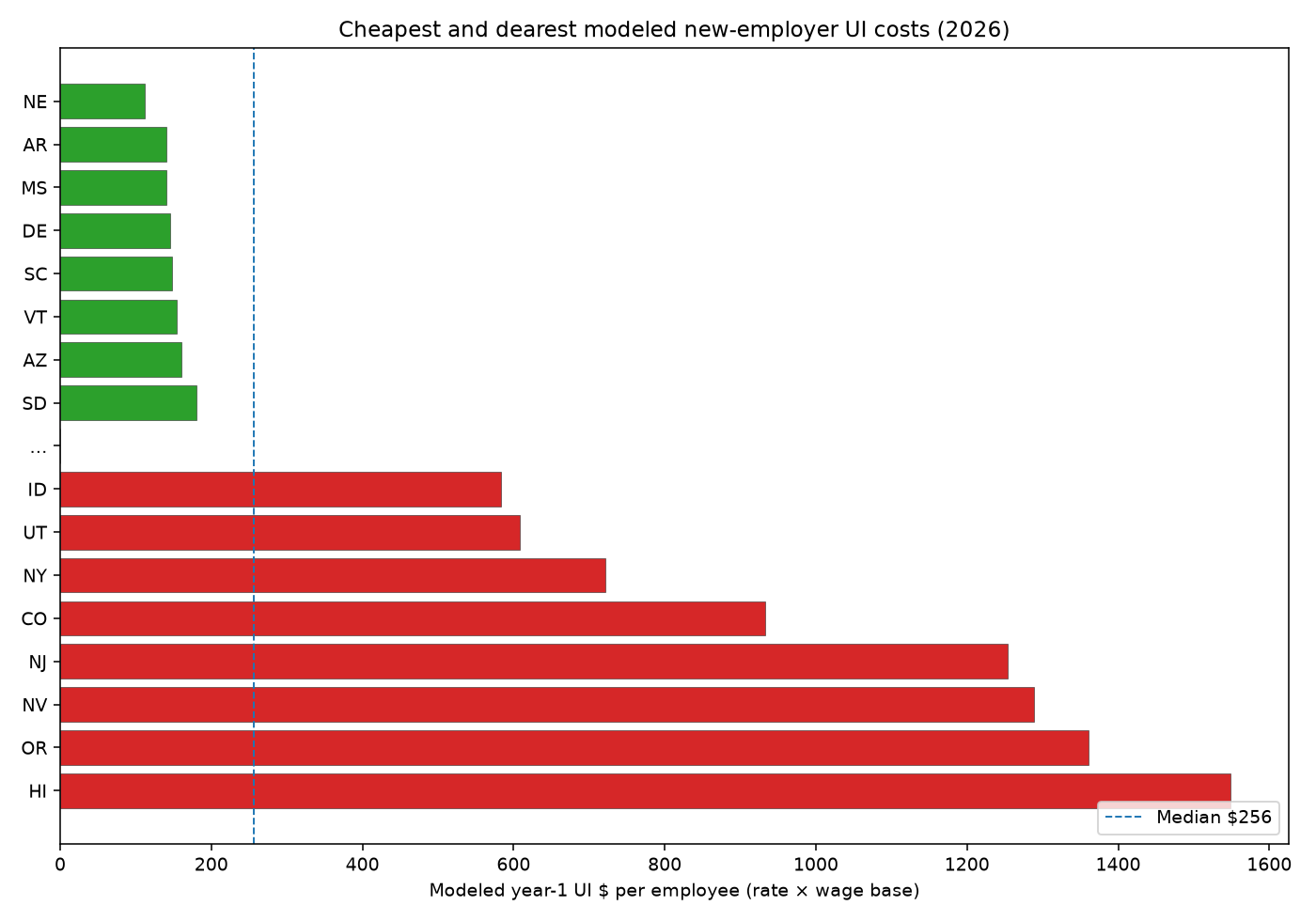
Across the 46 jurisdictions with a published single new-employer (or standard) rate, modeled year-1 UI cost for one full-time employee at or above the wage base ranges from
$112 in Nebraska
(1.25% × $9,000) to
$1,548 in Hawaii
(2.4% × $64,500). The median is about $256; the mean is about $410.
High wage bases (Hawaii, Oregon, Nevada, New Jersey) drive the top of the ranking even at mid-single-digit rates. Low wage bases (Arkansas, Florida, Tennessee, California at $7,000) keep absolute dollars modest even when the percentage looks higher.
Ranked table — tax year 2026
Default display rate is the non-construction / general new-employer figure used for service niches (cleaning, salon, daycare, landscaping, HVAC). Construction rates appear when the state publishes a separate new-construction column. Sortable columns: click headers.
| Rank | State | Wage base | New-employer rate | Construction rate | Modeled $/employee | Rate type |
|---|---|---|---|---|---|---|
| 1 | Nebraska | $9,000 | 1.25% | 5.4% | $112 | new employer non construction |
| 2 | Arkansas | $7,000 | 2% | — | $140 | new employer plus admin |
| 3 | Mississippi | $14,000 | 1% | — | $140 | new employer |
| 4 | Delaware | $14,500 | 1% | — | $145 | new employer |
| 5 | South Carolina | $14,000 | 1.06% | — | $148 | new employer plus contingency |
| 6 | Vermont | $15,400 | 1% | — | $154 | new employer |
| 7 | Arizona | $8,000 | 2% | — | $160 | new employer |
| 8 | South Dakota | $15,000 | 1.2% | — | $180 | new employer |
| 9 | Florida | $7,000 | 2.7% | — | $189 | new employer |
| 10 | Tennessee | $7,000 | 2.7% | — | $189 | new employer |
| 11 | Virginia | $8,000 | 2.5% | — | $200 | new employer |
| 12 | Iowa | $20,400 | 1% | — | $204 | new employer |
| 13 | Missouri | $9,000 | 2.376% | — | $214 | new employer |
| 14 | Alabama | $8,000 | 2.7% | — | $216 | new employer |
| 15 | Maryland | $8,500 | 2.6% | — | $221 | new employer |
| 16 | Indiana | $9,500 | 2.5% | — | $238 | new employer |
| 17 | California | $7,000 | 3.4% | — | $238 | new employer |
| 18 | New Hampshire | $14,000 | 1.7% | — | $238 | new employer with trust fund reduction |
| 19 | District of Columbia | $9,000 | 2.7% | — | $243 | new employer |
| 20 | Michigan | $9,000 | 2.7% | — | $243 | new employer |
| 21 | Texas | $9,000 | 2.7% | — | $243 | new employer |
| 22 | Georgia | $9,500 | 2.64% | — | $251 | new employer |
| 23 | Ohio | $9,000 | 2.85% | 5.85% | $256 | new employer plus tech fee |
| 24 | West Virginia | $9,500 | 2.7% | — | $256 | new employer |
| 25 | Kansas | $15,100 | 1.75% | 5.55% | $264 | new employer non construction |
| 26 | Maine | $12,000 | 2.54% | — | $305 | new employer combined |
| 27 | Kentucky | $12,000 | 2.7% | — | $324 | new employer |
| 28 | North Carolina | $34,200 | 1% | — | $342 | new employer |
| 29 | Massachusetts | $15,000 | 2.42% | — | $363 | new employer |
| 30 | Rhode Island | $30,800 | 1.21% | — | $373 | new employer |
| 31 | Oklahoma | $25,000 | 1.5% | — | $375 | new employer |
| 32 | Pennsylvania | $10,000 | 3.822% | — | $382 | new employer |
| 33 | Wisconsin | $14,000 | 3.05% | 2.5% | $427 | new employer non construction |
| 34 | North Dakota | $46,600 | 1% | — | $466 | new employer |
| 35 | Illinois | $14,250 | 3.35% | — | $477 | entry rate with fund building |
| 36 | Connecticut | $27,000 | 1.9% | — | $513 | new employer |
| 37 | Alaska | $54,200 | 1% | — | $542 | new employer employer share |
| 38 | Wyoming | $33,800 | 1.69% | — | $571 | new employer |
| 39 | Idaho | $58,300 | 1% | — | $583 | standard new employer |
| 40 | Utah | $50,700 | 1.2% | — | $608 | new employer |
| 41 | New York | $17,600 | 4.1% | — | $722 | new employer composite |
| 42 | Colorado | $30,600 | 3.05% | — | $933 | new employer composite |
| 43 | New Jersey | $44,800 | 2.8% | — | $1,254 | new employer |
| 44 | Nevada | $43,700 | 2.95% | — | $1,289 | new employer |
| 45 | Oregon | $56,700 | 2.4% | — | $1,361 | new employer |
| 46 | Hawaii | $64,500 | 2.4% | — | $1,548 | new employer |
| — | Louisiana | $7,000 | — | — | — | industry average |
| — | Minnesota | $44,000 | — | — | — | industry average |
| — | Montana | $47,300 | — | — | — | industry average |
| — | New Mexico | $34,800 | — | — | — | industry average |
| — | Washington | $78,200 | — | — | — | industry average |
Modeled $ is hypothetical: rate × wage_base for one employee at/above the base. Not an agency invoice. Not FUTA (federal unemployment tax is a separate layer, generally 6.0% on the first $7,000 with large credits when state UI is paid on time).
Construction vs non-construction
Several states publish a higher new-employer rate for construction. Examples in this table:
Nebraska 5.40% construction vs 1.25% non-construction;
Kansas 5.55% vs 1.75%;
Wisconsin new construction 2.50% (under $500k payroll) vs 3.05% all others;
Ohio construction new-employer commonly ~5.85% including the 0.15% tech fee vs 2.85% general.
Service businesses should budget the non-construction column unless their NAICS is classified as construction.
Methodology
- Vintage: Tax year 2026 preferred. Primary discovery: U.S. DOL ETA Significant Provisions of State UI Laws (January 2026), plus state DOL / workforce agency rate pages and PDFs archived under this study’s
sources/. Access date 2026-09-22 (ET). - Modeled cost:
new_employer_rate × taxable_wage_base. Assumes one FTE earns at least the wage base in the calendar (or rate) year. Label as modeled — actual invoices follow the employer’s assigned rate notice, surcharges, and timing. - Rate choice: Prefer the published new-employer / standard / unclassified / entry rate for non-construction. Where agencies publish a clear total including surcharges that apply to new employers (Maine CSSF+UPAF, Ohio tech fee, New York RSF, South Carolina contingency, Illinois fund building), we model the total and note components.
- Industry-average states: Louisiana, Minnesota, Montana, New Mexico, and Washington assign new-employer rates by industry NAICS without a single default. Wage base is shown; rate and modeled $ are blank — not zero-filled.
- Conflicts: When DOL Significant Provisions (often base rate only) disagree with agency totals that include surcharges, we prefer the agency total for budgeting and document both. Secondary payroll compilations (e.g. Eddy 2026 table) speed discovery but are spot-checked against agency PDFs.
- Experience rating: New-employer rates usually last until the account has enough history (often several years / quarters). After that, your rate moves with benefit charges — it can fall well below or rise above the entry rate.
- Not legal or tax advice. Confirm your rate notice with the state UI agency before filing.
FAQs
Is this what I will actually pay?
It is a budget model for a typical new non-construction employer with one employee at or above the wage base. Your assigned rate notice controls. Industry classification, successor transfers, and mid-year law changes can differ.
Does this include FUTA?
No. State UI is separate from federal FUTA. Most employers also owe FUTA on the first $7,000 of wages, often at a net 0.6% after timely state credits — confirm current IRS Publication 15.
Why are five states blank?
They publish industry-average new-employer schedules without a single “all other” percentage we can responsibly use for every service niche. See each state’s UI agency for your NAICS rate.
Where do NJ, ID, and NE numbers come from?
They match the agency cites already verified on our
UI tax changes tracker:
NJ Table C 2.8%, Idaho standard 1.000% on a $58,300 2026 wage base, Nebraska non-construction 1.25%.
Sources
- U.S. Department of Labor, ETA — Significant Provisions of State UI Laws, January 2026 (and July 2025 archive).
- State workforce / DOL employer UI rate pages and PDFs (see CSV
source_urlcolumn); NJ Table C, Idaho tax arrays, Nebraska Combined Tax Rates, Maine UI tax rates 2026 PDF, IDES EA-50 2026, Wisconsin DWD 2026 Schedule D, Ohio 2026 Rate Details, Washington ESD tax-rate materials. - Secondary discovery (spot-checked): Eddy 2026 new-employer table; Equifax 2026 SUI wage-base guide.
Forming the LLC before the first hire? ZenBusiness can handle formation paperwork in your state — then come back to this table when you register for UI.
Published 2026-09-22. Data vintage: tax year 2026 agency schedules / DOL Significant Provisions. Not legal or tax advice.