SBA policy notices (Feb. 2, Feb. 11 and Aug. 14, 2026) · SBA 7(a) loan data as of June 30, 2026 · Census ACS 2020-2024 · Last updated October 2, 2026
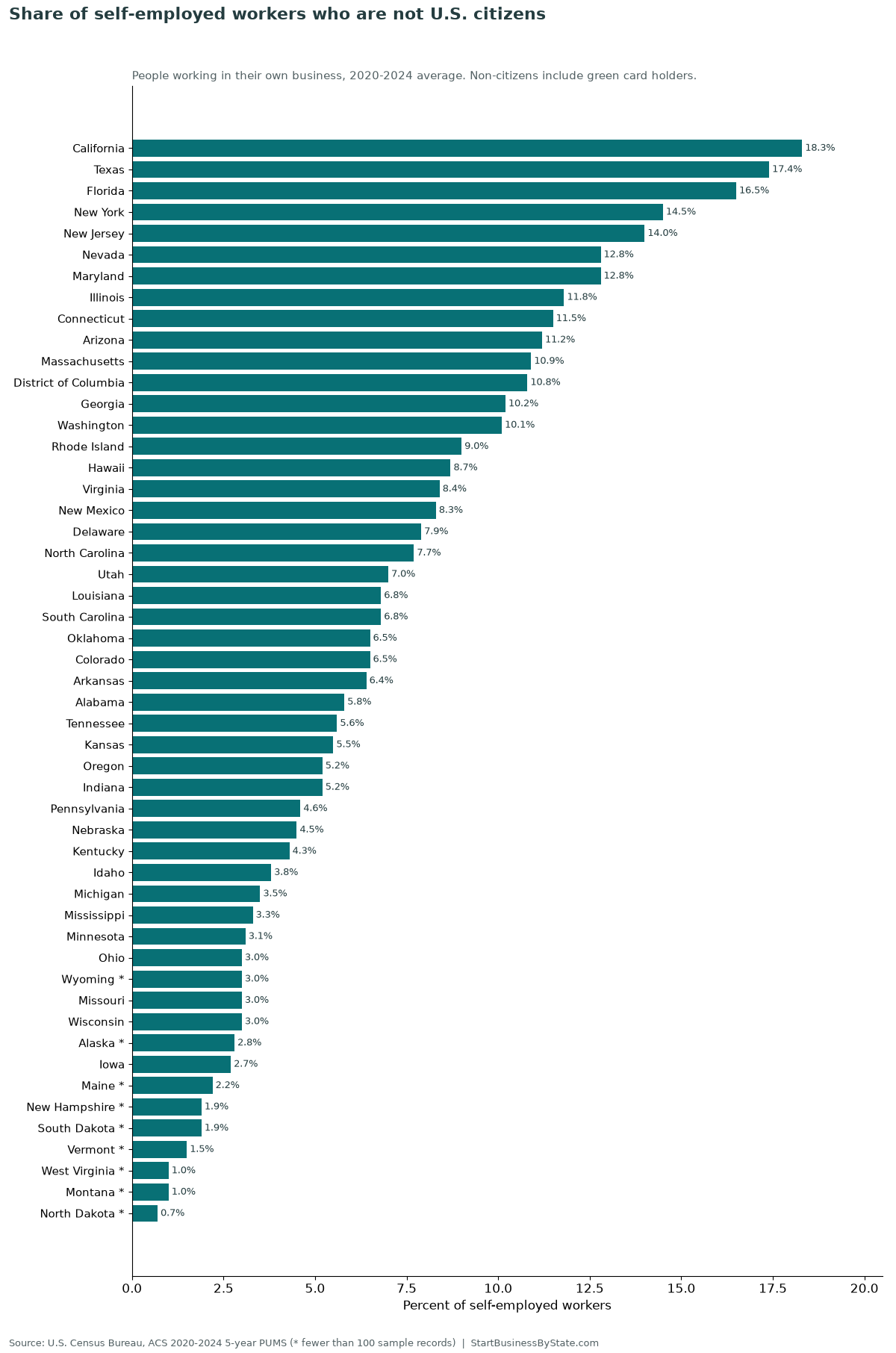
Since March 1, 2026, every owner of a business must be a U.S. citizen or U.S. national to get an SBA 7(a) or 504 loan. Green card holders no longer qualify. About 1.73 million self-employed workers, 10.7% of the total, are not U.S. citizens. The share is highest in California (18.3%), Texas and Florida.
Key findings
- The rule covers all SBA-backed loans. It started with 7(a) and 504 loans on March 1, 2026. On March 9, 2026, SBA extended it to Microloans and Surety Bonds, effective 30 days after publication. The new SBA lending rulebook (SOP 50 10 8.1) took effect October 1, 2026 and keeps the rule.
- SBA says 3,358 loans in fiscal 2025 went to businesses partly owned by a green card holder, about 4% of its roughly 85,000 approvals (SBA, March 9, 2026).
- 1,727,401 self-employed workers are not U.S. citizens, 10.7% of 16,073,188 people who work in their own business (ACS 2020-2024).
- California has the highest share at 18.3%, followed by Texas (17.4%) and Florida (16.5%). North Dakota is lowest at 0.7%.
- 7(a) approvals fell 30% from March-June 2025 (26,984 loans) to March-June 2026 (18,926). Only 2 jurisdictions (District of Columbia, Nebraska) saw an increase.
- The drop was broad, not tied to immigrant-heavy states. Across states, the size of the drop had almost no link to the non-citizen share (correlation -0.05). Other changes in SBA lending rules and the economy likely matter too.
What the rule says
- Who must qualify: 100% of direct and indirect owners, plus required guarantors, must be U.S. citizens or U.S. nationals with their main home in the U.S. or its territories.
- Who is out: green card holders (including conditional), visa holders, asylees, refugees, DACA recipients, people without legal status, and U.S. citizens whose main home is abroad.
- When: 7(a) and 504 loans given an SBA loan number on or after March 1, 2026 (Policy Notice 5000-876441, Procedural Notice 5000-876626). Applications with green card owners that reached SBA review by February 28, 2026 were still processed.
- The 5% exception is gone: SBA dropped the rule that let up to 5% of a business be owned by foreign nationals.
Non-citizen self-employed workers by state
SBA 7(a) loans since the rule started
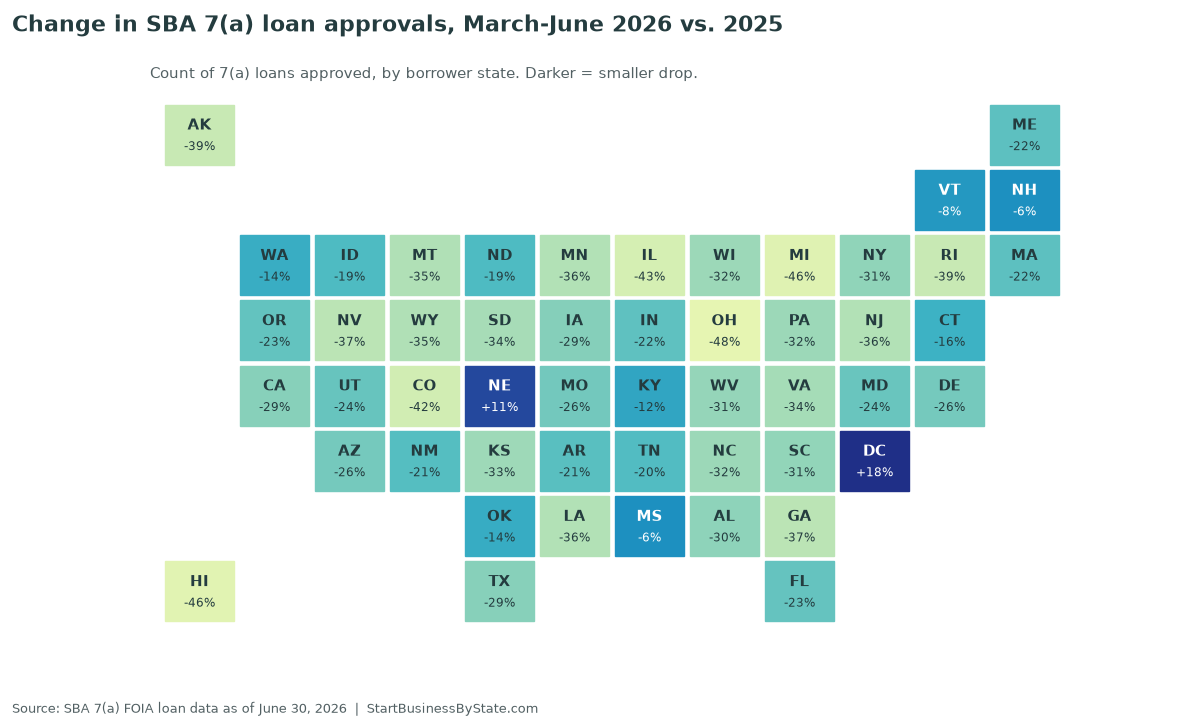
SBA’s loan files do not record owner citizenship, so this shows total approvals, not loans lost to the rule.
All 50 states and D.C.
Sorted by non-citizen share. Click a column heading to sort.
| State | Non-citizen share of self-employed | Non-citizen self-employed | All self-employed | 7(a) loans FY2025 | 7(a) approvals Mar-Jun 2025 | Mar-Jun 2026 | Change |
|---|---|---|---|---|---|---|---|
| United States | 10.7% | 1,727,401 | 16,073,188 | 77,504 | 26,984 | 18,926 | -30% |
| California | 18.3% | 392,528 | 2,144,613 | 9,691 | 3,288 | 2,328 | -29% |
| Texas | 17.4% | 261,714 | 1,507,412 | 6,303 | 2,143 | 1,522 | -29% |
| Florida | 16.5% | 221,502 | 1,342,389 | 6,300 | 2,045 | 1,565 | -23% |
| New York | 14.5% | 134,705 | 927,812 | 5,303 | 1,808 | 1,254 | -31% |
| New Jersey | 14.0% | 58,187 | 415,303 | 2,831 | 1,015 | 654 | -36% |
| Nevada | 12.8% | 18,376 | 143,800 | 880 | 309 | 195 | -37% |
| Maryland | 12.8% | 35,213 | 275,929 | 1,478 | 536 | 407 | -24% |
| Illinois | 11.8% | 64,112 | 544,187 | 2,836 | 966 | 553 | -43% |
| Connecticut | 11.5% | 20,938 | 181,955 | 1,004 | 369 | 311 | -16% |
| Arizona | 11.2% | 38,110 | 339,260 | 1,647 | 588 | 435 | -26% |
| Massachusetts | 10.9% | 35,508 | 326,158 | 2,035 | 716 | 558 | -22% |
| District of Columbia | 10.8% | 2,940 | 27,313 | 178 | 50 | 59 | +18% |
| Georgia | 10.2% | 53,829 | 528,955 | 2,377 | 823 | 519 | -37% |
| Washington | 10.1% | 36,884 | 366,691 | 2,215 | 759 | 649 | -14% |
| Rhode Island | 9.0% | 4,524 | 50,056 | 333 | 128 | 78 | -39% |
| Hawaii | 8.7% | 6,650 | 76,522 | 232 | 76 | 41 | -46% |
| Virginia | 8.4% | 30,861 | 367,144 | 1,498 | 549 | 364 | -34% |
| New Mexico | 8.3% | 7,741 | 92,849 | 311 | 97 | 77 | -21% |
| Delaware | 7.9% | 3,324 | 41,827 | 275 | 100 | 74 | -26% |
| North Carolina | 7.7% | 38,392 | 499,468 | 1,906 | 679 | 461 | -32% |
| Utah | 7.0% | 11,540 | 165,453 | 1,344 | 467 | 357 | -24% |
| Louisiana | 6.8% | 14,341 | 209,450 | 624 | 211 | 136 | -36% |
| South Carolina | 6.8% | 16,440 | 242,412 | 927 | 336 | 232 | -31% |
| Oklahoma | 6.5% | 12,469 | 192,611 | 510 | 191 | 164 | -14% |
| Colorado | 6.5% | 22,590 | 350,157 | 2,241 | 817 | 477 | -42% |
| Arkansas | 6.4% | 8,899 | 138,548 | 401 | 136 | 107 | -21% |
| Alabama | 5.8% | 12,085 | 207,818 | 629 | 221 | 154 | -30% |
| Tennessee | 5.6% | 18,468 | 328,048 | 1,021 | 370 | 296 | -20% |
| Kansas | 5.5% | 7,709 | 139,610 | 496 | 181 | 122 | -33% |
| Oregon | 5.2% | 11,950 | 228,302 | 1,232 | 436 | 336 | -23% |
| Indiana | 5.2% | 13,731 | 264,098 | 1,238 | 405 | 315 | -22% |
| Pennsylvania | 4.6% | 23,913 | 523,272 | 2,704 | 984 | 668 | -32% |
| Nebraska | 4.5% | 4,998 | 110,753 | 331 | 103 | 114 | +11% |
| Kentucky | 4.3% | 7,692 | 178,145 | 597 | 191 | 168 | -12% |
| Idaho | 3.8% | 4,402 | 114,501 | 811 | 292 | 236 | -19% |
| Michigan | 3.5% | 14,542 | 411,429 | 2,478 | 912 | 496 | -46% |
| Mississippi | 3.3% | 3,874 | 118,718 | 344 | 119 | 112 | -6% |
| Minnesota | 3.1% | 8,761 | 282,847 | 1,584 | 554 | 357 | -36% |
| Ohio | 3.0% | 13,996 | 460,477 | 3,338 | 1,216 | 637 | -48% |
| Wyoming | 3.0% (small sample) | 1,072 | 35,529 | 145 | 68 | 44 | -35% |
| Missouri | 3.0% | 8,014 | 268,286 | 1,200 | 413 | 307 | -26% |
| Wisconsin | 3.0% | 7,737 | 260,641 | 1,123 | 417 | 283 | -32% |
| Alaska | 2.8% (small sample) | 924 | 33,589 | 115 | 46 | 28 | -39% |
| Iowa | 2.7% | 4,486 | 166,796 | 428 | 157 | 112 | -29% |
| Maine | 2.2% (small sample) | 2,000 | 90,534 | 411 | 137 | 107 | -22% |
| New Hampshire | 1.9% (small sample) | 1,357 | 69,949 | 605 | 216 | 203 | -6% |
| South Dakota | 1.9% (small sample) | 1,059 | 57,058 | 175 | 56 | 37 | -34% |
| Vermont | 1.5% (small sample) | 636 | 43,013 | 210 | 71 | 65 | -8% |
| West Virginia | 1.0% (small sample) | 543 | 52,878 | 212 | 74 | 51 | -31% |
| Montana | 1.0% (small sample) | 815 | 82,414 | 265 | 91 | 59 | -35% |
| North Dakota | 0.7% (small sample) | 320 | 46,209 | 132 | 52 | 42 | -19% |
What to do now
- Check every owner, including anyone who owns part of your business through another company. One non-citizen owner makes the whole business ineligible.
- Compare other lenders. See small business credit access by state and SBA loan statistics.
- Got a loan before March 1, 2026? The notices cover new loans. Ask your lender before any change of ownership.
Cite or share this data
Source: StartBusinessByState.com, SBA loan citizenship rule by state (updated October 2, 2026). https://startbusinessbystate.com/sba-loan-citizenship-rule-by-state/
Sources and methods
- Rule. SBA Policy Notice 5000-876441 (published Feb. 2, 2026, effective March 1, 2026); Procedural Notice 5000-876626 (Feb. 11, 2026); SBA press release, March 9, 2026 (Microloan and Surety Bond extension, FY2025 counts); SBA Information Notice 5000-880695 (SOP 50 10 8.1, published Aug. 14, 2026, effective Oct. 1, 2026).
- Self-employed workers. U.S. Census Bureau, American Community Survey 2020-2024 5-year Public Use Microdata Sample, via the Census API. Employed people (ESR 1, 2, 4, 5) whose class of worker is self-employed in their own business, incorporated or not (COW 6, 7), weighted by PWGTP. “Not a citizen” is CIT 5. ACS does not separate green card holders from other non-citizens, and it counts people, not businesses or co-owners.
- SBA loans. SBA 7(a) FOIA loan data, file FOIA_7a_FY2020_Present_asof_260630 (through June 30, 2026). Counts include every approval in each window, by borrower state, including loans later canceled. FY2025 counts are 7(a) only (SBA’s 85,000 total also includes 504 loans). The file has no approvals dated October 2025.
- Small samples. States with fewer than 100 non-citizen self-employed sample records are flagged: Wyoming, Alaska, Maine, New Hampshire, South Dakota, Vermont, West Virginia, Montana, North Dakota.
- Not legal or financial advice.
FAQ
Who can get an SBA loan now?
Only businesses that are 100% owned by U.S. citizens or U.S. nationals whose main home is in the United States or its territories. That has applied to 7(a) and 504 loans since March 1, 2026, and SBA later extended it to Microloans and Surety Bonds.
Can a green card holder still get an SBA loan?
No. Since March 1, 2026, a lawful permanent resident cannot own any share of a business that gets a 7(a) or 504 loan. Before that, SBA allowed green card holders to own businesses that borrowed.
What if one co-owner is not a citizen?
The business is not eligible, even for a small ownership share. SBA ended an exception that allowed up to 5% foreign ownership.
Are naturalized citizens affected?
No. A naturalized citizen is a U.S. citizen and can own a business that gets an SBA loan.
Did the rule cause the drop in SBA loans?
We cannot tell from public data. SBA does not publish owner citizenship in its loan files. 7(a) approvals fell in almost every state, and the drop was not bigger in states with more non-citizen business owners.
What can a non-citizen owner do instead?
Look at bank loans without an SBA guarantee, credit unions, CDFIs, state small business programs and equipment financing. Rules and costs differ, so compare offers.
Can I use this data?
Yes. Please credit StartBusinessByState.com and link to this page. The full table is free to download as a CSV.