By StartBusinessByStatePublisher: Robert SmithResearch process
Effective September 30, 2026 · Research checked September 18, 2026
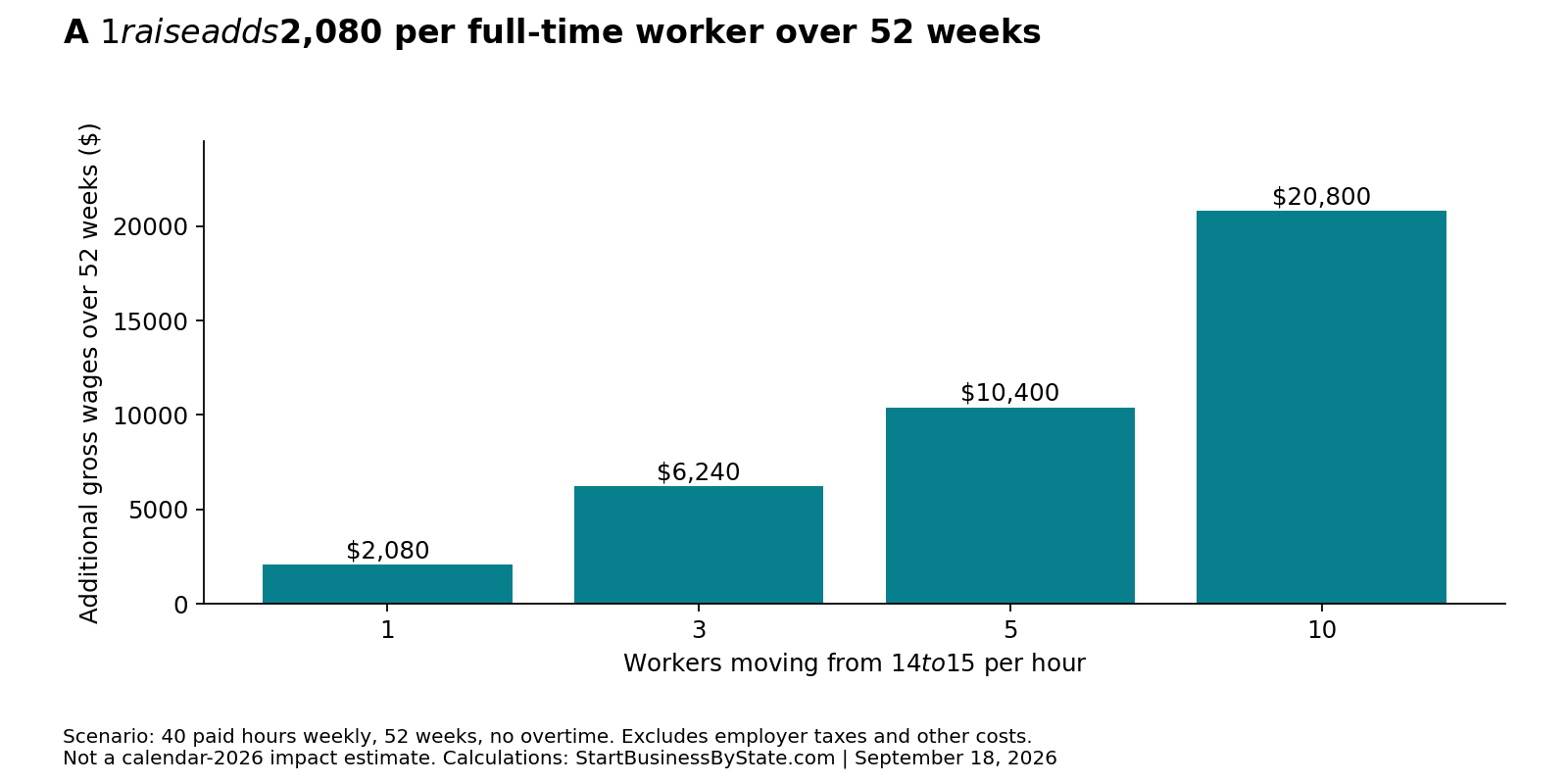
Florida’s minimum wage rises from $14 to $15 per hour on September 30, 2026. For a covered, non-tipped employee moving up by $1 and working 40 paid hours weekly, that adds $40 a week or $2,080 over 52 weeks in gross wages before employer taxes and other costs. Five such employees add $10,400 over 52 weeks. These are full-period scenarios—not the extra payroll for the remainder of 2026. The effective date is set in Florida Constitution Article X, Section 24.
Below, compare the new floor with historical Florida wage benchmarks for cleaning, childcare, landscaping and restaurant work, then calculate your own staffing scenario. The wage data are BLS May 2025 estimates; the legal increase takes effect in September 2026. Keeping those dates separate avoids overstating how many workers will receive raises.
Three findings for Florida business coverage
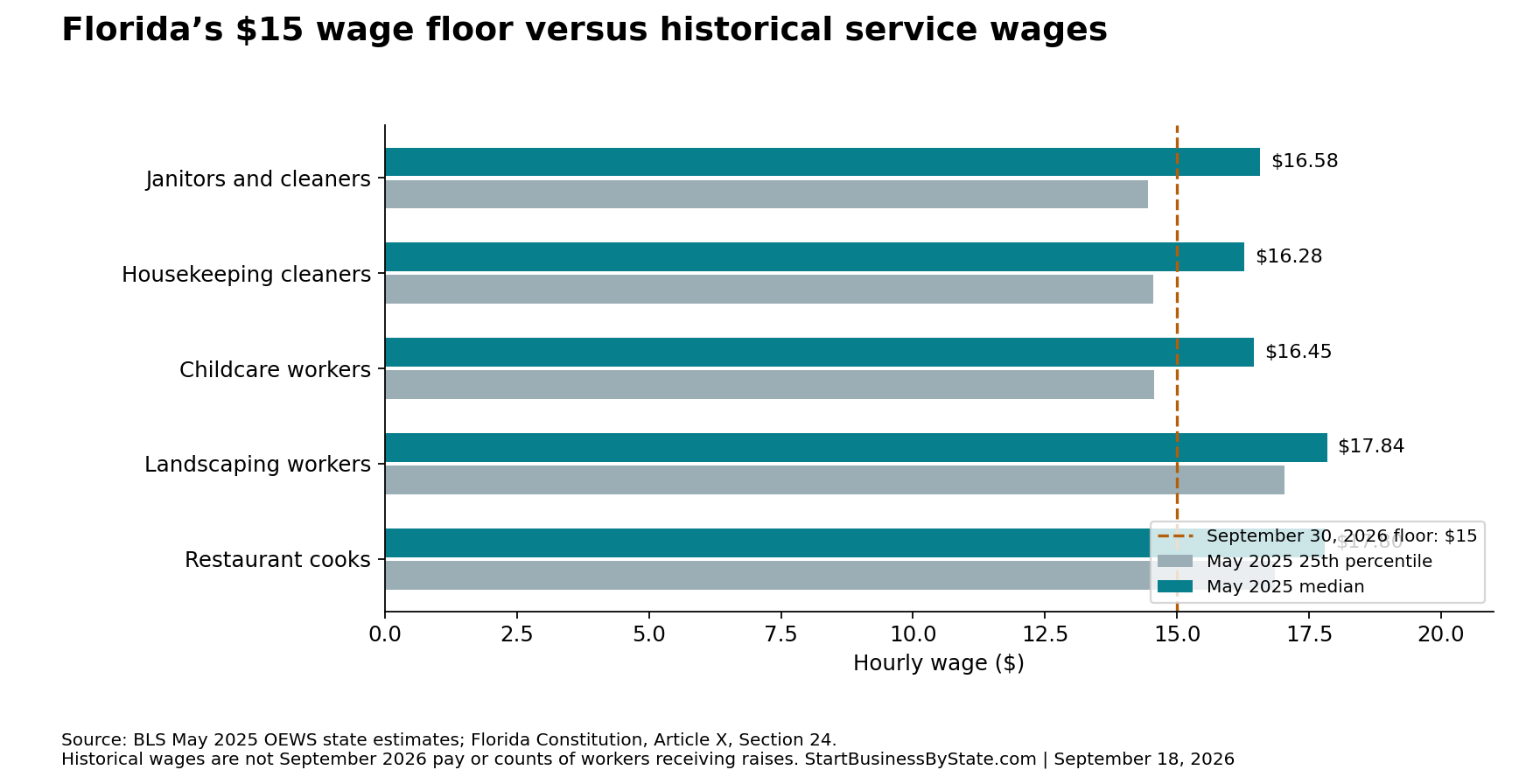
- Three of five selected occupations had a May 2025 lower-quartile wage below $15: janitors and cleaners ($14.45), housekeeping cleaners ($14.55), and childcare workers ($14.56). This is historical distribution context, not a count of workers below the new floor today.
- The new $15 floor is $1.28–$1.58 below the historical medians for those three occupations. The May 2025 medians were $16.28 for housekeeping cleaners, $16.45 for childcare workers and $16.58 for janitors and cleaners. Employers can use this comparison to review pay differences across roles, without assuming current market pay has stayed unchanged.
- Staffing hours change the cost. A $1 raise for five workers at 30 hours each adds $150 weekly; at 40 hours each it adds $200. At 45 hours, assuming five hours of overtime at 1.5 times the regular rate, it adds $237.50 weekly.
Florida service wages compared with the $15 floor
The 25th percentile is the lower-quartile wage; the median is the middle of the estimated wage distribution. These BLS occupations span employers across industries. Restaurant cooks are not a food-truck-only sample, and childcare workers do not represent every job in a daycare.
| Occupation / Florida business guide | 10th percentile | 25th percentile | Median | Historical median minus $15 |
|---|---|---|---|---|
| Janitors and cleaners SOC 37-2011 | $13.85 | $14.45 | $16.58 | $1.58 |
| Housekeeping cleaners SOC 37-2012 | $13.87 | $14.55 | $16.28 | $1.28 |
| Childcare workers SOC 39-9011 | $13.44 | $14.56 | $16.45 | $1.45 |
| Landscaping workers SOC 37-3011 | $14.74 | $17.03 | $17.84 | $2.84 |
| Restaurant cooks SOC 35-2014 | $14.28 | $16.85 | $17.80 | $2.80 |
Source: BLS Occupational Employment and Wage Statistics, May 2025 state workbook. Our downloadable CSV includes occupation codes, employment estimates and employment relative standard errors. Employment is provided as context, not as an estimate of employees affected by the law.
Calculate the added gross payroll
This model brings a single group of covered, non-tipped hourly employees up to at least $15. It leaves higher current wages unchanged. Use separate runs for groups with different rates or schedules. Hours above 40 per worker per week are modeled at 1.5 times the regular rate for a straightforward overtime-eligible arrangement; it does not handle bonuses, mixed rates, exemptions or tipped payroll.
What a $1 raise means for different staffing levels
All examples move from $14 to $15, with fixed weekly hours. The 45-hour examples include five overtime hours at 1.5 times the hourly rate. The 13-week column is an illustrative period, not an exact September 30–December 31 calculation. Choose actual affected hours and pay periods for a remainder-of-year budget. Employer taxes, benefits and insurance are excluded.
| Workers | Hours each per week | Weekly | 13 weeks | 52 weeks |
|---|---|---|---|---|
| 1 | 20 | $20.00 | $260.00 | $1,040.00 |
| 1 | 30 | $30.00 | $390.00 | $1,560.00 |
| 1 | 40 | $40.00 | $520.00 | $2,080.00 |
| 1 | 45 | $47.50 | $617.50 | $2,470.00 |
| 3 | 20 | $60.00 | $780.00 | $3,120.00 |
| 3 | 30 | $90.00 | $1,170.00 | $4,680.00 |
| 3 | 40 | $120.00 | $1,560.00 | $6,240.00 |
| 3 | 45 | $142.50 | $1,852.50 | $7,410.00 |
| 5 | 20 | $100.00 | $1,300.00 | $5,200.00 |
| 5 | 30 | $150.00 | $1,950.00 | $7,800.00 |
| 5 | 40 | $200.00 | $2,600.00 | $10,400.00 |
| 5 | 45 | $237.50 | $3,087.50 | $12,350.00 |
| 10 | 20 | $200.00 | $2,600.00 | $10,400.00 |
| 10 | 30 | $300.00 | $3,900.00 | $15,600.00 |
| 10 | 40 | $400.00 | $5,200.00 | $20,800.00 |
| 10 | 45 | $475.00 | $6,175.00 | $24,700.00 |
Effective dates, tipped wages and overtime
September 30 is the effective date
The constitutional schedule sets $15 beginning September 30, 2026. A pay period crossing that date needs the applicable rates assigned to the hours worked before and after the change; the date is not October 1. The $1 increase is approximately 7.14% of the old $14 hourly floor. It is not necessarily a 7.14% increase in a business’s total payroll.
Tipped employees require a separate calculation
Florida’s constitutional rule retains the permitted 2003 tip credit for eligible tipped employees. FloridaCommerce identifies that maximum credit as $3.02 in its official wage announcement explaining the credit. Subtracting $3.02 from the new $15 floor gives $11.98 in direct hourly wages where the full credit is lawfully available. The older announcement is cited for the credit explanation, not as a 2026 poster.
Cash wages plus tips must meet the applicable minimum, and tip-credit eligibility and notice requirements matter. The calculator above does not model tips. Review DOL’s tipped-employee guidance for the federal conditions; do not apply the lower cash wage merely because customers sometimes leave tips.
Overtime and future indexing
For covered nonexempt employees, the federal general rule requires at least 1.5 times the regular rate for hours above 40 in a workweek. A simple non-tipped $15 regular-rate example therefore produces $22.50 for an overtime hour. More complex pay arrangements can change the regular-rate calculation. See DOL’s overtime guidance.
The Constitution calls for the first subsequent inflation calculation on September 30, 2027, with the adjusted rate taking effect the following January 1—January 1, 2028 under that text. This page does not assume a future dollar amount. Check the state’s current guidance when updating payroll.
Use the result in a service-business budget
For a Florida service crew, put insurance beside wages and payroll taxes in the budget. Compare Florida cleaning-business insurance or Florida food-truck insurance using your updated payroll and actual work description.
Start with employees whose current pay is below the new floor. Review pay differences for experienced staff separately; this calculator does not assume everyone receives a $1 raise. If you already pay $15 or more, the floor-only model returns no direct wage increase for that group.
Cleaning operators can put their actual new pay rates into the employee cost calculator and check the timing of cash needs with the hiring cash calculator. Use cleaning payroll-to-revenue benchmarks as historical context, not a target margin. For local setup requirements, use the occupation-linked guides above or the Florida business guide.
Download charts and data for your coverage
- Five-occupation Florida wage benchmark CSV — source occupation codes, dated estimates, employment uncertainty and calculated median gaps.
- 16 staffing and payroll scenarios CSV — assumptions and gross-wage changes.
- Historical wage comparison chart (PNG).
- Annualized staffing-cost chart (PNG).
You may reuse our original charts and calculations with attribution and a link to this study. Keep the wage-data date and scenario assumptions attached. Suggested citation: StartBusinessByState.com, “Florida’s $15 Minimum Wage: Service-Business Payroll Costs,” September 18, 2026; analysis of BLS May 2025 OEWS and Florida’s constitutional wage schedule.
Methodology and limits
We extracted five detailed occupations from the BLS May 2025 Florida state workbook, using all-industry, public-and-private ownership estimates. The selected occupations match common work in four service-business categories; they are not an exhaustive list of low-paid work or an industry employment census. We reused an archived official workbook and checked its file hash and extracted rows. Fresh workbook downloads were unavailable during this review. Metro comparisons are not included because we could not verify the metro dataset.
For each occupation, the displayed gap equals the historical median hourly wage minus $15. We do not interpolate an affected-worker share from wage percentiles, treat all employment as minimum-wage employment, or sum statewide wage impacts. OEWS excludes self-employed workers; occupational wages may include tips and other components described in BLS technical notes. These estimates are not the minimum cash wage owed by an individual employer.
For the payroll model: new rate = max(current rate, $15); raise = new rate − current rate; weekly added wages = workers × raise × [min(weekly hours, 40) + 1.5 × max(weekly hours − 40, 0)]. Multiply by modeled weeks, then add any user-entered percentage allowance. Constant staffing, schedules and rates are assumed. The model does not calculate actual payroll taxes, tipped pay, bonuses, benefit changes, staffing responses or revenue effects.
First edition checked September 18, 2026. The page is manually maintained; legal dates and source vintages must be rechecked before a later edition. Broader compliance questions depend on coverage and the employee’s pay arrangement.