State minimum wage rates for 2027 · IRS employer payroll tax rate · Census County Business Patterns 2023 · Last updated October 1, 2026
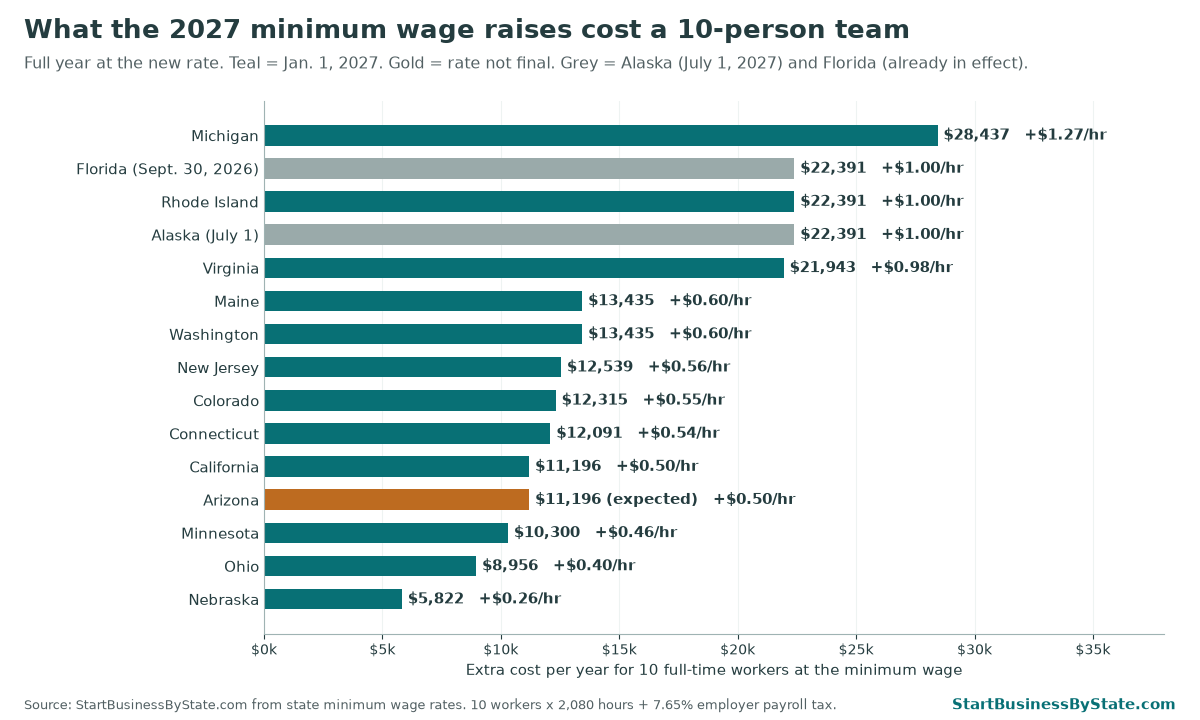
For a small business with 10 full-time workers at the minimum wage, the 2027 raises add from about $5,800 a year (Nebraska) to $28,437 (Michigan), counting the employer’s share of payroll taxes. In most of the states raising pay on January 1, it’s $11,000 to $14,000. Use the calculator below to plug in your own staff.
Key findings
- Michigan costs the most: a $1.27 raise adds $26,416 in wages for 10 full-time workers, or $28,437 with payroll taxes.
- Rhode Island and Alaska (both up $1.00) add $22,391 a year for 10 workers. Alaska’s raise starts July 1, 2027, so it costs about half that in 2027. Virginia (up $0.98) adds $21,943.
- Washington and Maine add $13,435. New Jersey adds $12,539, Colorado $12,315, Connecticut $12,091, and California and Arizona $11,196 each.
- Minnesota adds $10,300 and Ohio $8,956. Nebraska, with the smallest raise (26 cents, to the official $15.26), adds about $5,800.
- Per worker, the raise is worth $2,642 a year in Michigan, $2,080 in Rhode Island and $1,040 in California, before payroll taxes.
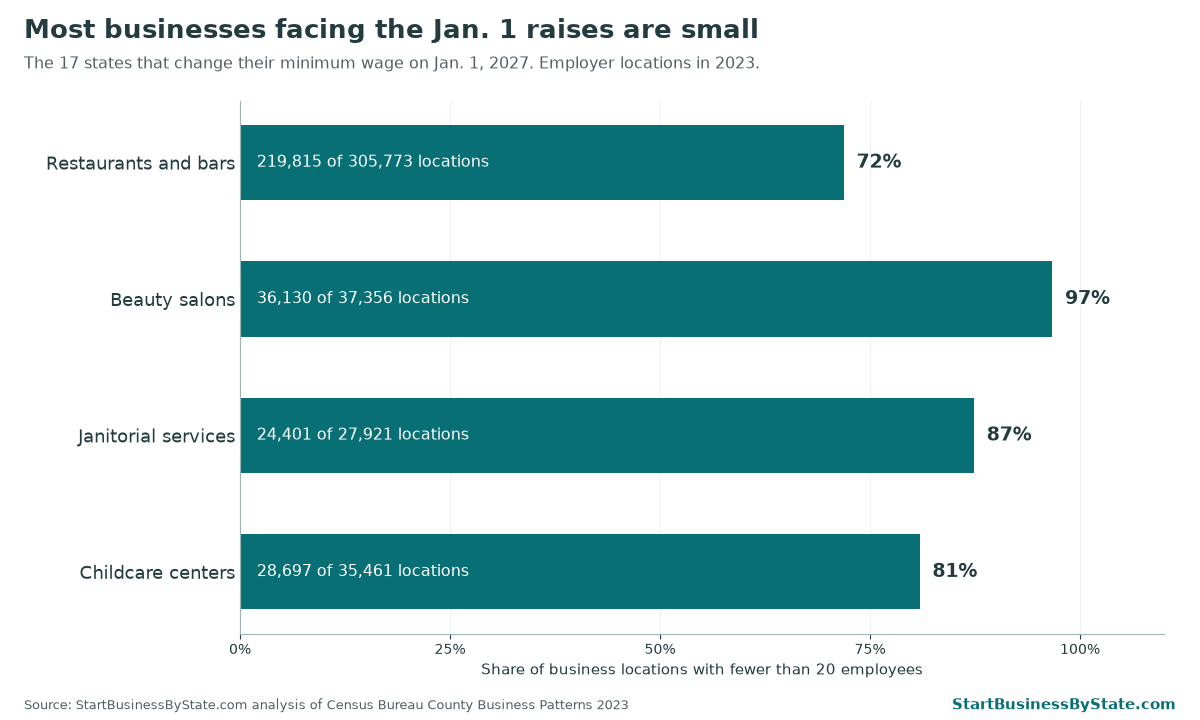
- Most of the businesses affected are small. In the 17 states raising pay on January 1, 72% of restaurant and bar locations had fewer than 20 employees in 2023. For beauty salons it’s 97%, janitorial services 87% and childcare centers 81%.
Cost by state for 10 full-time workers
Work out your own cost
Most small businesses don’t have 10 full-time workers at exactly the minimum. Put in your own team.
Your numbers
Uses 52 weeks and the 7.65% employer share of Social Security and Medicare. Leaves out unemployment tax, workers’ comp and benefits.
The full table
Click a column heading to sort. “Per worker” is the hourly raise times 2,080 hours.
| State | Takes effect | Before | After | Raise | Per full-time worker, per year | 10 workers, wages only | 10 workers, with payroll tax |
|---|---|---|---|---|---|---|---|
| Michigan | Jan. 1, 2027 | $13.73 | $15.00 | +$1.27 | $2,642 | $26,416 | $28,437 |
| Alaska | July 1, 2027 | $14.00 | $15.00 | +$1.00 | $2,080 | $20,800 | $22,391 |
| Rhode Island | Jan. 1, 2027 | $16.00 | $17.00 | +$1.00 | $2,080 | $20,800 | $22,391 |
| Florida | Sept. 30, 2026 (in effect) | $14.00 | $15.00 | +$1.00 | $2,080 | $20,800 | $22,391 |
| Virginia | Jan. 1, 2027 | $12.77 | $13.75 | +$0.98 | $2,038 | $20,384 | $21,943 |
| Washington | Jan. 1, 2027 | $17.13 | $17.73 | +$0.60 | $1,248 | $12,480 | $13,435 |
| Maine | Jan. 1, 2027 | $15.10 | $15.70 | +$0.60 | $1,248 | $12,480 | $13,435 |
| New Jersey | Jan. 1, 2027 | $15.92 | $16.48 | +$0.56 | $1,165 | $11,648 | $12,539 |
| Colorado | Jan. 1, 2027 | $15.16 | $15.71 | +$0.55 | $1,144 | $11,440 | $12,315 |
| Connecticut | Jan. 1, 2027 | $16.94 | $17.48 | +$0.54 | $1,123 | $11,232 | $12,091 |
| Arizona | Jan. 1, 2027 | $15.15 | $15.65 expected | +$0.50 | $1,040 | $10,400 | $11,196 |
| California | Jan. 1, 2027 | $16.90 | $17.40 | +$0.50 | $1,040 | $10,400 | $11,196 |
| Minnesota | Jan. 1, 2027 | $11.41 | $11.87 | +$0.46 | $957 | $9,568 | $10,300 |
| Ohio | Jan. 1, 2027 | $11.00 | $11.40 | +$0.40 | $832 | $8,320 | $8,956 |
| Nebraska | Jan. 1, 2027 | $15.00 | $15.26 | +$0.26 | $541 | $5,408 | $5,822 |
Not included yet: Montana, South Dakota, Vermont and New York, which change on January 1, 2027 but haven’t announced rates. See the 2027 minimum wage by state for every state’s status.
Who it hits: small businesses
Restaurant and bar locations by state (2023)
| State | Restaurant and bar locations | Share with fewer than 20 employees |
|---|---|---|
| California | 88,778 | 71% |
| New York | 52,317 | 80% |
| Ohio | 24,162 | 65% |
| New Jersey | 21,457 | 79% |
| Michigan | 19,760 | 69% |
| Virginia | 17,551 | 67% |
| Washington | 17,386 | 75% |
| Colorado | 13,677 | 66% |
| Arizona | 13,666 | 62% |
| Minnesota | 10,937 | 67% |
| Connecticut | 8,612 | 75% |
| Nebraska | 4,371 | 69% |
| Maine | 3,424 | 78% |
| Montana | 3,072 | 74% |
| Rhode Island | 3,046 | 73% |
| South Dakota | 2,060 | 72% |
| Vermont | 1,497 | 76% |
How owners plan for a raise
- Start with real hours. Pull last year’s payroll and count the hours worked by people who will be under the new rate. That’s more accurate than headcount.
- Decide about the people just above the minimum. If you pay a shift lead $1 over the minimum, decide now whether that gap stays. That’s where most of the surprise cost comes from.
- Remember the add-ons. Payroll taxes, workers’ comp premiums and some benefits go up with wages. See unemployment tax rates by state.
- Price changes: if you raise prices, January is when customers expect it.
- Industry help: for cleaning companies, see what a cleaning employee costs. For restaurants, see tip credits by state. In Florida, see the Florida $15 cost calculator. For typical pay in service jobs, see service employer pay by state.
More from our 2027 minimum wage research
- 2027 minimum wage by state: every state's rate on January 1, 2027
- Minimum wage vs. rent by state: hours of work it takes to rent a one-bedroom
- 2027 minimum wage vs. what workers earn: which jobs the new rates reach
- What the 2027 raises cost a small business (this page)
- Minimum wage gaps between neighboring states: border pairs like Washington and Idaho
- Real minimum wage by state: what the minimum buys after local prices
Cite or share this data
Business groups, chambers and reporters are welcome to use the table and charts. Please credit and link to this page.
Source: StartBusinessByState.com, cost of the 2027 minimum wage raises for small businesses (October 1, 2026). https://startbusinessbystate.com/minimum-wage-increase-cost-small-business-2027/
Methods and caveats
- It’s a scenario, not a survey. We assume 10 workers paid exactly the minimum, each working 2,080 hours a year (40 hours × 52 weeks). Real businesses have part-timers, people above the minimum and tipped staff.
- Rates come from our 2027 minimum wage tracker. Nebraska’s rate is the official $15.26 from the state labor department. Arizona’s is expected, from news reports.
- Payroll tax is the employer’s 7.65% share of Social Security and Medicare. We left out federal and state unemployment taxes, which usually stop at a wage cap, plus workers’ comp and benefits.
- What we don’t count: raises for people above the minimum, local minimum wages, overtime, and lower cash wages for tipped workers.
- Business counts are from the Census Bureau’s County Business Patterns, 2023, for restaurants and bars (NAICS 722), beauty salons (812112), janitorial services (561720) and childcare centers (624410). They count employer locations, not companies, and leave out businesses with no employees.
FAQ
How much does a $1 minimum wage raise cost per worker?
For a full-time worker (40 hours a week, 52 weeks), $1 an hour adds $2,080 a year in wages. Add 7.65% for the employer share of Social Security and Medicare, and it comes to about $2,239.
Does this include raises for workers already above the minimum?
No. The table counts only workers paid the minimum. Many owners also raise people just above it so they stay ahead of new hires. The calculator lets you add them.
What about tipped workers?
Tipped workers can cost less, since many states let you pay a lower cash wage if tips make up the difference. Rules vary a lot. See tip credits by state.
Why is Florida in the table?
Florida’s raise to $15.00 happened on September 30, 2026, so Florida employers are already paying it. It stays at $15.00 through 2027.
Why are some states missing?
Montana, South Dakota, Vermont and New York also change on January 1, 2027, but hadn’t announced their rates when we checked. We’ll add them when they do.
Can I use these numbers?
Yes. Please credit StartBusinessByState.com and link to this page. The table is free to download as a CSV.