Updated October 15, 2026. Data: U.S. Small Business Administration, 7(a) loan records through June 30, 2026. Next update: when the SBA posts its next quarterly file.
The typical SBA 7(a) loan to electrical contractors was $150,000 in fiscal years 2021 through 2026. Of the loans made from 2010 to 2015 that have since closed, 6.6% were charged off, lower than the 7.2% average for all industries.
This covers businesses the SBA lists as electrical contractors and other wiring installers, including companies that install solar panels, low-voltage systems and building controls.
How big a typical loan is
The 7(a) program is the SBA’s main loan program. A bank or other lender makes the loan, and the SBA guarantees part of it, which makes lenders more willing to lend to small firms. Work vans, tools, lifts, working cash while waiting on big jobs to pay, and buying an existing contractor are common reasons to borrow.
- Middle half of loans: $50,000 to $350,000.
- 56% of loans were $150,000 or less.
- 55% went through SBA Express, a faster version with less paperwork.
- 23% went to businesses two years old or younger, or not yet open.
- Typical term: 10 years. Typical starting rate: 9.85%.
Lenders usually ask for proof of business insurance before a loan closes, especially when a vehicle, equipment or a building secures it. If you’re shopping for coverage, see the insurance and bonds section of our electrical business guide.
| Fiscal year | Loans | Median loan |
|---|---|---|
| 2021 | 478 | $200,000 |
| 2022 | 535 | $124,000 |
| 2023 | 692 | $131,000 |
| 2024 | 883 | $137,000 |
| 2025 | 1,008 | $150,000 |
| 2026 | 516 | $150,000 |
Fiscal year 2026 runs through June 30, 2026, the date of the latest SBA file.
How often loans were charged off
We looked at the 2,616 loans to electrical contractors approved from fiscal 2010 to 2015 that have since closed, either paid off or charged off. Of those, 172 (6.6%) were charged off. Across all industries the rate was 7.2%. We used older loans because most newer loans are still being repaid, so their outcomes aren’t known yet.
What “charged off” means here. A charge-off is when the lender and the SBA write off what’s left of a loan as uncollectible. It is not the same as a default or a business failure. Some borrowers miss payments and later catch up. Some businesses close but repay in full, and some sell or refinance. A charge-off also says nothing about why the loan went bad. Use these rates to compare industries, not to predict what will happen to one business.
What paying it back looks like
At the typical recent rate of 9.85% over 10 years, a $150,000 loan costs about $1,970 a month. Rates and terms vary with the lender, the loan size and what the money buys. Loans for real estate can run 25 years.
Typical loan size in each state
Loan sizes vary a lot from place to place. Among states with at least 25 recent loans, the typical loan was largest in Alabama ($300,000), Wisconsin ($279,000) and Georgia ($260,000), and smallest in Arkansas ($56,750), Washington ($77,500) and Idaho ($87,500). Bigger loans usually mean the money went to buying real estate or an existing business.
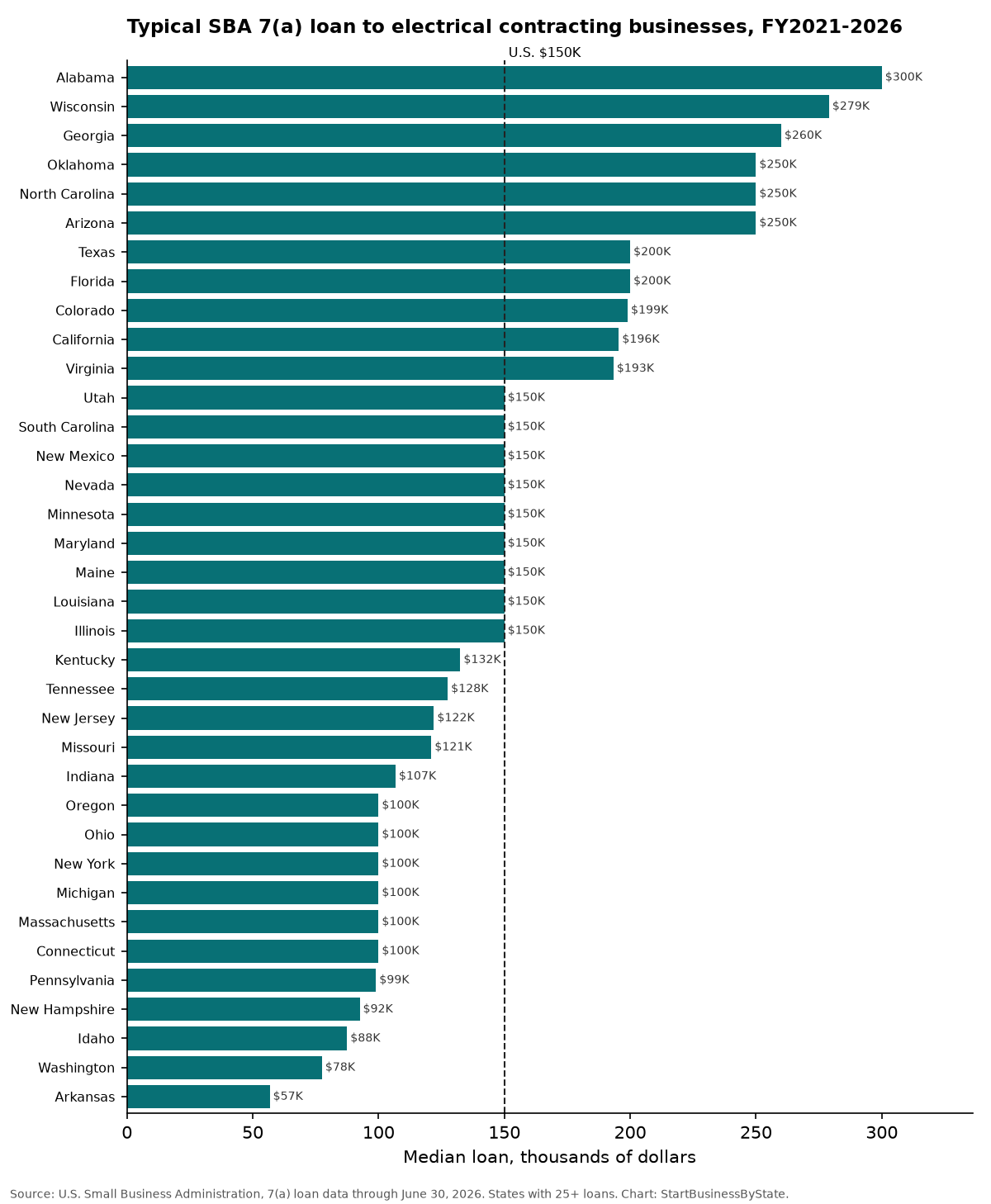
Click a column to sort. Each state links to that state’s guide to small business loans. *Charge-off rates are shown only for states with at least 50 closed loans. States with fewer than 25 recent loans are left out.
| State | Loans, FY2021-26 | Median loan | Charged off, FY2010-15 loans* |
|---|---|---|---|
| U.S. | 4,112 | $150,000 | 6.6% |
| Alabama | 31 | $300,000 | too few |
| Arizona | 89 | $250,000 | too few |
| Arkansas | 32 | $56,750 | too few |
| California | 497 | $195,500 | 8.8% |
| Colorado | 148 | $199,000 | 8.3% |
| Connecticut | 81 | $100,000 | too few |
| Florida | 314 | $200,000 | 6.2% |
| Georgia | 75 | $260,000 | too few |
| Idaho | 66 | $87,500 | too few |
| Illinois | 102 | $150,000 | 8.4% |
| Indiana | 74 | $106,750 | 6.2% |
| Kentucky | 42 | $132,500 | too few |
| Louisiana | 35 | $150,000 | too few |
| Maine | 27 | $150,000 | too few |
| Maryland | 81 | $150,000 | too few |
| Massachusetts | 166 | $100,000 | 5.8% |
| Michigan | 162 | $100,000 | 6.1% |
| Minnesota | 108 | $150,000 | 2.1% |
| Missouri | 68 | $121,000 | 5.8% |
| Nevada | 47 | $150,000 | too few |
| New Hampshire | 60 | $92,500 | too few |
| New Jersey | 155 | $122,000 | too few |
| New Mexico | 25 | $150,000 | too few |
| New York | 264 | $100,000 | 3.0% |
| North Carolina | 69 | $250,000 | too few |
| Ohio | 219 | $100,000 | 7.0% |
| Oklahoma | 44 | $250,000 | too few |
| Oregon | 61 | $100,000 | too few |
| Pennsylvania | 146 | $99,000 | 4.2% |
| South Carolina | 39 | $150,000 | too few |
| Tennessee | 54 | $127,500 | too few |
| Texas | 221 | $200,000 | 10.7% |
| Utah | 70 | $150,000 | 3.9% |
| Virginia | 42 | $193,350 | too few |
| Washington | 122 | $77,500 | 1.2% |
| Wisconsin | 43 | $279,000 | 7.1% |
Before you borrow
- Set up the business first. Lenders lend to a business, not just to you. An LLC also keeps business debts separate from your personal ones in most cases. See how to set up an LLC.
- Compare loan types. SBA loans are one option among several. See the main types of business loans, or open your state’s business-loans guide from the table above.
- Get insured. Have quotes ready so insurance doesn’t hold up closing. See the insurance and bonds section of our electrical business guide.
- See the bigger picture. For all industries, see SBA loan statistics.
Starting a electrical contracting business?
Compare business insurance quotes from Simply Business. Need to form your company first? Form your LLC with ZenBusiness.
We may earn a commission if you use this link. It doesn’t change what you pay, and it doesn’t affect the data on this page.
How we counted
- Source: U.S. Small Business Administration, 7(a) loan-level records for fiscal years 2010 through 2026, as of June 30, 2026.
- Typical loan: the median approved amount for loans approved in fiscal 2021 through June 30, 2026. Approved amounts can differ from what was actually paid out, and canceled loans are included.
- Charge-off rate: loans approved in fiscal 2010-2015 that were charged off, divided by those loans that were either paid in full or charged off. Loans still being repaid or canceled are left out.
- Industry: the industry code the lender recorded for the borrower. Codes can be wrong or outdated for some loans.
- State: where the project is located. U.S. figures also include Puerto Rico and other territories. States with fewer than 25 recent loans are left out of the state table.
- Monthly payment is an illustration using the median rate and term, with equal monthly payments. It isn’t a quote.
Sources
Cite this data
Reporters and bloggers may use these numbers and charts. Please credit StartBusinessByState and link to this page.
Source: StartBusinessByState, “Electrical Contractor Loans: How Big They Are and How Often They Are Charged Off,” https://startbusinessbystate.com/electrician-business-loans/ (updated October 15, 2026).
FAQ
How much do electrical contracting businesses borrow from the SBA?
The median 7(a) loan to electrical contractors was $150,000 in fiscal 2021-2026, across 4,112 loans. The middle half ranged from $50,000 to $350,000.
How often do electrical contracting loans go bad?
6.6% of 7(a) loans to electrical contractors made in 2010-2015 were charged off, against 7.2% for all industries. A charge-off isn’t the same as a default or a business failure.
What is a charge-off?
The lender and the SBA write off the unpaid balance as uncollectible. It usually comes after a long period of missed payments, but it is not the same as a default or a business closing.
What's the monthly payment on a typical electrical contracting loan?
About $1,970 a month for $150,000 at 9.85% over 10 years. Your rate and term will differ.
Where is this data from?
The U.S. Small Business Administration’s public 7(a) loan records, which list every loan with its amount, industry, state and status.
Last updated October 15, 2026 by StartBusinessByState.