Original research · FEMA NFIP policy data · Last updated October 6, 2026
Data through: NFIP policies in force on August 31, 2026, from OpenFEMA’s NFIP Redacted Policies v3 file (refreshed September 9, 2026). Deadline: December 11, 2026, set by Public Law 119-103.
Congress has extended the National Flood Insurance Program (NFIP) only through December 11, 2026. If it lapses again, existing policies stay in force, but insurers can’t sell new policies, raise coverage, or send new renewal offers. FEMA’s own policy file shows 4,453,421 policies in force across the 50 states and DC on August 31, 2026. 467,566 of them (10.5%) reach the end of their term between December 12 and January 31. Florida alone has 188,346.
Key findings
- 467,566 policies end in the seven weeks after the deadline. That is 10.5% of the 4,453,421 NFIP policies in force in the 50 states and DC on August 31, 2026. 289,625 end in the first 30 days (Dec 12 to Jan 10). Together they carry $128.2 billion in building and contents coverage.
- Florida, Texas and Louisiana hold 57% of them. Florida: 188,346. Texas: 43,928. Louisiana: 36,080.
- 233,455 policies cover business and other non-residential buildings. That is 5.2% of all policies, with $108.2 billion in coverage. 67,097 of them are flagged as small businesses (fewer than 100 employees). 28,041 of the business-building policies end in the post-deadline window.
- Florida has the most business-building policies. 56,294 in Florida, 30,674 in Texas and 26,885 in Louisiana. Measured as a share of each state’s policies, Iowa (22.8%), Missouri (22.5%) and Nebraska (21.0%) lean most on NFIP for non-residential buildings (states with 1,000+ policies).
- Business flood cover is not cheap. The average non-residential NFIP contract costs $3,395 a year, counting premium, the reserve fund assessment, the federal policy fee and the HFIAA surcharge.
- This would be the third lapse in about 14 months. The program lapsed from October 1 to November 12, 2025, and again from February 1 to 3, 2026, before Congress set the current December 11 end date in Public Law 119-103.
Which states have the most flood policies up for renewal after December 11?
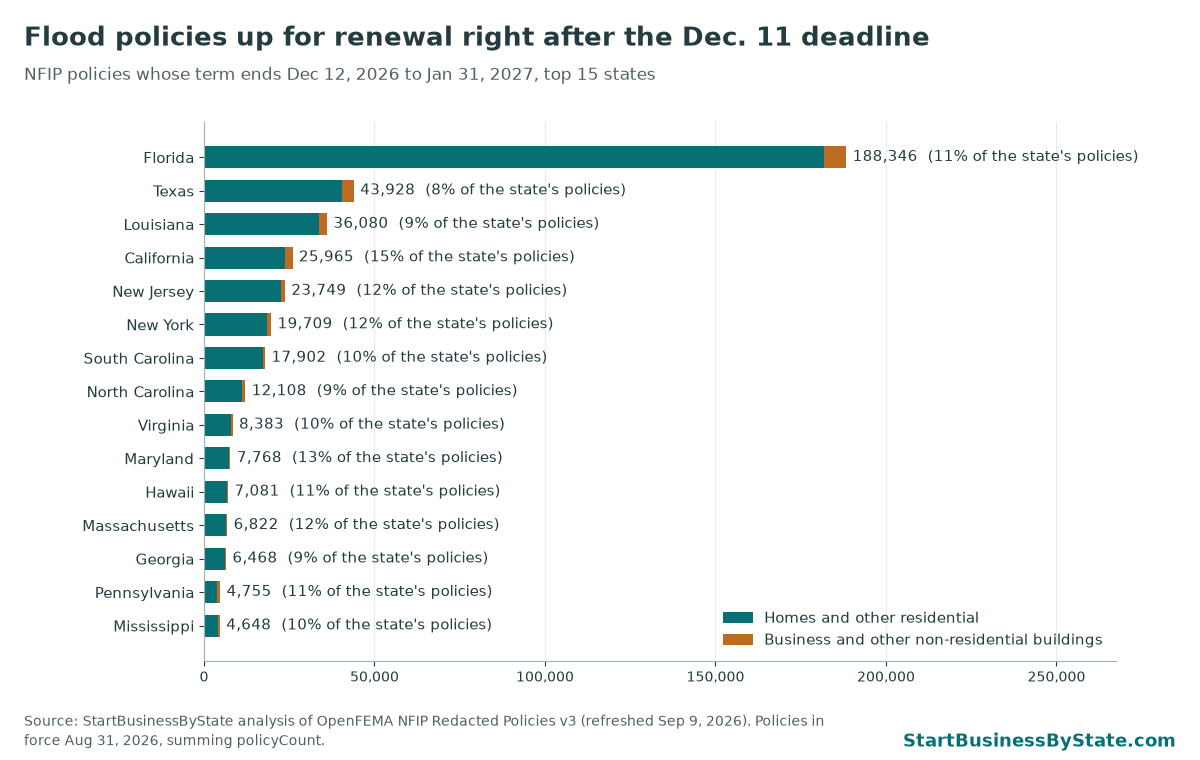
Most NFIP policies run for one year, so renewals are spread across the calendar. About 10.5% of policies come due in this seven-week window. In California, Washington and Oregon, the share is highest: 15.3%, 15.0% and 13.6% of policies (states with at least 1,000 policies).
NFIP policies and the December deadline in every state
Click a column header to sort. “Ending after deadline” counts policies whose term ends between December 12, 2026 and January 31, 2027. Each policy counts once per insured unit, so a condo building policy that covers 40 units counts as 40.
| Rank | State | Policies in force | Ending after deadline | Share of state’s policies | Ending in first 30 days | Business buildings ending after deadline | Business-building policies in force | Business share of policies | Flagged small business | Business coverage |
|---|---|---|---|---|---|---|---|---|---|---|
| 1 | Florida | 1,744,337 | 188,346 | 10.8% | 118,716 | 6,537 | 56,294 | 3.2% | 16,053 | $27,325M |
| 2 | Texas | 561,842 | 43,928 | 7.8% | 26,782 | 3,351 | 30,674 | 5.5% | 9,456 | $15,045M |
| 3 | Louisiana | 397,411 | 36,080 | 9.1% | 21,187 | 2,470 | 26,885 | 6.8% | 8,810 | $12,955M |
| 4 | California | 169,617 | 25,965 | 15.3% | 16,780 | 2,140 | 13,891 | 8.2% | 3,454 | $5,911M |
| 5 | New Jersey | 192,768 | 23,749 | 12.3% | 13,785 | 1,056 | 8,195 | 4.3% | 2,382 | $4,005M |
| 6 | New York | 163,294 | 19,709 | 12.1% | 12,044 | 1,227 | 9,458 | 5.8% | 2,040 | $4,804M |
| 7 | South Carolina | 188,318 | 17,902 | 9.5% | 11,024 | 595 | 5,383 | 2.9% | 1,393 | $2,563M |
| 8 | North Carolina | 128,344 | 12,108 | 9.4% | 7,191 | 830 | 6,839 | 5.3% | 2,415 | $2,911M |
| 9 | Virginia | 88,637 | 8,383 | 9.5% | 5,285 | 422 | 3,535 | 4.0% | 1,010 | $1,597M |
| 10 | Maryland | 61,336 | 7,768 | 12.7% | 5,218 | 301 | 2,192 | 3.6% | 642 | $1,050M |
| 11 | Hawaii | 64,636 | 7,081 | 11.0% | 4,938 | 208 | 1,386 | 2.1% | 505 | $718M |
| 12 | Massachusetts | 56,803 | 6,822 | 12.0% | 4,259 | 453 | 3,490 | 6.1% | 765 | $1,688M |
| 13 | Georgia | 69,202 | 6,468 | 9.3% | 4,125 | 391 | 3,656 | 5.3% | 1,043 | $1,744M |
| 14 | Pennsylvania | 41,535 | 4,755 | 11.4% | 2,835 | 879 | 6,302 | 15.2% | 1,828 | $2,713M |
| 15 | Mississippi | 47,820 | 4,648 | 9.7% | 2,791 | 476 | 4,968 | 10.4% | 1,440 | $2,218M |
| 16 | Washington | 29,034 | 4,360 | 15.0% | 2,862 | 514 | 3,072 | 10.6% | 710 | $1,337M |
| 17 | Connecticut | 30,805 | 3,917 | 12.7% | 2,187 | 332 | 2,091 | 6.8% | 498 | $996M |
| 18 | Alabama | 44,541 | 3,715 | 8.3% | 2,231 | 340 | 2,949 | 6.6% | 817 | $1,397M |
| 19 | Illinois | 30,181 | 3,230 | 10.7% | 1,940 | 303 | 2,204 | 7.3% | 574 | $991M |
| 20 | Oregon | 22,430 | 3,053 | 13.6% | 1,833 | 290 | 1,945 | 8.7% | 400 | $812M |
| 21 | Delaware | 25,001 | 2,878 | 11.5% | 1,827 | 89 | 712 | 2.8% | 237 | $338M |
| 22 | Arizona | 21,864 | 2,782 | 12.7% | 1,520 | 265 | 1,932 | 8.8% | 492 | $900M |
| 23 | Tennessee | 22,506 | 2,550 | 11.3% | 1,496 | 409 | 3,088 | 13.7% | 969 | $1,393M |
| 24 | Ohio | 21,707 | 2,497 | 11.5% | 1,529 | 352 | 2,792 | 12.9% | 804 | $1,179M |
| 25 | Michigan | 19,026 | 2,157 | 11.3% | 1,277 | 197 | 1,265 | 6.6% | 476 | $579M |
| 26 | Kentucky | 16,986 | 1,956 | 11.5% | 1,281 | 275 | 2,065 | 12.2% | 538 | $698M |
| 27 | Colorado | 15,653 | 1,738 | 11.1% | 1,086 | 219 | 1,703 | 10.9% | 457 | $795M |
| 28 | Indiana | 15,047 | 1,629 | 10.8% | 977 | 219 | 1,716 | 11.4% | 557 | $763M |
| 29 | Missouri | 14,260 | 1,548 | 10.9% | 907 | 444 | 3,212 | 22.5% | 925 | $1,303M |
| 30 | Wisconsin | 10,869 | 1,417 | 13.0% | 909 | 188 | 1,338 | 12.3% | 461 | $524M |
| 31 | Rhode Island | 11,336 | 1,319 | 11.6% | 752 | 123 | 896 | 7.9% | 295 | $420M |
| 32 | Arkansas | 10,879 | 1,262 | 11.6% | 779 | 274 | 1,740 | 16.0% | 615 | $663M |
| 33 | New Mexico | 13,574 | 1,215 | 9.0% | 763 | 135 | 2,135 | 15.7% | 298 | $546M |
| 34 | Nevada | 8,930 | 1,116 | 12.5% | 634 | 104 | 700 | 7.8% | 160 | $356M |
| 35 | Maine | 8,370 | 947 | 11.3% | 619 | 87 | 636 | 7.6% | 198 | $222M |
| 36 | Iowa | 9,079 | 895 | 9.9% | 601 | 249 | 2,074 | 22.8% | 686 | $846M |
| 37 | Oklahoma | 8,180 | 860 | 10.5% | 529 | 139 | 1,197 | 14.6% | 329 | $461M |
| 38 | West Virginia | 8,954 | 855 | 9.5% | 498 | 178 | 1,253 | 14.0% | 235 | $496M |
| 39 | Nebraska | 7,124 | 806 | 11.3% | 520 | 217 | 1,496 | 21.0% | 436 | $540M |
| 40 | Kansas | 6,474 | 683 | 10.5% | 430 | 130 | 1,026 | 15.8% | 222 | $378M |
| 41 | New Hampshire | 7,154 | 677 | 9.5% | 465 | 90 | 635 | 8.9% | 183 | $256M |
| 42 | North Dakota | 5,641 | 660 | 11.7% | 367 | 70 | 675 | 12.0% | 205 | $256M |
| 43 | Minnesota | 6,236 | 580 | 9.3% | 396 | 70 | 732 | 11.7% | 213 | $305M |
| 44 | Idaho | 4,682 | 451 | 9.6% | 269 | 54 | 467 | 10.0% | 143 | $193M |
| 45 | Vermont | 3,901 | 442 | 11.3% | 240 | 118 | 763 | 19.6% | 210 | $294M |
| 46 | Utah | 4,121 | 402 | 9.8% | 246 | 58 | 368 | 8.9% | 98 | $194M |
| 47 | Montana | 3,638 | 375 | 10.3% | 201 | 53 | 406 | 11.2% | 130 | $127M |
| 48 | Alaska | 3,229 | 344 | 10.7% | 173 | 49 | 328 | 10.2% | 89 | $155M |
| 49 | South Dakota | 2,410 | 199 | 8.3% | 123 | 39 | 411 | 17.1% | 127 | $153M |
| 50 | District of Columbia | 2,142 | 180 | 8.4% | 100 | 11 | 89 | 4.2% | 28 | $54M |
| 51 | Wyoming | 1,557 | 159 | 10.2% | 98 | 21 | 196 | 12.6% | 46 | $62M |
“Business buildings” means FEMA non-residential occupancy codes 4, 6, 17, 18 and 19. That includes stores, offices, warehouses and non-residential units in mixed-use buildings. Coverage is building plus contents. Totals for the 50 states and DC: 4,453,421 policies in force, 467,566 ending after the deadline. Puerto Rico, the U.S. Virgin Islands, Guam and the Northern Mariana Islands add 12,674 more policies and are in the CSV file only.
Download the data (CSV)Where do businesses rely most on federal flood insurance?
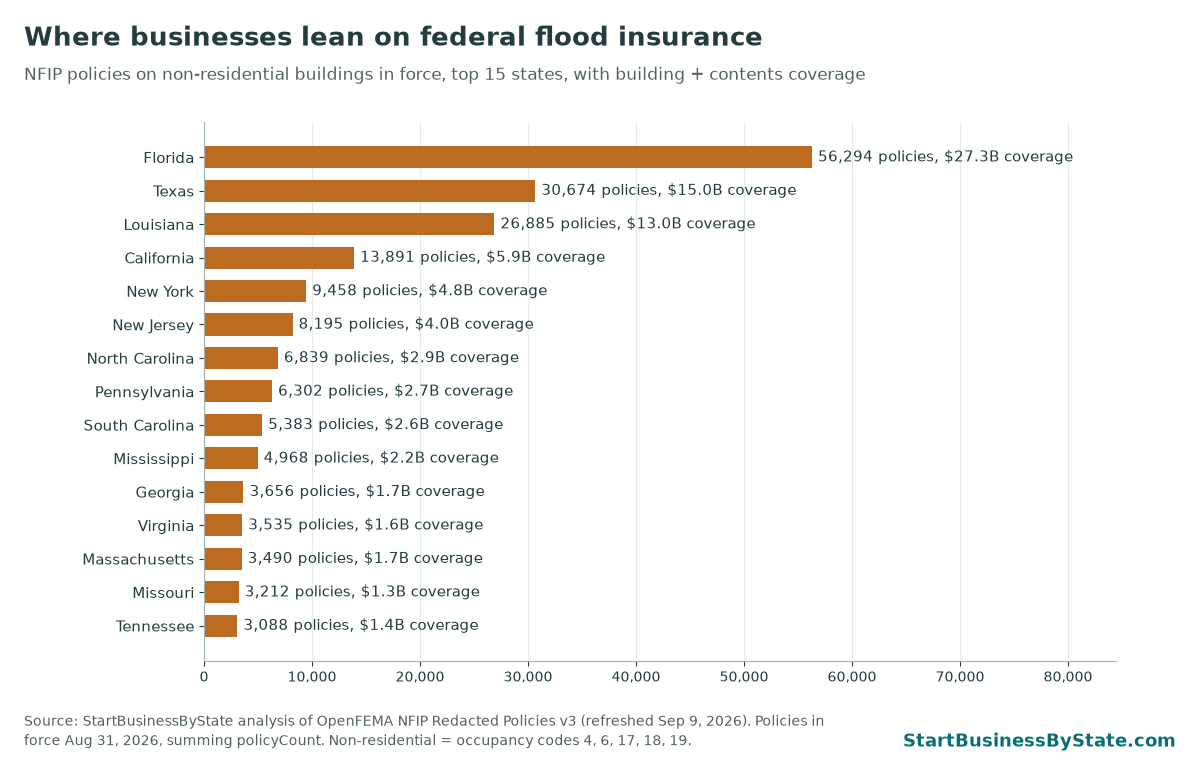
Coastal states lead on raw counts. Inland river states stand out on share. In Iowa, 22.8% of NFIP policies cover non-residential buildings, against 5.2% nationally. Those states have far fewer residential flood policies, so each business policy is a bigger slice of the total.
What happens if flood insurance lapses on December 11?
FEMA has published the same playbook before each recent deadline (bulletin W-24020, December 2024). If Congress lets the program’s authority expire:
- Existing policies keep working. Claims on policies already in force are still paid.
- No new policies and no coverage increases. An application dated after the lapse can’t be issued until Congress acts. Applications dated before the lapse can be issued if the full payment arrives within FEMA’s time limits.
- No new renewal offers. Insurers can’t send renewal notices during a lapse. If the offer went out before the lapse and you pay within the 30-day grace period, the policy can renew. After the October 2025 lapse, FEMA stretched that grace period to January 15, 2026 (memo W-25005).
Lapses hit real estate first. A buyer who needs flood insurance to get a mortgage in a high-risk zone can’t get a new NFIP policy during a lapse, so closings stall or move to private flood insurance.
What a flood insurance lapse means for your business
If you own a building or lease space in a flood zone, the December deadline matters even if you rarely think about flood insurance. Check these before December 11.
- Check your renewal date this week. Find the expiration date on your flood policy declarations page. If it falls in mid-December or January, ask your agent when the renewal offer will go out. If it goes out before December 11, pay it as soon as it arrives.
- Buying or refinancing a building? Get the flood policy bound well before December 11, or line up a private flood quote as a backup. Ask your lender in writing whether it will accept a private policy.
- Renting a storefront or shop? Your landlord’s policy covers the building, not your equipment and inventory. NFIP contents coverage for a business tops out at $500,000. Ask your agent whether you need your own contents policy.
- Trades that work after floods. HVAC, plumbing, cleaning and restoration companies get busy after storms. A lapse doesn’t stop claim payments on existing policies, so that work continues. Make sure your own HVAC business insurance or cleaning business insurance covers water-damage jobs.
- Home daycares. A homeowner’s NFIP policy covers the house. It does not cover business liability. See daycare insurance for what a home-based center needs.
Disaster history tells you how often your state floods. Our disaster declarations by state tracker counts FEMA declarations, and disaster dollars by state shows how much federal aid followed. To see how long FEMA has been taking to approve or turn down requests, check FEMA wait times by state.
How we did this
- Policy data. FEMA OpenFEMA data set “FIMA NFIP Redacted Policies – v3” (NfipPolicies), full parquet file, last refreshed September 9, 2026. The file’s as-of date is September 7, 2026. We replaced the older v2 file, which FEMA froze on June 1, 2026 and is removing.
- In force. A policy counts as in force on August 31, 2026 if its effective date is on or before that day, its termination date is after it, and it has no earlier cancellation date. We sum the policyCount field, which counts insured units, so condominium master policies count each unit.
- Business buildings. FEMA’s v3 data dictionary codes occupancy type 4 (non-residential building), 6 (non-residential business), 17 (non-residential mobile home), 18 (non-residential building) and 19 (non-residential unit in a multi-unit building). Code 14 is a residential manufactured home and is not counted as business. “Small business” is FEMA’s smallBusinessIndicatorBuilding flag: fewer than 100 employees on the application.
- Deadline window. Policies whose termination date falls December 12, 2026 through January 31, 2027. The first-30-days column runs through January 10, 2027.
- Cost. FEMA’s policyCost field: premium plus reserve fund assessment, federal policy fee and HFIAA surcharge, averaged per non-residential contract.
- Law and lapse rules. Public Law 119-103 (H.R. 6500), summarized in Congressional Research Service Insight IN10835; FEMA bulletins W-24020 (December 20, 2024) and W-25005 (November 14, 2025).
Caveats
- FEMA’s public file is redacted and updated monthly. Policies written in the last few weeks before the as-of date may be missing, which is why we use the month-end before it.
- A policy that ends in the window may already have a renewal offer in the mail. Our count is the number of policies exposed to a lapse, not the number that would lose coverage.
- A few policies have multi-year terms. They are counted by their actual end date.
FEMA data is public domain. This page has no ads or affiliate links. Cite as: StartBusinessByState, “Flood Insurance Deadline by State,” updated October 6, 2026, https://startbusinessbystate.com/flood-insurance-deadline-by-state/
Related research
- Disaster declarations by state: FEMA major disaster and emergency declarations, by year.
- Disaster dollars by state: federal disaster aid per state.
- Home prices vs. home services employment: where housing costs and trade jobs move together.
- Business survival rates by state.
- business flood insurance claims by state: what NFIP paid non-residential buildings in each state, 2016–2025.
FAQ
When does federal flood insurance expire?
The National Flood Insurance Program’s authority to issue and renew policies runs through December 11, 2026, under Public Law 119-103, signed September 2, 2026. That is the same date the current stopgap spending law ends. Congress has to act again before then to avoid a lapse.
What happens to my flood policy if the NFIP lapses?
A policy already in force stays in force, and claims keep getting paid. During a lapse, insurers cannot sell new NFIP policies, increase coverage, or send new renewal offers. A renewal can still go through if the renewal offer went out before the lapse and the premium is received within the 30-day grace period, according to FEMA bulletin W-24020.
How many flood policies renew right after December 11?
467,566 policies in the 50 states and DC have a term that ends between December 12, 2026 and January 31, 2027, based on FEMA’s NFIP policy file (policies in force on August 31, 2026). 28,041 of those cover non-residential buildings.
Can I still close on a building purchase during a lapse?
Lenders require flood insurance in high-risk flood zones for federally backed loans. During past lapses, NFIP insurers could not issue new policies unless the application and full payment arrived under FEMA’s timing rules from before the lapse. Private flood insurance is not affected by a lapse, so buyers often switch to a private policy to close.
Does a lapse affect private flood insurance?
No. Private flood policies are sold by private insurers and do not depend on NFIP’s authorization. Whether a private policy meets your lender’s requirement depends on the lender and the policy terms.
How often is this page updated?
When FEMA refreshes its NFIP policy data set (the current file was refreshed September 9, 2026) and whenever Congress changes the deadline. We count policies in force on the last day of the month before the file’s as-of date.
Last updated October 6, 2026. NFIP policies in force on August 31, 2026. Next check: FEMA’s next NfipPolicies refresh, or sooner if Congress moves the December 11 deadline.