By StartBusinessByStatePublisher: Robert SmithResearch process
Updated October 15, 2026. Data: U.S. Small Business Administration, 7(a) loan records through June 30, 2026. Next update: when the SBA posts its next quarterly file.
The typical SBA 7(a) loan to food trucks and other mobile food businesses was $50,000 in fiscal years 2021 through 2026. Of the loans made from 2010 to 2015 that have since closed, 8.9% were charged off, higher than the 7.2% average for all industries.
That makes food trucks one of the riskier small-business borrowers, even though the loans are small. About 62% of recent food truck borrowers were new businesses or startups, compared with about a third or less for HVAC, plumbing, electrical, landscaping and cleaning businesses. A new business has no track record of sales to repay from.
This covers businesses the SBA lists as mobile food services: food trucks, food carts and mobile catering trucks. A food truck run by a restaurant may be counted under the restaurant instead.
How big a typical loan is
The 7(a) program is the SBA’s main loan program. A bank or other lender makes the loan, and the SBA guarantees part of it, which makes lenders more willing to lend to small firms.
- Middle half of loans: $25,000 to $90,000.
- 89% of loans were $150,000 or less.
- 56% went through SBA Express, a faster version with less paperwork.
- 62% went to businesses two years old or younger, or not yet open.
- Typical term: 10 years. Typical starting rate: 9.99%.
Lenders usually ask for proof of business insurance before a loan closes, especially when a vehicle, equipment or a building secures it. If you’re shopping for coverage, see food truck insurance.
| Fiscal year | Loans | Median loan |
|---|---|---|
| 2021 | 142 | $50,750 |
| 2022 | 172 | $42,400 |
| 2023 | 263 | $49,500 |
| 2024 | 308 | $50,000 |
| 2025 | 315 | $50,000 |
| 2026 | 191 | $50,000 |
Fiscal year 2026 runs through June 30, 2026, the date of the latest SBA file.
How often loans were charged off
We looked at the 539 loans to food trucks and other mobile food businesses approved from fiscal 2010 to 2015 that have since closed, either paid off or charged off. Of those, 48 (8.9%) were charged off. Across all industries the rate was 7.2%. We used older loans because most newer loans are still being repaid, so their outcomes aren’t known yet.
What “charged off” means here. A charge-off is when the lender and the SBA write off what’s left of a loan as uncollectible. It is not the same as a default or a business failure. Some borrowers miss payments and later catch up. Some businesses close but repay in full, and some sell or refinance. A charge-off also says nothing about why the loan went bad. Use these rates to compare industries, not to predict what will happen to one business.
What paying it back looks like
At the typical recent rate of 9.99% over 10 years, a $50,000 loan costs about $660 a month, or about $7,926 a year. A truck has to clear that payment every month, including slow months, bad-weather weeks and the days it’s in the shop.
- Seasons matter. In colder states a truck may earn most of its money in six or seven months, but the payment comes due all twelve.
- Most loans are small and fast. About 56% of recent food truck loans went through SBA Express, a faster version of the program for loans up to $500,000 with less paperwork.
- The truck itself is the collateral. If it’s damaged and can’t run, income stops but the payment doesn’t. Lenders usually require proof of insurance before closing; see food truck insurance.
This page is about paying a loan back. For what it costs to build and run a truck, see food truck startup and operating costs.
Typical loan size in each state
Loan sizes vary a lot from place to place. Among states with at least 25 recent loans, the typical loan was largest in Wisconsin ($82,500), Texas ($63,700) and Minnesota ($56,000), and smallest in Oregon ($30,500), North Carolina ($35,000) and New Jersey ($36,300). Bigger loans usually mean the money went to buying real estate or an existing business.
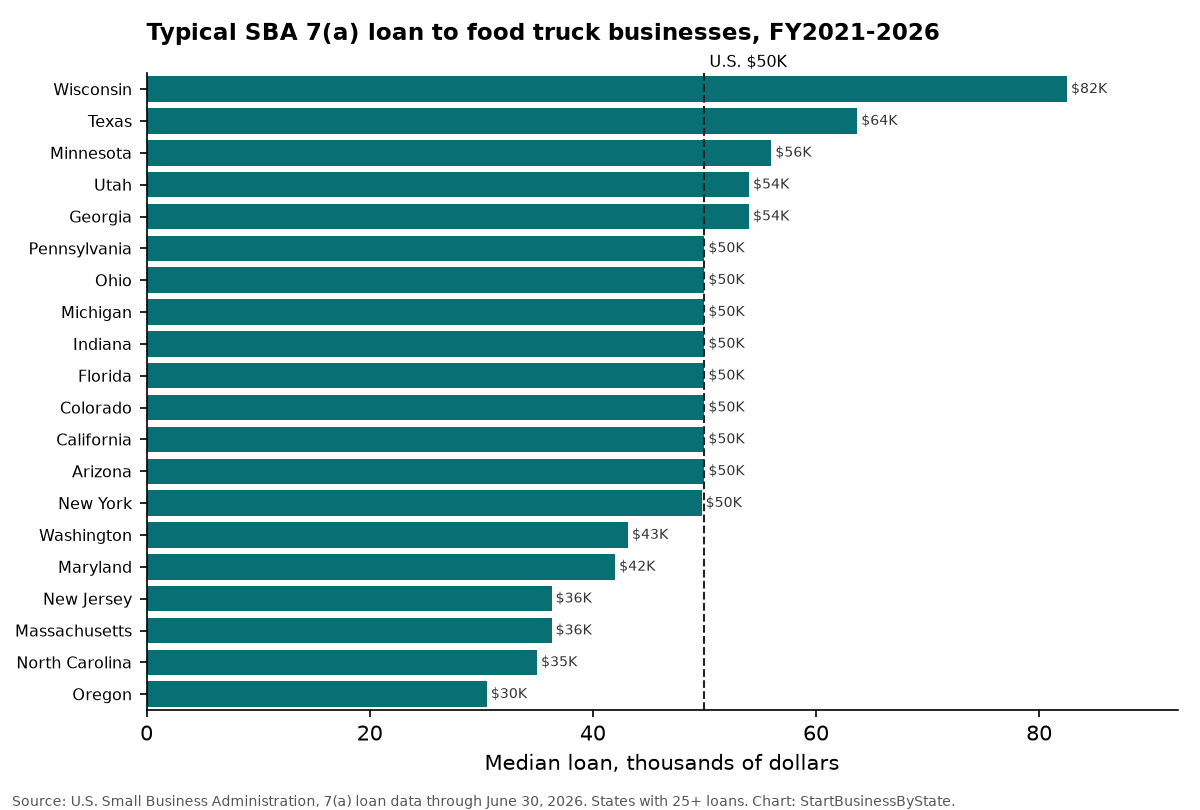
Click a column to sort. Each state links to that state’s guide to small business loans. States with fewer than 25 recent loans are left out.
| State | Loans, FY2021-26 | Median loan |
|---|---|---|
| U.S. | 1,391 | $50,000 |
| Arizona | 41 | $50,000 |
| California | 119 | $50,000 |
| Colorado | 41 | $50,000 |
| Florida | 68 | $50,000 |
| Georgia | 25 | $54,000 |
| Indiana | 27 | $50,000 |
| Maryland | 31 | $42,000 |
| Massachusetts | 33 | $36,300 |
| Michigan | 57 | $50,000 |
| Minnesota | 49 | $56,000 |
| New Jersey | 25 | $36,300 |
| New York | 66 | $49,750 |
| North Carolina | 40 | $35,000 |
| Ohio | 126 | $50,000 |
| Oregon | 47 | $30,500 |
| Pennsylvania | 60 | $50,000 |
| Texas | 64 | $63,700 |
| Utah | 27 | $54,000 |
| Washington | 34 | $43,150 |
| Wisconsin | 26 | $82,500 |
Before you borrow
- Set up the business first. Lenders lend to a business, not just to you. An LLC also keeps business debts separate from your personal ones in most cases. See how to set up an LLC.
- Compare loan types. SBA loans are one option among several. See the main types of business loans, or open your state’s business-loans guide from the table above.
- Get insured. Have quotes ready so insurance doesn’t hold up closing. See food truck insurance.
- See the bigger picture. For all industries, see SBA loan statistics.
Starting a food truck business?
Compare business insurance quotes from Simply Business. Need to form your company first? Form your LLC with LegalNature.
We may earn a commission if you use this link. It doesn’t change what you pay, and it doesn’t affect the data on this page.
How we counted
- Source: U.S. Small Business Administration, 7(a) loan-level records for fiscal years 2010 through 2026, as of June 30, 2026.
- Typical loan: the median approved amount for loans approved in fiscal 2021 through June 30, 2026. Approved amounts can differ from what was actually paid out, and canceled loans are included.
- Charge-off rate: loans approved in fiscal 2010-2015 that were charged off, divided by those loans that were either paid in full or charged off. Loans still being repaid or canceled are left out.
- Industry: the industry code the lender recorded for the borrower. Codes can be wrong or outdated for some loans.
- State: where the project is located. U.S. figures also include Puerto Rico and other territories. States with fewer than 25 recent loans are left out of the state table.
- Monthly payment is an illustration using the median rate and term, with equal monthly payments. It isn’t a quote.
Sources
Cite this data
Reporters and bloggers may use these numbers and charts. Please credit StartBusinessByState and link to this page.
Source: StartBusinessByState, “Food Truck Loans Are Small but Riskier to Repay,” https://startbusinessbystate.com/food-truck-loans/ (updated October 15, 2026).
FAQ
How much do food truck businesses borrow from the SBA?
The median 7(a) loan to food trucks and other mobile food businesses was $50,000 in fiscal 2021-2026, across 1,391 loans. The middle half ranged from $25,000 to $90,000.
How often do food truck loans go bad?
8.9% of 7(a) loans to food trucks and other mobile food businesses made in 2010-2015 were charged off, against 7.2% for all industries. A charge-off isn’t the same as a default or a business failure.
What is a charge-off?
The lender and the SBA write off the unpaid balance as uncollectible. It usually comes after a long period of missed payments, but it is not the same as a default or a business closing.
What's the monthly payment on a typical food truck loan?
About $660 a month for $50,000 at 9.99% over 10 years. Your rate and term will differ.
Where is this data from?
The U.S. Small Business Administration’s public 7(a) loan records, which list every loan with its amount, industry, state and status.
Last updated October 15, 2026 by StartBusinessByState.