By StartBusinessByStatePublisher: Robert SmithResearch process
Original research · Census government finances + American Community Survey · Last updated November 4, 2026
Data through: state and local tax collections for fiscal 2024; homeowner tax bills and home values for 2024 (the latest ACS 1-year release).
Property tax is the biggest tax local governments collect. It made up 70.7% of local tax revenue in fiscal 2024. State and local governments together collected $724.8 billion in property taxes, up 25.7% from fiscal 2019, and local governments took in 96.7% of it. The median homeowner paid $3,211 in 2024, from $9,358 in New Jersey to $881 in West Virginia.
Key findings
- New Hampshire, Alaska and Texas rely most on property taxes. They make up 64.3%, 42.4% and 40.9% of state and local tax revenue. At the other end: New Mexico (14.0%), Delaware (14.4%) and Alabama (16.8%).
- Florida’s property tax take grew 50.8% in five years. Collections rose from $30.9 billion in fiscal 2019 to $46.6 billion in fiscal 2024. The median Florida homeowner’s bill rose 47.1% from 2019 to 2024, the most of any state. Florida voters approved Amendment 3, a property tax cut, on November 3, 2026, with 61.98% in unofficial results.
- Revenue grew fastest in Nevada, Florida and Alabama. Property tax collections rose 51.4%, 50.8% and 45.7% from fiscal 2019 to 2024. Nationally they rose 25.7%.
- Tax bills as a share of home value run from 0.27% to 1.92%. Illinois (1.92%), New Jersey (1.89%) and Connecticut (1.66%) are highest. Hawaii (0.27%) and Alabama (0.38%) are lowest. This is our ratio of two Census medians, not an official rate.
- No-income-tax states lean on property. New Hampshire (64.3%), Alaska (42.4%), Texas (40.9%), Wyoming (38.5%) and Florida (37.4%) all rank in the top 8.
- Property taxes are local. Counties, cities, school districts and special districts collected 96.7% of all property taxes in fiscal 2024. The big exceptions are Vermont, where the state collected 58.4% through its statewide education property tax, and Arkansas, at 51.0%.
Buying premises for your business?
Include property taxes, insurance and upkeep beside the purchase price before comparing financing for the property.
Which states rely most on property taxes?
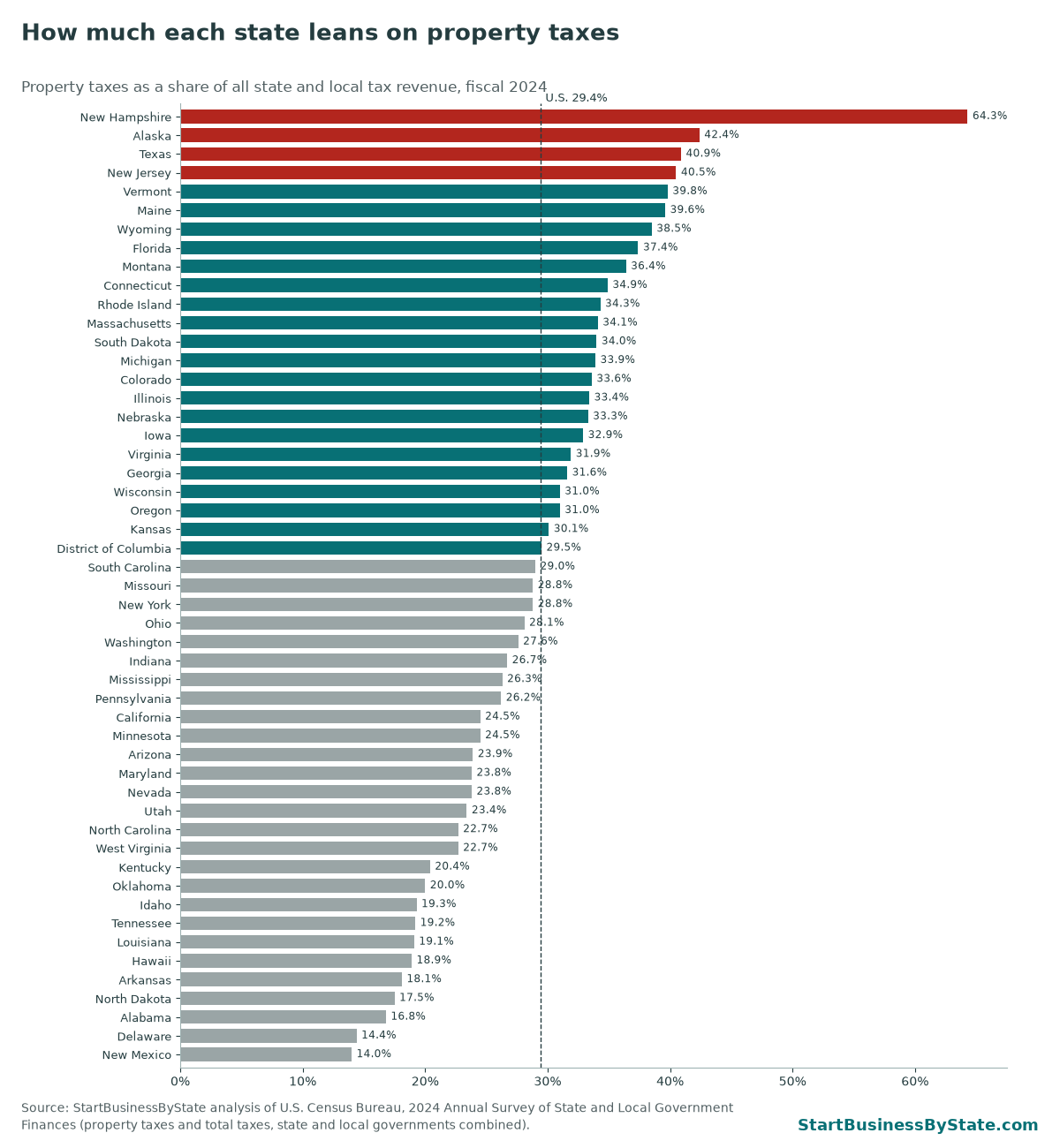
A high share doesn’t always mean high bills. It means the state and its local governments get more of their money from property and less from income or sales taxes. New Hampshire has no broad income tax on wages and no general sales tax, so property carries the load. Texas and Florida have no personal income tax, and property taxes bring in 37% or more of their state and local tax revenue.
How big is the typical property tax bill?
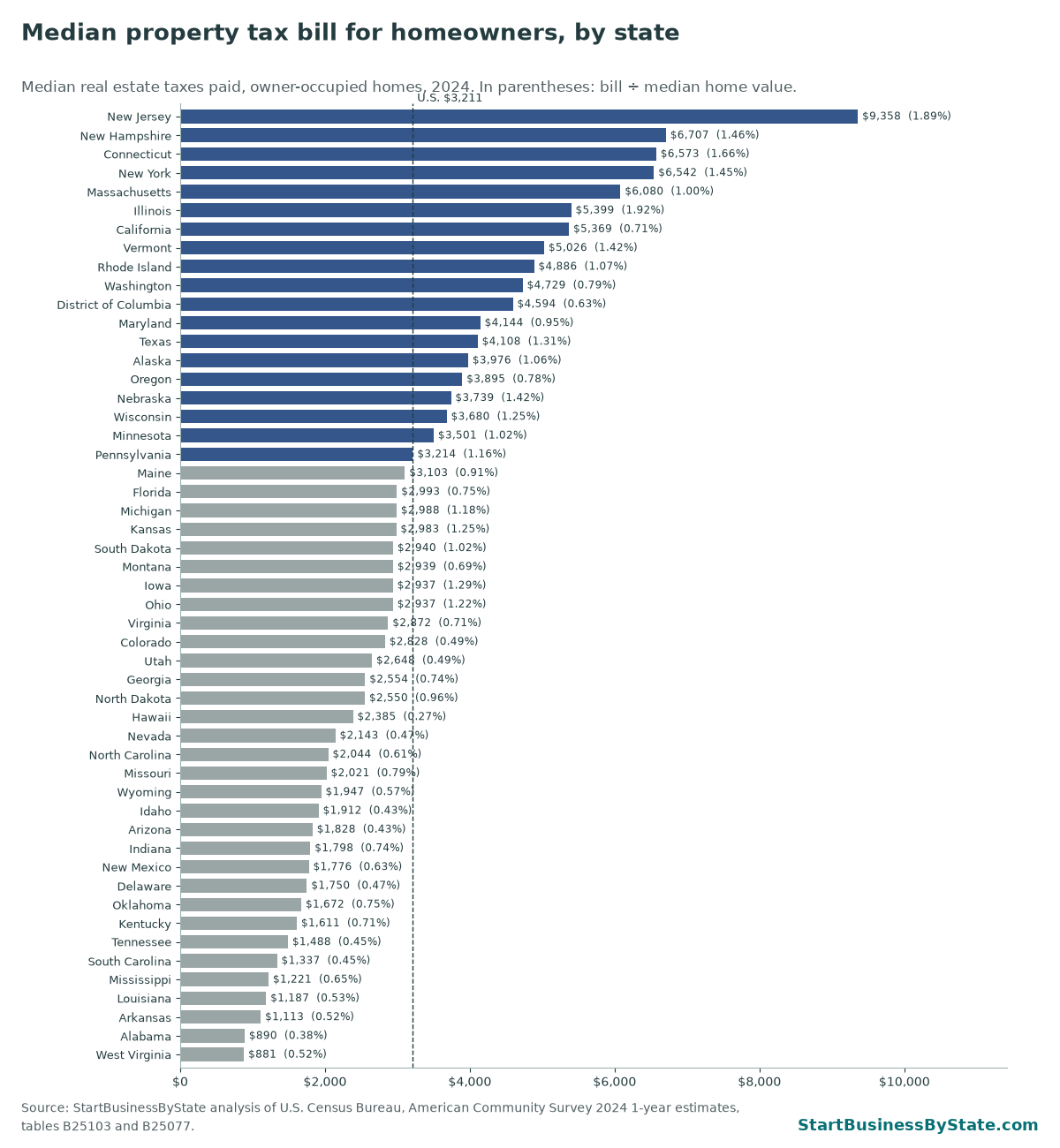
Homeowner bills are the best state-by-state view of property tax burden that the Census publishes every year. They matter for a new business in two ways. If you run the business from home, your own bill is part of your costs. If you rent space, your landlord’s bill is often built into your rent.
Property taxes in every state
Click a column header to sort. The table starts with the states that rely most on property taxes.
| Rank | State | Share of state + local taxes, FY2024 | Per resident | Revenue change since FY2019 | Median homeowner bill, 2024 | Median home value | Bill ÷ value | Bill change since 2019 |
|---|---|---|---|---|---|---|---|---|
| 1 | New Hampshire | 64.3% | $4,064 | +31.6% | $6,707 | $458,800 | 1.46% | +16.3% |
| 2 | Alaska | 42.4% | $2,444 | +11.3% | $3,976 | $376,500 | 1.06% | +19.6% |
| 3 | Texas | 40.9% | $2,322 | +17.9% | $4,108 | $313,200 | 1.31% | +21.2% |
| 4 | New Jersey | 40.5% | $3,667 | +11.8% | $9,358 | $496,000 | 1.89% | +11.0% |
| 5 | Vermont | 39.8% | $3,454 | +26.4% | $5,026 | $352,800 | 1.42% | +15.8% |
| 6 | Maine | 39.6% | $3,076 | +23.0% | $3,103 | $341,900 | 0.91% | +19.5% |
| 7 | Wyoming | 38.5% | $2,631 | +29.0% | $1,947 | $339,500 | 0.57% | +44.0% |
| 8 | Florida | 37.4% | $1,994 | +50.8% | $2,993 | $396,900 | 0.75% | +47.1% |
| 9 | Montana | 36.4% | $2,174 | +30.7% | $2,939 | $425,400 | 0.69% | +39.4% |
| 10 | Connecticut | 34.9% | $3,421 | +9.7% | $6,573 | $396,900 | 1.66% | +9.5% |
| 11 | Rhode Island | 34.3% | $2,525 | +6.0% | $4,886 | $455,700 | 1.07% | +12.6% |
| 12 | Massachusetts | 34.1% | $3,216 | +28.6% | $6,080 | $607,400 | 1.00% | +24.1% |
| 13 | South Dakota | 34.0% | $1,868 | +22.0% | $2,940 | $289,600 | 1.02% | +30.3% |
| 14 | Michigan | 33.9% | $1,887 | +25.6% | $2,988 | $254,200 | 1.18% | +21.7% |
| 15 | Colorado | 33.6% | $2,392 | +37.6% | $2,828 | $574,600 | 0.49% | +45.0% |
| 16 | Illinois | 33.4% | $3,014 | +30.2% | $5,399 | $280,700 | 1.92% | +19.3% |
| 17 | Nebraska | 33.3% | $2,354 | +21.7% | $3,739 | $263,100 | 1.42% | +34.2% |
| 18 | Iowa | 32.9% | $2,097 | +21.9% | $2,937 | $227,300 | 1.29% | +20.9% |
| 19 | Virginia | 31.9% | $2,298 | +33.6% | $2,872 | $403,500 | 0.71% | +23.7% |
| 20 | Georgia | 31.6% | $1,738 | +42.4% | $2,554 | $343,300 | 0.74% | +44.2% |
| 21 | Oregon | 31.0% | $2,104 | +27.7% | $3,895 | $497,500 | 0.78% | +21.6% |
| 22 | Wisconsin | 31.0% | $1,904 | +15.6% | $3,680 | $294,700 | 1.25% | +10.8% |
| 23 | Kansas | 30.1% | $2,013 | +23.9% | $2,983 | $238,700 | 1.25% | +33.5% |
| 24 | District of Columbia | 29.5% | $4,389 | +10.0% | $4,594 | $733,400 | 0.63% | +26.0% |
| 25 | South Carolina | 29.0% | $1,583 | +34.8% | $1,337 | $299,500 | 0.45% | +36.4% |
| 26 | Missouri | 28.8% | $1,567 | +38.9% | $2,021 | $254,400 | 0.79% | +29.3% |
| 27 | New York | 28.8% | $3,562 | +15.5% | $6,542 | $449,800 | 1.45% | +14.1% |
| 28 | Ohio | 28.1% | $1,685 | +22.8% | $2,937 | $239,800 | 1.22% | +26.4% |
| 29 | Washington | 27.6% | $2,126 | +33.9% | $4,729 | $602,200 | 0.79% | +31.3% |
| 30 | Indiana | 26.7% | $1,490 | +38.4% | $1,798 | $243,500 | 0.74% | +42.4% |
| 31 | Mississippi | 26.3% | $1,313 | +16.7% | $1,221 | $186,500 | 0.65% | +21.0% |
| 32 | Pennsylvania | 26.2% | $1,801 | +13.1% | $3,214 | $277,600 | 1.16% | +11.3% |
| 33 | California | 24.5% | $2,487 | +33.1% | $5,369 | $759,500 | 0.71% | +29.6% |
| 34 | Minnesota | 24.5% | $2,043 | +22.7% | $3,501 | $344,600 | 1.02% | +31.1% |
| 35 | Arizona | 23.9% | $1,264 | +14.8% | $1,828 | $426,000 | 0.43% | +15.8% |
| 36 | Nevada | 23.8% | $1,575 | +51.4% | $2,143 | $455,500 | 0.47% | +26.4% |
| 37 | Maryland | 23.8% | $1,977 | +19.5% | $4,144 | $436,300 | 0.95% | +17.9% |
| 38 | Utah | 23.4% | $1,427 | +36.0% | $2,648 | $545,200 | 0.49% | +39.4% |
| 39 | North Carolina | 22.7% | $1,204 | +21.5% | $2,044 | $333,000 | 0.61% | +36.9% |
| 40 | West Virginia | 22.7% | $1,256 | +29.1% | $881 | $170,800 | 0.52% | +23.9% |
| 41 | Kentucky | 20.4% | $1,117 | +28.7% | $1,611 | $226,000 | 0.71% | +28.2% |
| 42 | Oklahoma | 20.0% | $996 | +24.8% | $1,672 | $222,100 | 0.75% | +30.8% |
| 43 | Idaho | 19.3% | $1,058 | +8.2% | $1,912 | $446,400 | 0.43% | +18.3% |
| 44 | Tennessee | 19.2% | $924 | +17.5% | $1,488 | $332,600 | 0.45% | +22.0% |
| 45 | Louisiana | 19.1% | $1,196 | +29.1% | $1,187 | $223,200 | 0.53% | +29.2% |
| 46 | Hawaii | 18.9% | $1,913 | +34.3% | $2,385 | $875,900 | 0.27% | +27.5% |
| 47 | Arkansas | 18.1% | $963 | +26.2% | $1,113 | $215,600 | 0.52% | +33.5% |
| 48 | North Dakota | 17.5% | $1,677 | +18.9% | $2,550 | $266,100 | 0.96% | +25.9% |
| 49 | Alabama | 16.8% | $850 | +45.7% | $890 | $233,300 | 0.38% | +46.1% |
| 50 | Delaware | 14.4% | $1,085 | +22.4% | $1,750 | $371,600 | 0.47% | +19.0% |
| 51 | New Mexico | 14.0% | $1,249 | +43.3% | $1,776 | $279,900 | 0.63% | +26.6% |
Share, per-resident and revenue figures cover property taxes collected by the state and all local governments combined, including taxes paid on homes, businesses, farms and, where taxed, business equipment and vehicles. Per resident uses ACS 2024 population. “Bill ÷ value” divides the median bill by the median home value; it is our estimate, not a published rate.
Download the data (CSV)Florida voters approved Amendment 3
Amendment 3 passed on November 3, 2026, according to unofficial results. The Florida Division of Elections’ election-night results show 4,917,715 votes (61.98%) for approval and 3,016,136 (38.02%) against, out of 7,933,851 cast, as of the morning of November 4. A constitutional amendment needs 60% to pass (Florida Constitution, Article XI, Section 5). These totals are unofficial until the state certifies the election; provisional and late overseas ballots can still be added, but they would have to move the result by about two points to change it.
The amendment takes effect January 1, 2027. According to the ballot summary published by the Florida Division of Elections, it changes the state constitution in three ways that matter to business owners:
- The homestead exemption from non-school property taxes rises to $150,000 in 2027 and $250,000 in 2028, then adjusts for inflation. People who are not Florida residents on December 31, 2026 get the current exemption at first and the bigger one starting in their fifth year.
- The yearly cap on assessment increases for non-homestead property drops from 10% to 5% for non-school taxes. That covers rental homes and commercial property such as storefronts, offices and warehouses.
- Counties and cities may spend property tax money only on a listed set of core services: public safety, schools, infrastructure, natural resources, bond payments, employee retirement benefits, and operations and administration.
What it means if you own or rent business space in Florida
- Your assessed value can grow more slowly. If you own a storefront, office or warehouse, its assessed value for non-school taxes can rise no more than 5% a year instead of 10%. The cap limits the assessment, not the tax rate, so your bill can still go up if your county or city raises its millage rate. School taxes are not covered by the new cap.
- Leases pass it through. On a net lease, where you pay a share of the building’s property taxes, a slower-growing assessment means a slower-growing tax share. Check your lease for how property taxes are passed through, and ask your landlord about it at renewal.
- The homestead exemption is for homes, not business property. If you run your business from the home you live in, the larger exemption lowers the non-school taxes on that home. Commercial property and rental homes don’t get it.
- Watch your local budget. Florida’s state and local governments collected $46.6 billion in property taxes in fiscal 2024, 37.4% of all their tax revenue. A bigger homestead exemption shrinks the taxable base, so counties and cities will set 2027 rates and fees with less homestead value to tax. Local rate and fee decisions are made at public budget hearings each year.
Sources: Florida Division of Elections results (unofficial) and the official ballot summary.
What property taxes mean for your business
For an owner budgeting a commercial property purchase, compare business real-estate financing with the taxes, insurance and maintenance in the plan. A business managing premises for other owners can use our property management setup guide.
Most first-time owners don’t get a property tax bill in year one. You still pay for it. Here is where it shows up:
- Your rent. Many commercial leases are “net” leases, where the tenant pays a share of the building’s property taxes on top of base rent. Ask the landlord what the tax share was last year and whether a reassessment is coming. A building that just sold often gets reassessed higher.
- Your equipment. Many states and localities tax business personal property, such as furniture, tools, kitchen equipment and computers. You may have to file a list with the county assessor every year even if the tax is small. Check with your assessor before your first January 1 in business.
- Your home office. If you run the business from home and qualify for the home office deduction, the business share of your property taxes is deductible. IRS Publication 587 covers the math.
- Buying a building. Price the property tax into your monthly cost, not just the mortgage. In Illinois the typical homeowner bill is about 1.9% of value each year. In Hawaii it is under 0.3%. Commercial rates are often higher than homeowner rates because many states give homeowners exemptions that businesses don’t get.
If you are still choosing where to set up, compare property taxes with the other fixed costs on our best states to start a business ranking, LLC costs by state and new-employer unemployment tax rates. Home-based daycares feel property rules more than most; see childcare zoning laws by state.
How we did this
- Property tax revenue. U.S. Census Bureau, Annual Survey of State and Local Government Finances, fiscal 2024 and 2019, from the Census API dataset timeseries/govslocalfin. Item LF0009 (property taxes) and LF0008 (total taxes), government type 001 (state and local combined). Local share uses type 003. Amounts are reported in thousands of dollars.
- Homeowner bills and home values. American Community Survey 2024 and 2019 1-year estimates: B25103_001E (median real estate taxes paid, owner-occupied housing units) and B25077_001E (median value, owner-occupied housing units). Per-resident figures use B01003_001E (total population), ACS 2024.
Caveats
- Census does not split property tax revenue between homes and businesses, so the revenue columns include both.
- Fiscal years differ by state. Most end June 30; New York’s ends March 31, Texas’s August 31, and Alabama’s and Michigan’s September 30. Local government figures are survey estimates. 7 states have a coefficient of variation above 10% on the combined total (New Jersey, Maine, Illinois, Kansas, Washington, Pennsylvania, California). The CSV includes each state’s figure.
- ACS homeowner bills are self-reported, include all real estate taxes on the home, and exclude renters. Margins of error are in the CSV.
- The ACS 2019 figures are from the 2019 1-year release. Census did not publish standard 1-year estimates for 2020.
Census data are public domain. This page has no ads or affiliate links. Cite as: StartBusinessByState, “Property Taxes by State for Small Business Owners,” updated October 6, 2026, https://startbusinessbystate.com/property-taxes-by-state-small-business/
Related research
- Sales tax on services: bills by state.
- Data center tax break tracker.
- Home prices vs. home services employment.
- Disaster dollars by state.
- Business license requirements by state.
- home price changes by state: where prices rose and fell over the past year.
- investor home purchases by state: HMDA data on mortgage-financed rental purchases.
- home insurance cost by state: what homeowners pay for insurance in every state, Census data.
Your next step: compare commercial property financing
FAQ
Which state has the highest property taxes?
It depends on the measure. New Jersey has the highest median homeowner bill ($9,358 in 2024). Illinois has the highest bill relative to home value (1.92%). New Hampshire relies most on property taxes, at 64.3% of state and local tax revenue.
Which state has the lowest property taxes?
West Virginia has the lowest median homeowner bill, at $881 in 2024. Hawaii has the lowest bill relative to home value (0.27%), because its home values are high.
Do small businesses pay property tax?
Yes, if they own real estate. Owners of commercial buildings pay property tax on them, and many commercial leases pass those taxes on to the tenant. Many states and localities also tax business equipment and furniture as personal property, so check with your county or city assessor.
Can I deduct property taxes if I run a business from home?
If you qualify for the home office deduction, the business share of your home’s real estate taxes counts as a business expense. IRS Publication 587 explains how to figure the business share.
What is Florida Amendment 3?
It is a change to the Florida Constitution that voters approved on November 3, 2026, with 61.98% of the vote in unofficial results from the Florida Division of Elections (60% was needed). Starting January 1, 2027, it raises the homestead exemption from non-school property taxes to $150,000 in 2027 and $250,000 in 2028, and cuts the annual cap on assessment increases for non-homestead property, including commercial property, from 10% to 5% for non-school taxes.
How often is this updated?
Once a year. The Census Bureau releases new ACS 1-year estimates each September and new state and local government finance data about 18 months after the fiscal year ends.
Last updated November 4, 2026. Government finance data for fiscal 2024; ACS 2024 1-year estimates.