Census ACS 2024 heating fuel + EIA electricity data through July 2026 + EIA winter outlook · Updated by StartBusinessByState
Short answer: Electric heat is most common in the South and the Pacific Northwest: Florida (90%), South Carolina (70%), Alabama (67%), North Carolina (66%), Tennessee (65%). It’s least common in Vermont (12%), New Hampshire (12%), Michigan (13%), where most homes use gas or fuel oil. In those electric-heat states, winter power bills depend heavily on electricity prices and on how cold the weather is. Natural gas still heats more homes nationwide (46.6%), but electric heat has gained in 41 states since 2019.
Key facts for reporters
- Homes heated mainly with electricity, 2024: 55,481,476 (41.8% of occupied homes), up from 39.5% in 2019 (Census ACS B25040). Utility gas: 46.6%. Propane: 4.7%. Fuel oil: 3.5%.
- Highest electric heat share: Florida (90%), South Carolina (70%), Alabama (67%), North Carolina (66%), Tennessee (65%). Biggest gains since 2019: Hawaii (+10.7 pts), District of Columbia (+5.8 pts), Vermont (+5.4 pts), Maine (+5.2 pts).
- Average monthly home electric bill last winter (Dec 2025–Feb 2026): $162 nationally, +6.0% from the winter before and +45% from Dec 2019–Feb 2020 (EIA, revenue ÷ customers). Highest: Maryland ($247), Connecticut ($236), West Virginia ($220), Virginia ($218).
- Residential electricity price, July 2026: 18.3¢ per kWh nationally, +4.9% from July 2025. Prices rose in 45 of 51 states. Biggest increases: Hawaii (+22%), New Hampshire (+17%), Maine (+16%), New York (+14%).
- EIA’s latest Short-Term Energy Outlook forecasts an average U.S. residential price of 18.0¢ per kWh for Dec 2026–Feb 2027, compared with 17.4¢ last winter (+3.1%). That’s a forecast, and it’s for prices, not bills. Bills also depend on the weather. For all home utilities together, see household utility spending per person.
Which states heat with electricity
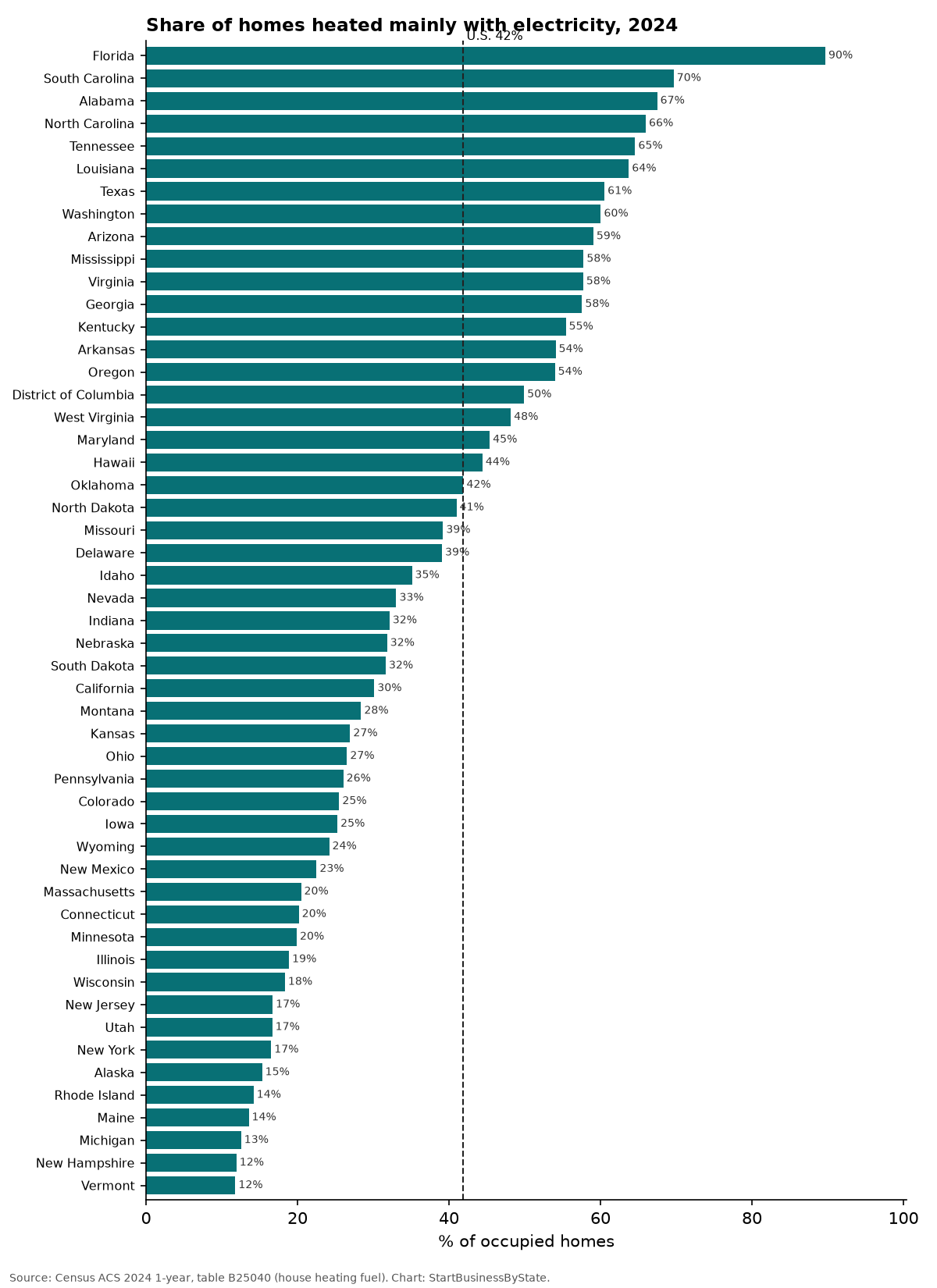
- Florida: 90% of homes (8,198,441)
- South Carolina: 70% of homes (1,548,377)
- Alabama: 67% of homes (1,389,802)
- North Carolina: 66% of homes (2,966,699)
- Tennessee: 65% of homes (1,891,350)
- Louisiana: 64% of homes (1,178,511)
- Texas: 61% of homes (6,929,859)
- Washington: 60% of homes (1,902,153)
- Arizona: 59% of homes (1,761,275)
- Mississippi: 58% of homes (679,675)
Electric heat includes electric furnaces, baseboard heaters and heat pumps. The Census survey doesn’t separate them. Heat pumps use much less electricity than baseboard or furnace heat for the same warmth, so two homes that both heat with electricity can have very different bills. The share of homes with electric heat grew most from 2019 to 2024 in Hawaii (+10.7 points), District of Columbia (+5.8 points), Vermont (+5.4 points), Maine (+5.2 points). New homes are often built with heat pumps, and some owners have switched. In Hawaii, few homes need much heat. Its rise came as the share of homes reporting no heating fuel at all fell from 59% to 44%. For rebates, see heat pump rebates by state. For homes on other fuels, see heating oil and propane prices by state.
Winter electric bills by state
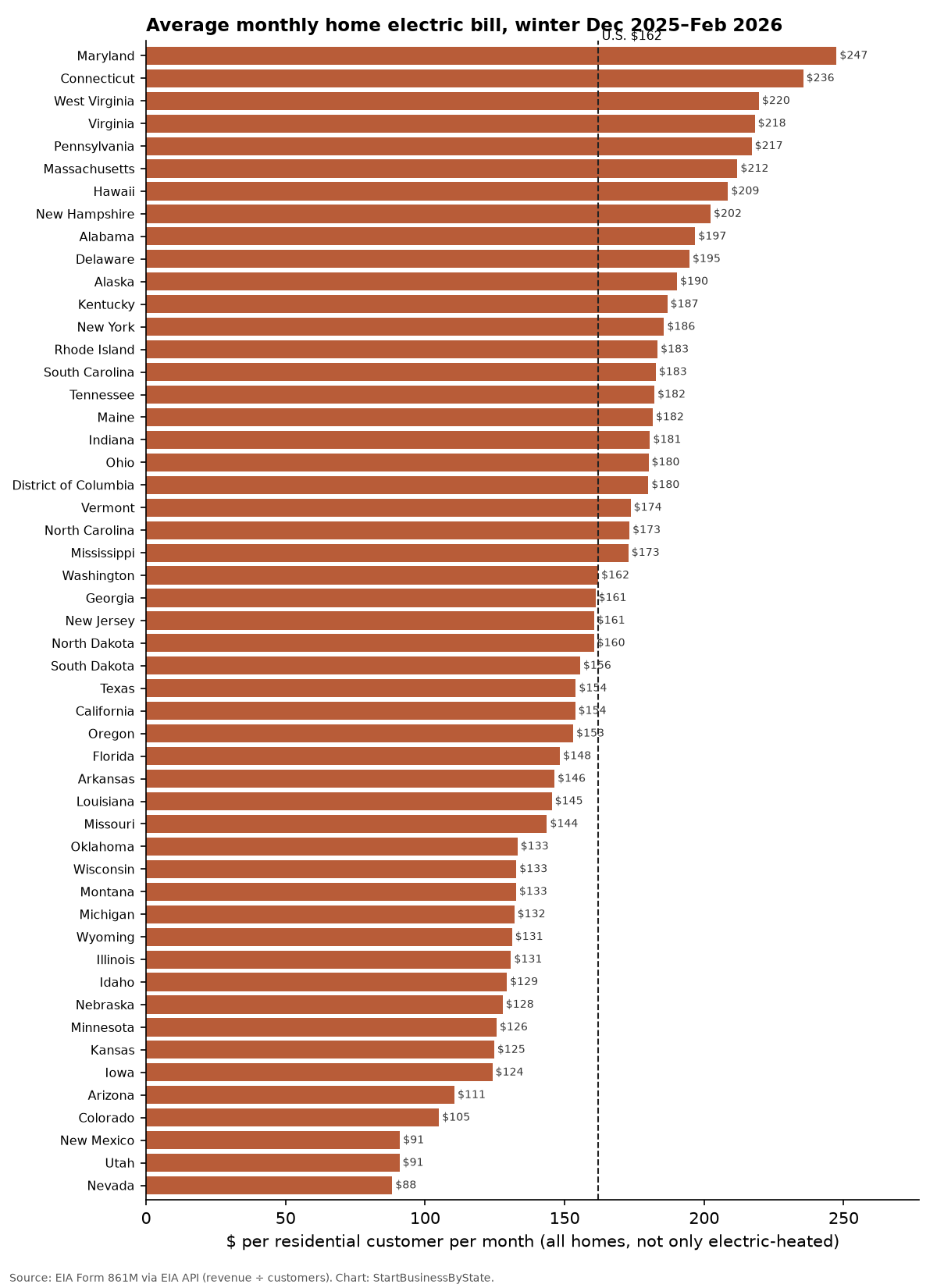
Last winter (Dec 2025–Feb 2026), the average home paid $162 a month for electricity. This figure covers every residential customer, not only homes with electric heat, so in states where most homes heat with electricity it tracks winter heating more closely. Bills were highest in Maryland ($247), Connecticut ($236), West Virginia ($220), Virginia ($218). Compared with the winter before, bills rose most in New Jersey (+26%), District of Columbia (+25%), Pennsylvania (+20%), New Hampshire (+17%) and fell in 10 states. Bills move with prices and with the weather: a colder winter means more kWh used even when prices don’t change.
Among states where at least half of homes heat with electricity, last winter’s bills rose most in Virginia (+13%), Kentucky (+10%), Mississippi (+7%), South Carolina (+7%). Electricity prices reflect the cost of fuel for power plants (natural gas is the largest source), spending on power lines and the grid, and growing demand, including from data centers. This data doesn’t separate those causes. See data center electricity prices by state and business electricity cost increases by state.
What to expect this winter
EIA’s latest Short-Term Energy Outlook expects the U.S. average residential electricity price to be 18.0¢ per kWh in Dec 2026–Feb 2027, up 3.1% from 17.4¢ last winter. EIA doesn’t publish this forecast by state. It’s also a forecast of prices, not bills. A home that uses the same amount of power would see its bill change by about the same percentage. A colder or milder winter would change usage, and that would change the bill too.
Electric heat and winter bills by state
Click a column to sort. Bills are averages for all residential customers.
| State | Electric heat share, 2024 | Share, 2019 | Change (pts) | Electric-heated homes | Avg monthly bill, Dec 2025–Feb 2026 | Change vs. prior winter | Change vs. Dec 2019–Feb 2020 | Price, July 2026 | Price change, 1 yr |
|---|---|---|---|---|---|---|---|---|---|
| U.S. | 41.8% | 39.5% | +2.3 | 55,481,476 | $162 | +6% | +45% | 18.3¢ | +4.9% |
| Alabama | 67.5% | 66.4% | +1.1 | 1,389,802 | $197 | +1% | +45% | 16.4¢ | +3.0% |
| Alaska | 15.3% | 12.1% | +3.2 | 41,975 | $190 | +14% | +25% | 28.8¢ | +5.6% |
| Arizona | 59.1% | 60.5% | -1.4 | 1,761,275 | $111 | -1% | +18% | 15.4¢ | +0.3% |
| Arkansas | 54.1% | 50.6% | +3.5 | 674,163 | $146 | +4% | +34% | 14.3¢ | +8.1% |
| California | 30.1% | 26.6% | +3.5 | 4,157,218 | $154 | -0% | +49% | 33.6¢ | +2.9% |
| Colorado | 25.5% | 23.6% | +1.9 | 632,297 | $105 | +2% | +32% | 17.0¢ | +6.3% |
| Connecticut | 20.2% | 17.3% | +2.9 | 293,463 | $236 | -4% | +40% | 24.2¢ | -12.5% |
| Delaware | 39.1% | 35.1% | +4.0 | 161,082 | $195 | +9% | +66% | 18.5¢ | +11.5% |
| District of Columbia | 49.9% | 44.2% | +5.8 | 164,551 | $180 | +25% | +105% | 25.2¢ | +9.4% |
| Florida | 89.7% | 92.1% | -2.5 | 8,198,441 | $148 | +6% | +43% | 15.0¢ | -0.5% |
| Georgia | 57.6% | 55.6% | +2.0 | 2,429,385 | $161 | +1% | +45% | 16.3¢ | +4.6% |
| Hawaii | 44.4% | 33.7% | +10.7 | 219,000 | $209 | +2% | +29% | 48.0¢ | +22.0% |
| Idaho | 35.1% | 34.4% | +0.7 | 263,648 | $129 | -1% | +16% | 13.7¢ | +11.8% |
| Illinois | 18.9% | 17.0% | +1.8 | 963,404 | $131 | +9% | +43% | 19.2¢ | +11.6% |
| Indiana | 32.1% | 29.7% | +2.4 | 891,938 | $181 | +11% | +46% | 16.7¢ | +3.4% |
| Iowa | 25.3% | 23.7% | +1.6 | 339,388 | $124 | +1% | +13% | 16.0¢ | +4.4% |
| Kansas | 26.9% | 25.5% | +1.5 | 324,483 | $125 | -1% | +21% | 15.3¢ | +5.6% |
| Kentucky | 55.4% | 52.7% | +2.7 | 1,033,715 | $187 | +10% | +50% | 13.8¢ | +5.2% |
| Louisiana | 63.7% | 64.0% | -0.2 | 1,178,511 | $145 | +5% | +46% | 12.7¢ | -3.0% |
| Maine | 13.5% | 8.4% | +5.2 | 83,361 | $182 | +14% | +69% | 32.4¢ | +15.8% |
| Maryland | 45.4% | 42.2% | +3.2 | 1,089,518 | $247 | +13% | +80% | 21.4¢ | +13.7% |
| Massachusetts | 20.5% | 16.9% | +3.5 | 578,927 | $212 | +8% | +56% | 30.5¢ | +1.4% |
| Michigan | 12.5% | 10.2% | +2.4 | 518,174 | $132 | +6% | +28% | 23.1¢ | +12.2% |
| Minnesota | 19.9% | 17.3% | +2.6 | 470,053 | $126 | +2% | +20% | 17.4¢ | +3.1% |
| Mississippi | 57.8% | 58.0% | -0.3 | 679,675 | $173 | +7% | +39% | 14.5¢ | +7.1% |
| Missouri | 39.2% | 37.1% | +2.1 | 1,004,835 | $144 | +2% | +30% | 16.1¢ | +3.4% |
| Montana | 28.4% | 26.2% | +2.2 | 133,123 | $133 | +0% | +16% | 15.0¢ | +5.0% |
| Nebraska | 31.8% | 30.6% | +1.2 | 262,175 | $128 | +2% | +15% | 13.8¢ | +7.3% |
| Nevada | 33.0% | 36.1% | -3.1 | 409,239 | $88 | -8% | +3% | 12.8¢ | +3.1% |
| New Hampshire | 11.9% | 9.9% | +2.0 | 68,090 | $202 | +17% | +54% | 26.6¢ | +16.7% |
| New Jersey | 16.7% | 13.6% | +3.1 | 592,186 | $161 | +26% | +73% | 25.2¢ | -0.5% |
| New Mexico | 22.5% | 22.6% | -0.1 | 192,892 | $91 | -0% | +14% | 16.1¢ | +1.8% |
| New York | 16.5% | 12.2% | +4.3 | 1,292,868 | $186 | +16% | +85% | 29.9¢ | +14.0% |
| North Carolina | 66.0% | 64.3% | +1.7 | 2,966,699 | $173 | +5% | +42% | 15.2¢ | +13.4% |
| North Dakota | 41.0% | 41.3% | -0.3 | 143,327 | $160 | +4% | +21% | 13.4¢ | +0.8% |
| Ohio | 26.5% | 24.7% | +1.8 | 1,307,559 | $180 | +12% | +62% | 19.4¢ | +11.9% |
| Oklahoma | 41.9% | 39.5% | +2.4 | 671,928 | $133 | +1% | +36% | 14.3¢ | +6.1% |
| Oregon | 54.0% | 52.4% | +1.5 | 941,491 | $153 | -6% | +28% | 16.0¢ | +2.3% |
| Pennsylvania | 26.0% | 23.9% | +2.2 | 1,396,275 | $217 | +20% | +71% | 21.7¢ | +11.3% |
| Rhode Island | 14.2% | 10.3% | +3.9 | 63,619 | $183 | +5% | +42% | 28.3¢ | +8.1% |
| South Carolina | 69.7% | 70.9% | -1.2 | 1,548,377 | $183 | +7% | +30% | 15.5¢ | +5.2% |
| South Dakota | 31.6% | 32.5% | -0.9 | 120,936 | $156 | +1% | +15% | 15.4¢ | +5.9% |
| Tennessee | 64.6% | 62.5% | +2.0 | 1,891,350 | $182 | +4% | +36% | 13.7¢ | +3.8% |
| Texas | 60.5% | 61.1% | -0.6 | 6,929,859 | $154 | -1% | +35% | 15.9¢ | +3.4% |
| Utah | 16.7% | 14.8% | +1.8 | 197,314 | $91 | +1% | +25% | 13.1¢ | -2.5% |
| Vermont | 11.8% | 6.4% | +5.4 | 33,651 | $174 | +10% | +44% | 23.8¢ | +7.3% |
| Virginia | 57.7% | 56.2% | +1.5 | 1,990,503 | $218 | +13% | +51% | 17.6¢ | +11.2% |
| Washington | 60.0% | 56.3% | +3.7 | 1,902,153 | $162 | +5% | +38% | 14.7¢ | +9.4% |
| West Virginia | 48.2% | 45.0% | +3.1 | 356,767 | $220 | +2% | +54% | 15.8¢ | +2.3% |
| Wisconsin | 18.3% | 16.1% | +2.2 | 464,872 | $133 | +6% | +32% | 19.1¢ | +4.4% |
| Wyoming | 24.2% | 22.8% | +1.4 | 61,941 | $131 | -2% | +15% | 14.4¢ | -1.9% |
State-by-state notes
Alabama
67% of homes in Alabama are heated mainly with electricity (rank 3 of 51; 1,389,802 homes), compared with 66% in 2019. Natural gas heats 26%, propane 5%, and fuel oil 0%. Last winter (Dec 2025–Feb 2026), the average home electric bill was $197 a month, +1% from the winter before and +45% from Dec 2019–Feb 2020. The residential price was 16.4¢ per kWh in July 2026, +3.0% from a year earlier.
Alaska
15% of homes in Alaska are heated mainly with electricity (rank 46 of 51; 41,975 homes), compared with 12% in 2019. Natural gas heats 48%, propane 2%, and fuel oil 28%. Last winter (Dec 2025–Feb 2026), the average home electric bill was $190 a month, +14% from the winter before and +25% from Dec 2019–Feb 2020. The residential price was 28.8¢ per kWh in July 2026, +5.6% from a year earlier.
Arizona
59% of homes in Arizona are heated mainly with electricity (rank 9 of 51; 1,761,275 homes), compared with 60% in 2019. Natural gas heats 34%, propane 3%, and fuel oil 0%. Last winter (Dec 2025–Feb 2026), the average home electric bill was $111 a month, -1% from the winter before and +18% from Dec 2019–Feb 2020. The residential price was 15.4¢ per kWh in July 2026, +0.3% from a year earlier.
Arkansas
54% of homes in Arkansas are heated mainly with electricity (rank 14 of 51; 674,163 homes), compared with 51% in 2019. Natural gas heats 37%, propane 6%, and fuel oil 0%. Last winter (Dec 2025–Feb 2026), the average home electric bill was $146 a month, +4% from the winter before and +34% from Dec 2019–Feb 2020. The residential price was 14.3¢ per kWh in July 2026, +8.1% from a year earlier.
California
30% of homes in California are heated mainly with electricity (rank 29 of 51; 4,157,218 homes), compared with 27% in 2019. Natural gas heats 61%, propane 3%, and fuel oil 0%. Last winter (Dec 2025–Feb 2026), the average home electric bill was $154 a month, -0% from the winter before and +49% from Dec 2019–Feb 2020. The residential price was 33.6¢ per kWh in July 2026, +2.9% from a year earlier.
Colorado
25% of homes in Colorado are heated mainly with electricity (rank 34 of 51; 632,297 homes), compared with 24% in 2019. Natural gas heats 67%, propane 5%, and fuel oil 0%. Last winter (Dec 2025–Feb 2026), the average home electric bill was $105 a month, +2% from the winter before and +32% from Dec 2019–Feb 2020. The residential price was 17.0¢ per kWh in July 2026, +6.3% from a year earlier.
Connecticut
20% of homes in Connecticut are heated mainly with electricity (rank 39 of 51; 293,463 homes), compared with 17% in 2019. Natural gas heats 36%, propane 6%, and fuel oil 35%. Last winter (Dec 2025–Feb 2026), the average home electric bill was $236 a month, -4% from the winter before and +40% from Dec 2019–Feb 2020. The residential price was 24.2¢ per kWh in July 2026, -12.5% from a year earlier.
Delaware
39% of homes in Delaware are heated mainly with electricity (rank 23 of 51; 161,082 homes), compared with 35% in 2019. Natural gas heats 41%, propane 10%, and fuel oil 7%. Last winter (Dec 2025–Feb 2026), the average home electric bill was $195 a month, +9% from the winter before and +66% from Dec 2019–Feb 2020. The residential price was 18.5¢ per kWh in July 2026, +11.5% from a year earlier.
District of Columbia
50% of homes in District of Columbia are heated mainly with electricity (rank 16 of 51; 164,551 homes), compared with 44% in 2019. Natural gas heats 45%, propane 1%, and fuel oil 1%. Last winter (Dec 2025–Feb 2026), the average home electric bill was $180 a month, +25% from the winter before and +105% from Dec 2019–Feb 2020. The residential price was 25.2¢ per kWh in July 2026, +9.4% from a year earlier.
Florida
90% of homes in Florida are heated mainly with electricity (rank 1 of 51; 8,198,441 homes), compared with 92% in 2019. Natural gas heats 6%, propane 1%, and fuel oil 0%. Last winter (Dec 2025–Feb 2026), the average home electric bill was $148 a month, +6% from the winter before and +43% from Dec 2019–Feb 2020. The residential price was 15.0¢ per kWh in July 2026, -0.5% from a year earlier.
Georgia
58% of homes in Georgia are heated mainly with electricity (rank 12 of 51; 2,429,385 homes), compared with 56% in 2019. Natural gas heats 37%, propane 4%, and fuel oil 0%. Last winter (Dec 2025–Feb 2026), the average home electric bill was $161 a month, +1% from the winter before and +45% from Dec 2019–Feb 2020. The residential price was 16.3¢ per kWh in July 2026, +4.6% from a year earlier.
Hawaii
44% of homes in Hawaii are heated mainly with electricity (rank 19 of 51; 219,000 homes), compared with 34% in 2019. Natural gas heats 4%, propane 2%, and fuel oil 0%. Last winter (Dec 2025–Feb 2026), the average home electric bill was $209 a month, +2% from the winter before and +29% from Dec 2019–Feb 2020. The residential price was 48.0¢ per kWh in July 2026, +22.0% from a year earlier.
Idaho
35% of homes in Idaho are heated mainly with electricity (rank 24 of 51; 263,648 homes), compared with 34% in 2019. Natural gas heats 53%, propane 5%, and fuel oil 1%. Last winter (Dec 2025–Feb 2026), the average home electric bill was $129 a month, -1% from the winter before and +16% from Dec 2019–Feb 2020. The residential price was 13.7¢ per kWh in July 2026, +11.8% from a year earlier.
Illinois
19% of homes in Illinois are heated mainly with electricity (rank 41 of 51; 963,404 homes), compared with 17% in 2019. Natural gas heats 76%, propane 4%, and fuel oil 0%. Last winter (Dec 2025–Feb 2026), the average home electric bill was $131 a month, +9% from the winter before and +43% from Dec 2019–Feb 2020. The residential price was 19.2¢ per kWh in July 2026, +11.6% from a year earlier.
Indiana
32% of homes in Indiana are heated mainly with electricity (rank 26 of 51; 891,938 homes), compared with 30% in 2019. Natural gas heats 59%, propane 7%, and fuel oil 0%. Last winter (Dec 2025–Feb 2026), the average home electric bill was $181 a month, +11% from the winter before and +46% from Dec 2019–Feb 2020. The residential price was 16.7¢ per kWh in July 2026, +3.4% from a year earlier.
Iowa
25% of homes in Iowa are heated mainly with electricity (rank 35 of 51; 339,388 homes), compared with 24% in 2019. Natural gas heats 60%, propane 12%, and fuel oil 0%. Last winter (Dec 2025–Feb 2026), the average home electric bill was $124 a month, +1% from the winter before and +13% from Dec 2019–Feb 2020. The residential price was 16.0¢ per kWh in July 2026, +4.4% from a year earlier.
Kansas
27% of homes in Kansas are heated mainly with electricity (rank 31 of 51; 324,483 homes), compared with 25% in 2019. Natural gas heats 63%, propane 8%, and fuel oil 0%. Last winter (Dec 2025–Feb 2026), the average home electric bill was $125 a month, -1% from the winter before and +21% from Dec 2019–Feb 2020. The residential price was 15.3¢ per kWh in July 2026, +5.6% from a year earlier.
Kentucky
55% of homes in Kentucky are heated mainly with electricity (rank 13 of 51; 1,033,715 homes), compared with 53% in 2019. Natural gas heats 35%, propane 7%, and fuel oil 1%. Last winter (Dec 2025–Feb 2026), the average home electric bill was $187 a month, +10% from the winter before and +50% from Dec 2019–Feb 2020. The residential price was 13.8¢ per kWh in July 2026, +5.2% from a year earlier.
Louisiana
64% of homes in Louisiana are heated mainly with electricity (rank 6 of 51; 1,178,511 homes), compared with 64% in 2019. Natural gas heats 33%, propane 2%, and fuel oil 0%. Last winter (Dec 2025–Feb 2026), the average home electric bill was $145 a month, +5% from the winter before and +46% from Dec 2019–Feb 2020. The residential price was 12.7¢ per kWh in July 2026, -3.0% from a year earlier.
Maine
14% of homes in Maine are heated mainly with electricity (rank 48 of 51; 83,361 homes), compared with 8% in 2019. Natural gas heats 8%, propane 16%, and fuel oil 50%. Last winter (Dec 2025–Feb 2026), the average home electric bill was $182 a month, +14% from the winter before and +69% from Dec 2019–Feb 2020. The residential price was 32.4¢ per kWh in July 2026, +15.8% from a year earlier.
Maryland
45% of homes in Maryland are heated mainly with electricity (rank 18 of 51; 1,089,518 homes), compared with 42% in 2019. Natural gas heats 43%, propane 4%, and fuel oil 6%. Last winter (Dec 2025–Feb 2026), the average home electric bill was $247 a month, +13% from the winter before and +80% from Dec 2019–Feb 2020. The residential price was 21.4¢ per kWh in July 2026, +13.7% from a year earlier.
Massachusetts
20% of homes in Massachusetts are heated mainly with electricity (rank 38 of 51; 578,927 homes), compared with 17% in 2019. Natural gas heats 52%, propane 4%, and fuel oil 20%. Last winter (Dec 2025–Feb 2026), the average home electric bill was $212 a month, +8% from the winter before and +56% from Dec 2019–Feb 2020. The residential price was 30.5¢ per kWh in July 2026, +1.4% from a year earlier.
Michigan
13% of homes in Michigan are heated mainly with electricity (rank 49 of 51; 518,174 homes), compared with 10% in 2019. Natural gas heats 75%, propane 9%, and fuel oil 1%. Last winter (Dec 2025–Feb 2026), the average home electric bill was $132 a month, +6% from the winter before and +28% from Dec 2019–Feb 2020. The residential price was 23.1¢ per kWh in July 2026, +12.2% from a year earlier.
Minnesota
20% of homes in Minnesota are heated mainly with electricity (rank 40 of 51; 470,053 homes), compared with 17% in 2019. Natural gas heats 65%, propane 10%, and fuel oil 1%. Last winter (Dec 2025–Feb 2026), the average home electric bill was $126 a month, +2% from the winter before and +20% from Dec 2019–Feb 2020. The residential price was 17.4¢ per kWh in July 2026, +3.1% from a year earlier.
Mississippi
58% of homes in Mississippi are heated mainly with electricity (rank 10 of 51; 679,675 homes), compared with 58% in 2019. Natural gas heats 31%, propane 10%, and fuel oil 0%. Last winter (Dec 2025–Feb 2026), the average home electric bill was $173 a month, +7% from the winter before and +39% from Dec 2019–Feb 2020. The residential price was 14.5¢ per kWh in July 2026, +7.1% from a year earlier.
Missouri
39% of homes in Missouri are heated mainly with electricity (rank 22 of 51; 1,004,835 homes), compared with 37% in 2019. Natural gas heats 49%, propane 8%, and fuel oil 0%. Last winter (Dec 2025–Feb 2026), the average home electric bill was $144 a month, +2% from the winter before and +30% from Dec 2019–Feb 2020. The residential price was 16.1¢ per kWh in July 2026, +3.4% from a year earlier.
Montana
28% of homes in Montana are heated mainly with electricity (rank 30 of 51; 133,123 homes), compared with 26% in 2019. Natural gas heats 50%, propane 14%, and fuel oil 1%. Last winter (Dec 2025–Feb 2026), the average home electric bill was $133 a month, +0% from the winter before and +16% from Dec 2019–Feb 2020. The residential price was 15.0¢ per kWh in July 2026, +5.0% from a year earlier.
Nebraska
32% of homes in Nebraska are heated mainly with electricity (rank 27 of 51; 262,175 homes), compared with 31% in 2019. Natural gas heats 59%, propane 7%, and fuel oil 0%. Last winter (Dec 2025–Feb 2026), the average home electric bill was $128 a month, +2% from the winter before and +15% from Dec 2019–Feb 2020. The residential price was 13.8¢ per kWh in July 2026, +7.3% from a year earlier.
Nevada
33% of homes in Nevada are heated mainly with electricity (rank 25 of 51; 409,239 homes), compared with 36% in 2019. Natural gas heats 61%, propane 3%, and fuel oil 0%. Last winter (Dec 2025–Feb 2026), the average home electric bill was $88 a month, -8% from the winter before and +3% from Dec 2019–Feb 2020. The residential price was 12.8¢ per kWh in July 2026, +3.1% from a year earlier.
New Hampshire
12% of homes in New Hampshire are heated mainly with electricity (rank 50 of 51; 68,090 homes), compared with 10% in 2019. Natural gas heats 22%, propane 20%, and fuel oil 37%. Last winter (Dec 2025–Feb 2026), the average home electric bill was $202 a month, +17% from the winter before and +54% from Dec 2019–Feb 2020. The residential price was 26.6¢ per kWh in July 2026, +16.7% from a year earlier.
New Jersey
17% of homes in New Jersey are heated mainly with electricity (rank 43 of 51; 592,186 homes), compared with 14% in 2019. Natural gas heats 74%, propane 2%, and fuel oil 6%. Last winter (Dec 2025–Feb 2026), the average home electric bill was $161 a month, +26% from the winter before and +73% from Dec 2019–Feb 2020. The residential price was 25.2¢ per kWh in July 2026, -0.5% from a year earlier.
New Mexico
23% of homes in New Mexico are heated mainly with electricity (rank 37 of 51; 192,892 homes), compared with 23% in 2019. Natural gas heats 63%, propane 6%, and fuel oil 0%. Last winter (Dec 2025–Feb 2026), the average home electric bill was $91 a month, -0% from the winter before and +14% from Dec 2019–Feb 2020. The residential price was 16.1¢ per kWh in July 2026, +1.8% from a year earlier.
New York
17% of homes in New York are heated mainly with electricity (rank 45 of 51; 1,292,868 homes), compared with 12% in 2019. Natural gas heats 60%, propane 5%, and fuel oil 15%. Last winter (Dec 2025–Feb 2026), the average home electric bill was $186 a month, +16% from the winter before and +85% from Dec 2019–Feb 2020. The residential price was 29.9¢ per kWh in July 2026, +14.0% from a year earlier.
North Carolina
66% of homes in North Carolina are heated mainly with electricity (rank 4 of 51; 2,966,699 homes), compared with 64% in 2019. Natural gas heats 25%, propane 5%, and fuel oil 2%. Last winter (Dec 2025–Feb 2026), the average home electric bill was $173 a month, +5% from the winter before and +42% from Dec 2019–Feb 2020. The residential price was 15.2¢ per kWh in July 2026, +13.4% from a year earlier.
North Dakota
41% of homes in North Dakota are heated mainly with electricity (rank 21 of 51; 143,327 homes), compared with 41% in 2019. Natural gas heats 40%, propane 14%, and fuel oil 2%. Last winter (Dec 2025–Feb 2026), the average home electric bill was $160 a month, +4% from the winter before and +21% from Dec 2019–Feb 2020. The residential price was 13.4¢ per kWh in July 2026, +0.8% from a year earlier.
Ohio
27% of homes in Ohio are heated mainly with electricity (rank 32 of 51; 1,307,559 homes), compared with 25% in 2019. Natural gas heats 64%, propane 5%, and fuel oil 2%. Last winter (Dec 2025–Feb 2026), the average home electric bill was $180 a month, +12% from the winter before and +62% from Dec 2019–Feb 2020. The residential price was 19.4¢ per kWh in July 2026, +11.9% from a year earlier.
Oklahoma
42% of homes in Oklahoma are heated mainly with electricity (rank 20 of 51; 671,928 homes), compared with 40% in 2019. Natural gas heats 50%, propane 6%, and fuel oil 0%. Last winter (Dec 2025–Feb 2026), the average home electric bill was $133 a month, +1% from the winter before and +36% from Dec 2019–Feb 2020. The residential price was 14.3¢ per kWh in July 2026, +6.1% from a year earlier.
Oregon
54% of homes in Oregon are heated mainly with electricity (rank 15 of 51; 941,491 homes), compared with 52% in 2019. Natural gas heats 37%, propane 1%, and fuel oil 1%. Last winter (Dec 2025–Feb 2026), the average home electric bill was $153 a month, -6% from the winter before and +28% from Dec 2019–Feb 2020. The residential price was 16.0¢ per kWh in July 2026, +2.3% from a year earlier.
Pennsylvania
26% of homes in Pennsylvania are heated mainly with electricity (rank 33 of 51; 1,396,275 homes), compared with 24% in 2019. Natural gas heats 52%, propane 5%, and fuel oil 13%. Last winter (Dec 2025–Feb 2026), the average home electric bill was $217 a month, +20% from the winter before and +71% from Dec 2019–Feb 2020. The residential price was 21.7¢ per kWh in July 2026, +11.3% from a year earlier.
Rhode Island
14% of homes in Rhode Island are heated mainly with electricity (rank 47 of 51; 63,619 homes), compared with 10% in 2019. Natural gas heats 53%, propane 5%, and fuel oil 25%. Last winter (Dec 2025–Feb 2026), the average home electric bill was $183 a month, +5% from the winter before and +42% from Dec 2019–Feb 2020. The residential price was 28.3¢ per kWh in July 2026, +8.1% from a year earlier.
South Carolina
70% of homes in South Carolina are heated mainly with electricity (rank 2 of 51; 1,548,377 homes), compared with 71% in 2019. Natural gas heats 25%, propane 3%, and fuel oil 0%. Last winter (Dec 2025–Feb 2026), the average home electric bill was $183 a month, +7% from the winter before and +30% from Dec 2019–Feb 2020. The residential price was 15.5¢ per kWh in July 2026, +5.2% from a year earlier.
South Dakota
32% of homes in South Dakota are heated mainly with electricity (rank 28 of 51; 120,936 homes), compared with 32% in 2019. Natural gas heats 49%, propane 16%, and fuel oil 1%. Last winter (Dec 2025–Feb 2026), the average home electric bill was $156 a month, +1% from the winter before and +15% from Dec 2019–Feb 2020. The residential price was 15.4¢ per kWh in July 2026, +5.9% from a year earlier.
Tennessee
65% of homes in Tennessee are heated mainly with electricity (rank 5 of 51; 1,891,350 homes), compared with 63% in 2019. Natural gas heats 30%, propane 3%, and fuel oil 0%. Last winter (Dec 2025–Feb 2026), the average home electric bill was $182 a month, +4% from the winter before and +36% from Dec 2019–Feb 2020. The residential price was 13.7¢ per kWh in July 2026, +3.8% from a year earlier.
Texas
61% of homes in Texas are heated mainly with electricity (rank 7 of 51; 6,929,859 homes), compared with 61% in 2019. Natural gas heats 35%, propane 3%, and fuel oil 0%. Last winter (Dec 2025–Feb 2026), the average home electric bill was $154 a month, -1% from the winter before and +35% from Dec 2019–Feb 2020. The residential price was 15.9¢ per kWh in July 2026, +3.4% from a year earlier.
Utah
17% of homes in Utah are heated mainly with electricity (rank 44 of 51; 197,314 homes), compared with 15% in 2019. Natural gas heats 79%, propane 2%, and fuel oil 0%. Last winter (Dec 2025–Feb 2026), the average home electric bill was $91 a month, +1% from the winter before and +25% from Dec 2019–Feb 2020. The residential price was 13.1¢ per kWh in July 2026, -2.5% from a year earlier.
Vermont
12% of homes in Vermont are heated mainly with electricity (rank 51 of 51; 33,651 homes), compared with 6% in 2019. Natural gas heats 20%, propane 20%, and fuel oil 35%. Last winter (Dec 2025–Feb 2026), the average home electric bill was $174 a month, +10% from the winter before and +44% from Dec 2019–Feb 2020. The residential price was 23.8¢ per kWh in July 2026, +7.3% from a year earlier.
Virginia
58% of homes in Virginia are heated mainly with electricity (rank 11 of 51; 1,990,503 homes), compared with 56% in 2019. Natural gas heats 33%, propane 4%, and fuel oil 3%. Last winter (Dec 2025–Feb 2026), the average home electric bill was $218 a month, +13% from the winter before and +51% from Dec 2019–Feb 2020. The residential price was 17.6¢ per kWh in July 2026, +11.2% from a year earlier.
Washington
60% of homes in Washington are heated mainly with electricity (rank 8 of 51; 1,902,153 homes), compared with 56% in 2019. Natural gas heats 33%, propane 3%, and fuel oil 1%. Last winter (Dec 2025–Feb 2026), the average home electric bill was $162 a month, +5% from the winter before and +38% from Dec 2019–Feb 2020. The residential price was 14.7¢ per kWh in July 2026, +9.4% from a year earlier.
West Virginia
48% of homes in West Virginia are heated mainly with electricity (rank 17 of 51; 356,767 homes), compared with 45% in 2019. Natural gas heats 39%, propane 5%, and fuel oil 2%. Last winter (Dec 2025–Feb 2026), the average home electric bill was $220 a month, +2% from the winter before and +54% from Dec 2019–Feb 2020. The residential price was 15.8¢ per kWh in July 2026, +2.3% from a year earlier.
Wisconsin
18% of homes in Wisconsin are heated mainly with electricity (rank 42 of 51; 464,872 homes), compared with 16% in 2019. Natural gas heats 65%, propane 12%, and fuel oil 1%. Last winter (Dec 2025–Feb 2026), the average home electric bill was $133 a month, +6% from the winter before and +32% from Dec 2019–Feb 2020. The residential price was 19.1¢ per kWh in July 2026, +4.4% from a year earlier.
Wyoming
24% of homes in Wyoming are heated mainly with electricity (rank 36 of 51; 61,941 homes), compared with 23% in 2019. Natural gas heats 59%, propane 10%, and fuel oil 0%. Last winter (Dec 2025–Feb 2026), the average home electric bill was $131 a month, -2% from the winter before and +15% from Dec 2019–Feb 2020. The residential price was 14.4¢ per kWh in July 2026, -1.9% from a year earlier.
Run an HVAC or electrical business?
For Florida and South Carolina, the leading electric-heat states above, compare Florida electrician insurance or South Carolina HVAC insurance for the installations and maintenance your company plans to offer.
More electric heat means more heat pump installs, service calls and electrical upgrades. If you install or repair heating systems, your insurance should cover the work you do in customers’ homes. See HVAC insurance and HVAC industry statistics.
Need insurance for your HVAC or electrical business?
Compare HVAC business insurance quotes from Simply Business. General liability, tools and equipment, and other policies for contractors.
We may earn a commission if you use this link. It doesn’t change what you pay, and it doesn’t affect the data on this page.
Methods and limits
- Heating fuel: Census ACS 2024 and 2019 1-year, table B25040 (house heating fuel, occupied housing units). “Electricity” is the main fuel used to heat the home. Margins of error for state shares are under 2.1 percentage points.
- Bills and prices: EIA API v2, electricity/retail-sales, residential sector, monthly (Form EIA-861M). The average monthly bill is total residential revenue divided by the number of customers for December–February. Recent months are preliminary and EIA may revise them. The price is average revenue per kWh, including fixed charges spread over usage.
- Outlook: EIA Short-Term Energy Outlook, series ESRCUUS (U.S. residential price). Months after July 2026 are EIA forecasts.
- Limits: EIA bill data covers all homes, not only electric-heated ones, and the Census doesn’t report bills by heating fuel. The 2025 ACS release has been delayed.
Sources
- U.S. Census Bureau, American Community Survey, table B25040 (Census API)
- U.S. Energy Information Administration, Form EIA-861M (EIA API)
- EIA Short-Term Energy Outlook (EIA API)
Cite this data
Reporters and bloggers may use these numbers and charts. Please credit StartBusinessByState and link to this page.
Source: StartBusinessByState, “Electric Heat and Winter Electric Bills, by State,” https://startbusinessbystate.com/electric-heat-winter-bills-by-state/ (updated October 8, 2026).
FAQ
What percentage of homes use electric heat?
41.8% of U.S. homes (55.5 million) heated mainly with electricity in 2024, up from 39.5% in 2019, according to the Census Bureau.
Which state uses the most electric heat?
Florida, where 90% of homes heat with electricity, followed by South Carolina (70%) and Alabama (67%).
How much is the average electric bill in winter?
Last winter (Dec 2025–Feb 2026), the average U.S. home paid $162 a month for electricity (EIA). Maryland was highest at $247.
Will electric bills go up this winter?
EIA forecasts the average U.S. residential electricity price at 18.0¢ per kWh for Dec 2026–Feb 2027, about 3% above last winter. Your bill also depends on the weather and how much power you use.
Is electric heat more expensive than gas?
It depends on local prices and the equipment. Heat pumps use much less electricity than baseboard or furnace heat. This page doesn’t compare fuels directly. It shows how many homes use electricity and what electric bills have been.
Last updated October 8, 2026 by StartBusinessByState.