Last updated:
Starting a landscaping business in West Virginia requires a pesticide license only if you apply chemicals for hire — mowing, mulching, planting, and non-chemical services can operate on just the standard business registrations. If you do apply pesticides, West Virginia uses a two-part licensing structure through the WV Department of Agriculture (WVDA): an individual Commercial Pesticide Applicator License ($20/year) and a business-level Licensed Pesticide Application Business (LPAB) license ($60/year). No general landscaping contractor license exists in WV; the Contractor Licensing Board applies to construction trades, not lawn care or planting services. Before any digging or earth-moving work, you must notify Miss Utility of West Virginia (WV 811) at least 48 business hours in advance, excluding weekends and state holidays, to get underground utilities marked.
Want the LLC part done today?
The lease, the insurance certificate, and the business bank account all attach to your registered business entity — so forming the LLC first saves redoing paperwork later. ZenBusiness files your West Virginia LLC and walks you through every step; most people finish the application in one sitting. The free plan is genuinely $0 plus the state fee, and you can skip any add-ons you don’t need at checkout — the filing itself is complete without them.
Affiliate link — we earn a commission at no cost to you.
$0 + $25 West Virginia state fee · Rated “Excellent” from 32,224 Trustpilot reviews · Prefer DIY? Our West Virginia guide covers filing directly with the state — the state fee is identical either way.
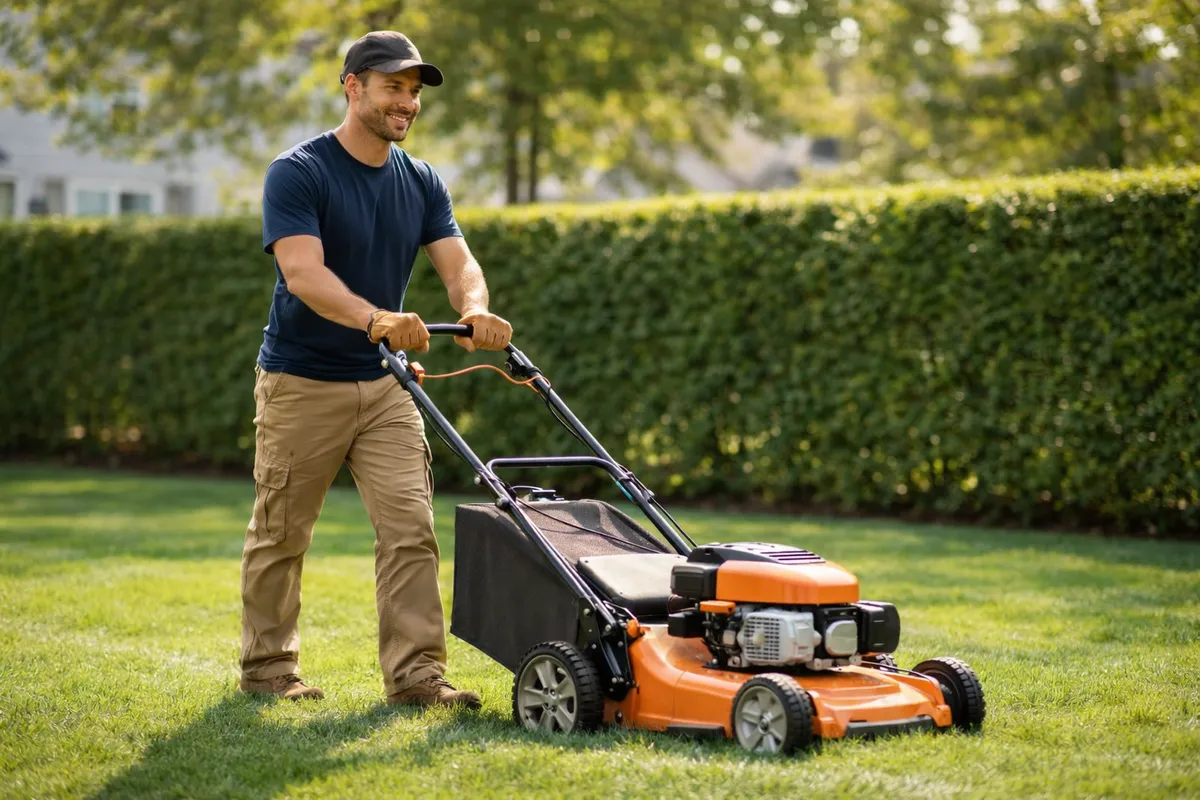
West Virginia landscaping presents geography-driven market realities that don’t exist in flatter states. The Appalachian terrain — steep grades, rocky soil, coal-country subsidence in some areas, and densely forested hillsides — affects both what equipment you need and what services you can realistically offer. Riding mowers are largely impractical on many WV residential properties; commercial walk-behind mowers and string trimmers dominate. Retaining wall construction and erosion control are genuine revenue opportunities in a state where hillside development creates constant slope stability challenges. The Eastern Panhandle’s suburban housing market (Berkeley and Jefferson counties, part of the DC metro) offers the strongest pricing and most standard suburban lawn care demand. Morgantown’s growth around WVU creates solid residential demand. Southern WV’s coal communities have lower pricing tolerance but also lower competition.
Landscaping Business Requirements in West Virginia at a Glance
| Requirement | Agency | Cost | Timeline |
|---|---|---|---|
| Commercial Pesticide Applicator License (individual — if applying pesticides) | WV Department of Agriculture | $20/year + $20 per exam attempt | 4-8 weeks (includes exam) |
| Licensed Pesticide Application Business (LPAB — if applying pesticides) | WV Department of Agriculture | $60/year | 2-4 weeks |
| Business Registration Certificate | WV State Tax Department | $30 one-time | Same day online |
| LLC Formation | WV Secretary of State (One Stop Portal) | $25 + $1 portal fee | 2-5 business days |
| General Liability Insurance ($300K-$1M) | Private insurer | $800-$2,500/year | 1-3 business days |
| Workers’ Compensation Insurance | Private carrier (required at 3+ employees) | Varies by payroll (NCCI code 0042) | Before 3rd employee starts |
| Miss Utility WV 811 notification | Miss Utility of West Virginia | Free | 48 business hours before any digging |
Shopping for coverage? Compare landscaping business insurance costs and coverage in West Virginia, including exclusions, state requirements and details to prepare for a quote.
How to Start a Landscaping Business in West Virginia (Step by Step)
Step 1: Determine Whether You Need a Pesticide License
The licensing question hinges on a single distinction: will you apply pesticides, herbicides, or chemical fertilizers with pesticide activity to client properties for hire?
If YES (chemical applications for hire):
- You need a Commercial Pesticide Applicator License (individual) AND an LPAB License (business entity)
- This covers herbicides (broadleaf weed killers, pre-emergents), insecticides, fungicides, and any fertilizers with a pesticide component
- Issued by the WV Department of Agriculture, Pesticide Regulatory Programs
- Phone: 304-558-2209
If NO (mowing, trimming, mulching, planting, edging — no chemical applications):
- No pesticide license required
- Still need: Business Registration Certificate ($30), LLC ($26), workers’ comp insurance at 3+ employees
Most professional landscaping companies eventually add weed control and fertilization to their service menu — chemical application adds revenue but requires the LPAB license structure. Build toward it if you’re starting mowing-only; the $80/year in license fees ($20 applicator + $60 LPAB) is modest overhead for the revenue it unlocks.
Step 2: Pass the Pesticide Applicator Exams
All WV Commercial Pesticide Applicator License applicants must pass:
- General Standards exam — Covers pesticide safety, label reading, equipment calibration, environmental and water protection, WV regulations, and personal protective equipment
- Category 4A: Ornamental and Turf Outdoors — The primary category exam for lawn care and landscaping businesses (covers turf management, weed identification, landscape plant pest control)
Additional category exams are available if you want to offer specialized services:
- Category 3: Forest Pest Control — For tree and forestry work
- Category 6: Right-of-Way — For vegetation management along roadsides and utility corridors
Exam logistics:
- Exam fee: $20 per exam attempt
- Exams are administered through the WV Department of Agriculture’s WVPlants online system
- No minimum training hours required — self-study is permitted
- Study materials available from the WV Department of Agriculture and WVU Extension Service
- WVU Extension (Pest Management) publishes study guides for each exam category; available at extension.wvu.edu
Step 3: Apply for Your Commercial Pesticide Applicator License
After passing the required exams, apply to the WVDA for your individual license:
- Annual license fee: $20
- Renewal window: November 1 through April 1 each year via the WVPlants online system
- No fee for city, state, county, or federal employees applying pesticides in their governmental capacity
- Continuing education (CCUs): 20 Continuing Credit Units per licensed category every 3 years, by December 31 of the third year. CCUs can be earned through WVDA-approved training events, WVU Extension programs, and pesticide applicator conferences.
Step 4: Apply for Your LPAB (Licensed Pesticide Application Business) License
In addition to the individual applicator license, your business entity must be licensed as an LPAB:
LPAB requirements:
- Annual fee: $60
- Renewal window: November 1 through April 1 (same as individual license)
- Must provide a current certificate of general liability insurance (see insurance requirements below)
- Must provide your WV Business Registration Certificate number from the Tax Department
LPAB minimum insurance requirements:
- Bodily injury: $300,000 minimum coverage
- Property damage: $100,000 minimum coverage
- Workers’ compensation: Required if you have 3 or more employees
Step 5: Form Your Business Entity
- LLC formation: $26 through the WV One Stop Business Portal
- Business Registration Certificate: $30 one-time (required before you can apply for the LPAB license)
- Annual Report: $25 + $1 before June 30 each year
Step 6: Insurance and Workers’ Compensation
General liability insurance:
- LPAB minimum: $300,000 bodily injury / $100,000 property damage
- Recommended for all landscaping businesses regardless of pesticide use: $1,000,000 per occurrence (commercial clients typically require $1M GL certificate)
- Annual cost: approximately $800-$2,500 depending on revenue and services offered
Workers’ compensation:
- Required once you have 3 or more employees
- Landscaping falls under NCCI code 0042 (grounds maintenance) — a higher-risk classification than office work, reflecting outdoor physical labor exposure
- Obtain from a private WV carrier through the WV Insurance Commissioner’s office
Sales tax note: Landscaping labor services performed on real property are generally not taxable in West Virginia. Materials (plants, mulch, sod, stone) that become part of the customer’s property are generally taxable to the contractor when purchased from the supplier — the contractor is treated as the end consumer at the supplier level, not when billed to the client. This means you typically do not charge sales tax to your landscaping clients on service labor, but you do pay tax when you buy materials. Consult the WV State Tax Department or a tax advisor if you have questions about specific services.
The LPAB minimum is well below what clients expect
Two different numbers apply and it is worth not confusing them. The LPAB minimum is $300,000 bodily injury / $100,000 property damage. What commercial clients typically require is a $1,000,000 per occurrence certificate — and that is recommended for every landscaping business whether or not you apply pesticides.
Annual cost runs roughly $800–$2,500 depending on scope. Meeting the regulatory floor and being eligible for the better contracts are not the same purchase.
West Virginia requires workers’ compensation at three or more employees, from a private carrier. Worth knowing the history: the market has only been competitive since 2008, when BrickStreet — now Encova — privatized what had been a monopolistic state fund. Older guidance still says otherwise. Simply Business quotes landscaping liability online, with your certificate of insurance ready the moment you buy.
Affiliate link — we earn a commission at no cost to you.
Check WV landscaping insurance prices →
Free quote, no obligation · multiple quotes in under 10 minutes online · Simply Business is rated 4.3/5 from 1,859 reviews on Trustpilot
Step 7: Miss Utility of WV (WV 811) — Underground Utility Protection
Any landscaping work involving digging, trenching, or earth-moving requires a utility locate request through Miss Utility of West Virginia (WV 811) before breaking ground:
- Call 811 or 1-800-245-4848 at least 48 business hours before excavation, excluding weekends and state and federal holidays
- The request must be made not more than 10 business days before work begins (the locate ticket has a validity window)
- After notification, utility companies will mark the location of underground lines (gas, electric, water, communications, sewer) with color-coded flags or paint
- Wait for all locates to be completed before digging; do not assume absent markings mean no utilities exist
- Violations can result in significant fines under WV law; more importantly, striking a buried gas or electric line can be fatal
- Website: wv811.com
WV’s mountainous terrain, history of mine subsidence in southern counties, and the extensive natural gas distribution infrastructure throughout the Marcellus/Utica shale production areas make 811 calls especially important. Underground gas pipelines serving the natural gas distribution system cross many residential and commercial properties in northern and western WV.
Step 8: Equipment and Launch
West Virginia’s terrain demands different equipment than flat-state landscaping markets:
- Commercial walk-behind mowers: Essential for steep hillside properties where zero-turn mowers cannot safely operate. Many WV residential lots are too steep for ride-on equipment. Quality walk-behind: $1,500-$5,000.
- Zero-turn mower (for flatter properties): Useful for Eastern Panhandle suburban properties and flat commercial accounts. $5,000-$12,000 for commercial grade.
- String trimmer(s): $200-$600 commercial grade
- Blower: $300-$600
- Edger: $200-$400
- Hand tools (shovels, rakes, pruners, loppers): $300-$800
- Trailer: $1,500-$5,000 (open utility trailer for equipment transport)
- Truck or large vehicle: $5,000-$30,000 (pickup truck suitable for towing)
- Pesticide application equipment (if licensed): $300-$3,000 (hand sprayer through ride-on spreader)
West Virginia Landscaping Market: Where the Demand Is
- Eastern Panhandle (Berkeley and Jefferson counties) — The strongest suburban landscaping market in WV. DC-metro commuter households maintain standard suburban properties and expect Northern Virginia-comparable pricing and service quality. Newer subdivision developments (Martinsburg growth corridors) generate installation work alongside maintenance contracts.
- Morgantown (Monongalia County) — WVU-driven growth has created a substantial residential market and a growing commercial district. University facilities and private student housing complexes are multi-unit accounts worth pursuing. Monongalia County is among WV’s highest-income counties, supporting competitive service pricing.
- Charleston MSA — State government facilities, WVU Medicine Charleston, and CAMC health campus represent significant commercial grounds maintenance opportunities. Kanawha County residential market is established but competitive.
- Retaining walls and erosion control statewide — WV’s hillside development creates consistent demand for hardscape services: retaining walls, terracing, grading, and erosion control plantings. These higher-margin services require more specialized skills but face less competition than basic mowing. Slopes are a liability risk without proper retention — homeowners and commercial property owners often have urgent need after rainfall events.
- Rural residential accounts — Lower pricing tolerance but also lower competition. Rural WV residential customers who want lawn care typically have fewer local options than urban customers. Solo operators can build profitable rural routes with modest marketing investment.
Cost to Start a Landscaping Business in West Virginia
| Item | Cost | Notes |
|---|---|---|
| Pesticide applicator exams (General Standards + Cat. 4A) | $40 (2 exams x $20) | WV Department of Agriculture; $20 per exam attempt |
| Commercial Applicator License | $20/year | WVDA; annual renewal November 1-April 1 |
| LPAB Business License | $60/year | WVDA; required for any pesticide application business |
| LLC formation | $26 | WV SOS + $1 portal fee |
| Business Registration Certificate | $30 | WV State Tax Department; one-time |
| General liability insurance | $800-$2,500/year | $300K/$100K minimum for LPAB; $1M recommended |
| Workers’ compensation (at 3+ employees) | Varies by payroll | NCCI code 0042; private market since 2008 |
| Commercial walk-behind mower | $1,500-$5,000 | Essential for WV steep terrain; used saves significantly |
| Zero-turn mower (optional for flatter accounts) | $5,000-$12,000 | Useful for Eastern Panhandle/flat commercial properties |
| Small equipment (trimmer, blower, edger) | $700-$1,600 | Commercial-grade battery or gas-powered |
| Hand tools and miscellaneous | $300-$800 | Shovels, rakes, pruners, loppers, wheelbarrow |
| Trailer | $1,500-$5,000 | Open utility trailer rated for mower weight |
| Truck or tow vehicle | $5,000-$30,000 | Used pickup truck most common; must tow trailer safely |
| Marketing (website, Google Business Profile, yard signs) | $300-$1,500 |
Estimated total startup cost: $12,000-$60,000
Ready to form your West Virginia LLC?
We earn a commission if you sign up through this link, at no extra cost to you.
ZenBusiness files your Articles of Organization with the West Virginia Secretary of State, so the filing that trips up most first-time owners is handled for you. The ongoing filings West Virginia requires afterwards are a separate compliance service, if you would rather not track those yourself.
Starts at $0 + West Virginia state fee · Rated “Excellent” from 32,224 Trustpilot reviews
Related West Virginia Business Guides
- How to Start a Cleaning Service in West Virginia
- How to Start a Food Truck in West Virginia
- How to Start a Daycare in West Virginia
- How to Start an HVAC Business in West Virginia
- How to Start a Hair Salon in West Virginia
- How to Start a Private Investigator Business in West Virginia
← Back to all West Virginia business guides
Data for West Virginia
Free research and planning tools for starting a landscaping business in West Virginia. Most of the data pages compare every state, so look for West Virginia in the table or map.
- Heat illness rules for outdoor crews: the states that have heat standards and the ones with bills pending.
- Home prices vs. home services jobs: whether rising home prices brought more landscaping and HVAC jobs.
- Immigrant workers by trade and state: the share of construction and cleaning workers in West Virginia who were born abroad.
- Landscaping job pricing calculator: price a job from crew hours, travel, equipment and materials.
- Landscaping seasonal cash flow calculator: see how much cash you need to get through the off-season.
Start a Landscaping Business in Nearby States
Thinking about taking jobs across the state line, or just want to see how West Virginia stacks up? Here are the same step-by-step guides for the states around West Virginia, plus a few that other new landscaping business owners read most.
- Starting a landscaping business in Ohio (borders West Virginia)
- Starting a landscaping business in Kentucky (borders West Virginia)
- Starting a landscaping business in Pennsylvania (borders West Virginia)
- Starting a landscaping business in Maryland (borders West Virginia)
- Starting a landscaping business in Virginia (borders West Virginia)
- Starting a landscaping business in Florida (one of our most-read landscaping guides)
- Starting a landscaping business in Washington (one of our most-read landscaping guides)
- Starting a landscaping business in California (one of our most-read landscaping guides)
Frequently Asked Questions
Do I need a license to start a landscaping business in West Virginia?
If you apply pesticides, herbicides, or chemical fertilizers to client properties for hire: yes, you need both a Commercial Pesticide Applicator License ($20/year) and a Licensed Pesticide Application Business (LPAB) license ($60/year) from the WV Department of Agriculture. If you only offer mowing, trimming, planting, and mulching without any chemical applications, no state landscaping license is required beyond the standard Business Registration Certificate ($30) and LLC formation ($26).
What pesticide license do I need for landscaping in West Virginia?
You need to pass the General Standards exam plus the Category 4A: Ornamental and Turf Outdoors exam, both administered by the WV Department of Agriculture. Each exam costs $20 per attempt. After passing, apply for your Commercial Applicator License ($20/year). Your business must separately register as a Licensed Pesticide Application Business (LPAB) at $60/year. Both licenses renew annually with a November 1 through April 1 renewal window.
What is Miss Utility WV 811 and when do I need to call?
Miss Utility of West Virginia (WV 811) is the underground utility locate service. Call 811 or 1-800-245-4848 at least 48 business hours before any digging, trenching, or earth-moving work (weekends and holidays excluded from the 48-hour count). Utility companies will mark the location of underground lines within the ticket validity window. Failure to call before digging can result in serious injury, service outages for the community, and significant fines under WV law. Website: wv811.com.
Is landscaping labor taxable in West Virginia?
Landscaping services performed on real property are generally not subject to WV sales tax on the labor component. Materials (plants, mulch, stone, sod, fertilizer) are taxable to the contractor at the time of purchase from the supplier — the contractor is treated as the end consumer for tax purposes when buying materials that will be installed in a customer’s property. You typically do not charge sales tax to clients on the service bill, but you do pay tax when purchasing materials. Consult the WV State Tax Department for guidance on your specific service mix.
How often do I need to renew my pesticide license in West Virginia?
Both the Commercial Applicator License ($20) and the LPAB License ($60) renew annually. The renewal window is November 1 through April 1 each year via the WVPlants online system at the WV Department of Agriculture. In addition, you must complete 20 Continuing Credit Units (CCUs) per licensed category every 3 years, by December 31 of the third year. Failure to renew or maintain CCUs can result in license suspension — plan your CE around the 3-year cycle rather than the annual renewal window.
Does West Virginia have a general landscaping contractor license?
No. West Virginia has no general landscaping contractor license at the state level. The WV Contractor Licensing Board (CLB) applies to construction trades (HVAC, electrical, plumbing, general construction), not to landscaping, lawn care, or grounds maintenance. The only state-level license specifically for landscaping businesses is the pesticide applicator license structure if you apply chemicals. Some municipalities may have local business license requirements — check with your city or county clerk.
Comparing states? See our landscaping business guides for all 50 states.
More West Virginia Business Guides
- Do You Need an Arborist License in West Virginia?
- How to Get a West Virginia Liquor License
- How to Get a West Virginia Massage License
- How to Start a Cleaning Service in West Virginia (2026)
- How to Start a Daycare in West Virginia (2026)
- How to Start a Food Truck in West Virginia (2026)
- How to Start a Hair Salon in West Virginia (2026)
- How to Start a Plumbing Business in West Virginia: Licenses, Costs & Insurance
- How to Start a Private Investigator Business in West Virginia (2026)
- How to Start an Electrical Business in West Virginia: Licenses, Costs & Insurance
- How to Start an HVAC Business in West Virginia (2026)
- West Virginia Business Loans: WVEDA & Working Capital
- West Virginia LLC Cost: $100 to File Articles (2026)
