Original research · Census government finances + American Community Survey · Last updated October 6, 2026
Data through: state and local tax collections for fiscal 2024; homeowner tax bills and home values for 2024 (the latest ACS 1-year release).
Property tax is the biggest tax local governments collect. It made up 70.7% of local tax revenue in fiscal 2024. State and local governments together collected $724.8 billion in property taxes, up 25.7% from fiscal 2019, and local governments took in 96.7% of it. The median homeowner paid $3,211 in 2024, from $9,358 in New Jersey to $881 in West Virginia.
Key findings
- New Hampshire, Alaska and Texas rely most on property taxes. They make up 64.3%, 42.4% and 40.9% of state and local tax revenue. At the other end: New Mexico (14.0%), Delaware (14.4%) and Alabama (16.8%).
- Florida’s property tax take grew 50.8% in five years. Collections rose from $30.9 billion in fiscal 2019 to $46.6 billion in fiscal 2024. The median Florida homeowner’s bill rose 47.1% from 2019 to 2024, the most of any state. Floridians vote on a constitutional amendment to cut property taxes on November 3, 2026.
- Revenue grew fastest in Nevada, Florida and Alabama. Property tax collections rose 51.4%, 50.8% and 45.7% from fiscal 2019 to 2024. Nationally they rose 25.7%.
- Tax bills as a share of home value run from 0.27% to 1.92%. Illinois (1.92%), New Jersey (1.89%) and Connecticut (1.66%) are highest. Hawaii (0.27%) and Alabama (0.38%) are lowest. This is our ratio of two Census medians, not an official rate.
- No-income-tax states lean on property. New Hampshire (64.3%), Alaska (42.4%), Texas (40.9%), Wyoming (38.5%) and Florida (37.4%) all rank in the top 8.
- Property taxes are local. Counties, cities, school districts and special districts collected 96.7% of all property taxes in fiscal 2024. The big exceptions are Vermont, where the state collected 58.4% through its statewide education property tax, and Arkansas, at 51.0%.
Which states rely most on property taxes?
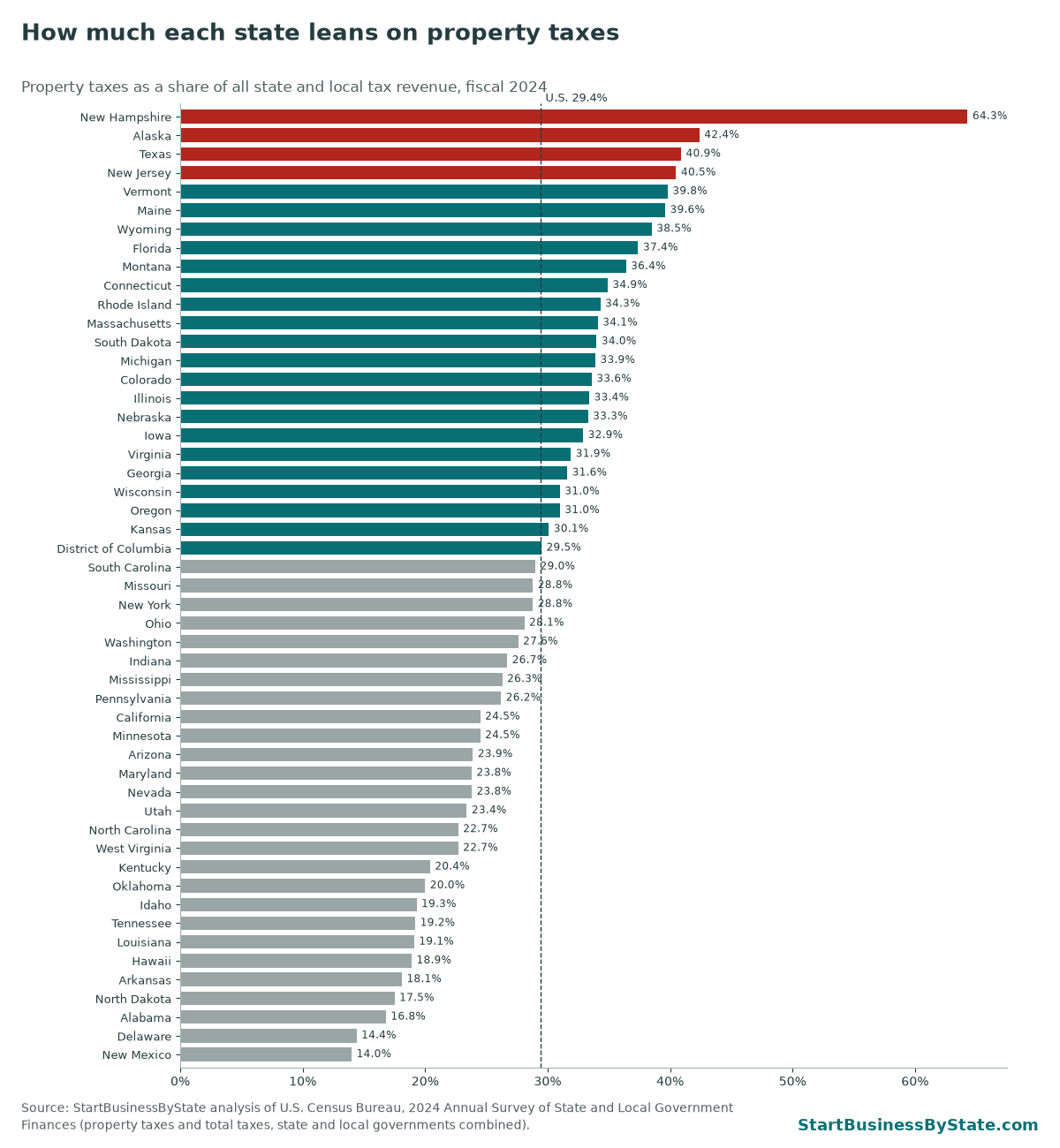
A high share doesn’t always mean high bills. It means the state and its local governments get more of their money from property and less from income or sales taxes. New Hampshire has no broad income tax on wages and no general sales tax, so property carries the load. Texas and Florida have no personal income tax, and property taxes bring in 37% or more of their state and local tax revenue.
How big is the typical property tax bill?
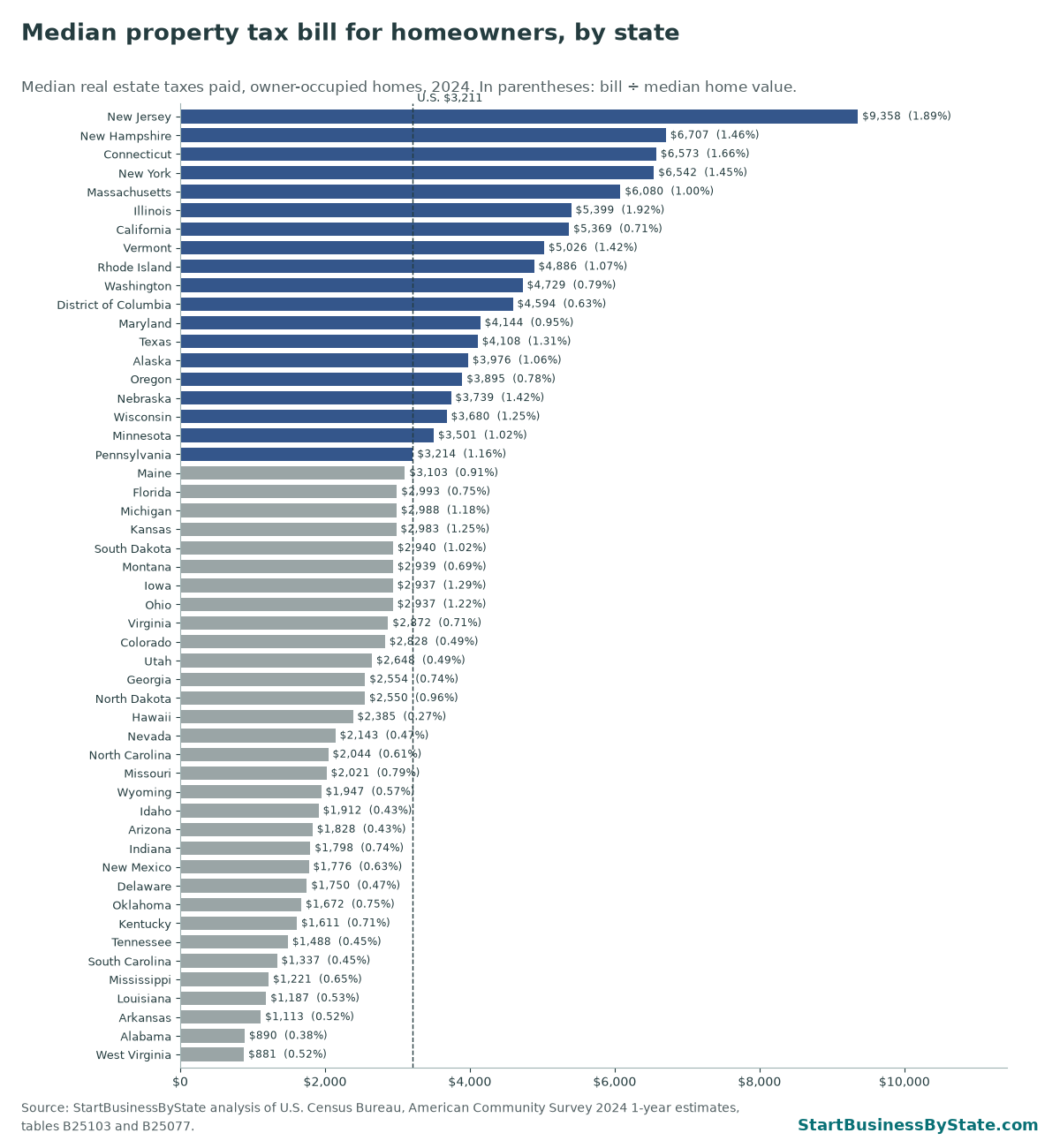
Homeowner bills are the best state-by-state view of property tax burden that the Census publishes every year. They matter for a new business in two ways. If you run the business from home, your own bill is part of your costs. If you rent space, your landlord’s bill is often built into your rent.
Property taxes in every state
Click a column header to sort. The table starts with the states that rely most on property taxes.
| Rank | State | Share of state + local taxes, FY2024 | Per resident | Revenue change since FY2019 | Median homeowner bill, 2024 | Median home value | Bill ÷ value | Bill change since 2019 |
|---|---|---|---|---|---|---|---|---|
| 1 | New Hampshire | 64.3% | $4,064 | +31.6% | $6,707 | $458,800 | 1.46% | +16.3% |
| 2 | Alaska | 42.4% | $2,444 | +11.3% | $3,976 | $376,500 | 1.06% | +19.6% |
| 3 | Texas | 40.9% | $2,322 | +17.9% | $4,108 | $313,200 | 1.31% | +21.2% |
| 4 | New Jersey | 40.5% | $3,667 | +11.8% | $9,358 | $496,000 | 1.89% | +11.0% |
| 5 | Vermont | 39.8% | $3,454 | +26.4% | $5,026 | $352,800 | 1.42% | +15.8% |
| 6 | Maine | 39.6% | $3,076 | +23.0% | $3,103 | $341,900 | 0.91% | +19.5% |
| 7 | Wyoming | 38.5% | $2,631 | +29.0% | $1,947 | $339,500 | 0.57% | +44.0% |
| 8 | Florida | 37.4% | $1,994 | +50.8% | $2,993 | $396,900 | 0.75% | +47.1% |
| 9 | Montana | 36.4% | $2,174 | +30.7% | $2,939 | $425,400 | 0.69% | +39.4% |
| 10 | Connecticut | 34.9% | $3,421 | +9.7% | $6,573 | $396,900 | 1.66% | +9.5% |
| 11 | Rhode Island | 34.3% | $2,525 | +6.0% | $4,886 | $455,700 | 1.07% | +12.6% |
| 12 | Massachusetts | 34.1% | $3,216 | +28.6% | $6,080 | $607,400 | 1.00% | +24.1% |
| 13 | South Dakota | 34.0% | $1,868 | +22.0% | $2,940 | $289,600 | 1.02% | +30.3% |
| 14 | Michigan | 33.9% | $1,887 | +25.6% | $2,988 | $254,200 | 1.18% | +21.7% |
| 15 | Colorado | 33.6% | $2,392 | +37.6% | $2,828 | $574,600 | 0.49% | +45.0% |
| 16 | Illinois | 33.4% | $3,014 | +30.2% | $5,399 | $280,700 | 1.92% | +19.3% |
| 17 | Nebraska | 33.3% | $2,354 | +21.7% | $3,739 | $263,100 | 1.42% | +34.2% |
| 18 | Iowa | 32.9% | $2,097 | +21.9% | $2,937 | $227,300 | 1.29% | +20.9% |
| 19 | Virginia | 31.9% | $2,298 | +33.6% | $2,872 | $403,500 | 0.71% | +23.7% |
| 20 | Georgia | 31.6% | $1,738 | +42.4% | $2,554 | $343,300 | 0.74% | +44.2% |
| 21 | Oregon | 31.0% | $2,104 | +27.7% | $3,895 | $497,500 | 0.78% | +21.6% |
| 22 | Wisconsin | 31.0% | $1,904 | +15.6% | $3,680 | $294,700 | 1.25% | +10.8% |
| 23 | Kansas | 30.1% | $2,013 | +23.9% | $2,983 | $238,700 | 1.25% | +33.5% |
| 24 | District of Columbia | 29.5% | $4,389 | +10.0% | $4,594 | $733,400 | 0.63% | +26.0% |
| 25 | South Carolina | 29.0% | $1,583 | +34.8% | $1,337 | $299,500 | 0.45% | +36.4% |
| 26 | Missouri | 28.8% | $1,567 | +38.9% | $2,021 | $254,400 | 0.79% | +29.3% |
| 27 | New York | 28.8% | $3,562 | +15.5% | $6,542 | $449,800 | 1.45% | +14.1% |
| 28 | Ohio | 28.1% | $1,685 | +22.8% | $2,937 | $239,800 | 1.22% | +26.4% |
| 29 | Washington | 27.6% | $2,126 | +33.9% | $4,729 | $602,200 | 0.79% | +31.3% |
| 30 | Indiana | 26.7% | $1,490 | +38.4% | $1,798 | $243,500 | 0.74% | +42.4% |
| 31 | Mississippi | 26.3% | $1,313 | +16.7% | $1,221 | $186,500 | 0.65% | +21.0% |
| 32 | Pennsylvania | 26.2% | $1,801 | +13.1% | $3,214 | $277,600 | 1.16% | +11.3% |
| 33 | California | 24.5% | $2,487 | +33.1% | $5,369 | $759,500 | 0.71% | +29.6% |
| 34 | Minnesota | 24.5% | $2,043 | +22.7% | $3,501 | $344,600 | 1.02% | +31.1% |
| 35 | Arizona | 23.9% | $1,264 | +14.8% | $1,828 | $426,000 | 0.43% | +15.8% |
| 36 | Nevada | 23.8% | $1,575 | +51.4% | $2,143 | $455,500 | 0.47% | +26.4% |
| 37 | Maryland | 23.8% | $1,977 | +19.5% | $4,144 | $436,300 | 0.95% | +17.9% |
| 38 | Utah | 23.4% | $1,427 | +36.0% | $2,648 | $545,200 | 0.49% | +39.4% |
| 39 | North Carolina | 22.7% | $1,204 | +21.5% | $2,044 | $333,000 | 0.61% | +36.9% |
| 40 | West Virginia | 22.7% | $1,256 | +29.1% | $881 | $170,800 | 0.52% | +23.9% |
| 41 | Kentucky | 20.4% | $1,117 | +28.7% | $1,611 | $226,000 | 0.71% | +28.2% |
| 42 | Oklahoma | 20.0% | $996 | +24.8% | $1,672 | $222,100 | 0.75% | +30.8% |
| 43 | Idaho | 19.3% | $1,058 | +8.2% | $1,912 | $446,400 | 0.43% | +18.3% |
| 44 | Tennessee | 19.2% | $924 | +17.5% | $1,488 | $332,600 | 0.45% | +22.0% |
| 45 | Louisiana | 19.1% | $1,196 | +29.1% | $1,187 | $223,200 | 0.53% | +29.2% |
| 46 | Hawaii | 18.9% | $1,913 | +34.3% | $2,385 | $875,900 | 0.27% | +27.5% |
| 47 | Arkansas | 18.1% | $963 | +26.2% | $1,113 | $215,600 | 0.52% | +33.5% |
| 48 | North Dakota | 17.5% | $1,677 | +18.9% | $2,550 | $266,100 | 0.96% | +25.9% |
| 49 | Alabama | 16.8% | $850 | +45.7% | $890 | $233,300 | 0.38% | +46.1% |
| 50 | Delaware | 14.4% | $1,085 | +22.4% | $1,750 | $371,600 | 0.47% | +19.0% |
| 51 | New Mexico | 14.0% | $1,249 | +43.3% | $1,776 | $279,900 | 0.63% | +26.6% |
Share, per-resident and revenue figures cover property taxes collected by the state and all local governments combined, including taxes paid on homes, businesses, farms and, where taxed, business equipment and vehicles. Per resident uses ACS 2024 population. “Bill ÷ value” divides the median bill by the median home value; it is our estimate, not a published rate.
Download the data (CSV)Florida votes on a property tax cut November 3
Amendment 3 on Florida’s November 3, 2026 ballot would change the state constitution in three ways that matter to business owners, according to the ballot summary published by the Florida Division of Elections:
- The homestead exemption from non-school property taxes would rise to $150,000 in 2027 and $250,000 in 2028, then adjust for inflation. People who are not Florida residents on December 31, 2026 would get the current exemption at first and the bigger one starting in their fifth year.
- The yearly cap on assessment increases for non-homestead property would drop from 10% to 5%. That covers rental homes and commercial property such as storefronts and offices, for non-school taxes.
- Counties and cities could spend property tax money only on a listed set of core services.
It would take effect January 1, 2027, and needs 60% of the vote to pass (Florida Constitution, Article XI, Section 5). Florida’s state and local governments collected $46.6 billion in property taxes in fiscal 2024, 37.4% of all their tax revenue. If you own or lease commercial space in Florida, the 5% cap could slow how fast your tax bill (or the tax share of your rent) goes up. Local governments would also have less room to raise money from property, which could push them toward fees.
What property taxes mean for your business
Most first-time owners don’t get a property tax bill in year one. You still pay for it. Here is where it shows up:
- Your rent. Many commercial leases are “net” leases, where the tenant pays a share of the building’s property taxes on top of base rent. Ask the landlord what the tax share was last year and whether a reassessment is coming. A building that just sold often gets reassessed higher.
- Your equipment. Many states and localities tax business personal property, such as furniture, tools, kitchen equipment and computers. You may have to file a list with the county assessor every year even if the tax is small. Check with your assessor before your first January 1 in business.
- Your home office. If you run the business from home and qualify for the home office deduction, the business share of your property taxes is deductible. IRS Publication 587 covers the math.
- Buying a building. Price the property tax into your monthly cost, not just the mortgage. In Illinois the typical homeowner bill is about 1.9% of value each year. In Hawaii it is under 0.3%. Commercial rates are often higher than homeowner rates because many states give homeowners exemptions that businesses don’t get.
If you are still choosing where to set up, compare property taxes with the other fixed costs on our best states to start a business ranking, LLC costs by state and new-employer unemployment tax rates. Home-based daycares feel property rules more than most; see childcare zoning laws by state.
How we did this
- Property tax revenue. U.S. Census Bureau, Annual Survey of State and Local Government Finances, fiscal 2024 and 2019, from the Census API dataset timeseries/govslocalfin. Item LF0009 (property taxes) and LF0008 (total taxes), government type 001 (state and local combined). Local share uses type 003. Amounts are reported in thousands of dollars.
- Homeowner bills and home values. American Community Survey 2024 and 2019 1-year estimates: B25103_001E (median real estate taxes paid, owner-occupied housing units) and B25077_001E (median value, owner-occupied housing units). Per-resident figures use B01003_001E (total population), ACS 2024.
Caveats
- Census does not split property tax revenue between homes and businesses, so the revenue columns include both.
- Fiscal years differ by state. Most end June 30; New York’s ends March 31, Texas’s August 31, and Alabama’s and Michigan’s September 30. Local government figures are survey estimates. 7 states have a coefficient of variation above 10% on the combined total (New Jersey, Maine, Illinois, Kansas, Washington, Pennsylvania, California). The CSV includes each state’s figure.
- ACS homeowner bills are self-reported, include all real estate taxes on the home, and exclude renters. Margins of error are in the CSV.
- The ACS 2019 figures are from the 2019 1-year release. Census did not publish standard 1-year estimates for 2020.
Census data are public domain. This page has no ads or affiliate links. Cite as: StartBusinessByState, “Property Taxes by State for Small Business Owners,” updated October 6, 2026, https://startbusinessbystate.com/property-taxes-by-state-small-business/
Related research
- Sales tax on services: bills by state.
- Data center tax break tracker.
- Home prices vs. home services employment.
- Disaster dollars by state.
- Business license requirements by state.
- home price changes by state: where prices rose and fell over the past year.
- investor home purchases by state: HMDA data on mortgage-financed rental purchases.
- home insurance cost by state: what homeowners pay for insurance in every state, Census data.
FAQ
Which state has the highest property taxes?
It depends on the measure. New Jersey has the highest median homeowner bill ($9,358 in 2024). Illinois has the highest bill relative to home value (1.92%). New Hampshire relies most on property taxes, at 64.3% of state and local tax revenue.
Which state has the lowest property taxes?
West Virginia has the lowest median homeowner bill, at $881 in 2024. Hawaii has the lowest bill relative to home value (0.27%), because its home values are high.
Do small businesses pay property tax?
Yes, if they own real estate. Owners of commercial buildings pay property tax on them, and many commercial leases pass those taxes on to the tenant. Many states and localities also tax business equipment and furniture as personal property, so check with your county or city assessor.
Can I deduct property taxes if I run a business from home?
If you qualify for the home office deduction, the business share of your home’s real estate taxes counts as a business expense. IRS Publication 587 explains how to figure the business share.
What is Florida Amendment 3?
It is a proposed change to the Florida Constitution on the November 3, 2026 ballot. It would raise the homestead exemption from non-school property taxes to $150,000 in 2027 and $250,000 in 2028, and cut the annual cap on assessment increases for non-homestead property, including commercial property, from 10% to 5% for non-school taxes. It needs 60% of the vote.
How often is this updated?
Once a year. The Census Bureau releases new ACS 1-year estimates each September and new state and local government finance data about 18 months after the fiscal year ends.
Last updated October 6, 2026. Government finance data for fiscal 2024; ACS 2024 1-year estimates.