Original research · Epoch AI data center database · EIA power plant inventory (August 2026) · BLS jobs data (2025) · LegiScan state bills · Last updated September 28, 2026
Data through: construction spending July 2026 (Census, preliminary) · power plant inventory August 2026 (EIA) · electricity prices January–July 2026 (EIA) · data hosting jobs 2025 (BLS) · electricians May 2025 (BLS) · AI sites as of September 28, 2026 (Epoch AI) · state bills as of September 28, 2026 (LegiScan) · Texas and New York status checked September 28, 2026
The AI data center boom is real, and it’s concentrated. Private data center construction is running at $75.2 billion a year, up 57% in a year. Texas is in a league of its own for big AI sites and new power plants. By our three signals, Indiana, Mississippi, Ohio, Texas, Virginia and Wisconsin are the hottest states. But the boom brings fights over electric bills, water and noise: lawmakers filed 452 data center bills in 46 states in 2025–26, and Texas paused hookups for big new data centers in August 2026.
Key findings
- Data center construction spending hit a record $75.2 billion a year. That’s the Census Bureau’s July 2026 estimate (seasonally adjusted annual rate, preliminary). It’s up from $47.8 billion in July 2025 and about 7.8 times the $9.7 billion rate of February 2020.
- Texas leads by a mile. It has 14 of the 77 large U.S. AI data center sites tracked by Epoch AI, with about 1,301 MW running now and 8,960 MW in Epoch’s projected build-out. Texas also accounts for 70.7 GW (34.5%) of all new power plant capacity planned in the U.S. for 2026–2028.
- Six states are running hot. Indiana, Mississippi, Ohio, Texas, Virginia and Wisconsin each show at least two of our three signals: 1,000+ MW at big AI sites, a top-10 pipeline of new power plants, or 10%+ growth in data hosting jobs. Right now, the most power at listed sites is in Ohio (1,482 MW), Tennessee (1,373 MW), Texas (1,301 MW), Indiana (1,088 MW) and Virginia (1,044 MW).
- The boom builds buildings more than it creates permanent jobs. Private jobs in data processing and hosting were 483,954 in 2025, 0.5% fewer than in 2023, even as construction spending soared. The steady work is in building and maintaining these sites: electricians, HVAC and mechanical trades, and suppliers.
- States are writing the rules now, mostly about who pays for the grid. We found 36 data center laws enacted in 21 states in 2025–26. The biggest group (14 laws in 10 states) aims to keep data center power costs off other customers’ bills. 30 moratorium or pause bills were filed in 15 states. None has become law.
Map: where the boom is hottest
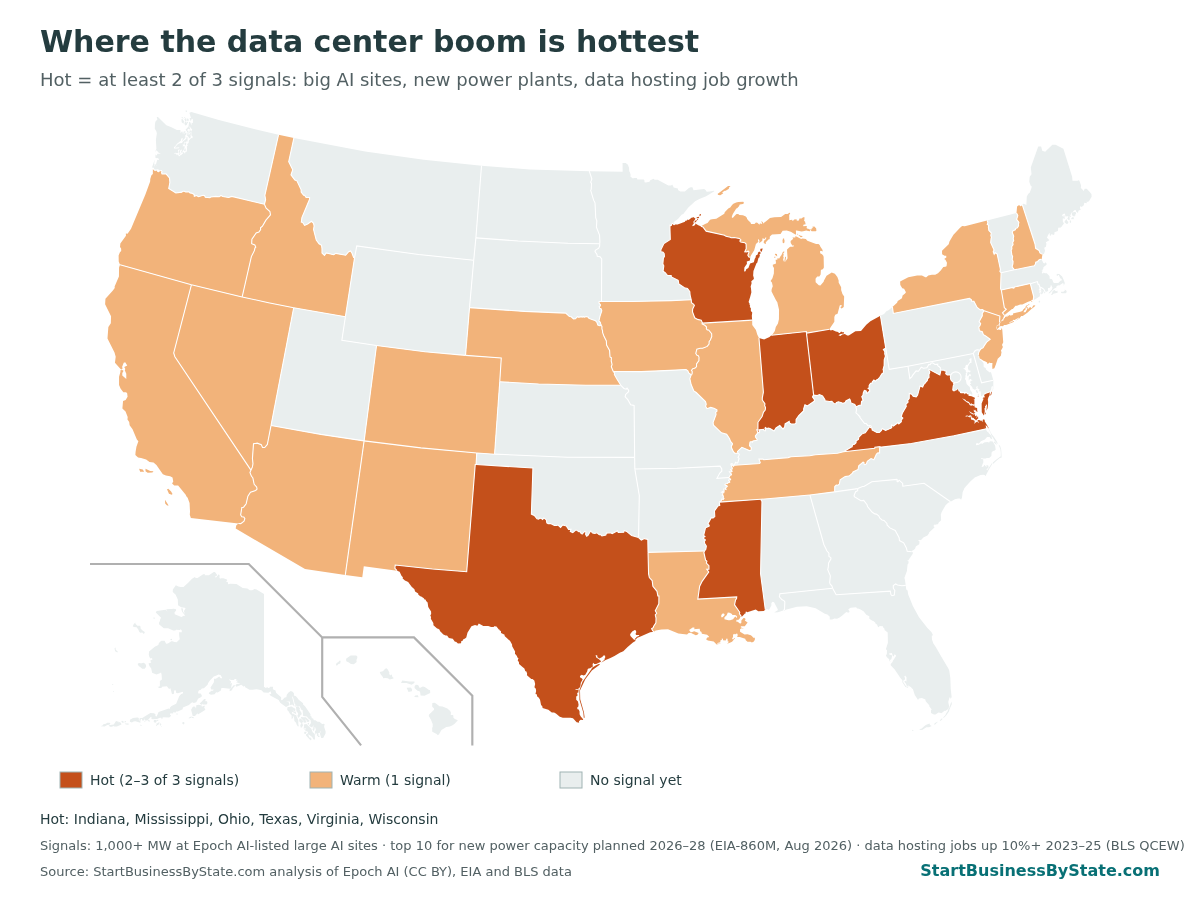
We looked at three things that show a data center boom is actually happening in a state, not just being talked about:
- Big AI sites: at least 1,000 megawatts (MW) at large AI data centers tracked by Epoch AI, counting what’s running now plus projected expansion. (12 states.)
- New power plants: a top-10 state for new generating capacity planned for 2026–2028 in the federal power plant inventory. (10 states.)
- Job growth: private jobs in data processing and hosting up 10% or more from 2023 to 2025, in states with at least 1,000 such jobs. (7 states.)
A gigawatt (GW) is 1,000 MW. Several of the largest AI campuses in Epoch’s list are planned at more than 1 GW each.
Spending: the national picture
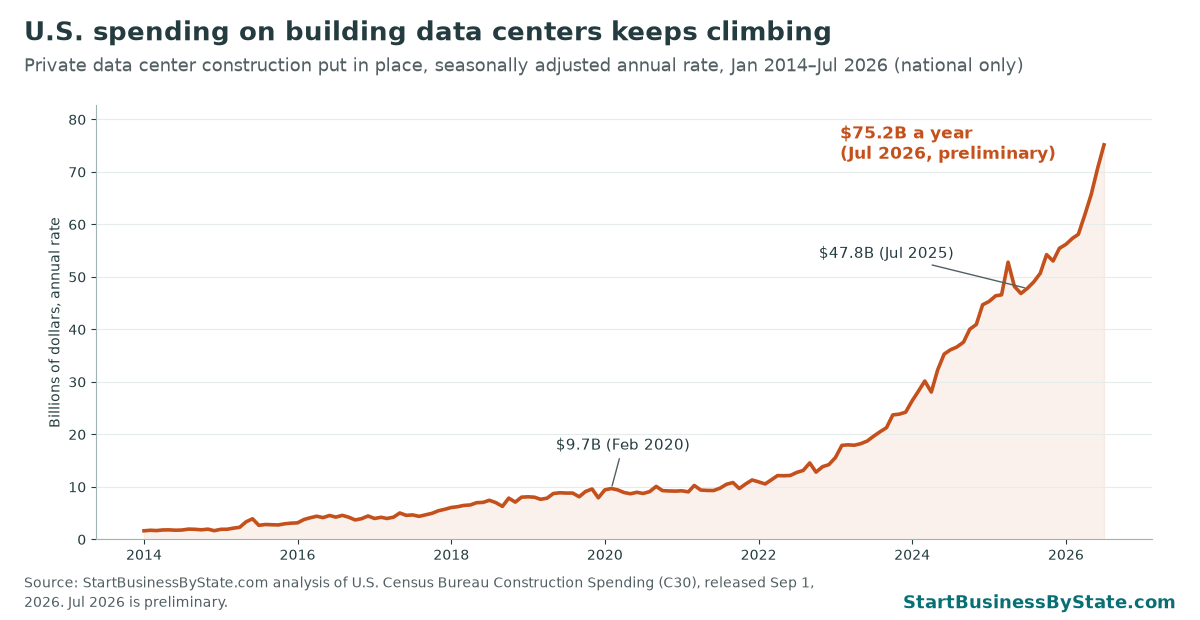
Through 2021, data center construction averaged under $10 billion a year. It has climbed steeply since 2022: the 2025 average was $49.7 billion a year. In July 2026, Census estimated $75.2 billion a year, 57.2% more than a year earlier. July numbers are preliminary and often get revised.
Where the big AI sites are
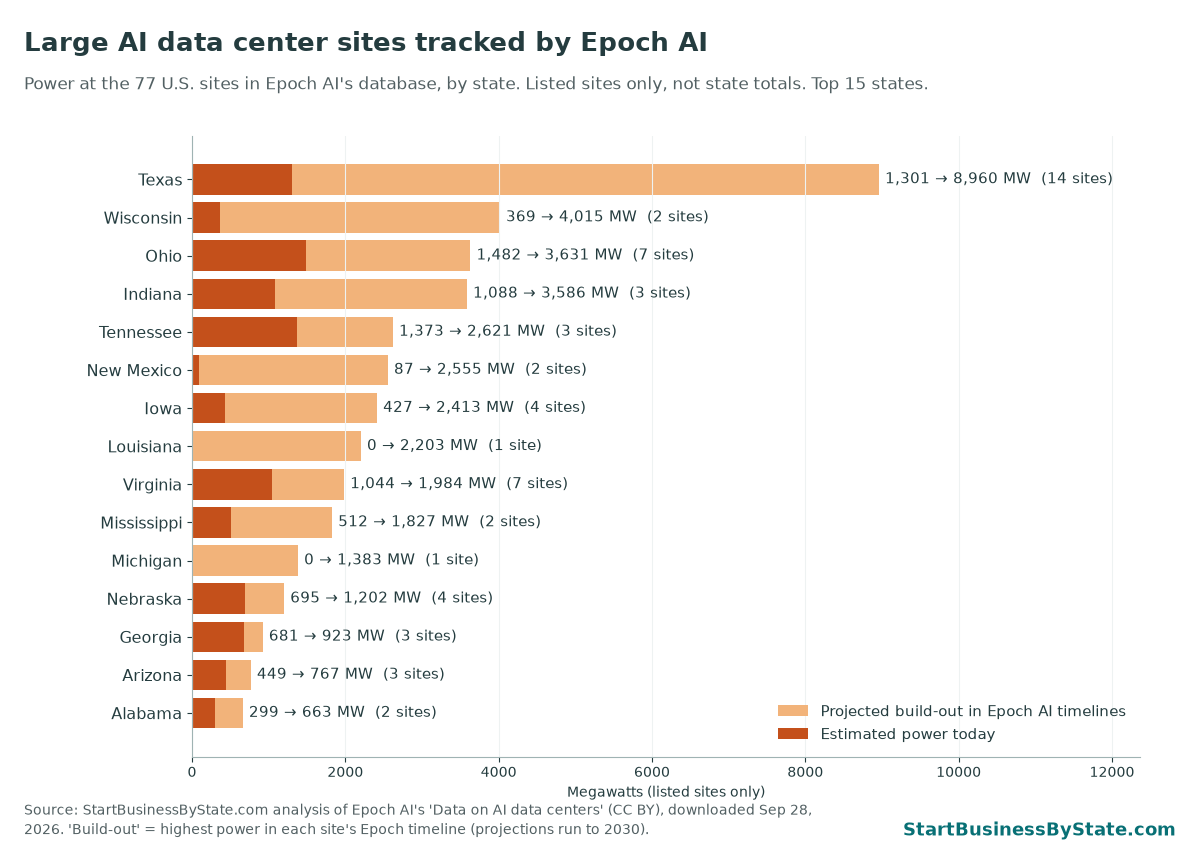
Epoch AI, a research group, tracks the biggest AI data centers using permits, satellite images and company filings. Its database lists 77 U.S. sites in 29 states. Together they draw an estimated 11,850 MW today, and Epoch projects about 43,183 MW once current plans are built (its timelines run to 2030).
Texas has the most planned: 8,960 MW across 14 sites, about 21% of the national build-out in Epoch’s list. Wisconsin is next (4,015 MW), mostly Microsoft’s Fairwater campus, the largest single site in the list at 2,715 MW projected. Several states have almost nothing running yet but huge projects on the way, like New Mexico, Louisiana (Meta’s Hyperion campus) and Michigan.
This list is not complete. It leaves out many ordinary data centers, including many in Northern Virginia. Virginia shows 1,044 MW here because only its largest AI-focused sites are included. Use these numbers to see where the giant AI projects are going, not to compare total data center capacity.
New power plants planned for 2026–2028
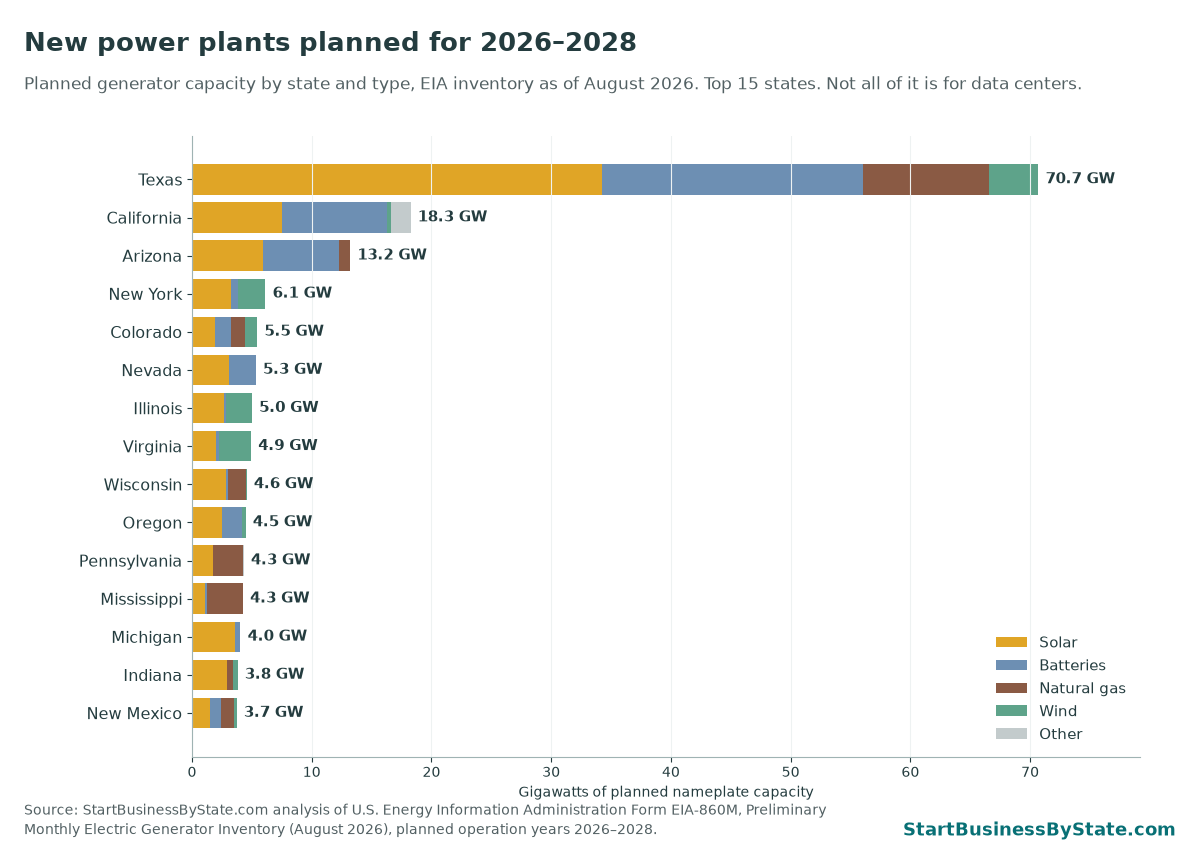
Data centers need huge amounts of electricity, so we checked where new power plants are planned. Power companies told the U.S. Energy Information Administration (EIA) about 205.1 GW of new generating capacity they plan to bring online in 2026–2028. By type: solar 100.1 GW, batteries 52.0 GW, natural gas 32.7 GW and wind 17.0 GW. About 44% (90.7 GW) was already under construction.
Texas alone plans 70.7 GW, including 10.5 GW of natural gas. California (18.3 GW) and Arizona (13.2 GW) are next. For gas plants, the leaders after Texas are Mississippi (3.0 GW), Pennsylvania (2.5 GW) and Tennessee (1.8 GW).
Not all of this is for data centers. New plants also serve population growth, factories, electric vehicles and the replacement of old plants. The inventory doesn’t say who will buy the power. It’s a sign of where the grid is growing, not a count of data center power.
Texas paused new data center hookups
What happened: On August 3, 2026, Texas Governor Greg Abbott ordered the state utility commission (PUCT) and grid operator ERCOT to verify and audit every data center in ERCOT’s connection process “before any additional data centers are approved to move forward.” His letter says ERCOT was considering about 474 gigawatts of requests to connect, more than five times the grid’s record peak demand, and that about 90% of the new requests are data centers.
The same day, ERCOT paused approvals to switch on new data centers and crypto mining sites of 75 MW or more, and paused its main study of large new loads. ERCOT says it will file an eligibility audit report and a community impact report with the PUCT by December 10, 2026. Big data centers already connected are not affected.
Sources: Office of the Texas Governor (Aug 3, 2026); ERCOT Batch Zero update (Sep 11, 2026); PUCT Project 59142 filing.
So the biggest boom state has hit the brakes on new grid hookups, at least for now. If you do business in Texas, watch what the PUCT decides after December 10.
Jobs: fewer than you’d think
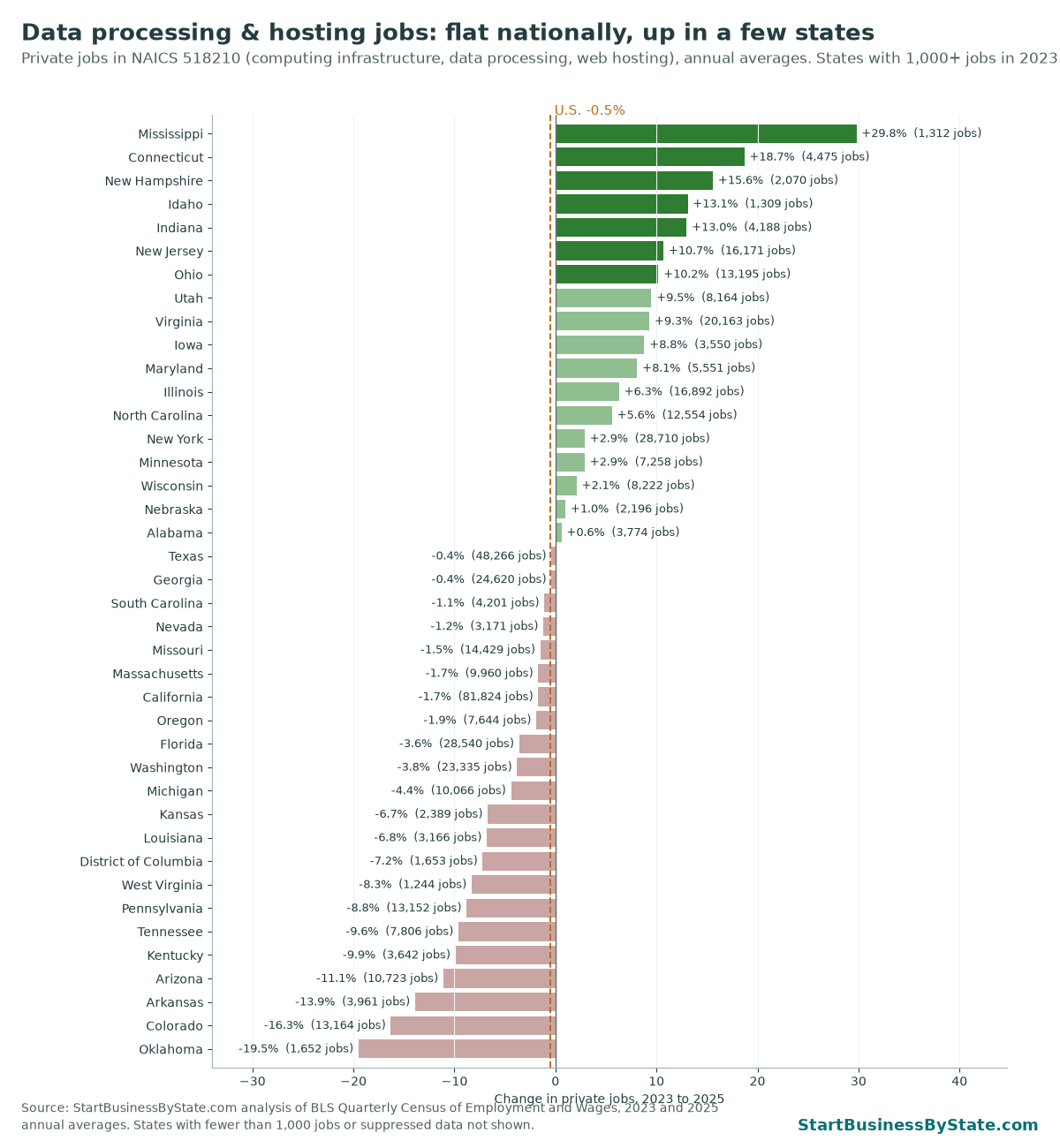
A finished data center can cost billions but needs relatively few permanent workers. The BLS count of private jobs in data processing and hosting shows it: 483,954 jobs in 2025, about the same as 2024 (483,804) and 2023 (486,208). These jobs pay well: an average of $205,865 a year in 2025.
By state, California (81,824), Texas (48,266) and New York (28,710) have the most. Growth from 2023 to 2025 was fastest in Mississippi (+29.8%), Connecticut (+18.7%), New Hampshire (+15.6%), Idaho (+13.1%) and Indiana (+13.0%). This category also covers payroll processors and hosting companies, so a jump doesn’t always mean a new data center. The Texas count, for example, barely moved (-0.4%).
Electricity prices
Cheap, available power is a big reason data centers pick a state, and rising demand is one reason some states worry about bills. Across the U.S., the average commercial electricity price was 13.97 cents per kilowatt-hour (kWh) for January–July 2026, up 5.6% from 13.23 cents a year earlier. The industrial price rose 5.9%, from 8.53 to 9.03 cents.
Two of the hot states have industrial power prices below the U.S. average: Texas (6.72 cents) and Mississippi (7.66 cents). Texas’s commercial price (8.56 cents) is also well below average. We can’t say how much data centers are pushing prices up in any one state; fuel costs, storms and grid upgrades matter too. For what power costs mean for a service business, see commercial electricity costs for service businesses.
State laws: taxes, grid costs, water and moratoriums
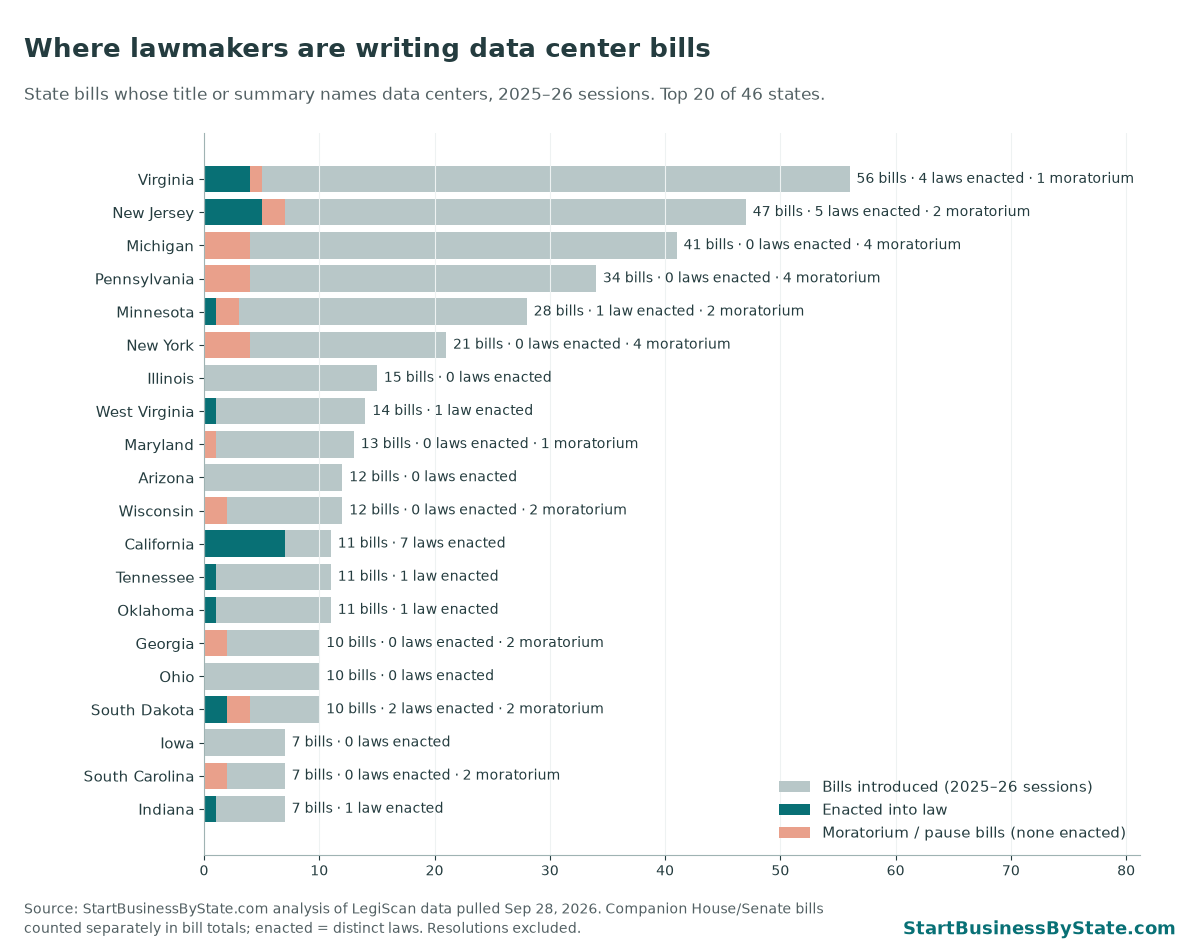
We pulled every state bill from the 2025 and 2026 sessions that mentions data centers from LegiScan, then kept the 452 bills whose title or official summary is about data centers. Virginia (56), New Jersey (47), Michigan (41) and Pennsylvania (34) filed the most. Then we read the ones that became law. Our data center tax break tracker counts 51 laws in 26 states instead of 36 because it also includes large-load power laws that don’t name data centers in their titles, such as Texas SB 6 and Indiana HB 1007.
- Grid costs and electric bills (14 laws, 10 states): Alabama, California, Florida, Maine, Minnesota, Nebraska, New Jersey, Oklahoma, South Dakota and Tennessee passed laws on large-load rates, cost studies or rules so other customers don’t pay for data center grid upgrades.
- Tax breaks go both ways: Arkansas, Kansas and Montana added or widened data center tax breaks. Maine, New Jersey and Washington cut theirs back. For every tax break bill, including the ones still alive, see our data center tax break tracker.
- Water (6 laws): California, Idaho, Mississippi, Utah and Virginia passed water-use limits, disclosures or water service deals. Florida’s and New Jersey’s laws also cover water.
- Moratoriums: 30 bills in 15 states (Delaware, Georgia, Maryland, Maine, Michigan, Minnesota, New Hampshire, New Jersey, New York, Pennsylvania, South Carolina, South Dakota, Virginia, Vermont and Wisconsin) would have paused new data centers statewide or let towns pause them. None has become law. Maine’s passed but was vetoed. New York’s one-year permit moratorium (A11560) passed both chambers in June 2026; the state’s bill page showed no action by the governor as of September 28. Pennsylvania’s House passed a local “pause” bill (HB 2496) that is now in the Senate.
| State | Bill | Type | What it does |
|---|---|---|---|
| Alabama | SB270 | Grid & ratepayer | Public Service Commission review of certain utility contracts with large-load data centers |
| California | AB2383 | Grid & ratepayer | Requires utility tariffs for data centers and other participating large customers |
| California | SB1168 | Grid & ratepayer | Utility regulators must study rate structures so data centers pay their share of grid costs |
| California | SB57 | Grid & ratepayer | Utility regulators may assess whether data center costs shift to other customers (report due Jan 1, 2027) |
| Florida | S0484 | Grid & ratepayer | Large-load tariff rules, local planning authority, and limits on water permits for large data centers |
| Maine | LD912 | Grid & ratepayer | Limits how much electricity can be supplied to data centers on a certain commercial or industrial site |
| Minnesota | HF16 | Grid & ratepayer | Broad data center law: annual fees, water permit rules, large-customer rate protections, sales tax changes |
| Nebraska | LB1010 | Grid & ratepayer | Large Load Customer Regulation Act |
| New Jersey | A5466 | Grid & ratepayer | State utility board must study data centers' effect on electricity costs |
| New Jersey | A796 | Grid & ratepayer | Utilities must set special rules so other customers are not stuck with data center costs |
| Oklahoma | HB2992 | Grid & ratepayer | Data Center Customer Ratepayer Protection Act of 2026 |
| South Dakota | HB1038 | Grid & ratepayer | Utility regulators can charge data centers their actual costs |
| South Dakota | SB135 | Grid & ratepayer | Protects residents from utility cost increases and shortages caused by data centers |
| Tennessee | HB1847/SB2128 | Grid & ratepayer | Generally bars cities and utilities from absorbing the cost of power infrastructure built to serve a data center (Pub. Ch. 961) |
| New Jersey | S4928 | Labor | Prevailing wage for certain data center construction |
| Indiana | SB0431 | Other | Limits data center construction by companies tied to foreign adversaries |
| Virginia | HB323 | Other | State energy office to push reuse of data center waste heat |
| West Virginia | HB4983 | Other | Authorizes the state rule for certifying microgrid districts and high impact data centers |
| California | AB1577 | Reporting & transparency | Data center reporting requirements |
| Delaware | SB312 | Reporting & transparency | Bans state and local nondisclosure agreements that hide large (100 MW+) data center plans from the public |
| New Jersey | S3379 | Reporting & transparency | Semi-annual water and energy use reports from data centers |
| California | SB887 | Siting & permits | Environmental review (CEQA) changes for certain data center projects tied to geothermal power |
| Virginia | HB153/SB94 | Siting & permits | Site assessment and sound profile before local approval of new high-energy-use facilities |
| Virginia | HB507 | Siting & permits | Emission limits for backup generator sets in new data center air permits |
| Arkansas | HB1444 | Tax break (added or widened) | Rewrote the data center sales and use tax exemption, including a "qualified large data center" category (Act 548 of 2025) |
| Kansas | SB98 | Tax break (added or widened) | New sales tax exemption for qualified data center construction and equipment |
| Montana | HB424 | Tax break (added or widened) | Extends low property tax class for data centers to projects built by 2037 and adds on-site power plants |
| Maine | LD713 | Tax break (cut) | Excludes data centers from the business equipment tax exemption and the Dirigo incentive program |
| New Jersey | S4390 | Tax break (cut) | "End Data Center Tax Credits Act" reduces credits available under the Next New Jersey Program |
| Washington | SB6231 | Tax break (cut) | Removes a sales tax exemption for replacement equipment at data centers |
| California | AB2469 | Water | Data center water-use disclosures |
| California | AB2619 | Water | Water planning and data centers |
| Idaho | H0895 | Water | Limits consumptive water use for cooling certain data centers |
| Mississippi | SB3410 | Water | Lets Brandon and a local utility authority contract with a data center for water and wastewater service |
| Utah | HB0076 | Water | Data center water transparency |
| Virginia | HB496/SB553 | Water | Water-use reporting, including water supplied to data centers |
We only count laws whose title or official summary names data centers. Broader large-load or energy laws that don’t use those words aren’t included. Download the laws list (CSV).
All states: the full table
Click a heading to sort. State names link to our guide for starting a business in that state. “—” means no data or suppressed by BLS.
| State | Tier (signals) | Epoch-listed AI sites | Listed sites: MW now | Listed sites: MW projected | Planned power 2026–28 (GW) | of which gas (GW) | Data hosting jobs, 2025 | Jobs change 2023–25 | Industrial power price (¢/kWh) | Commercial power price (¢/kWh) | Data center bills | Laws enacted | Electricians per 1,000 jobs |
|---|---|---|---|---|---|---|---|---|---|---|---|---|---|
| Texas | Hot sites, power |
14 | 1,301 | 8,960 | 70.7 | 10.5 | 48,266 | -0.4% | 6.72 | 8.56 | 3 | 0 | 5.5 |
| Wisconsin | Hot sites, power |
2 | 369 | 4,015 | 4.6 | 1.5 | 8,222 | +2.1% | 9.39 | 13.65 | 12 | 0 | 4.9 |
| Ohio | Hot sites, jobs |
7 | 1,482 | 3,631 | 3.4 | 0.0 | 13,195 | +10.2% | 10.32 | 13.83 | 10 | 0 | 5.2 |
| Indiana | Hot sites, jobs |
3 | 1,088 | 3,586 | 3.8 | 0.5 | 4,188 | +13.0% | 9.15 | 13.93 | 7 | 1 | 5.9 |
| Virginia | Hot sites, power |
7 | 1,044 | 1,984 | 4.9 | 0.0 | 20,163 | +9.3% | 10.08 | 11.21 | 56 | 4 | 5.8 |
| Mississippi | Hot sites, jobs |
2 | 512 | 1,827 | 4.3 | 3.0 | 1,312 | +29.8% | 7.66 | 14.10 | 3 | 1 | 5.7 |
| Tennessee | Warm sites |
3 | 1,373 | 2,621 | 2.4 | 1.8 | 7,806 | -9.6% | 6.82 | 13.65 | 11 | 1 | 5.2 |
| New Mexico | Warm sites |
2 | 87 | 2,555 | 3.7 | 1.1 | 997 | +1.2% | 5.21 | 10.75 | 0 | 0 | 5.8 |
| Iowa | Warm sites |
4 | 427 | 2,413 | 1.1 | 0.0 | 3,550 | +8.8% | 7.38 | 11.31 | 7 | 0 | 6.6 |
| Louisiana | Warm sites |
1 | 0 | 2,203 | 3.2 | 1.6 | 3,166 | -6.8% | 6.65 | 11.88 | 1 | 0 | 5.5 |
| Michigan | Warm sites |
1 | 0 | 1,383 | 4.0 | 0.0 | 10,066 | -4.4% | 9.33 | 15.73 | 41 | 0 | 5.3 |
| Nebraska | Warm sites |
4 | 695 | 1,202 | 0.5 | 0.3 | 2,196 | +1.0% | 8.65 | 8.95 | 4 | 1 | 6.3 |
| Arizona | Warm power |
3 | 449 | 767 | 13.2 | 0.9 | 10,723 | -11.1% | 7.66 | 12.14 | 12 | 0 | 6.5 |
| New York | Warm power |
2 | 100 | 499 | 6.1 | 0.0 | 28,710 | +2.9% | 10.24 | 22.91 | 21 | 0 | 4.1 |
| Oregon | Warm power |
2 | 334 | 428 | 4.5 | 0.0 | 7,644 | -1.9% | 8.33 | 10.57 | 2 | 0 | 5.4 |
| Nevada | Warm power |
1 | 161 | 389 | 5.3 | 0.0 | 3,171 | -1.2% | 8.43 | 9.29 | 0 | 0 | 5.4 |
| Idaho | Warm jobs |
1 | 152 | 198 | 1.0 | 0.0 | 1,309 | +13.1% | 8.14 | 9.67 | 4 | 1 | 6.6 |
| New Jersey | Warm jobs |
1 | 50 | 70 | 0.0 | 0.0 | 16,171 | +10.7% | 15.18 | 17.78 | 47 | 5 | 3.2 |
| California | Warm power |
0 | 0 | 0 | 18.3 | 0.0 | 81,824 | -1.7% | 20.74 | 26.39 | 11 | 7 | 4.0 |
| Colorado | Warm power |
0 | 0 | 0 | 5.5 | 1.2 | 13,164 | -16.3% | 9.60 | 13.29 | 3 | 0 | 5.9 |
| Illinois | Warm power |
0 | 0 | 0 | 5.0 | 0.0 | 16,892 | +6.3% | 10.24 | 13.95 | 15 | 0 | 3.8 |
| Connecticut | Warm jobs |
0 | 0 | 0 | 0.6 | 0.0 | 4,475 | +18.7% | 18.50 | 22.13 | 6 | 0 | 4.5 |
| New Hampshire | Warm jobs |
0 | 0 | 0 | 0.0 | 0.0 | 2,070 | +15.6% | 18.21 | 21.46 | 2 | 0 | 4.9 |
| Georgia | — |
3 | 681 | 923 | 2.9 | 1.5 | 24,620 | -0.4% | 7.99 | 11.70 | 10 | 0 | 4.4 |
| Alabama | — |
2 | 299 | 663 | 0.9 | 0.0 | 3,774 | +0.6% | 7.93 | 14.80 | 1 | 1 | 5.2 |
| Oklahoma | — |
2 | 368 | 623 | 3.3 | 1.5 | 1,652 | -19.5% | 6.69 | 9.08 | 11 | 1 | 5.0 |
| Utah | — |
2 | 133 | 590 | 2.7 | 0.0 | 8,164 | +9.5% | 8.58 | 10.38 | 3 | 1 | 6.6 |
| North Dakota | — |
1 | 68 | 520 | 1.2 | 0.0 | — | — | 8.18 | 7.67 | 2 | 0 | 8.3 |
| Pennsylvania | — |
2 | 108 | 336 | 4.3 | 2.5 | 13,152 | -8.8% | 10.93 | 13.97 | 34 | 0 | 3.7 |
| Wyoming | — |
1 | 152 | 249 | 1.5 | 0.1 | — | — | 8.78 | 9.75 | 0 | 0 | 10.5 |
| Minnesota | — |
1 | 178 | 241 | 1.8 | 0.4 | 7,258 | +2.9% | 9.75 | 12.47 | 28 | 1 | 4.9 |
| Missouri | — |
1 | 105 | 126 | 3.0 | 1.4 | 14,429 | -1.5% | 8.62 | 10.92 | 3 | 0 | 4.4 |
| North Carolina | — |
1 | 65 | 91 | 2.1 | 0.0 | 12,554 | +5.6% | 7.91 | 10.58 | 1 | 0 | 4.4 |
| South Carolina | — |
1 | 69 | 90 | 2.0 | 0.0 | 4,201 | -1.1% | 7.85 | 11.88 | 7 | 0 | 3.5 |
| Arkansas | — |
0 | 0 | 0 | 2.6 | 0.5 | 3,961 | -13.9% | 6.82 | 11.51 | 3 | 1 | 5.8 |
| Florida | — |
0 | 0 | 0 | 2.4 | 0.6 | 28,540 | -3.6% | 9.21 | 11.78 | 4 | 1 | 5.0 |
| Kentucky | — |
0 | 0 | 0 | 2.2 | 1.0 | 3,642 | -9.9% | 7.50 | 12.73 | 5 | 0 | 5.5 |
| Washington | — |
0 | 0 | 0 | 1.4 | 0.0 | 23,335 | -3.8% | 7.15 | 11.87 | 3 | 1 | 5.5 |
| West Virginia | — |
0 | 0 | 0 | 0.9 | 0.6 | 1,244 | -8.3% | 8.55 | 11.64 | 14 | 1 | 6.1 |
| Kansas | — |
0 | 0 | 0 | 0.8 | 0.0 | 2,389 | -6.7% | 8.30 | 11.69 | 4 | 1 | 4.4 |
| Massachusetts | — |
0 | 0 | 0 | 0.7 | 0.0 | 9,960 | -1.7% | 19.99 | 24.73 | 1 | 0 | 4.9 |
| Rhode Island | — |
0 | 0 | 0 | 0.7 | 0.0 | 691 | -6.0% | 21.86 | 23.74 | 6 | 0 | 4.8 |
| Montana | — |
0 | 0 | 0 | 0.5 | 0.0 | 506 | +8.1% | 6.83 | 12.77 | 3 | 1 | 5.4 |
| Maine | — |
0 | 0 | 0 | 0.3 | 0.0 | 805 | -6.0% | 15.61 | 23.09 | 3 | 2 | 5.9 |
| South Dakota | — |
0 | 0 | 0 | 0.2 | 0.1 | — | — | 9.46 | 11.65 | 10 | 2 | 6.5 |
| Delaware | — |
0 | 0 | 0 | 0.2 | 0.0 | 516 | +1.0% | 11.73 | 13.91 | 2 | 1 | 4.7 |
| Hawaii | — |
0 | 0 | 0 | 0.2 | 0.0 | 528 | -13.9% | 37.59 | 42.25 | 0 | 0 | 4.9 |
| Vermont | — |
0 | 0 | 0 | 0.1 | 0.0 | 496 | -2.9% | 12.93 | 20.93 | 2 | 0 | 4.2 |
| Alaska | — |
0 | 0 | 0 | 0.0 | 0.0 | — | — | 24.02 | 22.87 | 1 | 0 | 5.7 |
| Maryland | — |
0 | 0 | 0 | 0.0 | 0.0 | 5,551 | +8.1% | 15.28 | 17.18 | 13 | 0 | 5.0 |
| District of Columbia | — |
0 | 0 | 0 | 0.0 | 0.0 | 1,653 | -7.2% | 20.98 | 23.56 | 0 | 0 | 3.5 |
Listed-site MW covers only the large AI sites in Epoch AI’s database, not all data centers. Planned power = generators planned to start in 2026–2028 (EIA-860M, August 2026). Prices are January–July 2026 averages (EIA). Bills exclude resolutions. Download the full table (CSV).
What it means for small businesses and trades
Iowa electrical contractors: A data-center footprint can identify a market to investigate, but it does not establish an open bid or a place on the approved vendor list. Our guide to starting an electrical business in Iowa covers master qualification, DIAL registration, insurance and permit preparation before pursuing commercial electrical work.
Louisiana contractors. Before pursuing electrical bid packages tied to a large project, match the work to your classification, local credentials and available working capital. Our guide to starting an electrical business in Louisiana covers those approvals alongside insurance, business setup and job pricing.
If you are considering electrical contracting, use our electrical business startup guide to work through licensing, insurance, equipment and cash planning before pursuing larger commercial jobs.
For a Virginia operation, our guide to starting an electrical business in Virginia explains the contractor license, qualifying master electrician, local permits and preparation for commercial work.
- The work is in building and keeping these sites running. Data centers are packed with electrical gear, backup generators and cooling systems. That means demand for electricians, HVAC and refrigeration techs, and mechanical contractors, often as subcontractors to big general contractors. See how trade jobs have held up in our trade jobs vs. tech jobs study.
- Maintenance contracts outlast construction. Chillers, air handlers and generators need regular service for years. Our guides on getting commercial HVAC maintenance contracts, pricing an HVAC maintenance agreement and becoming a subcontractor for a facilities management company are a good place to start.
- Expect competition for workers. Big projects hire lots of electricians and pipefitters. Check how many trade workers your state has and how tight its job market is before you bid or plan to hire. Our HVAC industry statistics page has the national numbers.
- Watch your own power bill. Commercial electricity prices are up 5.6% this year nationally. Many of the new state laws aim to keep data center costs off small customers’ bills, but the details take years to play out. Utilities see it coming too: 71.4% of utility companies that filed a 10-K this year mention data centers, up from 23.5% in 2023 (see AI and data centers in 10-K filings).
- Know the local mood. Many towns are pushing back over noise, water and power lines, and some projects get delayed or canceled. Before you invest in equipment or hires for one project, make sure it has its permits and power.
- Use AI tools yourself. Businesses in every state are picking up AI for quotes, scheduling and marketing. See our small-business AI use by state study. Starting a trade business? Begin with our HVAC business guide.
- Epoch’s list is only the biggest AI sites. It’s a sample of large projects, not every data center. States with many ordinary data centers (like Virginia) look smaller than they are.
- Planned power plants aren’t all for data centers, and many planned projects slip or get canceled. Only about 44% of the 2026–2028 capacity was under construction in August 2026.
- Projects get canceled. Local opposition, lawsuits, power shortages and changing company plans can stop or shrink a project. Epoch’s projected build-out assumes current plans go ahead.
- The job numbers are broad. The BLS category includes data processing and hosting companies, not just data centers, and it doesn’t count construction workers who build them.
- Bill counts depend on wording. We only counted bills whose title or summary names data centers. Companion House and Senate bills are counted separately in the bill totals. Some bills marked “introduced” died when their session ended.
Cite or share this data
Reporters, bloggers and teachers are welcome to use the map, charts and numbers. Please credit and link to this page.
Source: StartBusinessByState.com analysis of Epoch AI (CC BY), EIA, BLS, Census Bureau and LegiScan data. https://startbusinessbystate.com/data-center-boom-by-state/
Embed the map:
<a href=”https://startbusinessbystate.com/data-center-boom-by-state/”><img src=”https://startbusinessbystate.com/wp-content/uploads/2026/09/data-center-boom-map.png” alt=”Data center boom by state map” width=”1200″></a><br>Source: StartBusinessByState.com analysis of Epoch AI, EIA and BLS data
Methodology
- Large AI data center sites. Epoch AI, Data on AI data centers, downloaded September 28, 2026 (Creative Commons Attribution license). We kept the 77 U.S. sites and took the state from each site’s address; for the 20 sites without a usable address we used Epoch’s cited sources or company filings. “MW now” is Epoch’s current power estimate. “MW projected” is the highest power in each site’s Epoch timeline, which includes Epoch’s projections through 2030.
- Planned power plants. EIA Form EIA-860M, Preliminary Monthly Electric Generator Inventory, August 2026 file, “Planned” sheet. We summed nameplate capacity for generators with a planned operation year of 2026, 2027 or 2028, by plant state and technology. “Under construction” = status codes U, V and TS. Generators under 1 MW aren’t in the inventory.
- Jobs. BLS Quarterly Census of Employment and Wages, NAICS 518210, private ownership, state annual averages for 2023, 2024 and 2025. We start in 2023 because BLS switched to the 2022 industry codes in 2022, which renamed and revised this category. BLS suppresses some small states for privacy (AK, ND, SD, WY in 2025).
- Electricity prices. EIA Electric Power Monthly, Table 5.6.B, average price to ultimate customers, year to date through July 2026 vs. the same months of 2025.
- Construction spending. U.S. Census Bureau Construction Spending (C30), private “data center” category, seasonally adjusted annual rate, released September 1, 2026. National only.
- State bills. LegiScan API, pulled September 28, 2026: full-text search for “data center” or “data centers” in 2025 and 2026 sessions (1,705 bills), then kept bills whose title or summary names data centers (452 bills plus 15 resolutions), dropping ones that use the phrase for something else (like state IT or education “data centers”). Types (tax, moratorium, grid, water) come from keywords in the title and summary. Every enacted law was checked against its official state page and sorted by hand. Congress is excluded.
- Electricians. BLS Occupational Employment and Wage Statistics, May 2025, electricians per 1,000 jobs.
- Hot-state tiers. Hot = 2 or 3 of the three signals above. Warm = 1. We show the signals instead of a combined score because there’s no fair way to weight megawatts against jobs or bills.
FAQ
Which state has the most data centers?
No official government source counts every data center by state. For the largest AI sites, Texas leads Epoch AI’s list with 14 sites and the most projected power (8,960 MW).
Did Texas stop building data centers?
Not exactly. Since August 3, 2026, ERCOT has paused approvals to switch on new data centers of 75 MW or more while it audits projects in line to connect. Reports are due to state regulators by December 10, 2026. Sites already connected to the grid aren’t affected.
Do data centers create a lot of jobs?
Mostly during construction. After they open, they need relatively few workers. Nationally, private data processing and hosting jobs were flat from 2023 to 2025 (483,954 in 2025), even as construction spending soared.
Are data centers raising electricity prices?
They’re one factor among many. Commercial power prices are up 5.6% nationally this year. At least 10 states have passed laws meant to make data centers pay their own grid costs.
Has any state banned new data centers?
No statewide moratorium has become law as far as we found. 30 moratorium or pause bills were filed in 15 states in 2025–26. Maine’s was vetoed, and New York’s passed the legislature in June 2026 with no action by the governor on record as of September 28.
How can a small trade business get data center work?
Usually as a subcontractor to the general, electrical or mechanical contractor on the project, or through maintenance contracts after it opens. Safety records, licenses, insurance and the ability to staff up quickly matter a lot.
Can I use your map and charts?
Yes. Please credit “StartBusinessByState.com analysis of Epoch AI, EIA and BLS data” and link to this page.