Original research · SEC EDGAR filings · Updated September 28, 2026
Data through: 10-K annual reports filed Jan 1–Sep 27, 2026, compared with the same Jan 1–Sep 27 window in each year back to 2019. Searched on EDGAR on Sep 28, 2026.
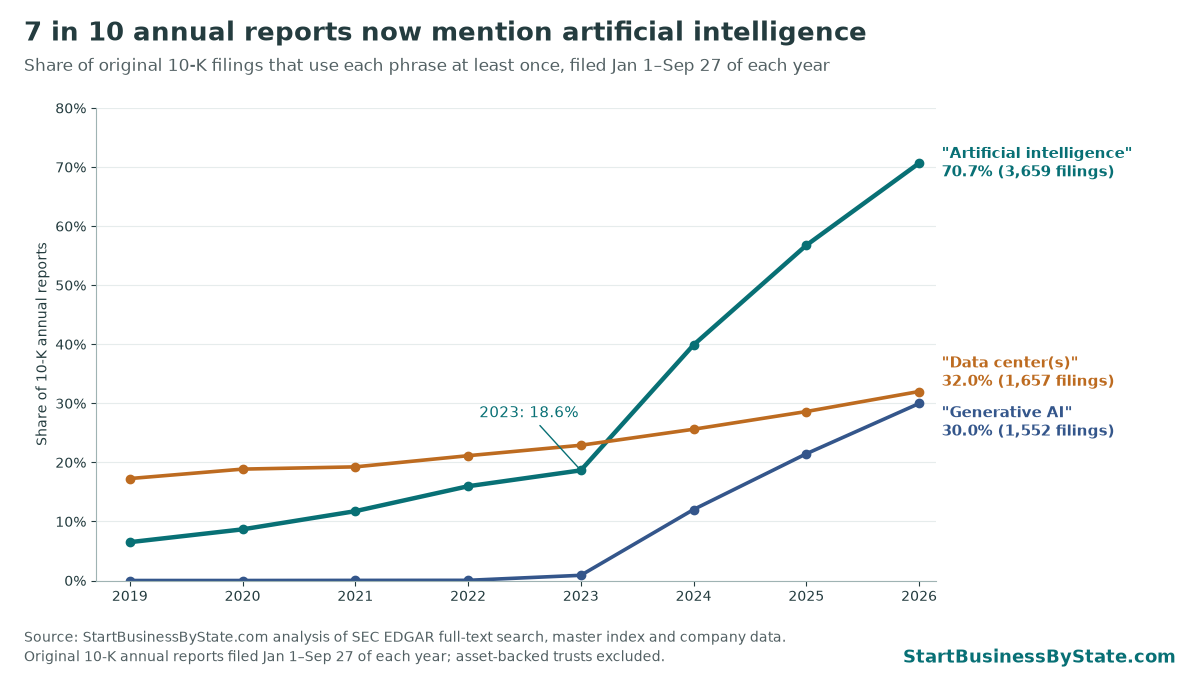
70.7% of the 10-K annual reports filed this year mention “artificial intelligence.” That’s 3,659 of 5,178 reports filed by public companies from Jan 1 to Sep 27, 2026. In the same stretch of 2023, it was 18.6% (1,101 reports). “Generative AI” went from 52 reports to 1,552. And more companies now bring up data centers: 32.0% of reports, up from 22.9% in 2023. Among electric, gas and water utilities, 71.4% mention data centers.
Key findings
- AI went from a side note to the norm in three years. 18.6% of 10-Ks filed Jan 1–Sep 27, 2023 said “artificial intelligence” at least once. It was 39.9% in 2024, 56.8% in 2025 and 70.7% in 2026. The number of reports mentioning AI grew 3.3 times, from 1,101 to 3,659, even though fewer companies filed.
- “Generative AI” barely existed in 10-Ks before 2023. It showed up in 52 reports in 2023 (0.9%) and 1,552 this year (30.0%).
- Talk of data centers is up, led by utilities. 32.0% of reports mention data centers, up from 22.9% in 2023. Among utilities, the share went from 23.5% to 71.4%. Among construction companies, from 14.5% to 44.8%.
- The biggest companies nearly all mention AI. 89.6% of the largest filers do, compared with 51.9% of the smallest public companies.
- Missouri, Michigan and Georgia companies mention AI most often. Among 28 states with at least 25 companies filing, Missouri leads at 88.1% (37 of 42), then Michigan (86.4%) and Georgia (86.3%). Nevada (53.3%) and Florida (59.7%) are lowest. California has the most: 608 companies.
- Companies also write much more about AI. We read a random sample of 60 reports from each year that mention AI. In 2023, the typical one used “artificial intelligence” or “AI” 2 times, and 55.0% used it only once or twice. In 2026, the typical report used the terms 13.5 times. Only 5.0% were one or two passing mentions.
How fast AI took over annual reports
Every public company in the U.S. files a 10-K each year. It’s a long report that describes the business and lists the risks the company faces. Lawyers review every word, so when a phrase spreads through 10-Ks, it tells you what company leaders think investors want to hear about.
The jump came in 2024, the first full filing season after ChatGPT came out in late 2022. The share of reports mentioning AI more than doubled that year, from 18.6% to 39.9%. It has kept climbing since.
A mention isn’t the same as using AI. Many companies bring it up as a risk: a competitor might use it better, it could raise cyber risks, or new laws could affect it. For the state AI laws that reach smaller businesses, see AI laws by state. Others describe products they sell. This count can’t tell those apart.
Mentions by year
Original 10-K filings, Jan 1–Sep 27 of each year. Each cell shows the number of reports mentioning the phrase and the share of all reports. Click a heading to sort.
| Year | 10-K reports filed | “Artificial intelligence” | “Generative AI” | “Data center(s)” |
|---|---|---|---|---|
| 2019 | 5,517 | 358 (6.5%) | 0 (0.0%) | 952 (17.3%) |
| 2020 | 5,324 | 461 (8.7%) | 0 (0.0%) | 1,004 (18.9%) |
| 2021 | 5,692 | 668 (11.7%) | 1 (0.0%) | 1,095 (19.2%) |
| 2022 | 6,286 | 1,003 (16.0%) | 2 (0.0%) | 1,328 (21.1%) |
| 2023 | 5,903 | 1,101 (18.6%) | 52 (0.9%) | 1,352 (22.9%) |
| 2024 | 5,432 | 2,167 (39.9%) | 653 (12.0%) | 1,391 (25.6%) |
| 2025 | 5,204 | 2,954 (56.8%) | 1,117 (21.5%) | 1,489 (28.6%) |
| 2026 | 5,178 | 3,659 (70.7%) | 1,552 (30.0%) | 1,657 (32.0%) |
Big companies vs. small public companies
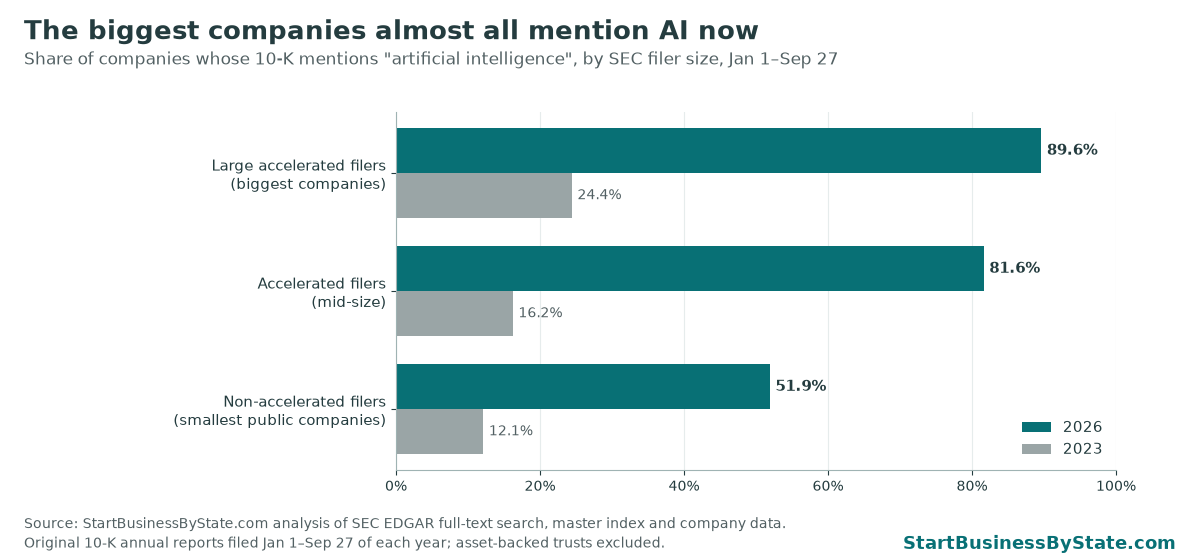
Among the largest companies, 89.6% mention AI, up from 24.4% in 2023. Mid-size filers are at 81.6%. The smallest public companies, many of them early-stage or shell companies, are at 51.9%.
Where AI talk is most common, by state

We matched each company to the state of its business address on file with the SEC. That is usually its headquarters, not the state where it’s incorporated. That’s why Delaware has only 37 filers here.
California has the most companies talking about AI: 608 of 834 (72.9%). New York has 453 (70.6%) and Texas 355 (69.1%). But as a share of each state’s filers, the leaders are Midwest and Southern states like Missouri, Michigan and Georgia, where most filers are larger, established companies.
Florida (59.7%) and Nevada (53.3%) rank lowest. Both have many small public companies and shell companies, which mention AI less often. Companies based outside the U.S. that file 10-Ks are at 56.1%.
All states
Companies that filed an original 10-K Jan 1–Sep 27, 2026, by headquarters state. Rank covers the 28 states with 25 or more filers. * = fewer than 25 filers, so one or two companies can swing the share a lot. Click a heading to sort. State names link to our state guides.
| Rank | State | Companies filing a 10-K | Mention AI | Share mentioning AI | Share mentioning generative AI | Share mentioning data centers | Share mentioning AI, 2023 |
|---|---|---|---|---|---|---|---|
| 17 | California | 834 | 608 | 72.9% | 38.8% | 41.5% | 25.0% |
| 21 | New York | 642 | 453 | 70.6% | 33.0% | 32.1% | 19.0% |
| 22 | Texas | 514 | 355 | 69.1% | 23.9% | 36.2% | 13.3% |
| 27 | Florida | 360 | 215 | 59.7% | 20.0% | 23.6% | 15.7% |
| Outside U.S. | 328 | 184 | 56.1% | 20.1% | 25.3% | 20.4% | |
| 9 | Massachusetts | 255 | 198 | 77.6% | 37.6% | 23.9% | 20.3% |
| 15 | Illinois | 189 | 141 | 74.6% | 32.8% | 32.3% | 12.3% |
| 20 | Pennsylvania | 188 | 134 | 71.3% | 35.1% | 30.9% | 15.2% |
| 23 | New Jersey | 169 | 114 | 67.5% | 27.2% | 25.4% | 17.2% |
| 5 | Virginia | 126 | 104 | 82.5% | 34.9% | 35.7% | 27.2% |
| 14 | Colorado | 123 | 92 | 74.8% | 26.8% | 36.6% | 14.2% |
| 11 | Ohio | 120 | 93 | 77.5% | 21.7% | 38.3% | 13.4% |
| 13 | Connecticut | 108 | 83 | 76.9% | 31.5% | 35.2% | 15.3% |
| 28 | Nevada | 105 | 56 | 53.3% | 18.1% | 23.8% | 16.6% |
| 12 | North Carolina | 97 | 75 | 77.3% | 33.0% | 35.1% | 15.0% |
| 3 | Georgia | 95 | 82 | 86.3% | 31.6% | 40.0% | 11.7% |
| 7 | Maryland | 84 | 66 | 78.6% | 32.1% | 26.2% | 25.0% |
| 8 | Arizona | 79 | 62 | 78.5% | 24.1% | 43.0% | 22.0% |
| 26 | Minnesota | 73 | 47 | 64.4% | 27.4% | 23.3% | 19.0% |
| 6 | Washington | 71 | 57 | 80.3% | 32.4% | 36.6% | 24.7% |
| 9 | Tennessee | 67 | 52 | 77.6% | 29.9% | 22.4% | 16.9% |
| 2 | Michigan | 66 | 57 | 86.4% | 24.2% | 34.8% | 17.8% |
| 17 | Indiana | 59 | 43 | 72.9% | 30.5% | 20.3% | 7.0% |
| 24 | Utah | 58 | 38 | 65.5% | 34.5% | 37.9% | 24.4% |
| 4 | Wisconsin | 53 | 45 | 84.9% | 37.7% | 39.6% | 14.8% |
| 1 | Missouri | 42 | 37 | 88.1% | 42.9% | 40.5% | 19.6% |
| 16 | Delaware | 37 | 27 | 73.0% | 32.4% | 51.4% | 21.2% |
| 24 | Oklahoma | 29 | 19 | 65.5% | 20.7% | 41.4% | 6.5% |
| 19 | Louisiana | 28 | 20 | 71.4% | 14.3% | 25.0% | 7.4% |
| South Carolina * | 22 | 18 | 81.8% | 9.1% | 31.8% | 25.0% | |
| District of Columbia * | 20 | 18 | 90.0% | 45.0% | 50.0% | 37.5% | |
| Kentucky * | 20 | 16 | 80.0% | 20.0% | 30.0% | 13.0% | |
| Oregon * | 20 | 14 | 70.0% | 10.0% | 40.0% | 31.8% | |
| Iowa * | 20 | 17 | 85.0% | 30.0% | 35.0% | 0.0% | |
| Idaho * | 18 | 9 | 50.0% | 11.1% | 16.7% | 9.1% | |
| Alabama * | 18 | 12 | 66.7% | 33.3% | 22.2% | 15.0% | |
| Nebraska * | 17 | 11 | 64.7% | 23.5% | 29.4% | 11.1% | |
| Kansas * | 15 | 12 | 80.0% | 60.0% | 26.7% | 5.0% | |
| Rhode Island * | 14 | 12 | 85.7% | 42.9% | 14.3% | 31.2% | |
| Arkansas * | 14 | 11 | 78.6% | 35.7% | 42.9% | 13.3% | |
| New Hampshire * | 12 | 9 | 75.0% | 16.7% | 33.3% | 18.8% | |
| Mississippi * | 10 | 8 | 80.0% | 30.0% | 30.0% | 0.0% | |
| Wyoming * | 10 | 4 | 40.0% | 20.0% | 10.0% | 14.3% | |
| North Dakota * | 10 | 8 | 80.0% | 40.0% | 40.0% | 0.0% | |
| Montana * | 9 | 7 | 77.8% | 33.3% | 33.3% | 22.2% | |
| Hawaii * | 8 | 6 | 75.0% | 37.5% | 0.0% | 18.2% | |
| Maine * | 7 | 5 | 71.4% | 42.9% | 14.3% | 0.0% | |
| West Virginia * | 7 | 7 | 100.0% | 0.0% | 28.6% | 16.7% | |
| Vermont * | 6 | 3 | 50.0% | 33.3% | 0.0% | 0.0% | |
| PR/territories * | 6 | 5 | 83.3% | 0.0% | 16.7% | 0.0% | |
| South Dakota * | 6 | 4 | 66.7% | 33.3% | 66.7% | 20.0% | |
| New Mexico * | 3 | 3 | 100.0% | 100.0% | 100.0% | 0.0% | |
| Alaska * | 2 | 1 | 50.0% | 0.0% | 0.0% | 0.0% |
Which industries talk about AI and data centers

Software companies have talked about data centers for years. What’s new is who else is talking about them. Utilities went from 23.5% to 71.4%. Many of them now describe new power demand from data centers. For what has happened to power prices in the top data center states, see are data centers raising power bills? Makers of electrical equipment (56.0%) and of machinery and HVAC equipment (49.7%) are up too. Construction companies went from 14.5% to 44.8%, though only 58 of them file 10-Ks.
AI mentions spread to industries that rarely used the phrase before. In 2023, 4.8% of utilities, 9.1% of banks and 2.9% of real estate investment trusts mentioned AI. This year it’s 80.4%, 79.9% and 82.0%. If you rent out property, note that several states now ban rent-setting software that pools other landlords’ data; see algorithmic pricing and rent algorithm laws by state.
Show all industry divisions
| Industry (SIC division) | Companies filing, 2026 | Mention AI, 2026 | Mention AI, 2023 | Mention generative AI, 2026 | Mention data centers, 2026 | Mention data centers, 2023 |
|---|---|---|---|---|---|---|
| No SIC code (mostly business development companies) | 165 | 92.7% | 0.8% | 35.2% | 18.2% | 1.7% |
| Transportation, communications & utilities | 398 | 80.7% | 11.6% | 25.1% | 56.5% | 28.9% |
| Services | 879 | 78.0% | 39.3% | 41.8% | 51.6% | 49.6% |
| Retail trade | 196 | 76.0% | 13.8% | 27.0% | 29.1% | 26.8% |
| Finance, insurance & real estate | 1,220 | 74.0% | 12.1% | 34.2% | 28.1% | 20.2% |
| Construction | 58 | 72.4% | 9.1% | 10.3% | 44.8% | 14.5% |
| Manufacturing | 1,803 | 69.6% | 16.4% | 29.7% | 27.4% | 17.5% |
| Wholesale trade | 93 | 68.8% | 10.3% | 22.6% | 19.4% | 15.5% |
| Mining, oil & gas | 216 | 55.1% | 3.4% | 8.3% | 25.9% | 2.3% |
| Agriculture, forestry & fishing | 27 | 33.3% | 16.1% | 18.5% | 14.8% | 9.7% |
| Blank-check companies (SPACs) | 238 | 32.4% | 21.7% | 4.2% | 11.8% | 4.7% |
Business development companies are investment funds that lend to private companies. Most have no SIC code in EDGAR, so they’re shown on their own line.
What this means for small businesses
A company writing “artificial intelligence” in its annual report doesn’t mean it’s spending a lot on AI. But two things in this data matter to small business owners.
- Your big customers are asking about it. When 89.6% of the largest companies write about AI in their annual reports, it shows up in their vendor questions too. If you sell to large companies, expect to be asked whether you use AI and how you protect their data. Have a plain answer ready.
- Data centers mean building work. The rise in data-center talk among utilities and equipment makers lines up with real construction. Data centers need electricians, HVAC and controls techs, and site crews. Our data center construction by state page shows where that spending is going. For what the power plants in those states run on, see electricity sources by state. If you run a trade business, maintenance contracts are one way in. Here’s how to win commercial HVAC maintenance contracts.
- Small businesses are trying AI too, just more slowly. About 1 in 4 businesses with employees used AI in the latest Census survey. See small-business AI use by state and which industries use it most. For what the AI build-out has meant for jobs, see trade jobs vs. tech jobs since ChatGPT. To see which jobs AI is most and least likely to touch in your state, see AI-proof jobs by state.
- It counts mentions, not spending or real use. A company that lists AI as a risk counts the same as one that sells AI products.
- It only covers public companies and others that file 10-Ks with the SEC. Private companies aren’t included.
- Search is for exact phrases. A report that only says “AI” or “machine learning” and never spells out “artificial intelligence” isn’t counted.
- State and industry come from each company’s current SEC profile, not what it listed years ago.
Cite or share this data
Reporters and bloggers are welcome to use the charts and numbers. Please credit and link to this page.
Source: StartBusinessByState.com analysis of SEC EDGAR 10-K filings. https://startbusinessbystate.com/ai-in-10-k-filings/
Methods and sources
- What we searched. We used the SEC’s EDGAR full-text search to find 10-K filings containing the exact phrases “artificial intelligence”; “generative AI” or “generative artificial intelligence”; and “data center” or “data centers.” The search doesn’t match word variants, so we searched both forms of the last two phrases and combined them.
- Time window. Filings dated Jan 1–Sep 27 in each year from 2019 to 2026. Using the same window each year makes the years comparable. Most 10-Ks are filed in February and March.
- What counts as a “hit.” EDGAR search returns one result per document, not per filing. A single 10-K filing can include the main report plus exhibits, and each document that contains the phrase is a separate result. We combined results into unique filings using the SEC accession number. For “artificial intelligence” in 2026, EDGAR shows 3,842 document results. They come from 3,752 filings, of which 3,659 are original 10-Ks and 93 are amendments.
- Which forms. We counted only original 10-K annual reports. We left out amended reports (10-K/A) so no company is counted twice for the same year. We also left out transition reports (10-KT). A filing counts if the phrase appears anywhere in it, including exhibits. Counting only the main report changes the 2026 AI share by less than a tenth of a point (70.6% vs. 70.7%).
- What we left out. Asset-backed securities trusts (SIC code 6189), such as car-loan and mortgage trusts. They file thousands of short 10-Ks with no business description, and their servicer reports sometimes mention data centers. We removed them from both the counts and the totals.
- The totals. The number of 10-Ks filed in each window comes from the SEC’s quarterly EDGAR master index. Every filing found by the search matched a filing in the index.
- States and industries. We matched each company to the business address state, SIC industry code and filer size in its SEC company profile (bulk file dated Sep 26, 2026). The state table counts companies, not filings, because a few filings are made jointly by a parent and a subsidiary. The filing date’s address matched the current profile state for 98.6% of 2026 AI filings.
- How deep mentions go. We downloaded a random sample of 60 main reports from 2023 and 60 from 2026 that mention “artificial intelligence” and counted every use of that phrase and of “AI” as a word. With 60 reports per year, these sample figures are rough (up to about ±13 points on a share).
- Sources. SEC EDGAR full-text search, EDGAR master index and EDGAR company submissions data, accessed Sep 28, 2026. SEC filings are public records.
FAQ
How many companies mention AI in their 10-K?
3,659 of the 5,178 original 10-Ks filed from Jan 1 to Sep 27, 2026 mention “artificial intelligence,” or 70.7%. In the same period of 2023 it was 1,101, or 18.6%.
What is a 10-K?
An annual report that public companies must file with the Securities and Exchange Commission. It covers the business, its risks and its finances. Anyone can read them for free on the SEC’s EDGAR website.
Does mentioning AI mean a company uses it?
Not necessarily. Many companies discuss AI mainly as a risk. But the mentions are no longer just one line. In our 2026 sample, 58.3% of reports that mention AI used the terms 10 or more times, up from 25.0% in 2023.
Why do utilities mention data centers so much now?
Data centers use a lot of electricity. Many utilities now describe data centers as a source of new demand in their annual reports. 71.4% of utility 10-Ks filed this year mention data centers, up from 23.5% in 2023.