Monthly tracker · USPTO Open Data Portal · Applications published through September 2026 · Last updated September 30, 2026 · Updated each month
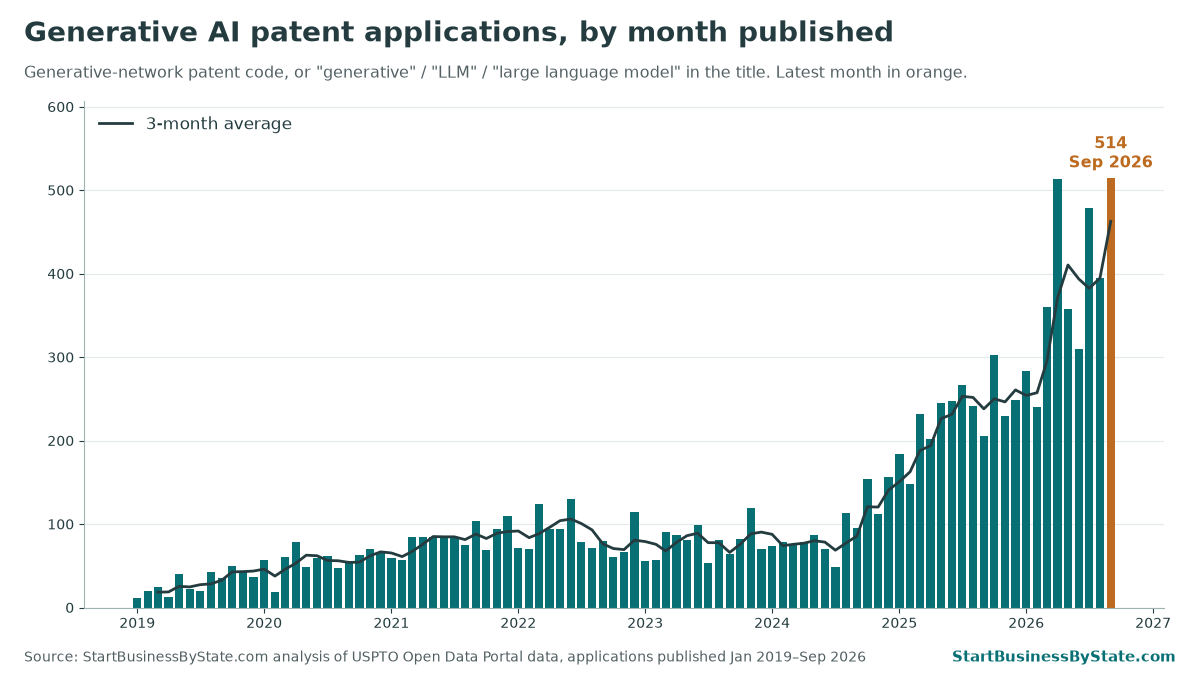
Generative AI is showing up fast at the U.S. patent office. 3,452 published patent applications fit our generative AI definition in January–September 2026, already more than in all of 2025 (2,754). In 2023 there were 939. In September 2026 alone there were 514.
Key findings
- Generative AI applications: 939 in 2023, 1,141 in 2024, 2,754 in 2025, 3,452 in January–September 2026. These are applications the patent office made public, counted by the month they came out.
- Compared with the same months of 2025: generative AI applications are up 75% (1,972 to 3,452).
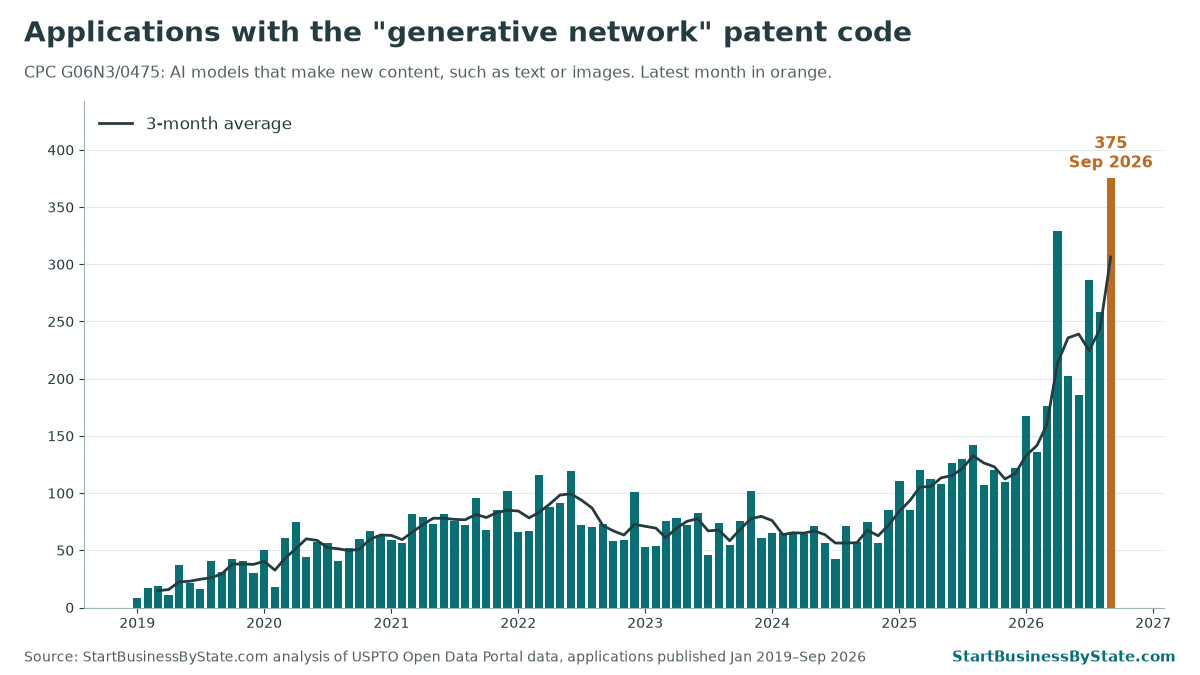
- The “generative network” patent code hit 375 in September 2026, its highest month on record. From 2020 through 2022 it ran between 18 and 119 a month.
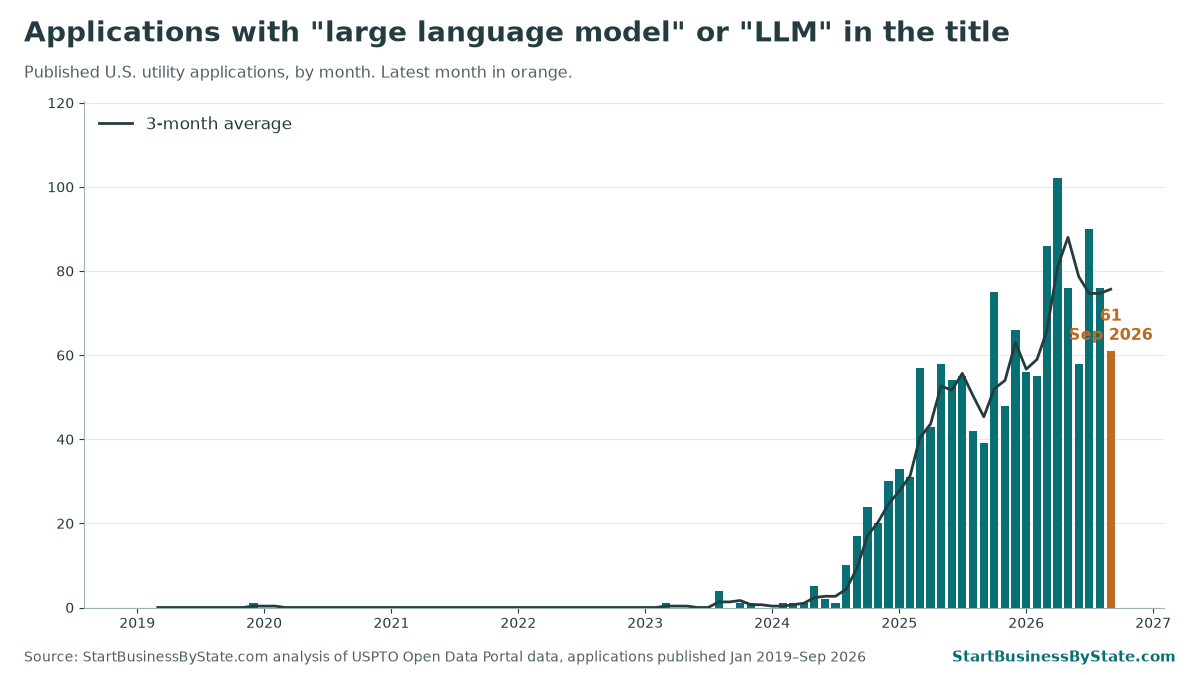
- “Large language model” or “LLM” in the title: 7 in 2023, 112 in 2024, 601 in 2025, 660 in January–September 2026. The first month with 10 or more was August 2024.
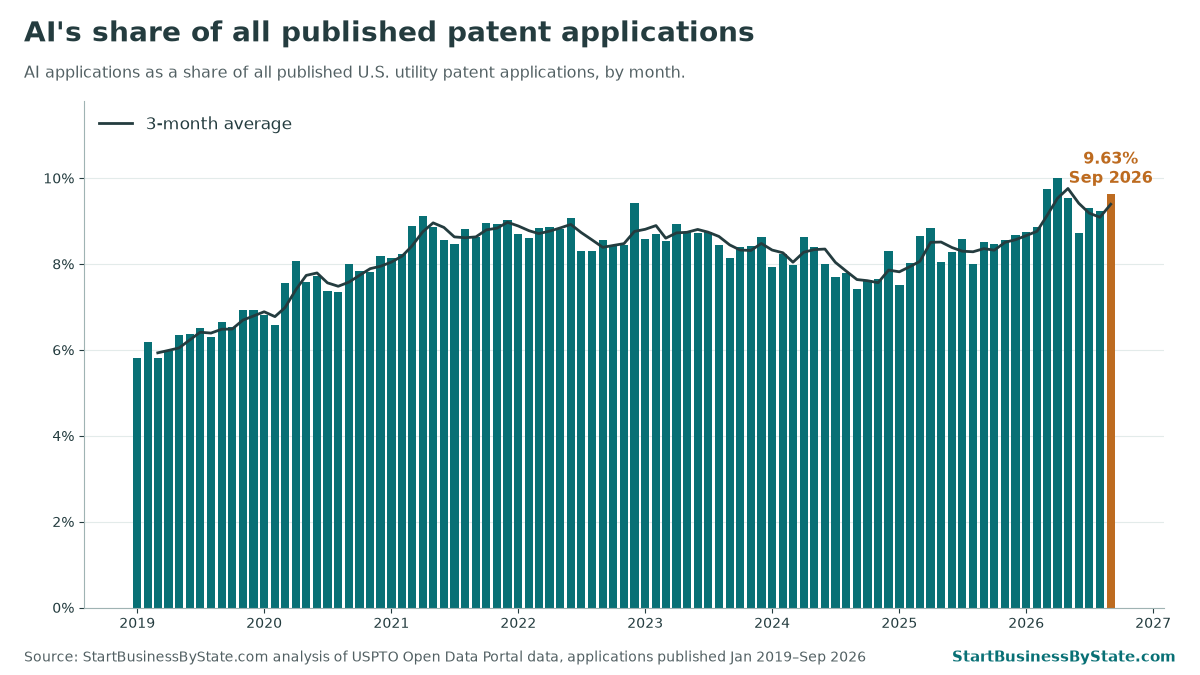
- AI’s share of all patent applications peaked at 9.99% in April 2026. The highest months in this series are April 2026 (9.99%), March 2026 (9.75%), September 2026 (9.63%). Before 2023 the peak was 9.41% (December 2022). In January 2019 it was 5.8%.
- The biggest LLM-title filers in 2026 so far are SAP (34), Google (31), IBM (27). In 2025 they were Google (37), Microsoft (29), Cisco (24).
Generative AI applications, month by month
Each bar is one month of published applications. The line is a 3-month average, which smooths out months that happen to have an extra publishing day.
The “generative network” patent code
The patent office sorts every application into technology codes. In 2023 it added a code just for generative networks: AI models that make new things, like text, images or designs. It is G06N3/0475. Examiners also add it to older applications, so earlier months fill in over time.
“Large language model” in the title
A large language model (LLM) is the kind of AI behind chatbots like ChatGPT. Almost no one put the term in a patent title before 2024. Remember the 18-month delay: applications published in September 2026 were mostly filed around March 2025.
AI’s share of all patent applications
This chart takes out the month-to-month swings in how many applications get published. It shows what share of all published applications are AI applications, using the same AI definition as our AI patents by state study.
Who files the most LLM applications
Ranked by the first applicant named on each published application with “large language model” or “LLM” in the title. We combined name spellings for big companies (for example “Google LLC” and “GOOGLE LLC”).
2026 (Jan–Sep): 660 LLM-title applications
| # | Applicant | Applications |
|---|---|---|
| 1 | SAP | 34 |
| 2 | 31 | |
| 3 | IBM | 27 |
| 4 | Oracle | 21 |
| 5 | Dell | 20 |
| 6 | Salesforce | 20 |
| 7 | Intuit | 18 |
| 8 | Microsoft | 17 |
| 9 | Cisco | 16 |
| 10 | Palo Alto Networks Inc. | 13 |
2025: 601 LLM-title applications
| # | Applicant | Applications |
|---|---|---|
| 1 | 37 | |
| 2 | Microsoft | 29 |
| 3 | Cisco | 24 |
| 4 | Maplebear (Instacart) | 18 |
| 5 | Baidu | 17 |
| 6 | Oracle | 15 |
| 7 | SAP | 14 |
| 8 | IBM | 13 |
| 9 | Intuit | 13 |
| 10 | NEC Laboratories America | 12 |
2024: 112 LLM-title applications
| # | Applicant | Applications |
|---|---|---|
| 1 | Microsoft | 25 |
| 2 | 13 | |
| 3 | Shopify Inc. | 7 |
| 4 | Cisco | 4 |
| 5 | Gongio Ltd. | 4 |
| 6 | Box Inc. | 3 |
| 7 | Intel | 3 |
| 8 | Palantir Technologies Inc. | 3 |
| 9 | CrowdStrike | 2 |
| 10 | Darktrace Holdings Limited | 2 |
Only the top 1,000 applicant names are returned by the patent office’s search, and smaller filers’ spellings are not combined, so small companies can be split across rows.
What this means for a small business
- A patent application is public long before it becomes a patent. If you’re building something with AI, you can search published applications for free to see what others have already claimed.
- Small companies file a real share of AI patents. See how that share has grown in small businesses’ share of AI patents, and every state’s count in AI patents by state.
- Most small businesses use AI rather than invent it. See small-business AI use by state, AI use by industry and the AI laws small businesses must follow. For how big companies talk about AI, see AI in annual reports; for jobs, see AI-proof jobs by state.
Download the data
Download the monthly numbers (CSV)
One row per month, January 2019 to September 2026: generative AI applications, the generative-network code, LLM titles, “generative” titles, all AI applications, all utility applications and AI’s share.
Cite or share this data
Source: StartBusinessByState.com analysis of USPTO Open Data Portal data. https://startbusinessbystate.com/generative-ai-patents/
Methods and caveats
- Source. USPTO Open Data Portal patent file search. Counts of published U.S. utility applications by earliest publication date, pulled September 30, 2026. Data runs January 2019 to September 2026.
- Generative AI definition. CPC G06N3/0475 (generative networks), or a title containing “generative,” “large language model,” “LLM” or “LLMs.” Each application counts once. The title words add some noise: “generative design” in engineering software also matches.
- AI definition. Any current CPC code in G06N (machine learning and neural networks), G06F40 (language processing), G06V (image and video recognition) or G10L15 (speech recognition). Same definition as AI patents by state.
- The 18-month delay. Most applications are published about 18 months after filing. Some are never published (for example, when the inventor asks the patent office not to). So these charts show what was filed about a year and a half earlier.
- Published is not granted. Many applications never become patents. These are not patent grants. For why AI patent grants have fallen since 2023 even as generative AI filings rose, see the AI patent paradox.
- Codes change after the fact. The patent office reclassifies older applications, especially into the newer generative-network code. Past months can go up or down a little between updates. Each update re-checks the last few months.
- Weekly publishing. Applications come out on Thursdays, so months with five Thursdays look bigger.
- Title search. The search matches word forms, so “LLM” and “LLMs” both count. An application that uses the idea but not the words in its title isn’t counted.
FAQ
What is a published patent application?
When an inventor applies for a U.S. patent, the patent office usually makes the application public about 18 months later, whether or not a patent is ever granted. This page counts those published applications, by the month they were made public.
How do you decide what counts as generative AI?
An application counts if the patent office gave it the "generative networks" code (CPC G06N3/0475), or if its title contains "generative," "large language model," "LLM" or "LLMs." Each application counts once, even if it matches more than one of these.
Why do the numbers jump around from month to month?
The patent office publishes applications once a week, on Thursdays. Some months have five Thursdays and some have four, so monthly totals swing. The 3-month average line and the share-of-all-applications chart smooth that out.
Does a spike this month mean a spike in new inventions this month?
No. Most applications are published about 18 months after they were filed. A jump now mostly reflects filings from about a year and a half ago.
How often is this updated?
Once a month, after the patent office publishes its last batch of applications for the month. This edition covers applications published through September 2026.
Can I use these charts?
Yes. Please credit StartBusinessByState.com and link to this page. The monthly numbers are free to download as a CSV.